Color gamut expansion techniques in AMOLED engineering.
JUL 17, 20259 MIN READ
Generate Your Research Report Instantly with AI Agent
PatSnap Eureka helps you evaluate technical feasibility & market potential.
AMOLED Color Gamut Evolution and Objectives
AMOLED (Active-Matrix Organic Light-Emitting Diode) technology has revolutionized display systems, offering superior color reproduction and contrast ratios. The evolution of color gamut in AMOLED engineering has been a continuous journey of innovation and improvement, driven by the ever-increasing demand for more vibrant and accurate color representation in various applications.
In the early stages of AMOLED development, the primary focus was on achieving basic color reproduction capabilities. As the technology matured, engineers began to explore ways to expand the color gamut, aiming to cover a broader spectrum of colors visible to the human eye. This pursuit led to the development of new organic materials and pixel architectures that could produce more saturated and pure colors.
The introduction of quantum dot technology marked a significant milestone in AMOLED color gamut expansion. By incorporating quantum dots into the OLED structure, displays could achieve a wider color range, particularly in the green and red regions of the spectrum. This advancement allowed AMOLED displays to approach or even exceed the DCI-P3 color space, which is widely used in the film industry.
Another crucial development in AMOLED color gamut evolution was the implementation of advanced color management systems. These systems enabled more precise control over color reproduction, allowing for better calibration and consistency across different devices and viewing conditions. This improvement was particularly important for professional applications where color accuracy is paramount.
The ongoing objective in AMOLED color gamut expansion is to achieve full coverage of the human visual color space, often referred to as the CIE 1931 color space. This ambitious goal drives research into new materials and pixel designs that can produce an even wider range of colors with greater efficiency and stability.
Current efforts are focused on developing AMOLED displays that can reproduce colors beyond the traditional RGB (Red, Green, Blue) color model. Some approaches involve adding a fourth primary color, such as yellow or cyan, to extend the color gamut further. These multi-primary color systems aim to provide a more comprehensive and nuanced color representation.
Looking ahead, the objectives for AMOLED color gamut expansion include not only widening the range of reproducible colors but also improving the accuracy and consistency of color reproduction across different viewing angles and ambient lighting conditions. This holistic approach to color gamut enhancement seeks to create displays that can deliver a more immersive and true-to-life visual experience in various environments and use cases.
In the early stages of AMOLED development, the primary focus was on achieving basic color reproduction capabilities. As the technology matured, engineers began to explore ways to expand the color gamut, aiming to cover a broader spectrum of colors visible to the human eye. This pursuit led to the development of new organic materials and pixel architectures that could produce more saturated and pure colors.
The introduction of quantum dot technology marked a significant milestone in AMOLED color gamut expansion. By incorporating quantum dots into the OLED structure, displays could achieve a wider color range, particularly in the green and red regions of the spectrum. This advancement allowed AMOLED displays to approach or even exceed the DCI-P3 color space, which is widely used in the film industry.
Another crucial development in AMOLED color gamut evolution was the implementation of advanced color management systems. These systems enabled more precise control over color reproduction, allowing for better calibration and consistency across different devices and viewing conditions. This improvement was particularly important for professional applications where color accuracy is paramount.
The ongoing objective in AMOLED color gamut expansion is to achieve full coverage of the human visual color space, often referred to as the CIE 1931 color space. This ambitious goal drives research into new materials and pixel designs that can produce an even wider range of colors with greater efficiency and stability.
Current efforts are focused on developing AMOLED displays that can reproduce colors beyond the traditional RGB (Red, Green, Blue) color model. Some approaches involve adding a fourth primary color, such as yellow or cyan, to extend the color gamut further. These multi-primary color systems aim to provide a more comprehensive and nuanced color representation.
Looking ahead, the objectives for AMOLED color gamut expansion include not only widening the range of reproducible colors but also improving the accuracy and consistency of color reproduction across different viewing angles and ambient lighting conditions. This holistic approach to color gamut enhancement seeks to create displays that can deliver a more immersive and true-to-life visual experience in various environments and use cases.
Market Demand for Wide Color Gamut Displays
The demand for wide color gamut displays has been steadily increasing across various industries, driven by the growing consumer appetite for more vibrant and lifelike visual experiences. This trend is particularly evident in the smartphone market, where AMOLED technology has gained significant traction due to its ability to produce richer colors and deeper blacks compared to traditional LCD displays.
In the consumer electronics sector, high-end televisions and monitors are increasingly adopting wide color gamut technologies to differentiate themselves in a competitive market. Content creators, including filmmakers and game developers, are also pushing for wider color gamuts to enhance the visual impact of their products. This has led to a ripple effect in the display industry, with manufacturers striving to meet these evolving demands.
The professional market segment, encompassing fields such as graphic design, photography, and video production, has long recognized the importance of accurate color reproduction. As color-critical workflows become more prevalent, there is a growing need for displays that can accurately represent a broader range of colors. This has spurred demand for wide color gamut displays in professional-grade monitors and laptops.
The automotive industry is another significant driver of wide color gamut display demand. As in-vehicle infotainment systems become more sophisticated, automakers are incorporating high-quality displays to enhance the user experience and differentiate their products. The ability to display vivid colors is particularly important for navigation systems, entertainment interfaces, and digital instrument clusters.
The rise of augmented reality (AR) and virtual reality (VR) technologies has further fueled the demand for wide color gamut displays. These immersive experiences rely heavily on realistic color reproduction to create convincing virtual environments. As AR and VR applications expand beyond gaming into fields such as education, training, and remote collaboration, the need for displays capable of rendering a wide range of colors accurately becomes increasingly critical.
In the mobile device market, manufacturers are leveraging wide color gamut displays as a key selling point. Consumers are becoming more discerning about display quality, and the ability to showcase vibrant colors in photos, videos, and games is a significant factor in purchasing decisions. This has led to a competitive race among smartphone makers to offer displays with ever-expanding color gamuts.
The growing popularity of HDR (High Dynamic Range) content across various media platforms has also contributed to the demand for wide color gamut displays. HDR technology relies on displays capable of reproducing a broader range of colors to fully realize its potential. As more streaming services and content providers offer HDR content, there is an increasing need for compatible displays in both consumer and professional settings.
In the consumer electronics sector, high-end televisions and monitors are increasingly adopting wide color gamut technologies to differentiate themselves in a competitive market. Content creators, including filmmakers and game developers, are also pushing for wider color gamuts to enhance the visual impact of their products. This has led to a ripple effect in the display industry, with manufacturers striving to meet these evolving demands.
The professional market segment, encompassing fields such as graphic design, photography, and video production, has long recognized the importance of accurate color reproduction. As color-critical workflows become more prevalent, there is a growing need for displays that can accurately represent a broader range of colors. This has spurred demand for wide color gamut displays in professional-grade monitors and laptops.
The automotive industry is another significant driver of wide color gamut display demand. As in-vehicle infotainment systems become more sophisticated, automakers are incorporating high-quality displays to enhance the user experience and differentiate their products. The ability to display vivid colors is particularly important for navigation systems, entertainment interfaces, and digital instrument clusters.
The rise of augmented reality (AR) and virtual reality (VR) technologies has further fueled the demand for wide color gamut displays. These immersive experiences rely heavily on realistic color reproduction to create convincing virtual environments. As AR and VR applications expand beyond gaming into fields such as education, training, and remote collaboration, the need for displays capable of rendering a wide range of colors accurately becomes increasingly critical.
In the mobile device market, manufacturers are leveraging wide color gamut displays as a key selling point. Consumers are becoming more discerning about display quality, and the ability to showcase vibrant colors in photos, videos, and games is a significant factor in purchasing decisions. This has led to a competitive race among smartphone makers to offer displays with ever-expanding color gamuts.
The growing popularity of HDR (High Dynamic Range) content across various media platforms has also contributed to the demand for wide color gamut displays. HDR technology relies on displays capable of reproducing a broader range of colors to fully realize its potential. As more streaming services and content providers offer HDR content, there is an increasing need for compatible displays in both consumer and professional settings.
Current AMOLED Color Gamut Limitations
AMOLED (Active-Matrix Organic Light-Emitting Diode) displays have revolutionized the mobile device industry with their vibrant colors and deep blacks. However, despite their advantages, current AMOLED technology faces limitations in color gamut expansion, which impacts the overall visual experience and color accuracy of displays.
One of the primary constraints is the inherent color spectrum of organic materials used in AMOLED panels. These materials, while capable of producing rich colors, have a finite range of wavelengths they can emit. This limitation directly affects the color gamut, restricting the display's ability to reproduce a wider range of colors, especially in the extreme ends of the visible spectrum.
Another challenge lies in the color filtering technology employed in AMOLED displays. The current color filters used to create red, green, and blue subpixels often have overlapping transmission spectra, leading to color mixing and reduced color purity. This overlap limits the display's ability to produce highly saturated colors, particularly in the corners of the color triangle.
The power consumption of AMOLED displays also poses a constraint on color gamut expansion. Achieving a wider color gamut often requires higher brightness levels, which in turn leads to increased power draw. This creates a trade-off between color performance and device battery life, a critical consideration in mobile device design.
Manufacturing processes present another hurdle in expanding the AMOLED color gamut. Precise deposition of organic materials and accurate color filter alignment are crucial for achieving wide color gamut displays. However, current manufacturing techniques face challenges in maintaining consistency and yield at scale, especially when pushing the boundaries of color reproduction.
The limitations of human color perception also play a role in AMOLED color gamut expansion. While it's technically possible to create displays with extremely wide color gamuts, the human eye has a finite ability to perceive and distinguish colors. This physiological limitation raises questions about the practical benefits of expanding color gamuts beyond certain thresholds.
Lastly, the lack of standardization in color space and content creation poses challenges for AMOLED displays. While standards like DCI-P3 and Rec. 2020 exist, there's still a gap between the colors that can be captured, the colors that can be displayed, and the colors present in most content. This discrepancy often results in color mapping issues and can limit the perceived benefits of wider color gamuts in real-world usage scenarios.
One of the primary constraints is the inherent color spectrum of organic materials used in AMOLED panels. These materials, while capable of producing rich colors, have a finite range of wavelengths they can emit. This limitation directly affects the color gamut, restricting the display's ability to reproduce a wider range of colors, especially in the extreme ends of the visible spectrum.
Another challenge lies in the color filtering technology employed in AMOLED displays. The current color filters used to create red, green, and blue subpixels often have overlapping transmission spectra, leading to color mixing and reduced color purity. This overlap limits the display's ability to produce highly saturated colors, particularly in the corners of the color triangle.
The power consumption of AMOLED displays also poses a constraint on color gamut expansion. Achieving a wider color gamut often requires higher brightness levels, which in turn leads to increased power draw. This creates a trade-off between color performance and device battery life, a critical consideration in mobile device design.
Manufacturing processes present another hurdle in expanding the AMOLED color gamut. Precise deposition of organic materials and accurate color filter alignment are crucial for achieving wide color gamut displays. However, current manufacturing techniques face challenges in maintaining consistency and yield at scale, especially when pushing the boundaries of color reproduction.
The limitations of human color perception also play a role in AMOLED color gamut expansion. While it's technically possible to create displays with extremely wide color gamuts, the human eye has a finite ability to perceive and distinguish colors. This physiological limitation raises questions about the practical benefits of expanding color gamuts beyond certain thresholds.
Lastly, the lack of standardization in color space and content creation poses challenges for AMOLED displays. While standards like DCI-P3 and Rec. 2020 exist, there's still a gap between the colors that can be captured, the colors that can be displayed, and the colors present in most content. This discrepancy often results in color mapping issues and can limit the perceived benefits of wider color gamuts in real-world usage scenarios.
Existing Color Gamut Expansion Solutions
01 Color gamut enhancement techniques
Various methods are employed to enhance the color gamut of AMOLED displays. These techniques include optimizing the OLED materials, improving pixel structures, and implementing advanced color management algorithms. By expanding the range of displayable colors, these methods aim to provide more vibrant and accurate color reproduction on AMOLED screens.- Color gamut enhancement techniques: Various techniques are employed to enhance the color gamut of AMOLED displays. These may include optimizing the OLED materials, improving pixel structures, and implementing advanced color management algorithms. Such enhancements result in a wider range of displayable colors, improved color accuracy, and overall better visual quality.
- Color conversion and mapping: AMOLED displays often utilize color conversion and mapping techniques to optimize color reproduction. This involves transforming input color signals to match the display's color space, compensating for device-specific characteristics, and ensuring accurate color representation across different content types and viewing conditions.
- Subpixel arrangements and driving methods: The arrangement and driving methods of subpixels in AMOLED displays play a crucial role in determining the color gamut. Various subpixel layouts and driving schemes are implemented to optimize color reproduction, improve resolution, and enhance overall display performance.
- Compensation and calibration techniques: To maintain consistent color performance and extend the color gamut, AMOLED displays employ various compensation and calibration techniques. These may include compensating for aging effects, temperature variations, and manufacturing inconsistencies, as well as periodic recalibration to ensure optimal color reproduction throughout the display's lifetime.
- Integration with other display technologies: AMOLED color gamut enhancements often involve integration with other display technologies. This may include combining AMOLED with quantum dot technology, implementing advanced backplane designs, or incorporating novel light management structures to further expand the color gamut and improve overall display performance.
02 Color conversion and mapping
Color conversion and mapping techniques are utilized to adapt content for AMOLED displays with wider color gamuts. These methods involve transforming color spaces, adjusting color saturation, and applying gamut mapping algorithms to ensure optimal color representation across different content types and display capabilities.Expand Specific Solutions03 OLED material composition for improved color gamut
Research focuses on developing and optimizing OLED materials to achieve a wider color gamut. This includes the design of new emissive materials, improving the efficiency of color conversion layers, and enhancing the overall performance of OLED pixels to produce more saturated and pure colors.Expand Specific Solutions04 Display calibration and color management
Advanced calibration techniques and color management systems are implemented to ensure accurate color reproduction on AMOLED displays. These methods involve characterizing the display's color response, creating color profiles, and applying real-time corrections to maintain color accuracy across different viewing conditions and content types.Expand Specific Solutions05 HDR and wide color gamut integration
Integration of High Dynamic Range (HDR) technology with wide color gamut AMOLED displays is explored to enhance overall image quality. This combination allows for a greater range of brightness levels and colors, resulting in more lifelike and immersive visual experiences on AMOLED screens.Expand Specific Solutions
Key AMOLED Display Manufacturers
The color gamut expansion techniques in AMOLED engineering are in a mature development stage, with a growing market driven by increasing demand for high-quality displays in smartphones, TVs, and other devices. The global AMOLED market size is projected to reach significant growth in the coming years. Technologically, companies like Samsung Display, BOE Technology, and LG Display are at the forefront, with advanced color gamut expansion techniques. These firms, along with others like Sharp and TCL, are continuously innovating to improve color accuracy, brightness, and energy efficiency in AMOLED displays. The competition is intense, with Chinese manufacturers rapidly catching up to Korean and Japanese counterparts in terms of technological capabilities and market share.
BOE Technology Group Co., Ltd.
Technical Solution: BOE has made significant strides in AMOLED color gamut expansion. They have developed a proprietary "Crystal Silicon AMOLED" technology that utilizes high-efficiency blue OLED materials and color conversion layers[4]. This approach allows for a wider color gamut, reaching up to 113% of the DCI-P3 standard. BOE has also implemented advanced color management systems that dynamically adjust color parameters based on displayed content and viewing conditions. Their latest AMOLED panels incorporate a unique subpixel arrangement that enhances color accuracy while maintaining high resolution[5]. Additionally, BOE has invested in developing new organic materials that offer improved color stability and longevity.
Strengths: Cost-effective production, scalable technology suitable for various display sizes. Weaknesses: Slightly lower color gamut coverage compared to some competitors, potential for color shift at extreme viewing angles.
Samsung Display Co., Ltd.
Technical Solution: Samsung Display has developed advanced color gamut expansion techniques for AMOLED displays. They utilize Quantum Dot (QD) technology to enhance color reproduction, achieving up to 120% of the DCI-P3 color space[1]. Their OLED panels incorporate a color filter and QD layer, allowing for precise control of individual subpixels. This results in more accurate and vibrant colors across the entire spectrum. Samsung has also implemented AI-enhanced color mapping algorithms to optimize color representation based on content and ambient lighting conditions[2]. Their latest AMOLED displays feature a novel pixel structure that improves color purity and reduces power consumption[3].
Strengths: Industry-leading color accuracy and vibrancy, energy-efficient designs, and advanced AI color optimization. Weaknesses: Higher production costs and potential for color oversaturation if not properly calibrated.
Innovative Color Material Developments
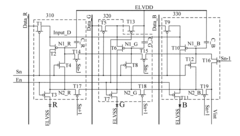
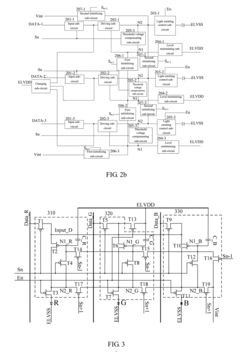
Pixel circuit, driving method applied to the pixel circuit, and array substrate
PatentActiveUS20180137817A1
Innovation
- A pixel circuit with integrated sub-pixel units, including input, driving, light emitting control, and level maintaining sub-circuits, along with a threshold voltage compensating sub-circuit, ensures that driving current is only applied during light emission, eliminating the impact of threshold voltage variations and reducing signal delays by sharing driving signals among sub-pixels.


Display panel including light-emitting units in through-holes of a retaining wall structure, and manufacturing method thereof
PatentActiveUS11943949B2
Innovation
- A display panel design featuring a light-emitting region and a non-light-emitting region with a retaining wall structure containing through-holes and retaining walls, where the light-emitting layer is positioned within the through-holes, and a packaging layer covers the structure, along with a specific substrate and electrode configuration to enhance planarization and material utilization.


Color Accuracy Standards and Certifications
Color accuracy standards and certifications play a crucial role in ensuring consistent and high-quality color reproduction across various display technologies, including AMOLED displays. These standards provide a framework for evaluating and validating color performance, enabling manufacturers to meet industry requirements and consumer expectations.
One of the most widely recognized color accuracy standards is the sRGB color space, which was developed by HP and Microsoft in 1996. It serves as a common reference for color reproduction in consumer electronics, web content, and digital imaging. The sRGB standard defines a specific gamut of colors that can be accurately displayed on most devices, ensuring consistency across different platforms.
Another important standard is the Adobe RGB color space, which was introduced in 1998. This standard offers a wider color gamut than sRGB, particularly in the cyan-green region, making it popular in professional photography and printing applications. AMOLED displays capable of reproducing the Adobe RGB color space can provide more vibrant and accurate colors for creative professionals.
The DCI-P3 color space, developed by the Digital Cinema Initiatives (DCI), has gained prominence in recent years. Originally designed for digital movie projection, it has become increasingly relevant for consumer displays, including AMOLED screens. DCI-P3 offers a wider color gamut than sRGB, particularly in the red and green regions, resulting in more vivid and lifelike colors.
To validate color accuracy, various certification programs have been established. One of the most respected is the DisplayHDR certification, developed by VESA (Video Electronics Standards Association). This program sets performance criteria for HDR displays, including color gamut coverage, peak luminance, and black levels. AMOLED displays that meet these standards can be certified at different tiers, such as DisplayHDR 400, 600, or 1000, indicating their level of performance.
The Pantone Validated certification is another important benchmark for color accuracy. This certification ensures that displays can accurately reproduce Pantone colors, which are widely used in design and printing industries. AMOLED displays that achieve Pantone Validation demonstrate their ability to render colors with high precision, making them suitable for professional design work.
CalMAN certification, offered by Portrait Displays, is a comprehensive color calibration and verification process. It involves rigorous testing of display performance, including color accuracy, gamma, and white point. AMOLED displays that undergo CalMAN certification can provide users with assurance of their color reproduction capabilities.
As AMOLED technology continues to evolve, adherence to these color accuracy standards and certifications becomes increasingly important. Manufacturers are constantly striving to expand the color gamut of their displays while maintaining accuracy and consistency. This ongoing pursuit of color excellence drives innovation in AMOLED engineering, leading to improved display technologies that can meet and exceed established industry standards.
One of the most widely recognized color accuracy standards is the sRGB color space, which was developed by HP and Microsoft in 1996. It serves as a common reference for color reproduction in consumer electronics, web content, and digital imaging. The sRGB standard defines a specific gamut of colors that can be accurately displayed on most devices, ensuring consistency across different platforms.
Another important standard is the Adobe RGB color space, which was introduced in 1998. This standard offers a wider color gamut than sRGB, particularly in the cyan-green region, making it popular in professional photography and printing applications. AMOLED displays capable of reproducing the Adobe RGB color space can provide more vibrant and accurate colors for creative professionals.
The DCI-P3 color space, developed by the Digital Cinema Initiatives (DCI), has gained prominence in recent years. Originally designed for digital movie projection, it has become increasingly relevant for consumer displays, including AMOLED screens. DCI-P3 offers a wider color gamut than sRGB, particularly in the red and green regions, resulting in more vivid and lifelike colors.
To validate color accuracy, various certification programs have been established. One of the most respected is the DisplayHDR certification, developed by VESA (Video Electronics Standards Association). This program sets performance criteria for HDR displays, including color gamut coverage, peak luminance, and black levels. AMOLED displays that meet these standards can be certified at different tiers, such as DisplayHDR 400, 600, or 1000, indicating their level of performance.
The Pantone Validated certification is another important benchmark for color accuracy. This certification ensures that displays can accurately reproduce Pantone colors, which are widely used in design and printing industries. AMOLED displays that achieve Pantone Validation demonstrate their ability to render colors with high precision, making them suitable for professional design work.
CalMAN certification, offered by Portrait Displays, is a comprehensive color calibration and verification process. It involves rigorous testing of display performance, including color accuracy, gamma, and white point. AMOLED displays that undergo CalMAN certification can provide users with assurance of their color reproduction capabilities.
As AMOLED technology continues to evolve, adherence to these color accuracy standards and certifications becomes increasingly important. Manufacturers are constantly striving to expand the color gamut of their displays while maintaining accuracy and consistency. This ongoing pursuit of color excellence drives innovation in AMOLED engineering, leading to improved display technologies that can meet and exceed established industry standards.
Energy Efficiency in Wide Gamut Displays
Energy efficiency is a critical consideration in the development of wide gamut displays, particularly in AMOLED technology. As color gamut expansion techniques advance, the challenge of maintaining power efficiency becomes increasingly significant. Traditional AMOLED displays often struggle to balance wide color reproduction with energy consumption, leading to compromises in either visual quality or battery life.
Recent advancements in AMOLED engineering have focused on optimizing the energy efficiency of wide gamut displays. One key approach involves the development of more efficient organic materials for blue emitters, which typically consume the most power in AMOLED displays. Researchers have made progress in creating blue phosphorescent materials that offer higher quantum efficiency, reducing energy loss through non-radiative decay processes.
Another promising technique is the implementation of advanced color filters and quantum dot technology. These innovations allow for more precise control over the spectral output of each subpixel, reducing the need for excessive brightness to achieve a wide color gamut. By fine-tuning the emission spectra, displays can produce a broader range of colors while minimizing unnecessary energy expenditure.
Power management algorithms have also played a crucial role in enhancing energy efficiency. Adaptive brightness control systems now incorporate color information, adjusting not only overall luminance but also the relative intensities of different color channels based on displayed content and ambient lighting conditions. This dynamic approach ensures that the display consumes only the necessary power to maintain optimal color reproduction and visibility.
The integration of advanced driver ICs (Integrated Circuits) has further contributed to energy savings in wide gamut AMOLED displays. These ICs employ sophisticated power distribution techniques, such as local dimming and pixel-level current control, to minimize power consumption without compromising color accuracy or display quality. By selectively reducing power to areas of the screen displaying darker content, overall energy efficiency is significantly improved.
As the demand for high-quality, energy-efficient displays continues to grow, particularly in mobile devices and automotive applications, the focus on balancing wide color gamut with power efficiency remains a key area of research and development in AMOLED engineering. The ongoing efforts in this field are likely to yield further innovations, pushing the boundaries of what is possible in terms of both visual performance and energy conservation in display technology.
Recent advancements in AMOLED engineering have focused on optimizing the energy efficiency of wide gamut displays. One key approach involves the development of more efficient organic materials for blue emitters, which typically consume the most power in AMOLED displays. Researchers have made progress in creating blue phosphorescent materials that offer higher quantum efficiency, reducing energy loss through non-radiative decay processes.
Another promising technique is the implementation of advanced color filters and quantum dot technology. These innovations allow for more precise control over the spectral output of each subpixel, reducing the need for excessive brightness to achieve a wide color gamut. By fine-tuning the emission spectra, displays can produce a broader range of colors while minimizing unnecessary energy expenditure.
Power management algorithms have also played a crucial role in enhancing energy efficiency. Adaptive brightness control systems now incorporate color information, adjusting not only overall luminance but also the relative intensities of different color channels based on displayed content and ambient lighting conditions. This dynamic approach ensures that the display consumes only the necessary power to maintain optimal color reproduction and visibility.
The integration of advanced driver ICs (Integrated Circuits) has further contributed to energy savings in wide gamut AMOLED displays. These ICs employ sophisticated power distribution techniques, such as local dimming and pixel-level current control, to minimize power consumption without compromising color accuracy or display quality. By selectively reducing power to areas of the screen displaying darker content, overall energy efficiency is significantly improved.
As the demand for high-quality, energy-efficient displays continues to grow, particularly in mobile devices and automotive applications, the focus on balancing wide color gamut with power efficiency remains a key area of research and development in AMOLED engineering. The ongoing efforts in this field are likely to yield further innovations, pushing the boundaries of what is possible in terms of both visual performance and energy conservation in display technology.
Unlock deeper insights with PatSnap Eureka Quick Research — get a full tech report to explore trends and direct your research. Try now!
Generate Your Research Report Instantly with AI Agent
Supercharge your innovation with PatSnap Eureka AI Agent Platform!