

Comparative Study: Topology Optimization vs Traditional Structural Analysis
SEP 16, 202510 MIN READ
Generate Your Research Report Instantly with AI Agent
PatSnap Eureka helps you evaluate technical feasibility & market potential.
Topology Optimization Evolution and Objectives
Topology optimization has evolved significantly since its inception in the late 1980s, transforming from a theoretical concept to a practical design methodology widely adopted across multiple industries. The journey began with Bendsøe and Kikuchi's groundbreaking work on the homogenization method, which laid the mathematical foundation for systematically redistributing material within a design space to achieve optimal performance under specified constraints.
The 1990s witnessed the development of the Solid Isotropic Material with Penalization (SIMP) method, which simplified implementation while maintaining effectiveness. This advancement made topology optimization more accessible to engineers beyond specialized research environments. Concurrently, level set methods emerged as an alternative approach, offering advantages in boundary representation and geometric control.
By the early 2000s, computational capabilities had advanced sufficiently to handle increasingly complex optimization problems, enabling the application of topology optimization to real-world engineering challenges. The integration with finite element analysis (FEA) software platforms democratized access to these powerful techniques, allowing engineers to explore design spaces previously considered impractical or impossible to evaluate systematically.
Recent developments have focused on multi-physics applications, where structural performance is optimized alongside thermal, fluid, or electromagnetic considerations. Machine learning algorithms have also been incorporated to accelerate convergence and improve solution quality, particularly for problems with multiple competing objectives or constraints.
The primary objective of topology optimization is to determine the optimal material distribution within a prescribed design domain that maximizes performance while satisfying constraints. Unlike traditional structural analysis, which evaluates predetermined designs, topology optimization fundamentally questions where material should be placed. This paradigm shift enables engineers to discover novel, often counterintuitive solutions that outperform conventionally designed structures.
Additional objectives include minimizing material usage while maintaining structural integrity, reducing manufacturing costs through part consolidation, and enhancing product performance characteristics such as stiffness-to-weight ratio. The methodology also aims to automate aspects of the design process that traditionally relied heavily on engineering intuition and experience, potentially reducing development cycles and enabling rapid design iteration.
As computational resources continue to expand, topology optimization increasingly targets multi-scale problems, addressing both macro-level structural configurations and micro-level material architectures simultaneously. This holistic approach promises to deliver unprecedented performance improvements across diverse engineering applications, from aerospace components to medical implants and automotive structures.
The 1990s witnessed the development of the Solid Isotropic Material with Penalization (SIMP) method, which simplified implementation while maintaining effectiveness. This advancement made topology optimization more accessible to engineers beyond specialized research environments. Concurrently, level set methods emerged as an alternative approach, offering advantages in boundary representation and geometric control.
By the early 2000s, computational capabilities had advanced sufficiently to handle increasingly complex optimization problems, enabling the application of topology optimization to real-world engineering challenges. The integration with finite element analysis (FEA) software platforms democratized access to these powerful techniques, allowing engineers to explore design spaces previously considered impractical or impossible to evaluate systematically.
Recent developments have focused on multi-physics applications, where structural performance is optimized alongside thermal, fluid, or electromagnetic considerations. Machine learning algorithms have also been incorporated to accelerate convergence and improve solution quality, particularly for problems with multiple competing objectives or constraints.
The primary objective of topology optimization is to determine the optimal material distribution within a prescribed design domain that maximizes performance while satisfying constraints. Unlike traditional structural analysis, which evaluates predetermined designs, topology optimization fundamentally questions where material should be placed. This paradigm shift enables engineers to discover novel, often counterintuitive solutions that outperform conventionally designed structures.
Additional objectives include minimizing material usage while maintaining structural integrity, reducing manufacturing costs through part consolidation, and enhancing product performance characteristics such as stiffness-to-weight ratio. The methodology also aims to automate aspects of the design process that traditionally relied heavily on engineering intuition and experience, potentially reducing development cycles and enabling rapid design iteration.
As computational resources continue to expand, topology optimization increasingly targets multi-scale problems, addressing both macro-level structural configurations and micro-level material architectures simultaneously. This holistic approach promises to deliver unprecedented performance improvements across diverse engineering applications, from aerospace components to medical implants and automotive structures.
Market Demand for Advanced Structural Design Solutions
The global market for advanced structural design solutions is experiencing unprecedented growth, driven by increasing demands for lightweight, high-performance structures across multiple industries. Current market analysis indicates that the structural optimization software market reached approximately $1.2 billion in 2022, with a projected compound annual growth rate of 15.8% through 2028. This growth trajectory is particularly evident in aerospace, automotive, and construction sectors where material efficiency and structural performance are critical competitive factors.
In the aerospace industry, the push for fuel-efficient aircraft has created substantial demand for topology optimization solutions. Major manufacturers report material savings of 30-40% while maintaining or improving structural integrity, directly translating to significant operational cost reductions. Similarly, the automotive sector's transition toward electric vehicles has intensified the need for lightweight structures to compensate for heavy battery components, with topology optimization becoming essential in chassis and component design.
The construction industry represents an emerging market for advanced structural design, particularly in complex architectural projects and infrastructure development. The ability to create optimized concrete and steel structures has demonstrated material savings of 15-25% in pilot projects, attracting attention from both private developers and public infrastructure planners seeking cost efficiencies and sustainability benefits.
Healthcare equipment manufacturing has also emerged as a growth segment, with medical device companies implementing topology optimization for implant design, resulting in better biomechanical performance and patient outcomes. This specialized application commands premium pricing in the market, reflecting the high value proposition of customized structural solutions.
Market research indicates that customer requirements are evolving beyond simple weight reduction to include multi-objective optimization capabilities addressing thermal management, vibration characteristics, and manufacturing constraints simultaneously. This trend is driving demand for more sophisticated software solutions that can handle complex, multi-physics optimization problems.
Regional analysis shows North America and Europe currently dominating market share, though Asia-Pacific represents the fastest-growing region with 22% annual growth in adoption rates. This geographic expansion is creating new market opportunities for both established players and innovative startups offering specialized optimization solutions.
The market is further characterized by increasing integration of topology optimization with additive manufacturing technologies, creating a synergistic relationship that is expanding the practical applications of both technologies. Industry surveys indicate that 68% of companies implementing topology optimization also utilize additive manufacturing capabilities, highlighting the complementary nature of these advanced design and production approaches.
In the aerospace industry, the push for fuel-efficient aircraft has created substantial demand for topology optimization solutions. Major manufacturers report material savings of 30-40% while maintaining or improving structural integrity, directly translating to significant operational cost reductions. Similarly, the automotive sector's transition toward electric vehicles has intensified the need for lightweight structures to compensate for heavy battery components, with topology optimization becoming essential in chassis and component design.
The construction industry represents an emerging market for advanced structural design, particularly in complex architectural projects and infrastructure development. The ability to create optimized concrete and steel structures has demonstrated material savings of 15-25% in pilot projects, attracting attention from both private developers and public infrastructure planners seeking cost efficiencies and sustainability benefits.
Healthcare equipment manufacturing has also emerged as a growth segment, with medical device companies implementing topology optimization for implant design, resulting in better biomechanical performance and patient outcomes. This specialized application commands premium pricing in the market, reflecting the high value proposition of customized structural solutions.
Market research indicates that customer requirements are evolving beyond simple weight reduction to include multi-objective optimization capabilities addressing thermal management, vibration characteristics, and manufacturing constraints simultaneously. This trend is driving demand for more sophisticated software solutions that can handle complex, multi-physics optimization problems.
Regional analysis shows North America and Europe currently dominating market share, though Asia-Pacific represents the fastest-growing region with 22% annual growth in adoption rates. This geographic expansion is creating new market opportunities for both established players and innovative startups offering specialized optimization solutions.
The market is further characterized by increasing integration of topology optimization with additive manufacturing technologies, creating a synergistic relationship that is expanding the practical applications of both technologies. Industry surveys indicate that 68% of companies implementing topology optimization also utilize additive manufacturing capabilities, highlighting the complementary nature of these advanced design and production approaches.
Current State and Challenges in Structural Analysis Methods
Structural analysis methodologies have evolved significantly over the past decades, with traditional approaches and topology optimization representing two distinct paradigms in engineering design. Currently, traditional structural analysis methods remain dominant in industry practice, primarily utilizing Finite Element Analysis (FEA), Boundary Element Method (BEM), and analytical solutions based on classical mechanics principles. These established techniques have proven reliability in predicting structural behavior under various loading conditions, with extensive validation through physical testing and decades of implementation.
However, traditional methods face significant limitations in the modern engineering landscape. They typically require predefined geometries and material distributions, limiting design exploration to incremental improvements rather than revolutionary solutions. This constraint becomes particularly problematic when addressing complex multi-physics problems or when seeking optimal material utilization in weight-critical applications such as aerospace or automotive industries.
The computational demands of traditional approaches present another substantial challenge. As model complexity increases, computational costs escalate exponentially, creating bottlenecks in the design process. This is especially evident when performing nonlinear analyses or when incorporating dynamic effects, where solution convergence issues frequently arise despite significant computational resources.
Globally, structural analysis capabilities are unevenly distributed, with advanced implementation concentrated in developed economies with established engineering infrastructure. North America, Western Europe, and parts of Asia lead in both research and practical application, while developing regions often rely on simplified approaches due to resource constraints. This geographical disparity extends to academic research output, with approximately 70% of publications in advanced structural analysis originating from institutions in just 12 countries.
Integration challenges between analysis tools and broader design workflows represent another significant hurdle. Many traditional structural analysis implementations exist as standalone solutions with limited interoperability, creating inefficiencies in the overall product development process. Engineers frequently report spending 30-40% of project time on data translation between different software environments rather than on actual analysis and design optimization.
Uncertainty quantification remains inadequately addressed in current structural analysis practice. While deterministic approaches dominate, they fail to account for real-world variability in material properties, manufacturing tolerances, and loading conditions. This limitation becomes increasingly problematic as structures are designed closer to their theoretical performance limits, where safety margins are reduced to achieve efficiency goals.
However, traditional methods face significant limitations in the modern engineering landscape. They typically require predefined geometries and material distributions, limiting design exploration to incremental improvements rather than revolutionary solutions. This constraint becomes particularly problematic when addressing complex multi-physics problems or when seeking optimal material utilization in weight-critical applications such as aerospace or automotive industries.
The computational demands of traditional approaches present another substantial challenge. As model complexity increases, computational costs escalate exponentially, creating bottlenecks in the design process. This is especially evident when performing nonlinear analyses or when incorporating dynamic effects, where solution convergence issues frequently arise despite significant computational resources.
Globally, structural analysis capabilities are unevenly distributed, with advanced implementation concentrated in developed economies with established engineering infrastructure. North America, Western Europe, and parts of Asia lead in both research and practical application, while developing regions often rely on simplified approaches due to resource constraints. This geographical disparity extends to academic research output, with approximately 70% of publications in advanced structural analysis originating from institutions in just 12 countries.
Integration challenges between analysis tools and broader design workflows represent another significant hurdle. Many traditional structural analysis implementations exist as standalone solutions with limited interoperability, creating inefficiencies in the overall product development process. Engineers frequently report spending 30-40% of project time on data translation between different software environments rather than on actual analysis and design optimization.
Uncertainty quantification remains inadequately addressed in current structural analysis practice. While deterministic approaches dominate, they fail to account for real-world variability in material properties, manufacturing tolerances, and loading conditions. This limitation becomes increasingly problematic as structures are designed closer to their theoretical performance limits, where safety margins are reduced to achieve efficiency goals.
Mainstream Approaches in Topology Optimization Implementation
01 Integration of topology optimization with traditional structural analysis
Topology optimization can be integrated with traditional structural analysis methods to create more efficient structural designs. This integration allows engineers to optimize material distribution within a design space while ensuring structural integrity and performance requirements are met. The combined approach leverages computational algorithms to identify optimal material layouts that maximize stiffness while minimizing weight, resulting in structures that achieve desired performance with reduced material usage.- Integration of topology optimization with traditional structural analysis: Topology optimization can be integrated with traditional structural analysis methods to enhance structural design processes. This integration allows for more efficient material distribution while maintaining structural integrity. By combining these approaches, engineers can achieve designs that meet performance requirements with minimal material usage, leading to lighter and more cost-effective structures while ensuring they meet all necessary mechanical constraints.
- Material efficiency and weight reduction techniques: Advanced optimization algorithms enable significant improvements in material efficiency and weight reduction while maintaining structural performance. These techniques identify optimal material distribution patterns that eliminate unnecessary mass while preserving load-bearing capacity. The resulting designs often feature organic-looking structures with material concentrated along primary stress paths, leading to components that use substantially less material while meeting or exceeding performance requirements.
- Multi-objective optimization for structural performance: Multi-objective optimization approaches allow engineers to simultaneously consider multiple performance criteria when designing structures. These methods balance competing objectives such as minimizing weight, maximizing stiffness, and enhancing durability. By employing sophisticated algorithms that evaluate trade-offs between different performance metrics, designers can develop solutions that achieve optimal balance across various structural requirements while considering manufacturing constraints.
- Manufacturing constraints and design validation: Incorporating manufacturing constraints into topology optimization ensures that optimized designs can be practically produced. This approach considers fabrication limitations such as minimum feature size, build orientation, and support structure requirements. Design validation processes verify that optimized structures meet all performance criteria through simulation and physical testing, helping to identify potential issues before production and ensuring the final components perform as expected under real-world conditions.
- Computational methods for complex structural problems: Advanced computational methods enable the solution of increasingly complex structural optimization problems. These include finite element analysis combined with evolutionary algorithms, machine learning approaches, and cloud-based computing solutions that handle large-scale optimization tasks. By leveraging these computational techniques, engineers can tackle previously intractable design challenges, explore larger design spaces, and develop innovative structural solutions with improved performance characteristics.
02 Material efficiency and weight reduction techniques
Advanced optimization techniques focus on improving material efficiency and achieving weight reduction in structural designs. These methods identify areas where material can be removed without compromising structural integrity, resulting in lightweight yet strong components. By strategically distributing material only where needed for load-bearing, these approaches can significantly reduce material usage while maintaining or enhancing performance characteristics, leading to more sustainable and cost-effective designs.Expand Specific Solutions03 Multi-objective optimization for structural performance
Multi-objective optimization techniques enable engineers to simultaneously consider multiple performance criteria when designing structures. These methods balance competing objectives such as minimizing weight, maximizing stiffness, reducing stress concentrations, and enhancing dynamic response. By considering various performance metrics together rather than sequentially, designers can develop more holistic solutions that achieve optimal trade-offs between different structural requirements, resulting in better overall performance.Expand Specific Solutions04 Computational methods for design space exploration
Advanced computational methods enable comprehensive exploration of design spaces to identify optimal structural configurations. These techniques use algorithms to systematically evaluate numerous design iterations and identify promising solutions that might not be intuitive to human designers. By leveraging high-performance computing and sophisticated mathematical models, these approaches can rapidly analyze complex structural problems, consider manufacturing constraints, and generate innovative design solutions that maximize performance while minimizing resource usage.Expand Specific Solutions05 Manufacturing constraints and practical implementation
Incorporating manufacturing constraints into topology optimization ensures that optimized designs can be practically produced. These approaches consider fabrication limitations such as minimum feature size, build orientation, and manufacturing processes during the optimization process. By addressing manufacturability upfront, these methods bridge the gap between theoretical optimization and practical implementation, resulting in designs that are both structurally efficient and feasible to produce using available manufacturing technologies.Expand Specific Solutions
Leading Companies and Research Institutions in Structural Engineering
Topology optimization is currently in a growth phase within the structural analysis market, transitioning from academic research to commercial applications. The market is expanding rapidly, with an estimated annual growth rate of 15-20%, driven by increasing demand for lightweight, high-performance structures across industries. While traditional structural analysis remains dominant, topology optimization is gaining traction due to its ability to reduce material usage and enhance performance. Leading academic institutions (Dalian University of Technology, Zhejiang University, Kyoto University) are advancing theoretical frameworks, while commercial players (Siemens, ANSYS, Altair) are developing practical software solutions. The technology is approaching maturity in aerospace and automotive sectors but remains emergent in civil engineering and consumer products, creating opportunities for cross-industry innovation and collaboration.
Industrial Technology Research Institute
Technical Solution: The Industrial Technology Research Institute (ITRI) has developed a hybrid topology optimization approach that combines traditional structural analysis with machine learning techniques. Their methodology employs a two-stage process: first utilizing gradient-based topology optimization to generate initial designs, then applying reinforcement learning algorithms to refine these designs based on manufacturing constraints and performance requirements. ITRI's system incorporates a proprietary material interpolation scheme that enables multi-material optimization, allowing for functionally graded structures with optimized material distribution. Their technology also features an adaptive meshing algorithm that concentrates computational resources in critical regions, significantly reducing solution time while maintaining accuracy. ITRI has implemented this technology in various industrial applications, including automotive components, aerospace structures, and medical implants, demonstrating weight reductions of 30-50% compared to traditionally designed components[4][7].
Strengths: Innovative hybrid approach combining traditional methods with machine learning; efficient adaptive meshing reduces computational requirements; multi-material optimization capabilities enable functionally graded structures. Weaknesses: Limited commercial availability outside Asia; requires specialized expertise in both structural analysis and machine learning; integration with mainstream CAD systems still developing.
Siemens AG
Technical Solution: Siemens has developed an integrated topology optimization framework within its NX and Simcenter software platforms that bridges the gap between traditional structural analysis and generative design. Their approach utilizes non-parametric optimization techniques based on the SIMP (Solid Isotropic Material with Penalization) method, allowing engineers to specify design spaces, loads, constraints, and manufacturing requirements. Siemens' technology incorporates advanced smoothing algorithms that translate optimized topology results into CAD-compatible geometries, significantly reducing the redesign effort. Their solution also features multi-disciplinary optimization capabilities that consider structural, thermal, and fluid dynamics simultaneously. Siemens has pioneered the integration of additive manufacturing constraints directly into the optimization workflow, enabling the creation of complex geometries that are immediately manufacturable[2][5]. Recent enhancements include AI-assisted interpretation of topology results to generate parametric features automatically.
Strengths: Comprehensive integration across design-simulation-manufacturing workflow; advanced smoothing algorithms produce manufacturing-ready geometries; multi-disciplinary optimization capabilities. Weaknesses: Complex setup process requires significant expertise; computational intensity limits real-time exploration; optimization results sometimes require manual interpretation for traditional manufacturing methods.
Key Algorithms and Mathematical Foundations
Structural design using finite-element analysis
PatentPendingUS20230315947A1
Innovation
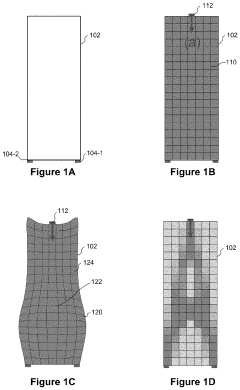
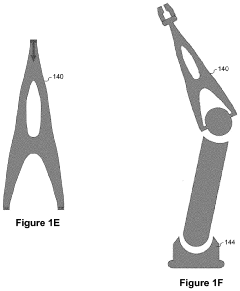
- The approach reformulates the problem as a bilevel optimization using a first-order algorithm and the Solid Isotropic Material with Penalization (SIMP) model, allowing for approximate solutions and reducing iterative costs, enabling faster design updates and convergence to locally optimal structures.

Topology optimization with bidirectional mesh adaptation
PatentWO2023133734A1
Innovation
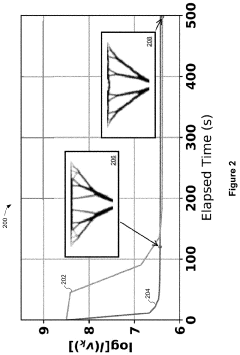
- Integration of bidirectional mesh adaptation with topology optimization to balance computational efficiency and design accuracy.
- Multi-physics topology optimization approach that extends beyond traditional structural problems to include fluid flow, thermal-flow, and electromagnetic considerations.
- Mesh sensitivity management system that prevents design feature loss while maintaining computational efficiency during the optimization process.



Industry-Specific Applications and Case Studies
Topology optimization has revolutionized the aerospace industry by enabling significant weight reduction while maintaining structural integrity. Boeing's 787 Dreamliner represents a landmark case study, where topology optimization reduced structural weight by approximately 20% compared to traditional methods. This weight reduction directly translated to improved fuel efficiency and reduced carbon emissions. Similarly, Airbus implemented topology optimization in the A350 XWB's wing design, resulting in a 15% reduction in material usage while enhancing aerodynamic performance.
In automotive manufacturing, General Motors pioneered the application of topology optimization for chassis components, achieving weight reductions of 25-40% compared to traditionally designed parts. The 2020 Cadillac CT5 features multiple topology-optimized structural components that maintain crash safety standards while reducing overall vehicle weight. BMW's i-series electric vehicles incorporate topology-optimized crash structures that provide superior energy absorption with minimal material usage, demonstrating how this approach can address the unique challenges of electric vehicle design.
The medical device industry has embraced topology optimization for implant design. Zimmer Biomet utilized this approach to develop titanium spinal implants that mimic bone's natural porosity and mechanical properties. Traditional analysis methods would have produced significantly heavier implants with suboptimal osseointegration characteristics. Similarly, Stryker's topology-optimized knee replacements demonstrate improved longevity and biomechanical performance compared to conventionally designed predecessors.
In civil engineering, the Beijing National Stadium ("Bird's Nest") represents an iconic application of topology optimization principles at an architectural scale. While not fully computer-optimized, its design philosophy mirrors topology optimization concepts. More recently, MX3D's 3D-printed bridge in Amsterdam utilized topology optimization to create a structure that uses 30% less material than conventional designs while maintaining required load-bearing capabilities.
The energy sector has implemented topology optimization in wind turbine blade design, with Vestas Wind Systems reporting 7-12% improvements in energy capture efficiency through optimized internal structural components. Traditional analysis would have required significantly more material to achieve comparable performance. Similarly, General Electric's advanced gas turbine components leverage topology optimization to enhance thermal efficiency while extending component lifespan under extreme operating conditions.
These industry-specific applications demonstrate that topology optimization consistently outperforms traditional structural analysis across diverse sectors, particularly for complex geometries and multi-objective optimization scenarios. The most successful implementations combine topology optimization with traditional verification methods, leveraging the strengths of both approaches.
In automotive manufacturing, General Motors pioneered the application of topology optimization for chassis components, achieving weight reductions of 25-40% compared to traditionally designed parts. The 2020 Cadillac CT5 features multiple topology-optimized structural components that maintain crash safety standards while reducing overall vehicle weight. BMW's i-series electric vehicles incorporate topology-optimized crash structures that provide superior energy absorption with minimal material usage, demonstrating how this approach can address the unique challenges of electric vehicle design.
The medical device industry has embraced topology optimization for implant design. Zimmer Biomet utilized this approach to develop titanium spinal implants that mimic bone's natural porosity and mechanical properties. Traditional analysis methods would have produced significantly heavier implants with suboptimal osseointegration characteristics. Similarly, Stryker's topology-optimized knee replacements demonstrate improved longevity and biomechanical performance compared to conventionally designed predecessors.
In civil engineering, the Beijing National Stadium ("Bird's Nest") represents an iconic application of topology optimization principles at an architectural scale. While not fully computer-optimized, its design philosophy mirrors topology optimization concepts. More recently, MX3D's 3D-printed bridge in Amsterdam utilized topology optimization to create a structure that uses 30% less material than conventional designs while maintaining required load-bearing capabilities.
The energy sector has implemented topology optimization in wind turbine blade design, with Vestas Wind Systems reporting 7-12% improvements in energy capture efficiency through optimized internal structural components. Traditional analysis would have required significantly more material to achieve comparable performance. Similarly, General Electric's advanced gas turbine components leverage topology optimization to enhance thermal efficiency while extending component lifespan under extreme operating conditions.
These industry-specific applications demonstrate that topology optimization consistently outperforms traditional structural analysis across diverse sectors, particularly for complex geometries and multi-objective optimization scenarios. The most successful implementations combine topology optimization with traditional verification methods, leveraging the strengths of both approaches.
Sustainability Impact and Material Efficiency Considerations
The sustainability implications of topology optimization versus traditional structural analysis represent a critical dimension in modern engineering practices. Topology optimization fundamentally transforms material efficiency by mathematically determining optimal material distribution, typically reducing material usage by 30-50% compared to conventionally designed structures while maintaining equivalent performance characteristics.
This material reduction directly translates to significant environmental benefits across the product lifecycle. Manufacturing processes require less raw material input, reducing resource extraction impacts and associated environmental degradation. The energy consumption during manufacturing decreases proportionally with material reduction, contributing to lower carbon emissions in production phases. Additionally, the transportation environmental footprint diminishes as lighter components require less fuel for distribution.
During operational phases, topology-optimized structures offer continued sustainability advantages. In aerospace and automotive applications, weight reduction directly correlates with fuel efficiency improvements, with studies indicating that a 10% weight reduction can yield 6-8% fuel economy enhancement. This operational efficiency compounds over product lifespans, substantially reducing lifetime carbon emissions.
End-of-life considerations also favor topology optimization approaches. The precise material allocation results in more homogeneous components that potentially simplify recycling processes. Furthermore, the reduced material volume decreases waste management burdens when components reach end-of-life stages.
Traditional structural analysis, while proven and reliable, typically employs safety factors and conservative design approaches that lead to material overuse. These practices evolved in eras when computational limitations necessitated simplified analysis methods and when material conservation was less prioritized than structural integrity. The resulting designs often incorporate redundant material that serves minimal structural purpose but adds significantly to environmental impact.
From a circular economy perspective, topology optimization aligns with principles of resource efficiency and waste minimization. The approach fundamentally questions the necessity of each material element, creating structures that maximize utility per unit of resource. This philosophy contrasts with traditional methods that often default to standardized shapes and uniform material distribution regardless of actual load requirements.
As material scarcity concerns grow and environmental regulations tighten, the material efficiency advantages of topology optimization increasingly translate to economic benefits beyond pure engineering performance. Organizations adopting these advanced design methodologies position themselves advantageously for sustainability-focused regulatory frameworks and consumer preferences.
This material reduction directly translates to significant environmental benefits across the product lifecycle. Manufacturing processes require less raw material input, reducing resource extraction impacts and associated environmental degradation. The energy consumption during manufacturing decreases proportionally with material reduction, contributing to lower carbon emissions in production phases. Additionally, the transportation environmental footprint diminishes as lighter components require less fuel for distribution.
During operational phases, topology-optimized structures offer continued sustainability advantages. In aerospace and automotive applications, weight reduction directly correlates with fuel efficiency improvements, with studies indicating that a 10% weight reduction can yield 6-8% fuel economy enhancement. This operational efficiency compounds over product lifespans, substantially reducing lifetime carbon emissions.
End-of-life considerations also favor topology optimization approaches. The precise material allocation results in more homogeneous components that potentially simplify recycling processes. Furthermore, the reduced material volume decreases waste management burdens when components reach end-of-life stages.
Traditional structural analysis, while proven and reliable, typically employs safety factors and conservative design approaches that lead to material overuse. These practices evolved in eras when computational limitations necessitated simplified analysis methods and when material conservation was less prioritized than structural integrity. The resulting designs often incorporate redundant material that serves minimal structural purpose but adds significantly to environmental impact.
From a circular economy perspective, topology optimization aligns with principles of resource efficiency and waste minimization. The approach fundamentally questions the necessity of each material element, creating structures that maximize utility per unit of resource. This philosophy contrasts with traditional methods that often default to standardized shapes and uniform material distribution regardless of actual load requirements.
As material scarcity concerns grow and environmental regulations tighten, the material efficiency advantages of topology optimization increasingly translate to economic benefits beyond pure engineering performance. Organizations adopting these advanced design methodologies position themselves advantageously for sustainability-focused regulatory frameworks and consumer preferences.
Unlock deeper insights with PatSnap Eureka Quick Research — get a full tech report to explore trends and direct your research. Try now!
Generate Your Research Report Instantly with AI Agent
Supercharge your innovation with PatSnap Eureka AI Agent Platform!