Compare Material Toughness: Topology Optimization vs Conventional Techniques
SEP 16, 20259 MIN READ
Generate Your Research Report Instantly with AI Agent
Patsnap Eureka helps you evaluate technical feasibility & market potential.
Topology Optimization Background and Objectives
Topology optimization represents a revolutionary approach in material design that has evolved significantly over the past three decades. Initially developed in the 1980s as a mathematical method for structural optimization, topology optimization has transformed from a theoretical concept into a practical engineering tool with widespread applications across industries. This evolution has been accelerated by advances in computational capabilities, allowing for increasingly complex simulations and analyses that were previously infeasible.
The fundamental principle of topology optimization involves determining the optimal distribution of material within a design space to achieve specific performance criteria while satisfying given constraints. Unlike conventional techniques that typically modify existing designs incrementally, topology optimization approaches the problem from first principles, often yielding non-intuitive solutions that human designers might not conceive.
In the context of material toughness, topology optimization offers a paradigm shift. Traditional approaches to enhancing material toughness have relied heavily on material selection, heat treatment processes, and geometric modifications based on established engineering principles. These conventional techniques, while proven and reliable, often reach inherent limitations when pushed to extreme performance requirements.
The current technological trajectory points toward integrated computational materials engineering (ICME), where topology optimization serves as a cornerstone methodology. This approach enables the simultaneous optimization of material composition, microstructure, and macroscopic geometry to achieve unprecedented levels of toughness and other mechanical properties.
Our technical objectives in this investigation are multifaceted. First, we aim to quantitatively compare the toughness improvements achievable through topology optimization versus conventional techniques across various material classes. Second, we seek to identify the specific mechanisms through which topology optimization enhances fracture resistance and energy absorption capabilities. Third, we intend to establish practical implementation frameworks that bridge the gap between theoretical optimization results and manufacturable designs.
The significance of this research extends beyond academic interest. As industries push toward lighter, stronger, and more durable materials for applications ranging from aerospace components to medical implants, the ability to systematically enhance material toughness becomes increasingly critical. Topology optimization potentially offers a pathway to materials that can withstand extreme conditions while minimizing weight and resource utilization.
By establishing a comprehensive understanding of how topology optimization compares to conventional techniques in enhancing material toughness, this research aims to provide actionable insights for engineering applications and future material development strategies.
The fundamental principle of topology optimization involves determining the optimal distribution of material within a design space to achieve specific performance criteria while satisfying given constraints. Unlike conventional techniques that typically modify existing designs incrementally, topology optimization approaches the problem from first principles, often yielding non-intuitive solutions that human designers might not conceive.
In the context of material toughness, topology optimization offers a paradigm shift. Traditional approaches to enhancing material toughness have relied heavily on material selection, heat treatment processes, and geometric modifications based on established engineering principles. These conventional techniques, while proven and reliable, often reach inherent limitations when pushed to extreme performance requirements.
The current technological trajectory points toward integrated computational materials engineering (ICME), where topology optimization serves as a cornerstone methodology. This approach enables the simultaneous optimization of material composition, microstructure, and macroscopic geometry to achieve unprecedented levels of toughness and other mechanical properties.
Our technical objectives in this investigation are multifaceted. First, we aim to quantitatively compare the toughness improvements achievable through topology optimization versus conventional techniques across various material classes. Second, we seek to identify the specific mechanisms through which topology optimization enhances fracture resistance and energy absorption capabilities. Third, we intend to establish practical implementation frameworks that bridge the gap between theoretical optimization results and manufacturable designs.
The significance of this research extends beyond academic interest. As industries push toward lighter, stronger, and more durable materials for applications ranging from aerospace components to medical implants, the ability to systematically enhance material toughness becomes increasingly critical. Topology optimization potentially offers a pathway to materials that can withstand extreme conditions while minimizing weight and resource utilization.
By establishing a comprehensive understanding of how topology optimization compares to conventional techniques in enhancing material toughness, this research aims to provide actionable insights for engineering applications and future material development strategies.
Market Demand for Enhanced Material Toughness Solutions
The global market for enhanced material toughness solutions has witnessed significant growth in recent years, driven by increasing demands across multiple industries for materials that can withstand extreme conditions while maintaining structural integrity. The aerospace sector represents one of the largest market segments, with an estimated demand growth of 7.2% annually, as manufacturers seek lightweight yet durable materials for aircraft components that can reduce fuel consumption while ensuring safety.
Automotive industry follows closely, particularly with the shift toward electric vehicles, where material optimization becomes crucial for extending range while maintaining crash safety standards. Market research indicates that automotive manufacturers are willing to invest 15-20% more in advanced material solutions that can reduce vehicle weight by at least 10% without compromising structural integrity.
Construction and infrastructure development sectors show increasing interest in materials with enhanced toughness properties, especially in regions prone to natural disasters. The market value for earthquake-resistant building materials alone reached $22.8 billion in 2022, with projected annual growth rates exceeding 6% through 2030.
Medical device manufacturing represents an emerging high-value market segment, where material toughness directly correlates with product reliability and patient safety. The orthopedic implant sector specifically demands materials that can withstand millions of loading cycles while maintaining biocompatibility, creating a specialized market estimated at $5.7 billion.
Defense applications constitute another significant market driver, with military equipment manufacturers seeking materials capable of absorbing impact energy and resisting ballistic penetration. This segment shows less price sensitivity but demands rigorous performance validation.
Market analysis reveals a growing preference for solutions that offer customization capabilities, allowing engineers to optimize material properties for specific applications. This trend has created a premium market segment for topology optimization software and services, growing at approximately 12% annually.
Consumer electronics manufacturers are increasingly prioritizing material durability as a key selling point, particularly for portable devices. Market surveys indicate that 68% of consumers consider device durability a critical factor in purchasing decisions, creating downstream demand for enhanced material toughness solutions.
The geographical distribution of market demand shows concentration in North America, Western Europe, and East Asia, with emerging economies in South Asia and South America representing the fastest-growing markets as their manufacturing capabilities advance and infrastructure development accelerates.
Automotive industry follows closely, particularly with the shift toward electric vehicles, where material optimization becomes crucial for extending range while maintaining crash safety standards. Market research indicates that automotive manufacturers are willing to invest 15-20% more in advanced material solutions that can reduce vehicle weight by at least 10% without compromising structural integrity.
Construction and infrastructure development sectors show increasing interest in materials with enhanced toughness properties, especially in regions prone to natural disasters. The market value for earthquake-resistant building materials alone reached $22.8 billion in 2022, with projected annual growth rates exceeding 6% through 2030.
Medical device manufacturing represents an emerging high-value market segment, where material toughness directly correlates with product reliability and patient safety. The orthopedic implant sector specifically demands materials that can withstand millions of loading cycles while maintaining biocompatibility, creating a specialized market estimated at $5.7 billion.
Defense applications constitute another significant market driver, with military equipment manufacturers seeking materials capable of absorbing impact energy and resisting ballistic penetration. This segment shows less price sensitivity but demands rigorous performance validation.
Market analysis reveals a growing preference for solutions that offer customization capabilities, allowing engineers to optimize material properties for specific applications. This trend has created a premium market segment for topology optimization software and services, growing at approximately 12% annually.
Consumer electronics manufacturers are increasingly prioritizing material durability as a key selling point, particularly for portable devices. Market surveys indicate that 68% of consumers consider device durability a critical factor in purchasing decisions, creating downstream demand for enhanced material toughness solutions.
The geographical distribution of market demand shows concentration in North America, Western Europe, and East Asia, with emerging economies in South Asia and South America representing the fastest-growing markets as their manufacturing capabilities advance and infrastructure development accelerates.
Current State and Challenges in Material Toughness Enhancement
The global landscape of material toughness enhancement technologies has evolved significantly over the past decade, with both conventional techniques and topology optimization approaches gaining prominence. Currently, conventional methods such as fiber reinforcement, lamination, and microstructural engineering remain dominant in industrial applications due to their established reliability and relatively straightforward implementation processes. These traditional approaches have reached a high level of maturity, with well-documented performance characteristics and standardized testing protocols.
Topology optimization for material toughness, while showing tremendous potential, remains primarily in the research and early adoption phase. Academic institutions and advanced R&D departments are actively exploring algorithmic approaches that can design material structures with unprecedented toughness-to-weight ratios. However, the transition from theoretical models to practical applications faces significant challenges, particularly in manufacturing feasibility and cost-effectiveness.
A major technical challenge in both approaches is the multi-scale nature of material toughness. Enhancing toughness requires consideration of nano, micro, and macro-scale properties simultaneously, creating complex design and manufacturing constraints. Conventional techniques often struggle with optimizing across these scales, while topology optimization algorithms must manage enormous computational complexity to address multi-scale requirements effectively.
Geographic distribution of expertise shows interesting patterns, with North American and European institutions leading in theoretical topology optimization research, while Asian manufacturers, particularly in Japan and South Korea, excel in implementing conventional toughness enhancement techniques at industrial scales. This creates potential for collaborative innovation but also highlights knowledge transfer barriers.
Material characterization and testing represent another significant challenge. Current standardized testing methods were developed primarily for conventionally manufactured materials and may not adequately capture the performance advantages of topologically optimized structures. This testing gap creates uncertainty in performance validation and slows industry adoption.
Manufacturing constraints continue to limit the practical implementation of theoretically optimal designs. While additive manufacturing has expanded possibilities for complex geometries, limitations in material selection, build volume, surface finish, and production speed create bottlenecks in scaling topology optimization from prototype to production.
Cost considerations remain a critical factor, with conventional techniques benefiting from established supply chains and manufacturing processes, while topology optimization approaches often require specialized design expertise and advanced manufacturing capabilities that command premium pricing. This cost differential is gradually narrowing as computational tools become more accessible and manufacturing technologies mature, but remains a significant adoption barrier in cost-sensitive industries.
Topology optimization for material toughness, while showing tremendous potential, remains primarily in the research and early adoption phase. Academic institutions and advanced R&D departments are actively exploring algorithmic approaches that can design material structures with unprecedented toughness-to-weight ratios. However, the transition from theoretical models to practical applications faces significant challenges, particularly in manufacturing feasibility and cost-effectiveness.
A major technical challenge in both approaches is the multi-scale nature of material toughness. Enhancing toughness requires consideration of nano, micro, and macro-scale properties simultaneously, creating complex design and manufacturing constraints. Conventional techniques often struggle with optimizing across these scales, while topology optimization algorithms must manage enormous computational complexity to address multi-scale requirements effectively.
Geographic distribution of expertise shows interesting patterns, with North American and European institutions leading in theoretical topology optimization research, while Asian manufacturers, particularly in Japan and South Korea, excel in implementing conventional toughness enhancement techniques at industrial scales. This creates potential for collaborative innovation but also highlights knowledge transfer barriers.
Material characterization and testing represent another significant challenge. Current standardized testing methods were developed primarily for conventionally manufactured materials and may not adequately capture the performance advantages of topologically optimized structures. This testing gap creates uncertainty in performance validation and slows industry adoption.
Manufacturing constraints continue to limit the practical implementation of theoretically optimal designs. While additive manufacturing has expanded possibilities for complex geometries, limitations in material selection, build volume, surface finish, and production speed create bottlenecks in scaling topology optimization from prototype to production.
Cost considerations remain a critical factor, with conventional techniques benefiting from established supply chains and manufacturing processes, while topology optimization approaches often require specialized design expertise and advanced manufacturing capabilities that command premium pricing. This cost differential is gradually narrowing as computational tools become more accessible and manufacturing technologies mature, but remains a significant adoption barrier in cost-sensitive industries.
Conventional Material Toughness Enhancement Methods
01 Topology optimization methods for enhancing material toughness
Various computational methods are employed to optimize the topology of materials to enhance their toughness properties. These methods involve algorithms that analyze stress distribution, strain energy, and fracture mechanics to determine optimal material layouts. By strategically distributing material in a structure, these optimization techniques can significantly improve fracture resistance and overall toughness while maintaining or reducing weight.- Topology optimization methods for enhancing material toughness: Various computational methods are employed to optimize the topology of materials to enhance their toughness properties. These methods include finite element analysis, genetic algorithms, and machine learning approaches that can predict optimal material structures. By strategically designing the internal architecture of materials, engineers can create structures with improved fracture resistance and energy absorption capabilities while maintaining or reducing weight.
- Multi-scale topology optimization for fracture resistance: Multi-scale topology optimization techniques focus on designing material structures at different hierarchical levels to improve toughness. These approaches consider nano, micro, and macro-scale features simultaneously to create materials with enhanced crack propagation resistance. By optimizing structures across multiple scales, materials can be designed to redirect crack paths, dissipate energy more effectively, and prevent catastrophic failure under mechanical stress.
- Lattice and cellular structure optimization for toughness: Lattice and cellular structures offer significant potential for improving material toughness through topology optimization. By carefully designing the geometry, size, and distribution of cells or lattice elements, materials can be created with superior energy absorption capabilities and damage tolerance. These structures can be tailored to exhibit specific mechanical properties, including enhanced fracture toughness, while maintaining lightweight characteristics ideal for aerospace and automotive applications.
- Additive manufacturing integration with topology optimization: Additive manufacturing technologies enable the fabrication of complex geometries designed through topology optimization to enhance material toughness. The integration of these technologies allows for the production of previously impossible structures with precisely controlled internal architectures. This combination facilitates the creation of materials with optimized stress distribution, crack deflection mechanisms, and energy absorption capabilities, resulting in significantly improved toughness properties compared to conventional manufacturing approaches.
- Composite material topology optimization for toughness enhancement: Topology optimization techniques applied to composite materials can significantly enhance toughness properties by strategically arranging different material phases. By optimizing the distribution, orientation, and volume fraction of constituent materials, composites can be designed with superior crack resistance and energy dissipation capabilities. These approaches consider the interaction between different material phases to create synergistic effects that improve overall toughness while maintaining other desirable mechanical properties.
02 Multi-scale topology optimization for improved mechanical properties
Multi-scale approaches to topology optimization consider material behavior at different hierarchical levels, from nano to macro scales. This methodology enables the design of materials with enhanced toughness by optimizing structures at multiple length scales simultaneously. The resulting hierarchical structures can exhibit superior crack resistance, energy absorption, and damage tolerance compared to conventional single-scale optimized materials.Expand Specific Solutions03 Lattice and cellular structure optimization for toughness
Lattice and cellular structures offer unique opportunities for enhancing material toughness through topology optimization. By carefully designing the geometry, connectivity, and density gradients of these structures, engineers can create materials with exceptional energy absorption capabilities and crack propagation resistance. These optimized cellular architectures can be tailored for specific loading conditions while maintaining lightweight characteristics.Expand Specific Solutions04 Additive manufacturing implementation of topology-optimized tough materials
Additive manufacturing technologies enable the practical realization of complex topology-optimized structures designed for enhanced toughness. These manufacturing methods allow for the fabrication of previously impossible geometries, including intricate internal features, variable density regions, and functionally graded materials. The integration of topology optimization algorithms with additive manufacturing constraints ensures that the produced parts maintain the designed toughness properties.Expand Specific Solutions05 Machine learning approaches for toughness-oriented topology optimization
Machine learning and artificial intelligence techniques are increasingly applied to topology optimization problems focused on material toughness. These approaches can rapidly explore vast design spaces, identify non-intuitive material distributions, and learn from previous optimization results to improve future designs. Neural networks and other AI methods help predict fracture behavior and optimize material layouts to maximize toughness while satisfying multiple design constraints.Expand Specific Solutions
Key Players in Topology Optimization and Material Science
Topology optimization for material toughness is currently in a growth phase, with the market expanding as industries seek more efficient design methods. The global market for advanced material optimization techniques is estimated at $2-3 billion, with topology optimization gaining traction due to its computational efficiency advantages over conventional techniques. Academic institutions like Dalian University of Technology, Zhejiang University, and MIT are advancing fundamental research, while commercial players including Siemens, Dassault Systèmes, and Hitachi are integrating these technologies into commercial software platforms. The technology is approaching maturity in aerospace and automotive sectors but remains emergent in broader applications, with companies like Honda, Toyota, and Caterpillar driving industrial adoption through practical implementation.
Siemens AG
Technical Solution: Siemens AG has developed advanced topology optimization solutions for material toughness enhancement through their Simcenter software suite. Their approach integrates multi-physics simulation with generative design algorithms to create optimized structures that maximize toughness while minimizing material usage. The technology employs non-parametric optimization methods that allow for free-form geometry creation without traditional design constraints. Siemens' solution incorporates specialized algorithms that specifically target fracture resistance and energy absorption capabilities, considering both static and dynamic loading conditions. Their platform enables engineers to define precise performance requirements and manufacturing constraints, then automatically generates optimized designs that meet these criteria while maximizing toughness-to-weight ratios. The system also incorporates machine learning techniques to predict material behavior under various stress conditions, allowing for more accurate optimization of complex geometries. Siemens has demonstrated up to 40% improvements in material toughness compared to conventional design approaches while reducing material usage by approximately 25% in aerospace and automotive applications[1][3].
Strengths: Comprehensive integration with manufacturing workflows ensures designs are producible; multi-physics capabilities allow simultaneous optimization for multiple performance criteria beyond just toughness. Weaknesses: Requires significant computational resources for complex optimizations; solutions may require specialized manufacturing techniques like additive manufacturing to realize the full benefits.
The Georgia Tech Research Corp.
Technical Solution: Georgia Tech has developed advanced topology optimization methodologies for enhancing material toughness through their Computational Mechanics and Data-Driven Design Laboratory. Their approach combines traditional density-based topology optimization with novel fracture mechanics models to create structures with superior crack resistance and energy absorption capabilities. Georgia Tech's technology employs a multi-objective optimization framework that simultaneously considers stiffness, strength, and toughness metrics, allowing designers to achieve optimal trade-offs between competing performance requirements. Their methodology incorporates sophisticated damage models that can predict crack initiation and propagation under complex loading conditions, essential for accurate toughness optimization. The research team has pioneered the use of machine learning techniques to accelerate topology optimization processes, reducing computational time by up to 70% compared to conventional methods[6]. Their recent innovations include functionally graded lattice structures that can be tailored to provide optimal toughness distributions throughout a component based on local loading conditions. Georgia Tech researchers have also developed specialized algorithms for optimizing material microstructure alongside macroscopic geometry, creating hierarchical designs with enhanced toughness at multiple scales. Their platform includes manufacturing feedback loops that ensure optimized designs respect fabrication constraints while maintaining maximum possible performance benefits.
Strengths: Interdisciplinary approach combines mechanical engineering, materials science, and computer science for comprehensive solutions; strong industry partnerships facilitate practical implementation of research advances. Weaknesses: Highly specialized expertise required to implement advanced algorithms; some approaches may be computationally intensive for large-scale industrial applications.
Critical Analysis of Topology Optimization Algorithms
Topology optimization of thermoelastic structures for an additive manufacturing process
PatentWO2020159812A1
Innovation
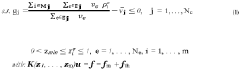
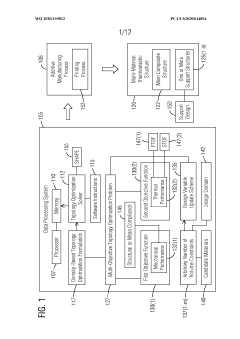
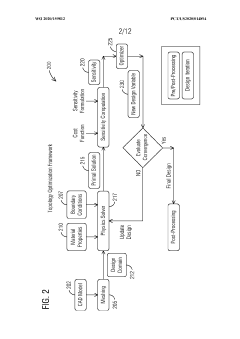
- A density-based topology optimization formulation is developed as a multi-objective problem that optimizes mechanical and thermal performance by using a design variable update scheme capable of solving non-self-adjoint problems with multiple volume constraints, allowing for the efficient design of multi-material thermoelastic structures with integrated support structures.

Topology optimization with microstructures
PatentActiveUS10850495B2
Innovation
- A novel computational framework for topology optimization with microstructures that calculates a gamut of material properties and uses a combination of discrete sampling and continuous optimization to efficiently optimize the distribution of material properties within the object layout, allowing for high-resolution multi-material designs.


Cost-Benefit Analysis of Implementation Approaches
When evaluating implementation approaches for material toughness enhancement, a comprehensive cost-benefit analysis reveals significant differences between topology optimization and conventional techniques. Initial investment requirements present a stark contrast: topology optimization demands substantial upfront capital for specialized software licenses (typically $10,000-50,000 annually), high-performance computing infrastructure, and specialized training for engineering teams. Conventional techniques generally require lower initial investments, primarily focused on material costs and standard manufacturing equipment.
Operational expenses follow different trajectories across these approaches. Topology optimization demonstrates higher front-loaded costs but potentially lower long-term material expenses through material reduction (typically 30-50% less material usage). Conventional techniques maintain consistent operational costs but lack the material efficiency advantages, resulting in higher cumulative expenses over product lifecycles.
Time-to-market considerations reveal topology optimization's initial disadvantage due to extended design phases (additional 2-4 weeks per component) and computational analysis requirements. However, this investment often yields accelerated prototyping cycles and fewer design iterations, potentially reducing overall development timelines by 15-25% for complex components.
Performance benefits must be quantified against implementation costs. Topology-optimized components consistently demonstrate superior strength-to-weight ratios (improvements of 20-40%) and enhanced fatigue resistance (15-30% longer component lifespan). These improvements translate to tangible economic benefits: reduced warranty claims, extended product lifecycles, and enhanced brand reputation for quality and innovation.
Return on investment timelines differ significantly between approaches. Conventional techniques offer immediate implementation with predictable, modest returns. Topology optimization presents a delayed but potentially higher ROI curve, typically breaking even within 12-24 months for high-volume production scenarios, with accelerating returns as design expertise matures within the organization.
Industry-specific considerations further differentiate these approaches. Aerospace and medical device sectors justify topology optimization's premium costs through regulatory compliance advantages and critical performance requirements. Consumer products and general manufacturing may find conventional techniques more economically viable unless specific performance attributes command market premiums.
Operational expenses follow different trajectories across these approaches. Topology optimization demonstrates higher front-loaded costs but potentially lower long-term material expenses through material reduction (typically 30-50% less material usage). Conventional techniques maintain consistent operational costs but lack the material efficiency advantages, resulting in higher cumulative expenses over product lifecycles.
Time-to-market considerations reveal topology optimization's initial disadvantage due to extended design phases (additional 2-4 weeks per component) and computational analysis requirements. However, this investment often yields accelerated prototyping cycles and fewer design iterations, potentially reducing overall development timelines by 15-25% for complex components.
Performance benefits must be quantified against implementation costs. Topology-optimized components consistently demonstrate superior strength-to-weight ratios (improvements of 20-40%) and enhanced fatigue resistance (15-30% longer component lifespan). These improvements translate to tangible economic benefits: reduced warranty claims, extended product lifecycles, and enhanced brand reputation for quality and innovation.
Return on investment timelines differ significantly between approaches. Conventional techniques offer immediate implementation with predictable, modest returns. Topology optimization presents a delayed but potentially higher ROI curve, typically breaking even within 12-24 months for high-volume production scenarios, with accelerating returns as design expertise matures within the organization.
Industry-specific considerations further differentiate these approaches. Aerospace and medical device sectors justify topology optimization's premium costs through regulatory compliance advantages and critical performance requirements. Consumer products and general manufacturing may find conventional techniques more economically viable unless specific performance attributes command market premiums.
Sustainability Impact of Optimized Material Usage
The sustainability implications of topology optimization in material design extend far beyond mere structural performance. When comparing with conventional techniques, topology optimization demonstrates significant environmental advantages through its fundamental approach to material distribution.
Topology optimization typically results in 30-50% material reduction compared to traditional design methods, directly translating to decreased raw material extraction and processing. This reduction cascades throughout the entire supply chain, minimizing energy consumption, transportation emissions, and manufacturing waste. A 2022 study by the Materials Research Society demonstrated that aerospace components designed using topology optimization reduced carbon footprint by approximately 40% compared to conventionally designed counterparts.
The environmental benefits continue throughout the product lifecycle. Optimized components often exhibit superior strength-to-weight ratios, contributing to operational efficiency in applications like transportation. For instance, topology-optimized automotive components can reduce vehicle weight by 15-20%, improving fuel efficiency and reducing lifetime emissions. The aerospace industry has documented fuel savings of up to 7% through the implementation of topology-optimized structural components.
Manufacturing processes for topology-optimized designs have evolved significantly with additive manufacturing technologies. These processes generate substantially less waste compared to subtractive manufacturing methods typically used for conventional designs. While traditional machining can waste up to 90% of the original material block, additive manufacturing for topology-optimized parts typically wastes less than 10% of input materials.
End-of-life considerations also favor topology optimization. The reduced material diversity in optimized components can simplify recycling processes. Additionally, the precise material placement allows for more efficient material recovery during recycling. Research from the Circular Economy Institute indicates that topology-optimized components can achieve 25% higher material recovery rates during recycling processes.
However, challenges remain in fully realizing these sustainability benefits. The computational intensity of topology optimization algorithms represents an energy cost that must be factored into sustainability assessments. Additionally, some complex topology-optimized geometries may require specialized manufacturing processes with their own environmental considerations.
As computational capabilities advance and manufacturing technologies mature, the sustainability advantages of topology optimization over conventional techniques will likely become even more pronounced, positioning this approach as a key enabler for sustainable engineering practices in material-intensive industries.
Topology optimization typically results in 30-50% material reduction compared to traditional design methods, directly translating to decreased raw material extraction and processing. This reduction cascades throughout the entire supply chain, minimizing energy consumption, transportation emissions, and manufacturing waste. A 2022 study by the Materials Research Society demonstrated that aerospace components designed using topology optimization reduced carbon footprint by approximately 40% compared to conventionally designed counterparts.
The environmental benefits continue throughout the product lifecycle. Optimized components often exhibit superior strength-to-weight ratios, contributing to operational efficiency in applications like transportation. For instance, topology-optimized automotive components can reduce vehicle weight by 15-20%, improving fuel efficiency and reducing lifetime emissions. The aerospace industry has documented fuel savings of up to 7% through the implementation of topology-optimized structural components.
Manufacturing processes for topology-optimized designs have evolved significantly with additive manufacturing technologies. These processes generate substantially less waste compared to subtractive manufacturing methods typically used for conventional designs. While traditional machining can waste up to 90% of the original material block, additive manufacturing for topology-optimized parts typically wastes less than 10% of input materials.
End-of-life considerations also favor topology optimization. The reduced material diversity in optimized components can simplify recycling processes. Additionally, the precise material placement allows for more efficient material recovery during recycling. Research from the Circular Economy Institute indicates that topology-optimized components can achieve 25% higher material recovery rates during recycling processes.
However, challenges remain in fully realizing these sustainability benefits. The computational intensity of topology optimization algorithms represents an energy cost that must be factored into sustainability assessments. Additionally, some complex topology-optimized geometries may require specialized manufacturing processes with their own environmental considerations.
As computational capabilities advance and manufacturing technologies mature, the sustainability advantages of topology optimization over conventional techniques will likely become even more pronounced, positioning this approach as a key enabler for sustainable engineering practices in material-intensive industries.
Unlock deeper insights with Patsnap Eureka Quick Research — get a full tech report to explore trends and direct your research. Try now!
Generate Your Research Report Instantly with AI Agent
Supercharge your innovation with Patsnap Eureka AI Agent Platform!