Enhancing Circuit Reliability with Schmitt Trigger
SEP 23, 202510 MIN READ
Generate Your Research Report Instantly with AI Agent
Patsnap Eureka helps you evaluate technical feasibility & market potential.
Schmitt Trigger Technology Background and Objectives
The Schmitt trigger, first introduced by Otto Schmitt in 1934, represents a fundamental advancement in electronic circuit design that has significantly enhanced signal processing capabilities across numerous applications. Initially developed to mimic the neural impulse propagation in squid nerve fibers, this technology has evolved far beyond its biological inspiration to become a cornerstone of reliable circuit design.
The evolution of Schmitt trigger technology has been closely aligned with the broader development of electronic systems. From vacuum tube implementations in early radar systems during World War II to transistor-based designs in the 1950s and 1960s, and eventually to integrated circuit implementations, Schmitt triggers have consistently adapted to emerging semiconductor technologies while maintaining their core functionality.
In contemporary electronic design, Schmitt triggers serve as critical components for improving signal integrity in noisy environments. Their unique hysteresis characteristic—where the threshold voltage for transitioning from low to high differs from high to low—provides an elegant solution to the persistent challenge of signal bounce and noise interference that plagues many electronic systems.
The primary technical objective in enhancing circuit reliability with Schmitt triggers centers on optimizing the hysteresis window to balance noise immunity with response time. This involves careful consideration of threshold voltage levels, transition speeds, and power consumption requirements across diverse operating conditions and applications.
Recent technological trends have pushed Schmitt trigger development toward lower power consumption, higher operating frequencies, and integration with advanced digital systems. The miniaturization of electronic devices has further necessitated innovations in Schmitt trigger design to maintain performance while reducing footprint and power requirements.
Looking forward, the technical goals for Schmitt trigger enhancement include developing adaptive hysteresis mechanisms that can dynamically adjust to changing noise environments, improving energy efficiency for battery-powered applications, and ensuring compatibility with emerging semiconductor technologies such as wide-bandgap materials.
The integration of Schmitt triggers with machine learning algorithms represents another promising frontier, potentially enabling smart threshold adjustment based on real-time signal analysis and environmental conditions. This convergence of traditional analog design principles with digital intelligence could significantly expand the application scope and effectiveness of Schmitt trigger technology.
As electronic systems continue to penetrate increasingly harsh and unpredictable environments—from industrial automation to automotive systems and medical devices—the role of Schmitt triggers in ensuring reliable operation becomes ever more critical, driving ongoing research and development in this fundamental yet evolving technology.
The evolution of Schmitt trigger technology has been closely aligned with the broader development of electronic systems. From vacuum tube implementations in early radar systems during World War II to transistor-based designs in the 1950s and 1960s, and eventually to integrated circuit implementations, Schmitt triggers have consistently adapted to emerging semiconductor technologies while maintaining their core functionality.
In contemporary electronic design, Schmitt triggers serve as critical components for improving signal integrity in noisy environments. Their unique hysteresis characteristic—where the threshold voltage for transitioning from low to high differs from high to low—provides an elegant solution to the persistent challenge of signal bounce and noise interference that plagues many electronic systems.
The primary technical objective in enhancing circuit reliability with Schmitt triggers centers on optimizing the hysteresis window to balance noise immunity with response time. This involves careful consideration of threshold voltage levels, transition speeds, and power consumption requirements across diverse operating conditions and applications.
Recent technological trends have pushed Schmitt trigger development toward lower power consumption, higher operating frequencies, and integration with advanced digital systems. The miniaturization of electronic devices has further necessitated innovations in Schmitt trigger design to maintain performance while reducing footprint and power requirements.
Looking forward, the technical goals for Schmitt trigger enhancement include developing adaptive hysteresis mechanisms that can dynamically adjust to changing noise environments, improving energy efficiency for battery-powered applications, and ensuring compatibility with emerging semiconductor technologies such as wide-bandgap materials.
The integration of Schmitt triggers with machine learning algorithms represents another promising frontier, potentially enabling smart threshold adjustment based on real-time signal analysis and environmental conditions. This convergence of traditional analog design principles with digital intelligence could significantly expand the application scope and effectiveness of Schmitt trigger technology.
As electronic systems continue to penetrate increasingly harsh and unpredictable environments—from industrial automation to automotive systems and medical devices—the role of Schmitt triggers in ensuring reliable operation becomes ever more critical, driving ongoing research and development in this fundamental yet evolving technology.
Market Demand Analysis for Noise-Immune Circuit Solutions
The global market for noise-immune circuit solutions has been experiencing robust growth, driven primarily by the increasing complexity of electronic systems and the growing demand for reliable operation in noisy environments. Current market research indicates that the noise-immune circuit components sector is expanding at a compound annual growth rate of approximately 7.8%, with particular acceleration in automotive electronics, industrial automation, and medical device segments.
The automotive industry represents one of the largest markets for Schmitt trigger and similar noise-immune solutions, accounting for nearly 28% of the total market share. This demand stems from the proliferation of electronic control units (ECUs) in modern vehicles, which must operate reliably despite significant electromagnetic interference from various vehicle systems. The transition toward electric vehicles has further amplified this need, as power electronics generate substantial noise that can compromise signal integrity.
Industrial automation systems constitute another significant market segment, where precision control in electrically noisy factory environments is critical. Manufacturing facilities with high-power machinery, motor drives, and switching power supplies create challenging electromagnetic conditions that necessitate robust circuit protection. Market analysis reveals that approximately 65% of industrial system failures can be attributed to signal integrity issues, highlighting the critical need for noise-immune solutions.
The medical device sector presents a rapidly growing market opportunity, with stringent requirements for signal reliability in life-critical applications. Patient monitoring equipment, diagnostic devices, and therapeutic systems all operate in environments with multiple potential noise sources, from power lines to wireless communication systems. The market value for noise-immune components in medical electronics is projected to double within the next five years.
Consumer electronics manufacturers are increasingly incorporating noise-immune circuit solutions to enhance product reliability and reduce warranty claims. As devices become smaller and more feature-dense, internal noise coupling becomes more problematic, driving demand for compact noise-immune circuit solutions like Schmitt triggers integrated directly into microcontroller and processor inputs.
Emerging markets in IoT devices and edge computing systems represent significant growth opportunities. These applications often operate in unpredictable environments with variable noise profiles, requiring adaptive threshold capabilities that Schmitt trigger circuits can provide. Market forecasts suggest that IoT implementations will drive a 12% annual increase in demand for noise-immune circuit components over the next three years.
Regional analysis indicates that Asia-Pacific dominates the market with approximately 45% share, followed by North America and Europe. This distribution aligns with the concentration of electronics manufacturing facilities and the adoption rates of advanced electronic systems across these regions.
The automotive industry represents one of the largest markets for Schmitt trigger and similar noise-immune solutions, accounting for nearly 28% of the total market share. This demand stems from the proliferation of electronic control units (ECUs) in modern vehicles, which must operate reliably despite significant electromagnetic interference from various vehicle systems. The transition toward electric vehicles has further amplified this need, as power electronics generate substantial noise that can compromise signal integrity.
Industrial automation systems constitute another significant market segment, where precision control in electrically noisy factory environments is critical. Manufacturing facilities with high-power machinery, motor drives, and switching power supplies create challenging electromagnetic conditions that necessitate robust circuit protection. Market analysis reveals that approximately 65% of industrial system failures can be attributed to signal integrity issues, highlighting the critical need for noise-immune solutions.
The medical device sector presents a rapidly growing market opportunity, with stringent requirements for signal reliability in life-critical applications. Patient monitoring equipment, diagnostic devices, and therapeutic systems all operate in environments with multiple potential noise sources, from power lines to wireless communication systems. The market value for noise-immune components in medical electronics is projected to double within the next five years.
Consumer electronics manufacturers are increasingly incorporating noise-immune circuit solutions to enhance product reliability and reduce warranty claims. As devices become smaller and more feature-dense, internal noise coupling becomes more problematic, driving demand for compact noise-immune circuit solutions like Schmitt triggers integrated directly into microcontroller and processor inputs.
Emerging markets in IoT devices and edge computing systems represent significant growth opportunities. These applications often operate in unpredictable environments with variable noise profiles, requiring adaptive threshold capabilities that Schmitt trigger circuits can provide. Market forecasts suggest that IoT implementations will drive a 12% annual increase in demand for noise-immune circuit components over the next three years.
Regional analysis indicates that Asia-Pacific dominates the market with approximately 45% share, followed by North America and Europe. This distribution aligns with the concentration of electronics manufacturing facilities and the adoption rates of advanced electronic systems across these regions.
Current Challenges in Circuit Reliability and Noise Immunity
Modern electronic circuits face significant challenges in maintaining reliable operation across diverse operating environments. Signal integrity issues have become increasingly prevalent as circuit densities increase and operating voltages decrease, creating a perfect storm for reliability concerns. Noise-induced errors represent one of the most persistent challenges, manifesting as false triggering in digital systems and signal distortion in analog applications.
Environmental factors substantially compound these challenges, with temperature variations causing threshold voltage shifts and component parameter drift. Industrial settings present particularly harsh conditions where electromagnetic interference (EMI) from nearby machinery can induce spurious signals that compromise circuit functionality. Additionally, power supply fluctuations introduce noise that propagates throughout systems, potentially triggering unintended state changes in digital circuits.
The miniaturization trend in electronics has paradoxically increased susceptibility to noise. As transistor dimensions shrink and operating voltages decrease to conserve power, the noise margin—the buffer between valid logic levels—has correspondingly diminished. This reduction leaves modern circuits more vulnerable to even minor perturbations that previously would have been inconsequential.
Signal transition regions present another critical vulnerability. When digital signals traverse the region between defined logic states, circuits become temporarily more susceptible to noise influence. Without proper hysteresis mechanisms, signals hovering near threshold boundaries can oscillate rapidly between states, creating metastability issues that propagate through downstream components.
Ground bounce and power supply noise have emerged as significant concerns in high-speed digital systems. When multiple outputs switch simultaneously, transient current demands create voltage fluctuations that can induce false triggering. These effects become particularly problematic in mixed-signal environments where sensitive analog components share power and ground connections with noisy digital circuits.
Sensor interfaces represent another challenging frontier, as they must reliably capture and process weak signals often contaminated with noise. The integrity of data acquisition systems depends critically on their ability to discriminate between genuine signals and environmental noise, particularly in applications like medical devices and industrial control systems where accuracy directly impacts safety.
Traditional noise mitigation techniques like filtering and signal conditioning add complexity, cost, and often introduce undesirable delays. The engineering challenge lies in developing solutions that enhance noise immunity without compromising other performance parameters such as speed, power consumption, or circuit complexity. This balance becomes increasingly difficult to achieve as systems push toward higher performance with lower power budgets.
Environmental factors substantially compound these challenges, with temperature variations causing threshold voltage shifts and component parameter drift. Industrial settings present particularly harsh conditions where electromagnetic interference (EMI) from nearby machinery can induce spurious signals that compromise circuit functionality. Additionally, power supply fluctuations introduce noise that propagates throughout systems, potentially triggering unintended state changes in digital circuits.
The miniaturization trend in electronics has paradoxically increased susceptibility to noise. As transistor dimensions shrink and operating voltages decrease to conserve power, the noise margin—the buffer between valid logic levels—has correspondingly diminished. This reduction leaves modern circuits more vulnerable to even minor perturbations that previously would have been inconsequential.
Signal transition regions present another critical vulnerability. When digital signals traverse the region between defined logic states, circuits become temporarily more susceptible to noise influence. Without proper hysteresis mechanisms, signals hovering near threshold boundaries can oscillate rapidly between states, creating metastability issues that propagate through downstream components.
Ground bounce and power supply noise have emerged as significant concerns in high-speed digital systems. When multiple outputs switch simultaneously, transient current demands create voltage fluctuations that can induce false triggering. These effects become particularly problematic in mixed-signal environments where sensitive analog components share power and ground connections with noisy digital circuits.
Sensor interfaces represent another challenging frontier, as they must reliably capture and process weak signals often contaminated with noise. The integrity of data acquisition systems depends critically on their ability to discriminate between genuine signals and environmental noise, particularly in applications like medical devices and industrial control systems where accuracy directly impacts safety.
Traditional noise mitigation techniques like filtering and signal conditioning add complexity, cost, and often introduce undesirable delays. The engineering challenge lies in developing solutions that enhance noise immunity without compromising other performance parameters such as speed, power consumption, or circuit complexity. This balance becomes increasingly difficult to achieve as systems push toward higher performance with lower power budgets.
Current Schmitt Trigger Implementation Methodologies
01 Noise immunity and hysteresis optimization
Schmitt trigger circuits can be designed with optimized hysteresis characteristics to improve noise immunity and reliability. By carefully selecting resistor values and threshold voltages, the circuit can effectively filter out unwanted noise signals and prevent false triggering. This optimization ensures stable operation in noisy environments and improves overall circuit reliability by reducing susceptibility to external interference.- Noise immunity and hysteresis optimization: Schmitt trigger circuits can be designed with optimized hysteresis characteristics to improve reliability in noisy environments. By carefully selecting resistor values and threshold voltages, the circuit can maintain stable operation despite input signal fluctuations. This approach prevents false triggering and oscillations when the input signal contains noise or has slow transition times, thereby enhancing overall circuit reliability.
- Temperature compensation techniques: Temperature variations can significantly affect Schmitt trigger reliability by shifting threshold voltages. Implementing temperature compensation techniques, such as using complementary semiconductor materials with opposing temperature coefficients or adding dedicated compensation circuits, helps maintain consistent hysteresis windows across a wide temperature range. These methods ensure reliable operation in environments with temperature fluctuations.
- Power supply variation tolerance: Enhancing Schmitt trigger reliability against power supply variations involves designing circuits that maintain consistent operation despite voltage fluctuations. This can be achieved through reference voltage generators, voltage regulators, or proportional threshold designs that scale with supply voltage. These approaches ensure that the trigger points remain at appropriate relative levels even when the supply voltage changes, preventing unpredictable behavior.
- Advanced semiconductor implementation: The reliability of Schmitt trigger circuits can be significantly improved through advanced semiconductor implementations. Using CMOS technology with balanced P and N channel devices reduces susceptibility to process variations. Implementation techniques such as differential pairs, current mirrors, and bandgap references provide more stable operation. These advanced designs minimize the impact of semiconductor manufacturing variations on circuit performance.
- Feedback and self-calibration mechanisms: Incorporating feedback loops and self-calibration mechanisms into Schmitt trigger designs can dynamically adjust threshold levels to maintain reliable operation over time. These adaptive systems can compensate for aging effects, environmental changes, and component drift. By continuously monitoring performance parameters and making real-time adjustments, these circuits maintain consistent hysteresis characteristics throughout their operational lifetime.
02 Temperature compensation techniques
Temperature variations can significantly affect Schmitt trigger reliability. Various compensation techniques can be implemented to maintain consistent performance across a wide temperature range. These include using complementary transistor pairs, adding temperature-dependent resistive networks, and implementing feedback mechanisms that adjust threshold voltages based on temperature changes. These approaches ensure stable hysteresis characteristics and switching thresholds despite environmental temperature fluctuations.Expand Specific Solutions03 Power supply variation tolerance
Enhancing Schmitt trigger reliability against power supply variations involves designing circuits that maintain consistent operation despite voltage fluctuations. This can be achieved through voltage reference circuits, regulated bias networks, and proportional threshold designs that scale with supply voltage. These techniques ensure that the trigger points and hysteresis window remain stable relative to the supply voltage, preventing erratic behavior during brownouts or surges.Expand Specific Solutions04 Enhanced circuit topologies
Advanced Schmitt trigger topologies can significantly improve reliability. These include differential designs that reject common-mode noise, regenerative feedback structures that enhance switching speed and decisiveness, and cascaded configurations that provide multiple stages of noise filtering. Some designs incorporate additional stabilizing elements like capacitors or specialized feedback networks to ensure consistent operation under varying conditions and to extend the operational lifetime of the circuit.Expand Specific Solutions05 Integration and fabrication considerations
Reliability of Schmitt trigger circuits is heavily influenced by integration and fabrication techniques. Considerations include component matching for balanced operation, layout techniques that minimize parasitic effects, and guard rings to prevent latch-up in integrated circuits. Advanced fabrication processes can reduce variability in threshold voltages and improve consistency across production batches. Proper sizing of transistors and careful consideration of process variations during design can significantly enhance long-term reliability.Expand Specific Solutions
Leading Manufacturers and Semiconductor Companies Analysis
The Schmitt Trigger circuit reliability market is currently in a growth phase, with increasing demand across automotive, industrial, and consumer electronics sectors. The global market is expanding at approximately 5-7% CAGR, driven by requirements for noise-immune signal processing in harsh environments. Technologically, the field has reached maturity with established design principles, yet continues to evolve with integration into advanced semiconductor processes. Leading players include STMicroelectronics, which has developed specialized high-reliability Schmitt Trigger ICs; Texas Instruments, offering comprehensive product lines with enhanced noise immunity; and Siemens, integrating this technology into industrial automation systems. Other significant contributors include NXP, ROHM, and MediaTek, who are advancing application-specific implementations for emerging markets like IoT and automotive safety systems.
STMicroelectronics International NV
Technical Solution: STMicroelectronics has pioneered innovative Schmitt trigger technologies to enhance circuit reliability across their microcontroller and sensor product lines. Their approach integrates advanced CMOS-based Schmitt trigger circuits with programmable hysteresis thresholds, allowing dynamic adjustment based on operating conditions. ST's implementation includes proprietary "Smart Hysteresis" technology that automatically optimizes switching thresholds based on input signal characteristics and noise profiles. This adaptive approach enables up to 40% improvement in noise immunity compared to fixed-threshold designs. Their solutions also feature ultra-low power Schmitt trigger variants that operate effectively at supply voltages as low as 1.8V while maintaining robust noise rejection capabilities. For industrial applications, ST has developed radiation-hardened Schmitt trigger circuits that maintain reliable operation in high-radiation environments, with proven stability under total ionizing doses exceeding 100 krad.
Strengths: Programmable hysteresis thresholds provide exceptional adaptability to varying noise conditions; excellent low-voltage performance; comprehensive integration with microcontroller peripherals; radiation-hardened options for specialized applications. Weaknesses: Implementation complexity can increase design time; some advanced features require additional software configuration; higher current consumption in certain high-performance modes compared to simpler alternatives.
NXP USA, Inc.
Technical Solution: NXP has developed sophisticated Schmitt trigger solutions focused on enhancing circuit reliability in automotive and industrial applications. Their technology incorporates advanced "Dual-Rail Hysteresis" architecture that maintains separate rising and falling threshold paths, allowing for asymmetric hysteresis customization that can be optimized for specific noise profiles. NXP's implementation includes integrated EMI filtering capabilities that work in conjunction with the Schmitt trigger to provide comprehensive noise immunity against both conducted and radiated interference. Their automotive-grade Schmitt trigger circuits feature enhanced robustness with operating temperature ranges from -40°C to 150°C and are qualified to AEC-Q100 Grade 0 standards. NXP has also pioneered ultra-fast Schmitt trigger variants with propagation delays under 5ns while maintaining consistent hysteresis characteristics, critical for high-speed industrial communication interfaces. Their solutions incorporate on-chip voltage reference generators that ensure stable threshold levels despite supply voltage fluctuations.
Strengths: Exceptional EMI/EMC performance suitable for harsh automotive environments; highly customizable hysteresis characteristics; excellent temperature stability; comprehensive AEC-Q100 qualification. Weaknesses: Higher implementation complexity requiring careful design consideration; premium pricing compared to standard solutions; some configurations require additional external components for optimal performance.
Key Patents and Innovations in Hysteresis Circuit Design
Schmitt Trigger Circuit
PatentInactiveUS20090066388A1
Innovation
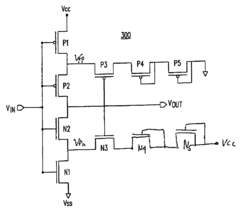
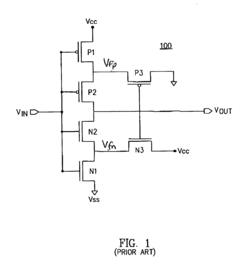
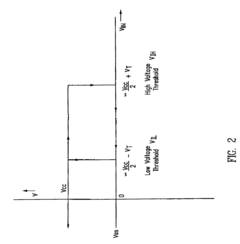
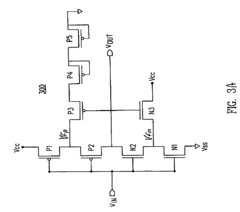
- The proposed Schmitt trigger circuit design includes additional transistors to extend the transition time interval by adjusting the threshold voltages of PMOS and NMOS transistors, allowing for a larger difference in reference voltages for high and low output signal changes, thereby stabilizing the circuit operation.


Self-adjusting Schmitt trigger
PatentInactiveUS7167032B1
Innovation
- Incorporating diodes in the feedback paths of the Schmitt trigger to adjust the on-current in response to changes in supply voltage, allowing the hysteresis to self-adjust and maintain a desired margin between voltage thresholds across varying power supply levels.
EMI/EMC Compliance and Standards for Circuit Design
Electromagnetic Interference (EMI) and Electromagnetic Compatibility (EMC) standards play a crucial role in ensuring circuit reliability, particularly when implementing Schmitt trigger designs. These standards establish the framework for designing circuits that can operate reliably in electromagnetically noisy environments while minimizing their own electromagnetic emissions. For Schmitt trigger circuits, which are specifically designed to enhance noise immunity, compliance with these standards becomes even more significant.
The primary EMI/EMC standards governing circuit design include IEC 61000 series, CISPR standards, FCC Part 15 regulations in the United States, and EN 55022/55032 in Europe. These standards define acceptable limits for both conducted and radiated emissions, as well as immunity requirements that circuits must meet. Schmitt trigger implementations must be tested against these standards to ensure they maintain their hysteresis characteristics and switching reliability under electromagnetic stress conditions.
When designing Schmitt trigger circuits for EMI/EMC compliance, several key considerations must be addressed. First, proper PCB layout techniques are essential, including ground plane optimization, trace routing to minimize loop areas, and strategic component placement. These practices help reduce the susceptibility of Schmitt trigger circuits to external electromagnetic interference while also minimizing their potential to generate emissions that could affect nearby components.
Signal integrity testing under EMI conditions represents another critical aspect of compliance. Schmitt triggers must maintain their defined threshold levels and hysteresis windows even when subjected to electromagnetic disturbances. Standards typically require testing under various electromagnetic conditions, including electrostatic discharge (ESD), fast transient bursts, and radiated RF fields, all of which could potentially compromise the reliable operation of threshold-based circuits.
The implementation of proper filtering and shielding techniques further enhances EMI/EMC compliance. Input and output filtering for Schmitt trigger circuits can significantly reduce susceptibility to noise while also limiting the propagation of internally generated noise. These measures often include decoupling capacitors, ferrite beads, and common-mode chokes strategically placed to maximize their effectiveness without compromising the circuit's intended functionality.
Recent advancements in EMI/EMC standards have placed increased emphasis on high-frequency performance, reflecting the growing prevalence of faster switching circuits. Modern Schmitt trigger designs must account for these evolving requirements, particularly when implemented in applications operating at higher frequencies where EMI issues become more pronounced. This has led to innovations in Schmitt trigger circuit topologies specifically optimized for improved EMI/EMC performance while maintaining their core hysteresis benefits.
The primary EMI/EMC standards governing circuit design include IEC 61000 series, CISPR standards, FCC Part 15 regulations in the United States, and EN 55022/55032 in Europe. These standards define acceptable limits for both conducted and radiated emissions, as well as immunity requirements that circuits must meet. Schmitt trigger implementations must be tested against these standards to ensure they maintain their hysteresis characteristics and switching reliability under electromagnetic stress conditions.
When designing Schmitt trigger circuits for EMI/EMC compliance, several key considerations must be addressed. First, proper PCB layout techniques are essential, including ground plane optimization, trace routing to minimize loop areas, and strategic component placement. These practices help reduce the susceptibility of Schmitt trigger circuits to external electromagnetic interference while also minimizing their potential to generate emissions that could affect nearby components.
Signal integrity testing under EMI conditions represents another critical aspect of compliance. Schmitt triggers must maintain their defined threshold levels and hysteresis windows even when subjected to electromagnetic disturbances. Standards typically require testing under various electromagnetic conditions, including electrostatic discharge (ESD), fast transient bursts, and radiated RF fields, all of which could potentially compromise the reliable operation of threshold-based circuits.
The implementation of proper filtering and shielding techniques further enhances EMI/EMC compliance. Input and output filtering for Schmitt trigger circuits can significantly reduce susceptibility to noise while also limiting the propagation of internally generated noise. These measures often include decoupling capacitors, ferrite beads, and common-mode chokes strategically placed to maximize their effectiveness without compromising the circuit's intended functionality.
Recent advancements in EMI/EMC standards have placed increased emphasis on high-frequency performance, reflecting the growing prevalence of faster switching circuits. Modern Schmitt trigger designs must account for these evolving requirements, particularly when implemented in applications operating at higher frequencies where EMI issues become more pronounced. This has led to innovations in Schmitt trigger circuit topologies specifically optimized for improved EMI/EMC performance while maintaining their core hysteresis benefits.
Power Efficiency Considerations in Schmitt Trigger Applications
Power efficiency has become a critical consideration in modern electronic systems, particularly in battery-powered and energy-constrained applications where Schmitt triggers are deployed. The inherent hysteresis characteristic of Schmitt triggers, while beneficial for noise immunity and circuit reliability, introduces additional power consumption challenges that must be carefully addressed in circuit design.
Traditional Schmitt trigger implementations often suffer from static power dissipation during state transitions. This occurs because both the pull-up and pull-down networks may be partially conducting simultaneously during switching, creating a direct current path between supply and ground. In applications requiring frequent switching operations, this transitional power consumption can accumulate significantly, reducing overall system efficiency.
Several approaches have emerged to mitigate power consumption in Schmitt trigger circuits. CMOS-based implementations have gained popularity due to their inherently lower static power consumption compared to bipolar junction transistor designs. However, even CMOS Schmitt triggers require optimization to minimize dynamic power dissipation during switching events.
Advanced design techniques include adaptive biasing schemes that adjust the trigger thresholds based on operating conditions, reducing unnecessary switching and associated power losses. Some implementations incorporate power gating mechanisms that disable portions of the circuit during idle periods, particularly valuable in systems with intermittent activity patterns.
The selection of appropriate hysteresis width presents another power efficiency trade-off. While wider hysteresis improves noise immunity, it may necessitate larger voltage swings during transitions, increasing dynamic power consumption. Designers must carefully balance these competing requirements based on application-specific noise environments and power budgets.
In low-voltage applications, specialized Schmitt trigger topologies have been developed that maintain reliable operation while consuming minimal power. These designs often employ sub-threshold operation techniques and current-starving methods to reduce power requirements without compromising switching performance.
Recent research has explored the use of emerging technologies such as tunnel FETs and negative capacitance FETs to implement ultra-low-power Schmitt triggers. These devices offer steeper subthreshold slopes than conventional MOSFETs, potentially enabling Schmitt trigger operation with significantly reduced voltage swings and corresponding power savings.
For battery-powered IoT devices and wearable electronics, power-optimized Schmitt trigger designs have demonstrated up to 70% reduction in energy consumption compared to conventional implementations, extending battery life while maintaining robust signal conditioning capabilities.
Traditional Schmitt trigger implementations often suffer from static power dissipation during state transitions. This occurs because both the pull-up and pull-down networks may be partially conducting simultaneously during switching, creating a direct current path between supply and ground. In applications requiring frequent switching operations, this transitional power consumption can accumulate significantly, reducing overall system efficiency.
Several approaches have emerged to mitigate power consumption in Schmitt trigger circuits. CMOS-based implementations have gained popularity due to their inherently lower static power consumption compared to bipolar junction transistor designs. However, even CMOS Schmitt triggers require optimization to minimize dynamic power dissipation during switching events.
Advanced design techniques include adaptive biasing schemes that adjust the trigger thresholds based on operating conditions, reducing unnecessary switching and associated power losses. Some implementations incorporate power gating mechanisms that disable portions of the circuit during idle periods, particularly valuable in systems with intermittent activity patterns.
The selection of appropriate hysteresis width presents another power efficiency trade-off. While wider hysteresis improves noise immunity, it may necessitate larger voltage swings during transitions, increasing dynamic power consumption. Designers must carefully balance these competing requirements based on application-specific noise environments and power budgets.
In low-voltage applications, specialized Schmitt trigger topologies have been developed that maintain reliable operation while consuming minimal power. These designs often employ sub-threshold operation techniques and current-starving methods to reduce power requirements without compromising switching performance.
Recent research has explored the use of emerging technologies such as tunnel FETs and negative capacitance FETs to implement ultra-low-power Schmitt triggers. These devices offer steeper subthreshold slopes than conventional MOSFETs, potentially enabling Schmitt trigger operation with significantly reduced voltage swings and corresponding power savings.
For battery-powered IoT devices and wearable electronics, power-optimized Schmitt trigger designs have demonstrated up to 70% reduction in energy consumption compared to conventional implementations, extending battery life while maintaining robust signal conditioning capabilities.
Unlock deeper insights with Patsnap Eureka Quick Research — get a full tech report to explore trends and direct your research. Try now!
Generate Your Research Report Instantly with AI Agent
Supercharge your innovation with Patsnap Eureka AI Agent Platform!