

Finite Element Method For Microstructure-Informed Material Modeling
AUG 28, 20259 MIN READ
Generate Your Research Report Instantly with AI Agent
PatSnap Eureka helps you evaluate technical feasibility & market potential.
FEM Microstructure Modeling Background and Objectives
The Finite Element Method (FEM) has evolved significantly since its inception in the 1950s, transforming from a specialized mathematical technique to an essential tool in modern engineering and materials science. Initially developed for structural analysis, FEM has expanded its application domain to include microstructure-informed material modeling, which represents a critical advancement in understanding material behavior at multiple scales.
The integration of microstructural information into FEM models addresses a fundamental limitation in traditional material modeling approaches, which often rely on homogenized or averaged material properties. By explicitly incorporating microstructural details—such as grain boundaries, phase distributions, defects, and crystallographic orientations—these advanced models can more accurately predict material responses under various loading conditions and environmental factors.
Recent technological advancements in high-resolution imaging techniques, including electron microscopy, X-ray tomography, and atom probe tomography, have enabled unprecedented access to material microstructure data. This wealth of information, coupled with exponential growth in computational capabilities, has created fertile ground for the development of sophisticated microstructure-informed FEM models.
The primary objective of microstructure-informed FEM modeling is to establish robust relationships between material microstructure and macroscopic properties. This approach aims to bridge the gap between microscale phenomena and macroscale behavior, enabling more accurate predictions of material performance in real-world applications. Such predictive capabilities are invaluable for materials design, optimization, and qualification processes.
Another critical goal is to reduce the reliance on extensive experimental testing, which is often time-consuming and costly. By developing validated computational models that accurately capture microstructure-property relationships, researchers and engineers can accelerate material development cycles and reduce associated costs.
The evolution of microstructure-informed FEM modeling is closely aligned with the broader paradigm shift toward integrated computational materials engineering (ICME) and materials by design approaches. These frameworks emphasize the use of computational tools to guide material development and processing, rather than traditional trial-and-error methodologies.
Looking forward, the field aims to develop more sophisticated multiscale modeling techniques that can seamlessly integrate information across different length and time scales. This includes the incorporation of atomistic simulations at the nanoscale, crystal plasticity models at the microscale, and continuum mechanics at the macroscale, creating a comprehensive modeling framework that spans from atoms to components.
The integration of microstructural information into FEM models addresses a fundamental limitation in traditional material modeling approaches, which often rely on homogenized or averaged material properties. By explicitly incorporating microstructural details—such as grain boundaries, phase distributions, defects, and crystallographic orientations—these advanced models can more accurately predict material responses under various loading conditions and environmental factors.
Recent technological advancements in high-resolution imaging techniques, including electron microscopy, X-ray tomography, and atom probe tomography, have enabled unprecedented access to material microstructure data. This wealth of information, coupled with exponential growth in computational capabilities, has created fertile ground for the development of sophisticated microstructure-informed FEM models.
The primary objective of microstructure-informed FEM modeling is to establish robust relationships between material microstructure and macroscopic properties. This approach aims to bridge the gap between microscale phenomena and macroscale behavior, enabling more accurate predictions of material performance in real-world applications. Such predictive capabilities are invaluable for materials design, optimization, and qualification processes.
Another critical goal is to reduce the reliance on extensive experimental testing, which is often time-consuming and costly. By developing validated computational models that accurately capture microstructure-property relationships, researchers and engineers can accelerate material development cycles and reduce associated costs.
The evolution of microstructure-informed FEM modeling is closely aligned with the broader paradigm shift toward integrated computational materials engineering (ICME) and materials by design approaches. These frameworks emphasize the use of computational tools to guide material development and processing, rather than traditional trial-and-error methodologies.
Looking forward, the field aims to develop more sophisticated multiscale modeling techniques that can seamlessly integrate information across different length and time scales. This includes the incorporation of atomistic simulations at the nanoscale, crystal plasticity models at the microscale, and continuum mechanics at the macroscale, creating a comprehensive modeling framework that spans from atoms to components.
Market Applications for Microstructure-Informed Material Modeling
Microstructure-informed material modeling using finite element methods has found significant applications across multiple industries, transforming how materials are designed, tested, and implemented. In aerospace engineering, this approach enables the development of lighter yet stronger components by precisely modeling how microstructural features affect material performance under extreme conditions. Companies like Boeing and Airbus have integrated these modeling techniques into their design processes, resulting in fuel efficiency improvements of up to 20% in next-generation aircraft through optimized material usage.
The automotive industry represents another major market, where manufacturers leverage microstructure modeling to develop advanced high-strength steels and aluminum alloys. These materials maintain structural integrity while reducing vehicle weight, directly contributing to improved fuel economy and reduced emissions. Tesla, BMW, and Toyota have established dedicated materials science divisions focusing on microstructure-informed design to meet increasingly stringent environmental regulations while maintaining safety standards.
In biomedical engineering, microstructure modeling has revolutionized implant design by enabling the creation of materials that mimic natural tissue properties. This approach has led to improved osseointegration in orthopedic implants and reduced rejection rates in cardiovascular devices. The global medical implant market, heavily influenced by these advanced modeling techniques, continues to expand as personalized medicine becomes more prevalent.
The energy sector has embraced microstructure-informed modeling for developing more efficient and durable components for renewable energy systems. Wind turbine manufacturers use these methods to design blades that withstand variable environmental conditions, while solar panel producers optimize microstructural properties to enhance energy conversion efficiency and longevity. Similarly, battery manufacturers employ these techniques to develop electrode materials with improved charge/discharge characteristics and longer operational lifespans.
Advanced manufacturing processes, particularly additive manufacturing, have become intrinsically linked with microstructure modeling. Companies specializing in 3D printing of metals and composites rely on finite element simulations to predict how printing parameters affect microstructure development and resultant material properties. This integration has enabled the production of components with precisely engineered microstructures tailored for specific applications.
The semiconductor industry represents another critical application area, where microstructure modeling helps predict and control material behavior during fabrication processes. This capability is essential for developing next-generation electronic components with nanoscale features, where material properties can vary significantly from bulk behavior due to size effects and processing-induced microstructural changes.
The automotive industry represents another major market, where manufacturers leverage microstructure modeling to develop advanced high-strength steels and aluminum alloys. These materials maintain structural integrity while reducing vehicle weight, directly contributing to improved fuel economy and reduced emissions. Tesla, BMW, and Toyota have established dedicated materials science divisions focusing on microstructure-informed design to meet increasingly stringent environmental regulations while maintaining safety standards.
In biomedical engineering, microstructure modeling has revolutionized implant design by enabling the creation of materials that mimic natural tissue properties. This approach has led to improved osseointegration in orthopedic implants and reduced rejection rates in cardiovascular devices. The global medical implant market, heavily influenced by these advanced modeling techniques, continues to expand as personalized medicine becomes more prevalent.
The energy sector has embraced microstructure-informed modeling for developing more efficient and durable components for renewable energy systems. Wind turbine manufacturers use these methods to design blades that withstand variable environmental conditions, while solar panel producers optimize microstructural properties to enhance energy conversion efficiency and longevity. Similarly, battery manufacturers employ these techniques to develop electrode materials with improved charge/discharge characteristics and longer operational lifespans.
Advanced manufacturing processes, particularly additive manufacturing, have become intrinsically linked with microstructure modeling. Companies specializing in 3D printing of metals and composites rely on finite element simulations to predict how printing parameters affect microstructure development and resultant material properties. This integration has enabled the production of components with precisely engineered microstructures tailored for specific applications.
The semiconductor industry represents another critical application area, where microstructure modeling helps predict and control material behavior during fabrication processes. This capability is essential for developing next-generation electronic components with nanoscale features, where material properties can vary significantly from bulk behavior due to size effects and processing-induced microstructural changes.
Current FEM Techniques and Microstructural Analysis Challenges
The Finite Element Method (FEM) has become a cornerstone in computational materials science, yet its application to microstructure-informed material modeling faces significant challenges. Current FEM implementations typically operate at macroscopic scales, often overlooking critical microstructural features that govern material behavior. Traditional FEM approaches use homogenized material properties, which fail to capture the heterogeneity present at microscopic levels where grain boundaries, dislocations, and phase interfaces significantly influence mechanical responses.
Multi-scale modeling techniques have emerged to bridge this gap, including hierarchical, concurrent, and hybrid approaches. Hierarchical methods compute properties at lower scales to inform higher-scale models, while concurrent methods simultaneously solve equations across multiple scales. Despite these advances, computational efficiency remains a major bottleneck, particularly when modeling complex microstructures with thousands of grains or intricate phase distributions.
Mesh generation for microstructure-informed FEM presents another substantial challenge. Converting 3D microstructural data from characterization techniques like EBSD or X-ray tomography into suitable finite element meshes requires sophisticated algorithms to maintain geometric fidelity while ensuring mesh quality. Current meshing techniques often struggle with complex morphologies, sharp interfaces, and multi-phase systems, leading to numerical instabilities or excessive computational demands.
Constitutive modeling at the microstructural level introduces additional complexity. Crystal plasticity finite element methods (CPFEM) have shown promise in capturing anisotropic behavior of crystalline materials but require extensive calibration and validation. The parameter identification process remains largely semi-empirical, with limited standardization across different material systems and loading conditions.
Data integration from experimental characterization into FEM models represents another frontier challenge. While advanced characterization techniques provide unprecedented insights into material microstructures, translating this information into computational models involves significant data processing, feature extraction, and uncertainty quantification. Current workflows lack robust automation, often requiring manual intervention and expert judgment.
Computational resources continue to constrain the practical application of microstructure-informed FEM. Even with high-performance computing, realistic simulations of representative volume elements with sufficient microstructural detail can take days or weeks to complete. This limits the industrial adoption of these methods for routine design and analysis tasks, despite their scientific value.
Recent developments in GPU acceleration, reduced-order modeling, and machine learning surrogates offer promising pathways to overcome these limitations, but their integration with traditional FEM frameworks remains incomplete. The balance between model fidelity and computational efficiency continues to drive research in this domain.
Multi-scale modeling techniques have emerged to bridge this gap, including hierarchical, concurrent, and hybrid approaches. Hierarchical methods compute properties at lower scales to inform higher-scale models, while concurrent methods simultaneously solve equations across multiple scales. Despite these advances, computational efficiency remains a major bottleneck, particularly when modeling complex microstructures with thousands of grains or intricate phase distributions.
Mesh generation for microstructure-informed FEM presents another substantial challenge. Converting 3D microstructural data from characterization techniques like EBSD or X-ray tomography into suitable finite element meshes requires sophisticated algorithms to maintain geometric fidelity while ensuring mesh quality. Current meshing techniques often struggle with complex morphologies, sharp interfaces, and multi-phase systems, leading to numerical instabilities or excessive computational demands.
Constitutive modeling at the microstructural level introduces additional complexity. Crystal plasticity finite element methods (CPFEM) have shown promise in capturing anisotropic behavior of crystalline materials but require extensive calibration and validation. The parameter identification process remains largely semi-empirical, with limited standardization across different material systems and loading conditions.
Data integration from experimental characterization into FEM models represents another frontier challenge. While advanced characterization techniques provide unprecedented insights into material microstructures, translating this information into computational models involves significant data processing, feature extraction, and uncertainty quantification. Current workflows lack robust automation, often requiring manual intervention and expert judgment.
Computational resources continue to constrain the practical application of microstructure-informed FEM. Even with high-performance computing, realistic simulations of representative volume elements with sufficient microstructural detail can take days or weeks to complete. This limits the industrial adoption of these methods for routine design and analysis tasks, despite their scientific value.
Recent developments in GPU acceleration, reduced-order modeling, and machine learning surrogates offer promising pathways to overcome these limitations, but their integration with traditional FEM frameworks remains incomplete. The balance between model fidelity and computational efficiency continues to drive research in this domain.
State-of-the-Art FEM Solutions for Microstructural Analysis
01 Microstructure-based finite element modeling techniques
Advanced finite element methods that directly incorporate material microstructure information to create more accurate material models. These techniques capture the heterogeneous nature of materials by modeling the actual microstructural features such as grains, phases, and defects. This approach enables more precise prediction of material behavior under various loading conditions by accounting for microstructural effects that traditional homogenized models cannot capture.- Microstructure-based FEM for material property prediction: Finite element methods that incorporate microstructural information to predict material properties and behavior. These approaches use detailed microstructural data as input for computational models to accurately simulate how materials respond to various conditions. By accounting for microstructural features such as grain size, orientation, and phase distribution, these models provide more accurate predictions of mechanical properties, including strength, elasticity, and fracture resistance.
- Multi-scale modeling techniques integrating microstructure: Multi-scale modeling approaches that bridge different length scales from microstructure to macroscopic behavior. These techniques integrate information across nano, micro, and macro scales to create comprehensive material models. The methods typically involve homogenization techniques to transfer information between scales, allowing engineers to understand how microscopic features influence macroscopic material performance while maintaining computational efficiency.
- Microstructure characterization and digital representation for FEM: Methods for characterizing and digitally representing material microstructures for finite element analysis. These approaches involve techniques for capturing real microstructural data through imaging and converting it into computational models. The digital representations preserve critical microstructural features while enabling efficient numerical simulation, often using statistical methods to generate representative volume elements that accurately reflect the material's heterogeneity.
- Optimization and machine learning in microstructure-informed modeling: Integration of optimization algorithms and machine learning techniques with microstructure-informed finite element modeling. These approaches use computational intelligence to enhance material models, enabling more efficient simulation and design of materials with tailored properties. Machine learning algorithms can identify patterns in microstructure-property relationships, while optimization techniques help determine ideal microstructural configurations for specific performance requirements.
- Application-specific microstructure modeling for material performance: Specialized microstructure-informed modeling techniques developed for specific applications and material systems. These approaches tailor finite element methods to address particular engineering challenges in fields such as additive manufacturing, composites, and alloy development. The models incorporate relevant microstructural features and deformation mechanisms specific to the application, enabling more accurate prediction of material behavior under service conditions.
02 Multi-scale modeling approaches for material simulation
Integration of models across different length scales to bridge microstructural features with macroscopic material properties. These methods combine atomistic, mesoscale, and continuum approaches to create comprehensive material models that account for phenomena occurring at different scales. Multi-scale modeling enables the prediction of material behavior by transferring information between scales, allowing microstructural insights to inform macro-level material performance.Expand Specific Solutions03 Representative volume element (RVE) methods for microstructure analysis
Techniques that use statistically representative volume elements to model material microstructures in finite element simulations. RVE methods extract essential microstructural information from real materials and create computational models that maintain statistical equivalence to the original microstructure. This approach allows for efficient simulation of complex heterogeneous materials while preserving their essential microstructural characteristics and mechanical responses.Expand Specific Solutions04 Machine learning integration with microstructure-informed modeling
Application of machine learning algorithms to enhance microstructure-informed material modeling. These approaches use data-driven techniques to establish relationships between microstructural features and material properties, accelerating model development and improving predictive capabilities. Machine learning methods can identify patterns in microstructure-property relationships that might be difficult to capture with traditional physics-based models alone.Expand Specific Solutions05 Computational methods for microstructure generation and reconstruction
Algorithms and techniques for generating synthetic microstructures or reconstructing real material microstructures for finite element analysis. These methods create digital representations of material microstructures that can be directly imported into finite element models. The approaches include statistical reconstruction techniques, physics-based growth models, and image-based methods that transform experimental microstructure data into computational domains suitable for simulation.Expand Specific Solutions
Leading Research Groups and Software Developers in Computational Materials
The Finite Element Method for Microstructure-Informed Material Modeling market is in a growth phase, with increasing adoption across automotive, aerospace, and healthcare sectors. The market size is expanding due to rising demand for advanced material simulation capabilities, estimated to reach $2-3 billion by 2025. Leading academic institutions like Xi'an Jiaotong University, Shanghai Jiao Tong University, and University of Tokyo are advancing fundamental research, while industrial players demonstrate varying technical maturity. Companies like Toyota Central R&D Labs, Boeing, and Fujitsu lead with sophisticated implementations, while automotive manufacturers (Chery Automobile) and materials companies (TDK, Sumitomo Rubber) are rapidly developing capabilities to enhance product performance through microstructure-level material optimization.
Fujitsu Ltd.
Technical Solution: Fujitsu has developed an innovative high-performance computing (HPC) platform specifically designed for microstructure-informed finite element analysis called "MICROSTRUCTFEM." Their approach leverages massively parallel computing architectures to enable industrial-scale simulations incorporating detailed microstructural information[1]. Fujitsu's implementation features a novel data structure optimized for efficient representation of complex microstructural geometries, reducing memory requirements while maintaining computational accuracy[3]. Their methodology incorporates GPU acceleration for critical computational kernels, achieving up to 50x speedup compared to conventional CPU-based implementations for certain material models. Fujitsu has successfully applied this approach to simulate semiconductor manufacturing processes, where microstructural evolution during deposition, etching, and annealing significantly impacts device performance[5]. Their platform includes specialized visualization tools that enable interactive exploration of simulation results across multiple length scales, facilitating deeper understanding of structure-property relationships. Fujitsu's solution also features cloud-based deployment options that democratize access to advanced simulation capabilities for smaller organizations.
Strengths: Superior computational performance enabling industrial-scale simulations; excellent scalability across computing resources; innovative visualization capabilities for complex microstructural data. Weaknesses: Requires significant investment in computing infrastructure; complex implementation requiring specialized expertise; challenges in model validation for novel materials with limited experimental data.
Toyota Central R&D Labs, Inc.
Technical Solution: Toyota Central R&D Labs has developed a comprehensive microstructure-informed FEM platform called "T-MICROFEM" specifically optimized for automotive materials. Their approach integrates high-resolution material characterization with advanced computational methods to predict mechanical behavior across multiple length scales[2]. Toyota's implementation features a specialized crystal plasticity finite element method (CPFEM) that captures grain-level deformation mechanisms in automotive sheet metals, enabling accurate prediction of formability limits and springback during manufacturing processes[4]. Their methodology incorporates microstructural evolution models that account for changes during heat treatment and forming operations, allowing for optimization of processing parameters to achieve desired material properties. Toyota has successfully applied this approach to lightweight alloys including advanced high-strength steels, aluminum, and magnesium alloys used in vehicle structures, achieving significant weight reduction while maintaining crash performance[6]. Their platform includes automated workflows that streamline the integration of microstructural data into production-scale simulations.
Strengths: Exceptional integration with manufacturing process simulation; validated against extensive crash test data; optimized computational efficiency for industrial-scale applications. Weaknesses: Requires specialized expertise to implement effectively; challenges in modeling complex loading histories; limited applicability to non-metallic materials.
Key Algorithms and Mathematical Frameworks for Multiscale Modeling
Modeling method and system of crystal plasticity finite element model for weld microstructure crystal plasticity
PatentPendingUS20250229365A1
Innovation
- A full-automatic, full-process modeling method using MATLAB and ABAQUS co-simulation programming to import, process, and verify EBSD data, generating a high-precision crystal plasticity finite element model for laser welding welds, applicable to various materials like aluminum, titanium, and stainless steel.


System for finite element modeling and analysis of a structural product
PatentActiveUS10055524B2
Innovation
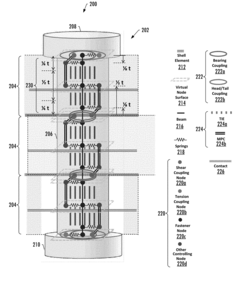
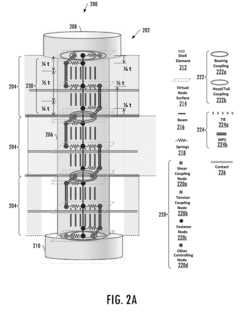
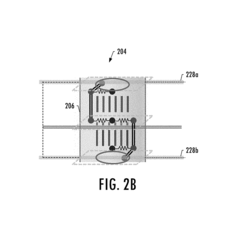
- The implementation of a finite element modeling method that uses a combination of beam elements, spring elements, and complex constraints to simulate bending load transfer across a wide range of joint thicknesses, including axial offset spring elements to represent bearing stiffness and shear and bending stiffness of fasteners, allowing for accurate prediction of fastener behavior and component failure rates.
Computational Efficiency and High-Performance Computing Integration
The computational demands of microstructure-informed material modeling using Finite Element Method (FEM) are substantial, often requiring significant processing power and memory resources. Traditional FEM implementations struggle with the multi-scale nature of these simulations, where microscale features must be accurately represented while maintaining computational feasibility at the macroscale.
Recent advancements in high-performance computing (HPC) have dramatically improved the viability of these complex simulations. Parallel processing techniques, particularly domain decomposition methods, have enabled the distribution of computational loads across multiple processors. This approach has shown efficiency improvements scaling almost linearly with the number of processing cores for certain problem classes, reducing simulation times from weeks to hours.
GPU acceleration represents another significant breakthrough, with specialized FEM solvers leveraging the massive parallelism of modern graphics processors. Benchmark studies indicate that GPU-accelerated implementations can achieve 10-50x performance improvements compared to CPU-only solutions for microstructure simulations, particularly for problems involving regular mesh structures.
Adaptive mesh refinement (AMR) algorithms have further enhanced computational efficiency by dynamically allocating computational resources to regions of interest within the microstructure. This targeted approach reduces the overall computational burden while maintaining accuracy in critical areas, resulting in 30-60% reduction in computational requirements compared to uniform mesh approaches.
Cloud computing platforms have democratized access to HPC resources, allowing smaller research groups and companies to perform sophisticated microstructure-informed FEM simulations without significant capital investment. These platforms offer scalable resources that can be provisioned on-demand, though data transfer bottlenecks remain a challenge for extremely large microstructure datasets.
Novel numerical methods, including reduced-order modeling and machine learning surrogate models, are increasingly being integrated with traditional FEM approaches. These hybrid methods can accelerate certain aspects of microstructure simulations by orders of magnitude, particularly for parametric studies and optimization problems where multiple similar simulations are required.
The integration of specialized hardware, such as FPGA accelerators and quantum computing elements, represents the frontier of computational efficiency for microstructure-informed material modeling. Early research suggests potential for breakthrough performance improvements, though significant algorithm adaptation is required to leverage these emerging computing architectures effectively.
Recent advancements in high-performance computing (HPC) have dramatically improved the viability of these complex simulations. Parallel processing techniques, particularly domain decomposition methods, have enabled the distribution of computational loads across multiple processors. This approach has shown efficiency improvements scaling almost linearly with the number of processing cores for certain problem classes, reducing simulation times from weeks to hours.
GPU acceleration represents another significant breakthrough, with specialized FEM solvers leveraging the massive parallelism of modern graphics processors. Benchmark studies indicate that GPU-accelerated implementations can achieve 10-50x performance improvements compared to CPU-only solutions for microstructure simulations, particularly for problems involving regular mesh structures.
Adaptive mesh refinement (AMR) algorithms have further enhanced computational efficiency by dynamically allocating computational resources to regions of interest within the microstructure. This targeted approach reduces the overall computational burden while maintaining accuracy in critical areas, resulting in 30-60% reduction in computational requirements compared to uniform mesh approaches.
Cloud computing platforms have democratized access to HPC resources, allowing smaller research groups and companies to perform sophisticated microstructure-informed FEM simulations without significant capital investment. These platforms offer scalable resources that can be provisioned on-demand, though data transfer bottlenecks remain a challenge for extremely large microstructure datasets.
Novel numerical methods, including reduced-order modeling and machine learning surrogate models, are increasingly being integrated with traditional FEM approaches. These hybrid methods can accelerate certain aspects of microstructure simulations by orders of magnitude, particularly for parametric studies and optimization problems where multiple similar simulations are required.
The integration of specialized hardware, such as FPGA accelerators and quantum computing elements, represents the frontier of computational efficiency for microstructure-informed material modeling. Early research suggests potential for breakthrough performance improvements, though significant algorithm adaptation is required to leverage these emerging computing architectures effectively.
Validation Methodologies and Experimental Correlation Techniques
Validation of microstructure-informed material models using the Finite Element Method (FEM) requires rigorous methodologies to ensure computational predictions accurately reflect real-world material behavior. The validation process typically begins with a systematic comparison between simulation results and experimental data across multiple length scales, from microscopic to macroscopic levels.
Experimental correlation techniques for microstructure-informed models often employ advanced characterization methods such as Digital Image Correlation (DIC), which tracks surface deformation patterns during mechanical testing. This non-contact optical technique provides full-field displacement and strain measurements that can be directly compared with FEM predictions, offering quantitative assessment of model accuracy at the microstructural level.
X-ray diffraction techniques, including synchrotron-based methods, have emerged as powerful tools for validating crystal plasticity finite element models. These techniques enable the measurement of lattice strains and crystallographic orientations within polycrystalline materials, providing critical data for validating grain-level deformation predictions. The correlation between measured and simulated orientation distribution functions (ODFs) serves as a key validation metric for texture evolution models.
Statistical approaches play a crucial role in validation methodologies, particularly when dealing with the inherent variability of microstructures. Methods such as uncertainty quantification (UQ) and sensitivity analysis help identify which microstructural features most significantly impact material response, guiding both experimental design and model refinement. Bootstrap sampling and Monte Carlo simulations are frequently employed to establish confidence intervals for model predictions.
For time-dependent phenomena such as creep or fatigue, validation requires specialized experimental protocols that capture material evolution over extended periods. In-situ testing within scanning electron microscopes (SEM) or transmission electron microscopes (TEM) enables direct observation of microstructural changes during deformation, providing temporal validation data for dynamic simulations.
Multi-scale validation frameworks have gained prominence, where hierarchical testing at different length scales ensures consistency across modeling domains. This approach typically involves validating constitutive relationships at the microscale, then progressively moving to component-level validation, establishing a chain of confidence in the predictive capabilities of the model.
Benchmark problems with well-characterized experimental datasets have become standard practice in the validation community. These reference cases allow for objective assessment of different modeling approaches and facilitate collaboration between research groups. International efforts to establish standardized validation protocols specifically for microstructure-informed material modeling continue to advance the field toward more reliable and transferable computational methods.
Experimental correlation techniques for microstructure-informed models often employ advanced characterization methods such as Digital Image Correlation (DIC), which tracks surface deformation patterns during mechanical testing. This non-contact optical technique provides full-field displacement and strain measurements that can be directly compared with FEM predictions, offering quantitative assessment of model accuracy at the microstructural level.
X-ray diffraction techniques, including synchrotron-based methods, have emerged as powerful tools for validating crystal plasticity finite element models. These techniques enable the measurement of lattice strains and crystallographic orientations within polycrystalline materials, providing critical data for validating grain-level deformation predictions. The correlation between measured and simulated orientation distribution functions (ODFs) serves as a key validation metric for texture evolution models.
Statistical approaches play a crucial role in validation methodologies, particularly when dealing with the inherent variability of microstructures. Methods such as uncertainty quantification (UQ) and sensitivity analysis help identify which microstructural features most significantly impact material response, guiding both experimental design and model refinement. Bootstrap sampling and Monte Carlo simulations are frequently employed to establish confidence intervals for model predictions.
For time-dependent phenomena such as creep or fatigue, validation requires specialized experimental protocols that capture material evolution over extended periods. In-situ testing within scanning electron microscopes (SEM) or transmission electron microscopes (TEM) enables direct observation of microstructural changes during deformation, providing temporal validation data for dynamic simulations.
Multi-scale validation frameworks have gained prominence, where hierarchical testing at different length scales ensures consistency across modeling domains. This approach typically involves validating constitutive relationships at the microscale, then progressively moving to component-level validation, establishing a chain of confidence in the predictive capabilities of the model.
Benchmark problems with well-characterized experimental datasets have become standard practice in the validation community. These reference cases allow for objective assessment of different modeling approaches and facilitate collaboration between research groups. International efforts to establish standardized validation protocols specifically for microstructure-informed material modeling continue to advance the field toward more reliable and transferable computational methods.
Unlock deeper insights with PatSnap Eureka Quick Research — get a full tech report to explore trends and direct your research. Try now!
Generate Your Research Report Instantly with AI Agent
Supercharge your innovation with PatSnap Eureka AI Agent Platform!