Future-proofing AMOLED for long-term tech investments.
SEP 12, 20259 MIN READ
Generate Your Research Report Instantly with AI Agent
Patsnap Eureka helps you evaluate technical feasibility & market potential.
AMOLED Evolution and Objectives
AMOLED (Active-Matrix Organic Light-Emitting Diode) technology has revolutionized the display industry since its inception in the late 1990s. This advanced display technology offers superior image quality, energy efficiency, and design flexibility compared to traditional LCD displays. The evolution of AMOLED has been marked by continuous improvements in performance, durability, and manufacturing processes.
The primary objective of AMOLED technology development is to achieve higher display quality while reducing power consumption and production costs. This involves enhancing color accuracy, brightness, contrast ratio, and viewing angles. Additionally, researchers and manufacturers aim to improve the lifespan of AMOLED displays, addressing issues such as burn-in and color degradation over time.
Another crucial goal is to expand the application scope of AMOLED technology beyond smartphones and televisions. This includes developing flexible and foldable displays, as well as integrating AMOLED into automotive, wearable, and augmented reality devices. The pursuit of these objectives drives innovation in materials science, manufacturing techniques, and display architectures.
The AMOLED industry is also focused on overcoming technical challenges related to scalability and yield rates in production. As demand for larger AMOLED displays grows, manufacturers are investing in new fabrication methods and equipment to increase production efficiency and reduce costs. This is essential for maintaining AMOLED's competitiveness against emerging display technologies.
Future-proofing AMOLED for long-term tech investments requires a multifaceted approach. This includes developing more stable organic materials to extend display lifespan, improving thin-film transistor (TFT) backplane technologies for better performance, and exploring novel pixel structures for enhanced efficiency. Additionally, research into quantum dot AMOLED (QD-AMOLED) technology promises to combine the benefits of quantum dots with OLED's self-emissive properties, potentially leading to displays with wider color gamut and higher brightness.
The ongoing trend towards sustainability in technology also influences AMOLED development. Efforts are being made to reduce the environmental impact of AMOLED production, including the use of eco-friendly materials and the development of recycling processes for end-of-life displays. This aligns with global initiatives for greener electronics and circular economy principles.
As AMOLED technology continues to evolve, it faces competition from emerging display technologies such as microLED and electroluminescent quantum dot displays. To maintain its market position and ensure long-term viability, the AMOLED industry must focus on continuous innovation, cost reduction, and expansion into new application areas. This strategic approach will be crucial for securing AMOLED's place in the future of display technology and justifying long-term investments in this field.
The primary objective of AMOLED technology development is to achieve higher display quality while reducing power consumption and production costs. This involves enhancing color accuracy, brightness, contrast ratio, and viewing angles. Additionally, researchers and manufacturers aim to improve the lifespan of AMOLED displays, addressing issues such as burn-in and color degradation over time.
Another crucial goal is to expand the application scope of AMOLED technology beyond smartphones and televisions. This includes developing flexible and foldable displays, as well as integrating AMOLED into automotive, wearable, and augmented reality devices. The pursuit of these objectives drives innovation in materials science, manufacturing techniques, and display architectures.
The AMOLED industry is also focused on overcoming technical challenges related to scalability and yield rates in production. As demand for larger AMOLED displays grows, manufacturers are investing in new fabrication methods and equipment to increase production efficiency and reduce costs. This is essential for maintaining AMOLED's competitiveness against emerging display technologies.
Future-proofing AMOLED for long-term tech investments requires a multifaceted approach. This includes developing more stable organic materials to extend display lifespan, improving thin-film transistor (TFT) backplane technologies for better performance, and exploring novel pixel structures for enhanced efficiency. Additionally, research into quantum dot AMOLED (QD-AMOLED) technology promises to combine the benefits of quantum dots with OLED's self-emissive properties, potentially leading to displays with wider color gamut and higher brightness.
The ongoing trend towards sustainability in technology also influences AMOLED development. Efforts are being made to reduce the environmental impact of AMOLED production, including the use of eco-friendly materials and the development of recycling processes for end-of-life displays. This aligns with global initiatives for greener electronics and circular economy principles.
As AMOLED technology continues to evolve, it faces competition from emerging display technologies such as microLED and electroluminescent quantum dot displays. To maintain its market position and ensure long-term viability, the AMOLED industry must focus on continuous innovation, cost reduction, and expansion into new application areas. This strategic approach will be crucial for securing AMOLED's place in the future of display technology and justifying long-term investments in this field.
AMOLED Market Dynamics
The AMOLED (Active-Matrix Organic Light-Emitting Diode) market has experienced significant growth in recent years, driven by increasing demand for high-quality displays in smartphones, televisions, and other electronic devices. This technology offers superior image quality, energy efficiency, and design flexibility compared to traditional LCD displays, making it a preferred choice for many manufacturers and consumers.
The global AMOLED market has been expanding rapidly, with major players like Samsung Display, LG Display, and BOE Technology Group leading the charge. These companies have invested heavily in research and development, as well as production capacity, to meet the growing demand for AMOLED panels. The market has seen a shift towards larger display sizes and higher resolutions, particularly in the smartphone and television segments.
In the smartphone industry, AMOLED displays have become a standard feature in premium devices, with an increasing number of mid-range phones also adopting this technology. The trend towards bezel-less designs and foldable smartphones has further boosted the demand for flexible AMOLED panels, creating new opportunities for manufacturers and driving innovation in the field.
The television market has also witnessed a growing adoption of AMOLED technology, particularly in the high-end segment. OLED TVs, which use AMOLED panels, have gained popularity due to their superior picture quality, deep blacks, and wide viewing angles. As production costs decrease and manufacturing processes improve, AMOLED TVs are expected to penetrate more price-sensitive market segments.
Emerging applications in automotive displays, wearable devices, and augmented reality (AR) / virtual reality (VR) headsets are creating new growth avenues for the AMOLED market. These sectors require high-performance displays with low power consumption and flexible form factors, making AMOLED an ideal choice.
However, the AMOLED market faces challenges such as high production costs, limited supply chain diversity, and competition from alternative technologies like mini-LED and micro-LED displays. Manufacturers are working to address these issues through technological advancements and increased production capacity.
The future of the AMOLED market looks promising, with continued growth expected in various consumer electronics segments. As the technology matures and becomes more cost-effective, it is likely to expand into new applications and markets, further solidifying its position as a key display technology for the coming years.
The global AMOLED market has been expanding rapidly, with major players like Samsung Display, LG Display, and BOE Technology Group leading the charge. These companies have invested heavily in research and development, as well as production capacity, to meet the growing demand for AMOLED panels. The market has seen a shift towards larger display sizes and higher resolutions, particularly in the smartphone and television segments.
In the smartphone industry, AMOLED displays have become a standard feature in premium devices, with an increasing number of mid-range phones also adopting this technology. The trend towards bezel-less designs and foldable smartphones has further boosted the demand for flexible AMOLED panels, creating new opportunities for manufacturers and driving innovation in the field.
The television market has also witnessed a growing adoption of AMOLED technology, particularly in the high-end segment. OLED TVs, which use AMOLED panels, have gained popularity due to their superior picture quality, deep blacks, and wide viewing angles. As production costs decrease and manufacturing processes improve, AMOLED TVs are expected to penetrate more price-sensitive market segments.
Emerging applications in automotive displays, wearable devices, and augmented reality (AR) / virtual reality (VR) headsets are creating new growth avenues for the AMOLED market. These sectors require high-performance displays with low power consumption and flexible form factors, making AMOLED an ideal choice.
However, the AMOLED market faces challenges such as high production costs, limited supply chain diversity, and competition from alternative technologies like mini-LED and micro-LED displays. Manufacturers are working to address these issues through technological advancements and increased production capacity.
The future of the AMOLED market looks promising, with continued growth expected in various consumer electronics segments. As the technology matures and becomes more cost-effective, it is likely to expand into new applications and markets, further solidifying its position as a key display technology for the coming years.
AMOLED Tech Challenges
AMOLED technology, while revolutionary in display technology, faces several significant challenges that need to be addressed for long-term viability and investment. One of the primary concerns is the issue of burn-in, where static images can cause permanent damage to the screen over time. This occurs due to the organic compounds in OLED pixels degrading at different rates, leading to uneven wear and potential image retention.
Another major challenge is the limited lifespan of AMOLED displays compared to some other technologies. The organic materials used in these displays are susceptible to degradation over time, which can result in decreased brightness and color accuracy. This degradation is particularly pronounced in blue subpixels, which tend to have a shorter lifespan than red and green subpixels, potentially leading to color imbalance as the display ages.
Power consumption remains a concern, especially for mobile devices. While AMOLED displays can be more energy-efficient than LCD screens when displaying dark content, they can consume significantly more power when displaying bright or white content. This variability in power consumption poses challenges for device manufacturers in optimizing battery life across different usage scenarios.
Manufacturing complexity and costs present another hurdle for AMOLED technology. The production process for AMOLED displays is more intricate than that of LCD screens, involving the precise deposition of organic materials. This complexity contributes to higher production costs and potential yield issues, which can impact the overall affordability and widespread adoption of AMOLED devices.
Durability and longevity are ongoing concerns, particularly in relation to environmental factors. AMOLED displays are sensitive to moisture and oxygen, which can degrade the organic materials and shorten the display's lifespan. This necessitates advanced encapsulation techniques to protect the sensitive components, adding to the manufacturing complexity and cost.
Color accuracy and consistency across different viewing angles represent another technical challenge. While AMOLED displays generally offer excellent color reproduction, maintaining consistent color representation across various viewing angles and under different lighting conditions remains an area for improvement.
Lastly, the scalability of AMOLED technology for larger displays, such as televisions and monitors, presents unique challenges. As the display size increases, issues related to uniformity, power consumption, and manufacturing complexity become more pronounced, requiring innovative solutions to maintain quality and cost-effectiveness at larger scales.
Another major challenge is the limited lifespan of AMOLED displays compared to some other technologies. The organic materials used in these displays are susceptible to degradation over time, which can result in decreased brightness and color accuracy. This degradation is particularly pronounced in blue subpixels, which tend to have a shorter lifespan than red and green subpixels, potentially leading to color imbalance as the display ages.
Power consumption remains a concern, especially for mobile devices. While AMOLED displays can be more energy-efficient than LCD screens when displaying dark content, they can consume significantly more power when displaying bright or white content. This variability in power consumption poses challenges for device manufacturers in optimizing battery life across different usage scenarios.
Manufacturing complexity and costs present another hurdle for AMOLED technology. The production process for AMOLED displays is more intricate than that of LCD screens, involving the precise deposition of organic materials. This complexity contributes to higher production costs and potential yield issues, which can impact the overall affordability and widespread adoption of AMOLED devices.
Durability and longevity are ongoing concerns, particularly in relation to environmental factors. AMOLED displays are sensitive to moisture and oxygen, which can degrade the organic materials and shorten the display's lifespan. This necessitates advanced encapsulation techniques to protect the sensitive components, adding to the manufacturing complexity and cost.
Color accuracy and consistency across different viewing angles represent another technical challenge. While AMOLED displays generally offer excellent color reproduction, maintaining consistent color representation across various viewing angles and under different lighting conditions remains an area for improvement.
Lastly, the scalability of AMOLED technology for larger displays, such as televisions and monitors, presents unique challenges. As the display size increases, issues related to uniformity, power consumption, and manufacturing complexity become more pronounced, requiring innovative solutions to maintain quality and cost-effectiveness at larger scales.
Current AMOLED Solutions
01 Advanced AMOLED display technologies
Future-proofing AMOLED displays involves developing advanced technologies such as improved pixel structures, enhanced color gamut, and higher refresh rates. These advancements aim to provide better image quality, energy efficiency, and overall performance for next-generation displays.- Advanced OLED pixel structures: Future-proofing AMOLED displays involves developing advanced pixel structures to improve efficiency, longevity, and image quality. This includes innovations in sub-pixel arrangements, pixel circuits, and materials to enhance color accuracy, brightness, and power consumption. These advancements aim to address current limitations and prepare for future display requirements.
- Compensation techniques for display aging: To ensure long-term performance and image quality, AMOLED displays implement various compensation techniques to address issues related to pixel aging and degradation. These methods include real-time monitoring of pixel characteristics, adaptive brightness control, and voltage/current compensation algorithms to maintain consistent display performance over time.
- Integration of advanced sensing technologies: Future-proofing AMOLED displays involves incorporating advanced sensing technologies directly into the display panel. This includes integrating touch sensors, fingerprint scanners, and other biometric sensors within the display structure. These innovations aim to enhance user interaction, security features, and overall device functionality without compromising display quality.
- Flexible and foldable AMOLED technologies: Developing flexible and foldable AMOLED displays is a key aspect of future-proofing the technology. This involves creating new materials, manufacturing processes, and structural designs that allow displays to bend, fold, or roll while maintaining performance and durability. These advancements enable new form factors and applications for AMOLED displays.
- Energy efficiency and power management: Improving energy efficiency and power management is crucial for future-proofing AMOLED displays. This includes developing low-power driving schemes, optimizing pixel circuits, and implementing intelligent power management algorithms. These innovations aim to extend battery life in mobile devices and reduce overall power consumption in various applications.
02 AMOLED panel durability and lifespan
Enhancing the durability and lifespan of AMOLED panels is crucial for future-proofing. This includes developing new materials and manufacturing processes to prevent issues like burn-in, color degradation, and pixel aging, ensuring long-term reliability and consistent performance.Expand Specific Solutions03 Integration of advanced features in AMOLED displays
Future-proofing AMOLED technology involves integrating advanced features such as in-display fingerprint sensors, under-display cameras, and foldable or rollable display capabilities. These innovations aim to expand the functionality and versatility of AMOLED displays in various applications.Expand Specific Solutions04 Energy efficiency and power management
Improving energy efficiency and power management in AMOLED displays is essential for future-proofing. This includes developing new driving schemes, optimizing pixel circuits, and implementing intelligent power-saving technologies to extend battery life in mobile devices and reduce overall power consumption.Expand Specific Solutions05 AMOLED manufacturing and scalability
Future-proofing AMOLED technology requires advancements in manufacturing processes and scalability. This involves developing new production techniques, improving yield rates, and reducing costs to make AMOLED displays more accessible and competitive in various market segments.Expand Specific Solutions
AMOLED Industry Leaders
The future-proofing of AMOLED technology for long-term investments is characterized by a competitive landscape in a maturing industry with significant growth potential. The market is experiencing rapid expansion, driven by increasing demand for high-quality displays in smartphones, TVs, and emerging applications. Key players like BOE Technology, TCL China Star Optoelectronics, and Samsung Electronics are investing heavily in R&D to enhance AMOLED performance and production efficiency. The technology's maturity is advancing, with companies like Everdisplay Optronics and Visionox focusing on innovative solutions to address challenges such as image retention and longevity. As the industry progresses, collaborations between display manufacturers and electronics giants are becoming crucial for driving technological advancements and securing market share.
BOE Technology Group Co., Ltd.
Technical Solution: BOE has developed advanced AMOLED technologies to future-proof displays. Their flexible AMOLED panels utilize low-temperature polycrystalline oxide (LTPO) backplanes, enabling variable refresh rates from 1-120Hz for improved power efficiency[1]. BOE has also implemented advanced compensation algorithms to mitigate OLED burn-in and extend panel lifespan[2]. Their latest 8K AMOLED displays feature AI-powered image processing to enhance picture quality and reduce power consumption by up to 30%[3]. BOE is investing heavily in inkjet-printed OLED manufacturing, which could significantly reduce production costs and enable larger screen sizes in the future[4].
Strengths: Large-scale production capacity, diverse product portfolio, strong R&D capabilities. Weaknesses: Relatively new to high-end AMOLED market, facing competition from established Korean manufacturers.
Huawei Technologies Co., Ltd.
Technical Solution: Huawei is investing in AMOLED technology to future-proof its devices and potentially enter the display market. They have developed a proprietary "Quad-curve OLED" display that extends the screen to all four edges of the device, maximizing screen-to-body ratio and enhancing user experience[13]. Huawei's research includes advanced touch integration techniques, such as in-display fingerprint sensors and under-screen cameras, which could become standard features in future AMOLED devices[14]. To address power consumption, Huawei has implemented AI-driven display management systems that dynamically adjust brightness and color temperature based on ambient conditions and user behavior, potentially extending battery life by up to 20%[15]. The company is also exploring the use of graphene-based materials in AMOLED displays to improve conductivity and reduce thickness[16].
Strengths: Strong integration capabilities, innovative device designs, significant R&D investments. Weaknesses: Limited experience in display manufacturing, potential supply chain challenges due to geopolitical factors.
AMOLED Core Innovations
Display panel and manufacturing method thereof
PatentActiveUS20220344613A1
Innovation
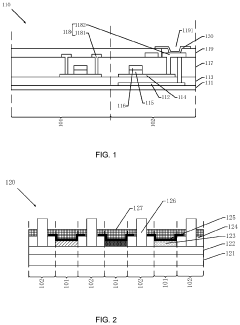
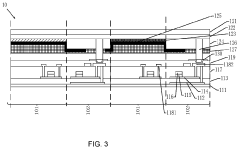
- A display panel design featuring a light-emitting region and a non-light-emitting region with a retaining wall structure containing through-holes and retaining walls, where the light-emitting layer is positioned within the through-holes, and a packaging layer covers the structure, along with a second electrode extending from the light-emitting region to the non-light-emitting region, ensuring proper electrical connections and preventing short-circuiting.
Active Matrix Displays
PatentInactiveUS20110181630A1
Innovation
- The integration of negative capacitance circuits on the glass panel or in chiplets, which compensate for programming line capacitance by delivering charge equal to the stored capacitance, reducing effective resistance and improving performance, and the use of a reference capacitor to accurately track and compensate for display capacitance, allowing for more adaptable and accurate charge compensation.


AMOLED Supply Chain Analysis
The AMOLED supply chain is a complex network of manufacturers, suppliers, and technology providers that work together to produce advanced display panels. At the core of this chain are the panel manufacturers, such as Samsung Display, LG Display, and BOE, who are responsible for the final assembly of AMOLED screens. These companies rely on a diverse array of suppliers for key components and materials.
One critical element in the AMOLED supply chain is the organic materials used to create the light-emitting layers. Companies like Universal Display Corporation (UDC) and Idemitsu Kosan are major players in this segment, providing patented phosphorescent OLED materials that are essential for efficient and long-lasting displays. The development and production of these materials require significant research and development investments, making this a high-value segment of the supply chain.
Another crucial component is the thin-film transistor (TFT) backplane, which controls individual pixels. Manufacturers like Applied Materials and Tokyo Electron supply the equipment used to produce these backplanes, while companies such as Merck and JNC Corporation provide the liquid crystal materials used in some AMOLED designs.
The supply of glass substrates, a fundamental component of AMOLED panels, is dominated by a few key players such as Corning, AGC, and NEG. These companies continually innovate to produce thinner, more durable glass that can withstand the high-temperature processes involved in AMOLED production.
Touch sensors, which are often integrated into AMOLED displays, form another important part of the supply chain. Companies like TPK Holding and O-Film provide touch sensor solutions, while others like Synaptics specialize in touch controller ICs.
The AMOLED supply chain also includes providers of specialized manufacturing equipment. Companies such as Canon Tokki and SFA Engineering supply critical deposition equipment used in the OLED manufacturing process, while others like Coherent and Han's Laser provide laser cutting and patterning systems.
As the demand for AMOLED displays continues to grow, particularly in the smartphone and television markets, the supply chain is evolving to meet new challenges. Manufacturers are investing in expanding production capacity, while also exploring new technologies like inkjet printing for OLED production. This ongoing development and diversification of the supply chain are crucial for future-proofing AMOLED technology and ensuring its long-term viability as a key component in consumer electronics.
One critical element in the AMOLED supply chain is the organic materials used to create the light-emitting layers. Companies like Universal Display Corporation (UDC) and Idemitsu Kosan are major players in this segment, providing patented phosphorescent OLED materials that are essential for efficient and long-lasting displays. The development and production of these materials require significant research and development investments, making this a high-value segment of the supply chain.
Another crucial component is the thin-film transistor (TFT) backplane, which controls individual pixels. Manufacturers like Applied Materials and Tokyo Electron supply the equipment used to produce these backplanes, while companies such as Merck and JNC Corporation provide the liquid crystal materials used in some AMOLED designs.
The supply of glass substrates, a fundamental component of AMOLED panels, is dominated by a few key players such as Corning, AGC, and NEG. These companies continually innovate to produce thinner, more durable glass that can withstand the high-temperature processes involved in AMOLED production.
Touch sensors, which are often integrated into AMOLED displays, form another important part of the supply chain. Companies like TPK Holding and O-Film provide touch sensor solutions, while others like Synaptics specialize in touch controller ICs.
The AMOLED supply chain also includes providers of specialized manufacturing equipment. Companies such as Canon Tokki and SFA Engineering supply critical deposition equipment used in the OLED manufacturing process, while others like Coherent and Han's Laser provide laser cutting and patterning systems.
As the demand for AMOLED displays continues to grow, particularly in the smartphone and television markets, the supply chain is evolving to meet new challenges. Manufacturers are investing in expanding production capacity, while also exploring new technologies like inkjet printing for OLED production. This ongoing development and diversification of the supply chain are crucial for future-proofing AMOLED technology and ensuring its long-term viability as a key component in consumer electronics.
AMOLED Sustainability Factors
AMOLED technology has become a cornerstone in display manufacturing, but its long-term sustainability is a critical factor for tech investments. Several key elements contribute to the sustainability of AMOLED displays, ensuring their relevance and viability in the coming years.
Material efficiency is a primary concern for AMOLED sustainability. The organic compounds used in these displays are finite resources, and their production can have environmental impacts. Researchers are focusing on developing more sustainable organic materials that offer improved performance while reducing environmental footprint. This includes exploring bio-based alternatives and enhancing the efficiency of existing materials to minimize waste.
Energy consumption is another crucial aspect of AMOLED sustainability. While these displays are known for their energy efficiency, particularly when displaying dark content, there is ongoing work to further reduce power requirements. This involves optimizing pixel designs, improving driver circuits, and developing more efficient power management systems. The goal is to extend battery life in mobile devices and reduce overall energy consumption in larger displays.
Durability and lifespan are significant factors in AMOLED sustainability. The organic nature of these displays makes them susceptible to degradation over time, particularly due to exposure to oxygen and moisture. Advancements in encapsulation technologies and the development of more stable organic compounds are key areas of focus. These improvements aim to extend the operational life of AMOLED displays, reducing the need for frequent replacements and minimizing electronic waste.
Manufacturing processes play a vital role in the sustainability of AMOLED technology. The industry is moving towards more environmentally friendly production methods, including the use of less toxic chemicals, improved waste management, and the implementation of recycling programs for rare materials. Additionally, advancements in printing technologies for OLED materials promise to reduce material waste and energy consumption during production.
Recyclability and end-of-life management are becoming increasingly important sustainability factors for AMOLED displays. As the number of devices using these displays grows, so does the need for effective recycling solutions. Research is underway to develop methods for separating and recovering valuable materials from old AMOLED panels, as well as designing displays with easier disassembly in mind.
The adaptability of AMOLED technology to new form factors and applications also contributes to its long-term sustainability. The flexibility and thinness of AMOLED displays open up possibilities for innovative device designs and new use cases, potentially extending the technology's relevance in various industries beyond traditional consumer electronics.
Material efficiency is a primary concern for AMOLED sustainability. The organic compounds used in these displays are finite resources, and their production can have environmental impacts. Researchers are focusing on developing more sustainable organic materials that offer improved performance while reducing environmental footprint. This includes exploring bio-based alternatives and enhancing the efficiency of existing materials to minimize waste.
Energy consumption is another crucial aspect of AMOLED sustainability. While these displays are known for their energy efficiency, particularly when displaying dark content, there is ongoing work to further reduce power requirements. This involves optimizing pixel designs, improving driver circuits, and developing more efficient power management systems. The goal is to extend battery life in mobile devices and reduce overall energy consumption in larger displays.
Durability and lifespan are significant factors in AMOLED sustainability. The organic nature of these displays makes them susceptible to degradation over time, particularly due to exposure to oxygen and moisture. Advancements in encapsulation technologies and the development of more stable organic compounds are key areas of focus. These improvements aim to extend the operational life of AMOLED displays, reducing the need for frequent replacements and minimizing electronic waste.
Manufacturing processes play a vital role in the sustainability of AMOLED technology. The industry is moving towards more environmentally friendly production methods, including the use of less toxic chemicals, improved waste management, and the implementation of recycling programs for rare materials. Additionally, advancements in printing technologies for OLED materials promise to reduce material waste and energy consumption during production.
Recyclability and end-of-life management are becoming increasingly important sustainability factors for AMOLED displays. As the number of devices using these displays grows, so does the need for effective recycling solutions. Research is underway to develop methods for separating and recovering valuable materials from old AMOLED panels, as well as designing displays with easier disassembly in mind.
The adaptability of AMOLED technology to new form factors and applications also contributes to its long-term sustainability. The flexibility and thinness of AMOLED displays open up possibilities for innovative device designs and new use cases, potentially extending the technology's relevance in various industries beyond traditional consumer electronics.
Unlock deeper insights with Patsnap Eureka Quick Research — get a full tech report to explore trends and direct your research. Try now!
Generate Your Research Report Instantly with AI Agent
Supercharge your innovation with Patsnap Eureka AI Agent Platform!