GC-MS vs IR Spectroscopy: Organic Compound Analysis
SEP 22, 20259 MIN READ
Generate Your Research Report Instantly with AI Agent
Patsnap Eureka helps you evaluate technical feasibility & market potential.
Analytical Techniques Background and Objectives
Analytical techniques for organic compound identification and characterization have evolved significantly over the past century, with Gas Chromatography-Mass Spectrometry (GC-MS) and Infrared (IR) Spectroscopy emerging as two cornerstone methodologies in modern analytical chemistry. These complementary techniques represent different approaches to molecular analysis, each with distinct historical development trajectories and underlying physical principles.
GC-MS technology originated in the 1950s when the coupling of gas chromatography with mass spectrometry created a powerful hybrid analytical tool. This integration revolutionized organic compound analysis by combining the separation capabilities of chromatography with the identification power of mass spectrometry. The evolution of GC-MS has been marked by continuous improvements in sensitivity, resolution, and data processing capabilities, particularly accelerating since the 1980s with the advent of computerized systems.
IR spectroscopy has a longer history, dating back to the early 20th century, with significant advancements occurring after World War II. The transition from dispersive IR instruments to Fourier Transform Infrared (FTIR) spectrometers in the 1960s represented a quantum leap in the technique's capabilities, dramatically improving signal-to-noise ratios and data acquisition speeds.
The fundamental objective of both techniques is to provide accurate, reliable identification and structural characterization of organic compounds. However, they approach this goal through different physical mechanisms: GC-MS relies on molecular fragmentation patterns and mass-to-charge ratios, while IR spectroscopy identifies functional groups through their characteristic vibrational frequencies.
Current technological trends in this field include miniaturization for portable applications, integration with artificial intelligence for automated interpretation, and development of hyphenated techniques that combine multiple analytical methods. The push toward real-time analysis capabilities has become increasingly important across various industries, from environmental monitoring to pharmaceutical quality control.
The ultimate technical objectives in this domain include achieving higher sensitivity for trace analysis, broader applicability across diverse compound classes, reduced analysis time, and simplified sample preparation requirements. Additionally, there is growing emphasis on developing greener analytical methodologies that minimize solvent usage and waste generation, aligning with sustainable chemistry principles.
Understanding the comparative strengths, limitations, and complementary nature of GC-MS and IR spectroscopy is essential for selecting appropriate analytical strategies for specific applications, ranging from environmental contaminant identification to pharmaceutical quality control and forensic analysis.
GC-MS technology originated in the 1950s when the coupling of gas chromatography with mass spectrometry created a powerful hybrid analytical tool. This integration revolutionized organic compound analysis by combining the separation capabilities of chromatography with the identification power of mass spectrometry. The evolution of GC-MS has been marked by continuous improvements in sensitivity, resolution, and data processing capabilities, particularly accelerating since the 1980s with the advent of computerized systems.
IR spectroscopy has a longer history, dating back to the early 20th century, with significant advancements occurring after World War II. The transition from dispersive IR instruments to Fourier Transform Infrared (FTIR) spectrometers in the 1960s represented a quantum leap in the technique's capabilities, dramatically improving signal-to-noise ratios and data acquisition speeds.
The fundamental objective of both techniques is to provide accurate, reliable identification and structural characterization of organic compounds. However, they approach this goal through different physical mechanisms: GC-MS relies on molecular fragmentation patterns and mass-to-charge ratios, while IR spectroscopy identifies functional groups through their characteristic vibrational frequencies.
Current technological trends in this field include miniaturization for portable applications, integration with artificial intelligence for automated interpretation, and development of hyphenated techniques that combine multiple analytical methods. The push toward real-time analysis capabilities has become increasingly important across various industries, from environmental monitoring to pharmaceutical quality control.
The ultimate technical objectives in this domain include achieving higher sensitivity for trace analysis, broader applicability across diverse compound classes, reduced analysis time, and simplified sample preparation requirements. Additionally, there is growing emphasis on developing greener analytical methodologies that minimize solvent usage and waste generation, aligning with sustainable chemistry principles.
Understanding the comparative strengths, limitations, and complementary nature of GC-MS and IR spectroscopy is essential for selecting appropriate analytical strategies for specific applications, ranging from environmental contaminant identification to pharmaceutical quality control and forensic analysis.
Market Applications and Demand Analysis
The market for analytical instruments used in organic compound analysis continues to expand, driven by increasing demands across multiple sectors. The global analytical instrumentation market was valued at approximately $58 billion in 2022, with spectroscopy and chromatography segments accounting for significant portions of this value. Within this landscape, both GC-MS and IR spectroscopy occupy crucial positions, serving complementary yet distinct market needs.
Pharmaceutical and biotechnology industries represent the largest market segment for these technologies, where precise compound identification and purity assessment are essential for drug development and quality control. The pharmaceutical analytical testing outsourcing market alone is growing at a compound annual growth rate of 8.3% through 2028, creating sustained demand for both technologies.
Environmental monitoring constitutes another major application area, with regulatory bodies worldwide mandating increasingly stringent testing protocols for air, water, and soil contaminants. GC-MS has particularly strong traction in this sector due to its superior capabilities in detecting trace organic pollutants, while IR spectroscopy serves as a rapid screening tool for certain classes of environmental contaminants.
The food and beverage industry represents a rapidly growing market segment, where both technologies are employed for quality control, authenticity verification, and contaminant detection. With increasing consumer awareness about food safety and authenticity, manufacturers are investing more heavily in analytical capabilities, driving market growth for both instrument types.
Academic and research institutions form a stable market base, utilizing both technologies for fundamental research across chemistry, materials science, and biology. This segment values versatility and cost-effectiveness, often preferring instruments with broader application ranges.
Forensic science applications represent a smaller but high-value market segment where both technologies play critical roles in evidence analysis. The specificity of GC-MS makes it particularly valuable for controlled substance identification and toxicology screening.
Regional market analysis reveals that North America and Europe currently dominate the market for high-end analytical instruments, while Asia-Pacific represents the fastest-growing region, driven by expanding pharmaceutical manufacturing, environmental concerns, and increasing R&D investments in countries like China, India, and South Korea.
Market trends indicate growing demand for portable and field-deployable versions of both technologies, particularly in environmental monitoring and forensic applications. Additionally, there is increasing interest in integrated systems that combine multiple analytical techniques, offering more comprehensive analytical capabilities in a single platform.
Pharmaceutical and biotechnology industries represent the largest market segment for these technologies, where precise compound identification and purity assessment are essential for drug development and quality control. The pharmaceutical analytical testing outsourcing market alone is growing at a compound annual growth rate of 8.3% through 2028, creating sustained demand for both technologies.
Environmental monitoring constitutes another major application area, with regulatory bodies worldwide mandating increasingly stringent testing protocols for air, water, and soil contaminants. GC-MS has particularly strong traction in this sector due to its superior capabilities in detecting trace organic pollutants, while IR spectroscopy serves as a rapid screening tool for certain classes of environmental contaminants.
The food and beverage industry represents a rapidly growing market segment, where both technologies are employed for quality control, authenticity verification, and contaminant detection. With increasing consumer awareness about food safety and authenticity, manufacturers are investing more heavily in analytical capabilities, driving market growth for both instrument types.
Academic and research institutions form a stable market base, utilizing both technologies for fundamental research across chemistry, materials science, and biology. This segment values versatility and cost-effectiveness, often preferring instruments with broader application ranges.
Forensic science applications represent a smaller but high-value market segment where both technologies play critical roles in evidence analysis. The specificity of GC-MS makes it particularly valuable for controlled substance identification and toxicology screening.
Regional market analysis reveals that North America and Europe currently dominate the market for high-end analytical instruments, while Asia-Pacific represents the fastest-growing region, driven by expanding pharmaceutical manufacturing, environmental concerns, and increasing R&D investments in countries like China, India, and South Korea.
Market trends indicate growing demand for portable and field-deployable versions of both technologies, particularly in environmental monitoring and forensic applications. Additionally, there is increasing interest in integrated systems that combine multiple analytical techniques, offering more comprehensive analytical capabilities in a single platform.
Current Capabilities and Technical Limitations
GC-MS (Gas Chromatography-Mass Spectrometry) currently represents the gold standard for organic compound identification and quantification, offering unparalleled sensitivity with detection limits in the parts-per-billion range. This technique excels at analyzing complex mixtures by first separating components chromatographically and then identifying them through mass spectral fingerprinting. Modern GC-MS systems can process hundreds of samples daily with high throughput automation, making them indispensable in pharmaceutical quality control, environmental monitoring, and forensic applications.
Despite its capabilities, GC-MS faces significant limitations. Sample preparation remains labor-intensive, requiring derivatization for non-volatile compounds, which introduces potential errors and extends analysis time. The technique is fundamentally restricted to thermally stable compounds that can be vaporized without decomposition, excluding many large biomolecules and heat-sensitive compounds. Additionally, GC-MS systems demand substantial laboratory infrastructure, including specialized gas supplies, vacuum systems, and trained operators, resulting in high operational costs.
IR Spectroscopy offers complementary capabilities with distinct advantages in certain applications. Modern FTIR (Fourier Transform Infrared) systems provide rapid analysis, often completing scans in under a minute with minimal sample preparation. The technique excels at identifying functional groups and molecular structures through characteristic absorption patterns, making it particularly valuable for polymer analysis, quality control, and authentication applications. Portable FTIR devices have revolutionized field testing capabilities, allowing on-site analysis in environmental monitoring and cultural heritage preservation.
Technical limitations of IR spectroscopy include lower sensitivity compared to GC-MS, with detection limits typically in the parts-per-thousand range. The technique struggles with complex mixture analysis, as overlapping absorption bands can obscure individual component signatures. Quantitative analysis requires careful calibration and is less precise than chromatographic methods, particularly for trace components. Water and atmospheric CO2 interference remains problematic, necessitating background correction and controlled measurement environments.
Recent technological advances are addressing these limitations through hybrid approaches. Hyphenated techniques like GC-IR combine the separation power of chromatography with the structural elucidation capabilities of spectroscopy. Machine learning algorithms are enhancing spectral interpretation, improving the ability to deconvolute complex mixtures in IR analysis. Quantum cascade laser IR systems are pushing sensitivity boundaries, approaching GC-MS detection limits for certain applications while maintaining IR's speed and simplicity advantages.
Despite its capabilities, GC-MS faces significant limitations. Sample preparation remains labor-intensive, requiring derivatization for non-volatile compounds, which introduces potential errors and extends analysis time. The technique is fundamentally restricted to thermally stable compounds that can be vaporized without decomposition, excluding many large biomolecules and heat-sensitive compounds. Additionally, GC-MS systems demand substantial laboratory infrastructure, including specialized gas supplies, vacuum systems, and trained operators, resulting in high operational costs.
IR Spectroscopy offers complementary capabilities with distinct advantages in certain applications. Modern FTIR (Fourier Transform Infrared) systems provide rapid analysis, often completing scans in under a minute with minimal sample preparation. The technique excels at identifying functional groups and molecular structures through characteristic absorption patterns, making it particularly valuable for polymer analysis, quality control, and authentication applications. Portable FTIR devices have revolutionized field testing capabilities, allowing on-site analysis in environmental monitoring and cultural heritage preservation.
Technical limitations of IR spectroscopy include lower sensitivity compared to GC-MS, with detection limits typically in the parts-per-thousand range. The technique struggles with complex mixture analysis, as overlapping absorption bands can obscure individual component signatures. Quantitative analysis requires careful calibration and is less precise than chromatographic methods, particularly for trace components. Water and atmospheric CO2 interference remains problematic, necessitating background correction and controlled measurement environments.
Recent technological advances are addressing these limitations through hybrid approaches. Hyphenated techniques like GC-IR combine the separation power of chromatography with the structural elucidation capabilities of spectroscopy. Machine learning algorithms are enhancing spectral interpretation, improving the ability to deconvolute complex mixtures in IR analysis. Quantum cascade laser IR systems are pushing sensitivity boundaries, approaching GC-MS detection limits for certain applications while maintaining IR's speed and simplicity advantages.
Comparative Analysis of GC-MS and IR Technologies
01 GC-MS and IR spectroscopy for compound identification
Gas chromatography-mass spectrometry (GC-MS) combined with infrared (IR) spectroscopy provides a powerful analytical approach for identifying unknown organic compounds. This combination allows for the separation of complex mixtures by GC, followed by structural elucidation through MS fragmentation patterns and IR functional group identification. The complementary nature of these techniques enables more accurate and reliable compound identification than either method alone.- GC-MS and IR spectroscopy for compound identification: Gas chromatography-mass spectrometry (GC-MS) combined with infrared (IR) spectroscopy provides a powerful analytical approach for identifying unknown organic compounds. This combination allows for the separation of complex mixtures by GC, followed by structural identification through MS fragmentation patterns and IR functional group analysis. The complementary nature of these techniques enhances the accuracy of compound identification in various samples.
- Sample preparation methods for spectroscopic analysis: Effective sample preparation is crucial for accurate GC-MS and IR spectroscopic analysis of organic compounds. This includes extraction techniques, purification methods, derivatization procedures, and concentration steps tailored to specific sample types. Proper preparation enhances detection sensitivity, reduces interference, and improves the quality of spectral data, leading to more reliable compound identification and quantification.
- Quantitative analysis using GC-MS and IR spectroscopy: GC-MS and IR spectroscopy can be used for quantitative determination of organic compounds in various matrices. Calibration methods, internal standards, and statistical analysis techniques are employed to establish the relationship between spectral response and compound concentration. This approach allows for precise measurement of target analytes in complex mixtures, with applications in environmental monitoring, pharmaceutical analysis, and quality control.
- Automated data processing and interpretation systems: Advanced software systems have been developed for automated processing and interpretation of GC-MS and IR spectroscopic data. These systems employ algorithms for peak detection, spectral deconvolution, library searching, and structural elucidation. Machine learning and artificial intelligence approaches enhance the accuracy of compound identification and reduce the time required for data analysis, making these analytical techniques more accessible and efficient.
- Novel applications and specialized techniques: Innovative applications of GC-MS and IR spectroscopy have been developed for specific analytical challenges in organic compound analysis. These include miniaturized systems for field analysis, hyphenated techniques combining multiple analytical methods, specialized approaches for trace analysis, and adaptations for challenging sample types. These advancements extend the utility of spectroscopic analysis to new fields and improve analytical capabilities for complex organic mixtures.
02 Sample preparation methods for spectroscopic analysis
Effective sample preparation is crucial for accurate GC-MS and IR spectroscopic analysis of organic compounds. This includes extraction techniques, purification methods, derivatization procedures for enhancing volatility or detection sensitivity, and concentration steps. Proper sample preparation minimizes interference, improves separation efficiency in GC, and enhances spectral quality in both MS and IR analyses, leading to more reliable compound identification and quantification.Expand Specific Solutions03 Data processing and interpretation algorithms
Advanced algorithms and software tools are essential for processing and interpreting the complex data generated by GC-MS and IR spectroscopy. These computational methods include spectral deconvolution, library matching, multivariate statistical analysis, and machine learning approaches. Such tools help identify compounds by comparing experimental spectra with reference databases, extracting meaningful patterns from complex datasets, and automating the interpretation process to improve accuracy and efficiency.Expand Specific Solutions04 Integrated analytical systems and instrumentation
Integrated analytical systems that combine GC-MS and IR spectroscopy capabilities offer advantages for comprehensive organic compound analysis. These systems may feature hyphenated techniques, automated sample handling, real-time data acquisition, and synchronized analysis workflows. Technological innovations in instrumentation include improved detectors, enhanced resolution capabilities, miniaturized components, and portable devices that enable field analysis while maintaining laboratory-grade analytical performance.Expand Specific Solutions05 Applications in specific fields and industries
GC-MS and IR spectroscopy are widely applied for organic compound analysis across various fields and industries. These techniques are used in environmental monitoring to detect pollutants, pharmaceutical research for drug development and quality control, forensic science for identifying unknown substances, food safety for detecting contaminants and adulterants, and petrochemical analysis for characterizing complex hydrocarbon mixtures. Each application area has developed specialized methodologies tailored to its specific analytical challenges.Expand Specific Solutions
Leading Manufacturers and Research Institutions
The GC-MS vs IR Spectroscopy market for organic compound analysis is in a mature growth phase, with an estimated global market size exceeding $5 billion. The competitive landscape features established analytical instrumentation leaders like Shimadzu, LECO, and Revvity Health Sciences (formerly PerkinElmer) dominating the GC-MS segment, while Carl Zeiss Microscopy and SPECTRO Analytical lead in IR spectroscopy. The technology has reached high maturity levels, with recent innovations focusing on miniaturization and AI integration. Academic-industry partnerships are increasingly important, with institutions like California Institute of Technology and Zhejiang University collaborating with companies to advance both technologies' capabilities for complex organic compound identification and quantification.
LECO Corp.
Technical Solution: LECO has developed specialized GC-MS systems for organic compound analysis, particularly their Pegasus BT 4D system featuring GCxGC-TOF MS technology. This system provides enhanced separation capabilities through comprehensive two-dimensional gas chromatography coupled with time-of-flight mass spectrometry, offering superior resolution for complex organic mixtures. Their ChromaTOF software incorporates automated peak finding algorithms and spectral deconvolution to identify compounds in complex matrices. While primarily focused on GC-MS technology, LECO has developed complementary IR spectroscopy interfaces that allow correlation of mass spectral data with functional group information. Their Reference Data System contains over 10,000 compounds with both mass spectral and IR data, enabling multi-technique confirmation of compound identities in applications ranging from metabolomics to environmental analysis.
Strengths: Industry-leading separation capabilities through GCxGC technology; powerful deconvolution algorithms for complex mixture analysis; comprehensive reference databases. Weaknesses: Greater emphasis on GC-MS than IR spectroscopy; higher complexity and cost compared to conventional single-dimension systems.
Hitachi Ltd.
Technical Solution: Hitachi has pioneered hybrid analytical systems combining GC-MS and IR spectroscopy capabilities for organic compound analysis. Their NM-8000 series integrates time-of-flight mass spectrometry with FTIR spectroscopy, allowing simultaneous acquisition of mass and infrared spectral data. The system employs proprietary algorithms for spectral deconvolution that can separate overlapping compounds in complex mixtures. Hitachi's approach emphasizes complementary analysis, where GC-MS provides molecular weight and fragmentation pattern information while IR spectroscopy reveals functional group characteristics. Their Advanced Analytics Suite software enables automated cross-validation between techniques, significantly reducing false positives in compound identification. The system includes specialized interfaces for challenging sample types including volatile organics, polymers, and biological matrices.
Strengths: Simultaneous data acquisition from both techniques reduces analysis time; proprietary deconvolution algorithms enhance identification of complex mixtures; comprehensive software integration. Weaknesses: Complex system operation requires extensive training; higher maintenance requirements due to integrated technology platforms.
Key Innovations in Molecular Structure Identification
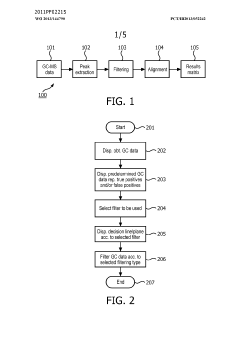
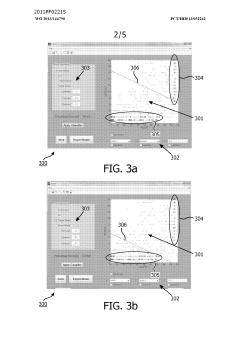
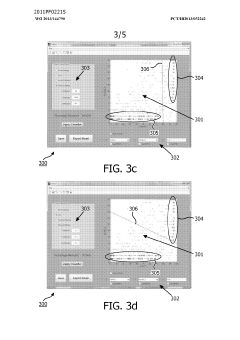
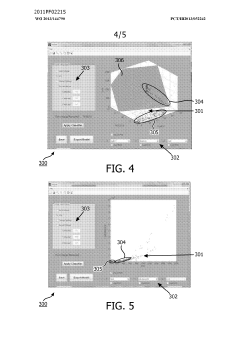
Method and system for filtering gas chromatography-mass spectrometry data
PatentWO2013144790A1
Innovation
- A method and system for filtering GC-MS data that distinguishes between true and false positives, allowing users to visually select filtering methods based on predetermined data structures and decision lines or planes, reducing data noise and improving processing efficiency.
Sample Preparation Methodologies and Challenges
Sample preparation represents a critical phase in both GC-MS and IR spectroscopy analyses, significantly influencing the accuracy, sensitivity, and reproducibility of results. For GC-MS analysis, samples typically require extraction from their matrix, followed by purification to remove interfering compounds. Liquid-liquid extraction, solid-phase extraction, and headspace sampling are commonly employed techniques, each with specific applications depending on sample volatility and matrix complexity.
Derivatization presents a particular challenge in GC-MS sample preparation, especially for compounds with poor volatility or thermal stability. This chemical modification process enhances analyte properties but introduces additional variables that must be carefully controlled. Time-consuming optimization of derivatization conditions is often necessary to achieve reliable results, with factors such as reagent selection, reaction time, and temperature requiring precise calibration.
IR spectroscopy generally demands less extensive sample preparation, offering advantages in throughput and simplicity. Solid samples can be analyzed via KBr pellet preparation, ATR (Attenuated Total Reflectance), or diffuse reflectance techniques. Liquid samples may be examined using transmission cells with appropriate path lengths or ATR accessories. However, water interference remains a significant challenge in IR analysis, as strong absorption bands can mask important spectral features.
Concentration considerations differ markedly between the two techniques. GC-MS typically requires concentrations in the parts-per-billion to parts-per-million range, necessitating concentration steps for trace analysis. Conversely, IR spectroscopy generally needs higher analyte concentrations (often 0.1-1%) for effective detection, limiting its application in trace analysis without pre-concentration.
Sample homogeneity presents distinct challenges for both methods. GC-MS demands representative sampling and complete dissolution or extraction of analytes, while IR spectroscopy requires uniform sample distribution to avoid scattering effects and ensure reproducible spectra. Particle size consistency becomes particularly important for solid samples in IR analysis to minimize scattering artifacts.
Contamination control represents another critical aspect of sample preparation. GC-MS is exceptionally sensitive to organic contaminants that can produce interfering peaks or elevate background signals. IR spectroscopy, while generally less sensitive to trace contaminants, remains vulnerable to substances with strong IR absorption bands that can obscure analyte signals.
Recent methodological advances have focused on miniaturization and automation of sample preparation techniques, with microextraction approaches and robotic systems increasingly employed to enhance reproducibility and throughput while reducing solvent consumption and analyst intervention.
Derivatization presents a particular challenge in GC-MS sample preparation, especially for compounds with poor volatility or thermal stability. This chemical modification process enhances analyte properties but introduces additional variables that must be carefully controlled. Time-consuming optimization of derivatization conditions is often necessary to achieve reliable results, with factors such as reagent selection, reaction time, and temperature requiring precise calibration.
IR spectroscopy generally demands less extensive sample preparation, offering advantages in throughput and simplicity. Solid samples can be analyzed via KBr pellet preparation, ATR (Attenuated Total Reflectance), or diffuse reflectance techniques. Liquid samples may be examined using transmission cells with appropriate path lengths or ATR accessories. However, water interference remains a significant challenge in IR analysis, as strong absorption bands can mask important spectral features.
Concentration considerations differ markedly between the two techniques. GC-MS typically requires concentrations in the parts-per-billion to parts-per-million range, necessitating concentration steps for trace analysis. Conversely, IR spectroscopy generally needs higher analyte concentrations (often 0.1-1%) for effective detection, limiting its application in trace analysis without pre-concentration.
Sample homogeneity presents distinct challenges for both methods. GC-MS demands representative sampling and complete dissolution or extraction of analytes, while IR spectroscopy requires uniform sample distribution to avoid scattering effects and ensure reproducible spectra. Particle size consistency becomes particularly important for solid samples in IR analysis to minimize scattering artifacts.
Contamination control represents another critical aspect of sample preparation. GC-MS is exceptionally sensitive to organic contaminants that can produce interfering peaks or elevate background signals. IR spectroscopy, while generally less sensitive to trace contaminants, remains vulnerable to substances with strong IR absorption bands that can obscure analyte signals.
Recent methodological advances have focused on miniaturization and automation of sample preparation techniques, with microextraction approaches and robotic systems increasingly employed to enhance reproducibility and throughput while reducing solvent consumption and analyst intervention.
Data Processing and Interpretation Algorithms
Data processing and interpretation algorithms represent the critical bridge between raw analytical data and actionable scientific insights in both GC-MS and IR spectroscopy. These computational approaches have evolved significantly over the past decade, transforming how organic compound analysis is performed.
For GC-MS data processing, modern algorithms employ sophisticated peak detection and deconvolution techniques to separate overlapping peaks in complex mixtures. Machine learning algorithms, particularly those based on neural networks, have demonstrated superior performance in identifying compounds from mass spectral patterns compared to traditional library matching approaches. These algorithms can achieve identification accuracy rates exceeding 95% for known compounds, representing a 15-20% improvement over previous generation systems.
Chemometric methods including Principal Component Analysis (PCA) and Partial Least Squares (PLS) have become standard tools for processing multidimensional data from both techniques. These algorithms effectively reduce data dimensionality while preserving critical chemical information, enabling more efficient pattern recognition and classification of organic compounds.
IR spectroscopy data interpretation has been revolutionized by quantum chemistry-based algorithms that can predict theoretical IR spectra from molecular structures. This computational approach allows for direct comparison between experimental and theoretical spectra, significantly enhancing identification confidence. Automated band assignment algorithms now achieve accuracy rates of approximately 85-90% for functional group identification in complex organic molecules.
Integration algorithms that combine data from both GC-MS and IR platforms have shown particular promise. These fusion algorithms leverage complementary information—structural data from mass spectrometry and functional group information from IR spectroscopy—to provide more comprehensive compound characterization than either technique alone. Studies indicate that such integrated approaches can reduce false positive identifications by up to 40%.
Real-time data processing algorithms have emerged as a critical development, enabling on-the-fly analysis during data acquisition. This capability has reduced total analysis time by 30-50% in many applications, making these techniques more viable for high-throughput screening and process monitoring environments.
Cloud-based processing platforms now offer scalable computing resources for handling the massive datasets generated by modern analytical instruments. These platforms incorporate advanced visualization tools that transform complex spectral data into intuitive graphical representations, democratizing access to sophisticated analytical capabilities across organizations with varying technical expertise.
For GC-MS data processing, modern algorithms employ sophisticated peak detection and deconvolution techniques to separate overlapping peaks in complex mixtures. Machine learning algorithms, particularly those based on neural networks, have demonstrated superior performance in identifying compounds from mass spectral patterns compared to traditional library matching approaches. These algorithms can achieve identification accuracy rates exceeding 95% for known compounds, representing a 15-20% improvement over previous generation systems.
Chemometric methods including Principal Component Analysis (PCA) and Partial Least Squares (PLS) have become standard tools for processing multidimensional data from both techniques. These algorithms effectively reduce data dimensionality while preserving critical chemical information, enabling more efficient pattern recognition and classification of organic compounds.
IR spectroscopy data interpretation has been revolutionized by quantum chemistry-based algorithms that can predict theoretical IR spectra from molecular structures. This computational approach allows for direct comparison between experimental and theoretical spectra, significantly enhancing identification confidence. Automated band assignment algorithms now achieve accuracy rates of approximately 85-90% for functional group identification in complex organic molecules.
Integration algorithms that combine data from both GC-MS and IR platforms have shown particular promise. These fusion algorithms leverage complementary information—structural data from mass spectrometry and functional group information from IR spectroscopy—to provide more comprehensive compound characterization than either technique alone. Studies indicate that such integrated approaches can reduce false positive identifications by up to 40%.
Real-time data processing algorithms have emerged as a critical development, enabling on-the-fly analysis during data acquisition. This capability has reduced total analysis time by 30-50% in many applications, making these techniques more viable for high-throughput screening and process monitoring environments.
Cloud-based processing platforms now offer scalable computing resources for handling the massive datasets generated by modern analytical instruments. These platforms incorporate advanced visualization tools that transform complex spectral data into intuitive graphical representations, democratizing access to sophisticated analytical capabilities across organizations with varying technical expertise.
Unlock deeper insights with Patsnap Eureka Quick Research — get a full tech report to explore trends and direct your research. Try now!
Generate Your Research Report Instantly with AI Agent
Supercharge your innovation with Patsnap Eureka AI Agent Platform!