

How AMOLED contributes to immersive smart home environments?
SEP 12, 20259 MIN READ
Generate Your Research Report Instantly with AI Agent
PatSnap Eureka helps you evaluate technical feasibility & market potential.
AMOLED in Smart Homes
AMOLED (Active-Matrix Organic Light-Emitting Diode) technology has emerged as a game-changer in the realm of smart home environments, offering unprecedented visual experiences and energy efficiency. This advanced display technology is revolutionizing the way we interact with our living spaces, creating more immersive and responsive smart home ecosystems.
The integration of AMOLED displays in smart home devices has significantly enhanced the user interface and overall aesthetics of connected living spaces. These high-resolution, vibrant screens provide superior color reproduction, deeper blacks, and wider viewing angles compared to traditional LCD displays. This visual prowess allows for more intuitive and engaging interactions with smart home control panels, digital assistants, and other connected devices.
One of the key contributions of AMOLED to immersive smart home environments is its ability to seamlessly blend into the surroundings when not in use. The technology's true black capabilities enable displays to completely shut off individual pixels, creating an "invisible" effect that maintains the aesthetic integrity of living spaces. This feature is particularly valuable in smart mirrors, digital picture frames, and wall-mounted control panels, where the display can disappear into the background when inactive.
AMOLED's energy efficiency is another crucial factor in its adoption for smart home applications. The technology consumes significantly less power than traditional displays, especially when displaying darker content. This efficiency not only reduces energy costs but also aligns with the growing trend of eco-friendly smart homes, contributing to overall sustainability efforts.
The flexibility of AMOLED panels opens up new possibilities for innovative smart home designs. Curved and even rollable displays can be integrated into various surfaces and objects within the home, creating futuristic and adaptable living spaces. This flexibility allows for more creative and space-efficient solutions in smart home design, such as curved dashboard displays in smart kitchens or rollable screens that can be hidden away when not in use.
Furthermore, AMOLED's fast response times and high refresh rates contribute to a more responsive and fluid user experience in smart home interfaces. This is particularly beneficial for real-time monitoring and control systems, where lag-free interaction is crucial for effective home management and security applications.
The technology's wide color gamut and HDR (High Dynamic Range) capabilities also play a significant role in creating immersive environments. Smart home systems equipped with AMOLED displays can render more lifelike images and videos, enhancing the visual appeal of security camera feeds, video doorbells, and entertainment systems integrated into the smart home ecosystem.
The integration of AMOLED displays in smart home devices has significantly enhanced the user interface and overall aesthetics of connected living spaces. These high-resolution, vibrant screens provide superior color reproduction, deeper blacks, and wider viewing angles compared to traditional LCD displays. This visual prowess allows for more intuitive and engaging interactions with smart home control panels, digital assistants, and other connected devices.
One of the key contributions of AMOLED to immersive smart home environments is its ability to seamlessly blend into the surroundings when not in use. The technology's true black capabilities enable displays to completely shut off individual pixels, creating an "invisible" effect that maintains the aesthetic integrity of living spaces. This feature is particularly valuable in smart mirrors, digital picture frames, and wall-mounted control panels, where the display can disappear into the background when inactive.
AMOLED's energy efficiency is another crucial factor in its adoption for smart home applications. The technology consumes significantly less power than traditional displays, especially when displaying darker content. This efficiency not only reduces energy costs but also aligns with the growing trend of eco-friendly smart homes, contributing to overall sustainability efforts.
The flexibility of AMOLED panels opens up new possibilities for innovative smart home designs. Curved and even rollable displays can be integrated into various surfaces and objects within the home, creating futuristic and adaptable living spaces. This flexibility allows for more creative and space-efficient solutions in smart home design, such as curved dashboard displays in smart kitchens or rollable screens that can be hidden away when not in use.
Furthermore, AMOLED's fast response times and high refresh rates contribute to a more responsive and fluid user experience in smart home interfaces. This is particularly beneficial for real-time monitoring and control systems, where lag-free interaction is crucial for effective home management and security applications.
The technology's wide color gamut and HDR (High Dynamic Range) capabilities also play a significant role in creating immersive environments. Smart home systems equipped with AMOLED displays can render more lifelike images and videos, enhancing the visual appeal of security camera feeds, video doorbells, and entertainment systems integrated into the smart home ecosystem.
Market Demand Analysis
The market demand for AMOLED technology in smart home environments has been steadily increasing, driven by the growing consumer desire for more immersive and interactive living spaces. As smart homes become increasingly sophisticated, there is a rising need for display technologies that can seamlessly integrate into various household surfaces and objects, providing both aesthetic appeal and functional utility.
AMOLED displays offer several key advantages that make them particularly well-suited for smart home applications. Their ability to produce vibrant colors, deep blacks, and high contrast ratios contributes significantly to creating visually stunning and immersive environments. This is especially important in smart home settings where ambiance and user experience are paramount.
The flexibility of AMOLED panels allows for the creation of curved, bendable, and even rollable displays. This adaptability is highly valued in smart home design, as it enables the integration of screens into unconventional surfaces such as furniture, appliances, and architectural elements. The market has shown a strong interest in these innovative form factors, with consumers expressing enthusiasm for seamlessly blended technology that doesn't disrupt the home's aesthetic.
Energy efficiency is another crucial factor driving the demand for AMOLED in smart homes. As households become more conscious of their energy consumption, the lower power requirements of AMOLED displays compared to traditional LCD screens make them an attractive option for always-on information displays and ambient lighting solutions.
The smart home market has also seen an increased demand for personalized and context-aware environments. AMOLED's ability to selectively illuminate pixels allows for the creation of dynamic and responsive displays that can adapt to user preferences, time of day, or specific activities. This level of customization aligns well with the trend towards more intelligent and user-centric home automation systems.
Furthermore, the growing interest in augmented reality (AR) and mixed reality (MR) experiences within the home has created new opportunities for AMOLED technology. The superior color reproduction and fast response times of AMOLED displays make them ideal for AR overlays and interactive interfaces that blend digital information with the physical environment.
Market analysts predict that the integration of AMOLED technology in smart home devices will continue to expand, with applications ranging from smart mirrors and interactive wall panels to advanced kitchen appliances and entertainment systems. The demand is expected to be particularly strong in high-end residential markets and luxury smart home installations, where the visual quality and innovative design possibilities of AMOLED can justify the higher costs associated with the technology.
AMOLED displays offer several key advantages that make them particularly well-suited for smart home applications. Their ability to produce vibrant colors, deep blacks, and high contrast ratios contributes significantly to creating visually stunning and immersive environments. This is especially important in smart home settings where ambiance and user experience are paramount.
The flexibility of AMOLED panels allows for the creation of curved, bendable, and even rollable displays. This adaptability is highly valued in smart home design, as it enables the integration of screens into unconventional surfaces such as furniture, appliances, and architectural elements. The market has shown a strong interest in these innovative form factors, with consumers expressing enthusiasm for seamlessly blended technology that doesn't disrupt the home's aesthetic.
Energy efficiency is another crucial factor driving the demand for AMOLED in smart homes. As households become more conscious of their energy consumption, the lower power requirements of AMOLED displays compared to traditional LCD screens make them an attractive option for always-on information displays and ambient lighting solutions.
The smart home market has also seen an increased demand for personalized and context-aware environments. AMOLED's ability to selectively illuminate pixels allows for the creation of dynamic and responsive displays that can adapt to user preferences, time of day, or specific activities. This level of customization aligns well with the trend towards more intelligent and user-centric home automation systems.
Furthermore, the growing interest in augmented reality (AR) and mixed reality (MR) experiences within the home has created new opportunities for AMOLED technology. The superior color reproduction and fast response times of AMOLED displays make them ideal for AR overlays and interactive interfaces that blend digital information with the physical environment.
Market analysts predict that the integration of AMOLED technology in smart home devices will continue to expand, with applications ranging from smart mirrors and interactive wall panels to advanced kitchen appliances and entertainment systems. The demand is expected to be particularly strong in high-end residential markets and luxury smart home installations, where the visual quality and innovative design possibilities of AMOLED can justify the higher costs associated with the technology.
AMOLED Tech Challenges
AMOLED technology, while offering significant advantages in display quality and energy efficiency, faces several challenges in its application to immersive smart home environments. One of the primary obstacles is the high cost of production, which limits widespread adoption in larger display formats typically required for smart home applications. The complex manufacturing process and expensive materials contribute to this cost barrier, making it difficult to integrate AMOLED displays into a wide range of smart home devices.
Another significant challenge is the potential for screen burn-in, particularly in static elements of smart home interfaces. AMOLED displays are susceptible to permanent image retention when certain pixels are used more frequently than others, which can be problematic for always-on displays or those with persistent UI elements common in smart home control panels.
Durability and lifespan concerns also present challenges for AMOLED in smart home environments. The organic compounds in AMOLED displays degrade over time, leading to reduced brightness and color accuracy. This degradation can be accelerated by exposure to heat, humidity, and ambient light – all factors present in various smart home settings.
Power consumption, while generally lower than traditional LCD displays, remains a concern for larger AMOLED panels. As smart home devices often require continuous operation, balancing power efficiency with display size and brightness becomes crucial. This challenge is particularly evident in battery-operated smart home devices where energy management is critical.
Color accuracy and consistency across different viewing angles pose another technical hurdle. While AMOLED displays offer superior color reproduction, maintaining this quality across various viewing positions – essential in a multi-user smart home environment – requires advanced color management systems and precise calibration techniques.
The integration of touch functionality, crucial for interactive smart home interfaces, presents additional complexities. Incorporating touch sensors without compromising display quality or increasing device thickness remains a challenge, especially for flexible or curved AMOLED displays that may be desirable in certain smart home applications.
Lastly, the environmental impact of AMOLED production and disposal is a growing concern. The use of rare materials and the difficulty in recycling AMOLED panels pose sustainability challenges that need to be addressed for long-term viability in the eco-conscious smart home market.
Another significant challenge is the potential for screen burn-in, particularly in static elements of smart home interfaces. AMOLED displays are susceptible to permanent image retention when certain pixels are used more frequently than others, which can be problematic for always-on displays or those with persistent UI elements common in smart home control panels.
Durability and lifespan concerns also present challenges for AMOLED in smart home environments. The organic compounds in AMOLED displays degrade over time, leading to reduced brightness and color accuracy. This degradation can be accelerated by exposure to heat, humidity, and ambient light – all factors present in various smart home settings.
Power consumption, while generally lower than traditional LCD displays, remains a concern for larger AMOLED panels. As smart home devices often require continuous operation, balancing power efficiency with display size and brightness becomes crucial. This challenge is particularly evident in battery-operated smart home devices where energy management is critical.
Color accuracy and consistency across different viewing angles pose another technical hurdle. While AMOLED displays offer superior color reproduction, maintaining this quality across various viewing positions – essential in a multi-user smart home environment – requires advanced color management systems and precise calibration techniques.
The integration of touch functionality, crucial for interactive smart home interfaces, presents additional complexities. Incorporating touch sensors without compromising display quality or increasing device thickness remains a challenge, especially for flexible or curved AMOLED displays that may be desirable in certain smart home applications.
Lastly, the environmental impact of AMOLED production and disposal is a growing concern. The use of rare materials and the difficulty in recycling AMOLED panels pose sustainability challenges that need to be addressed for long-term viability in the eco-conscious smart home market.
Current AMOLED Solutions
01 Enhanced display technologies for AMOLED screens
Advanced AMOLED display technologies are developed to improve immersiveness. These include optimizing pixel arrangements, enhancing color reproduction, and increasing resolution. Such improvements result in more vibrant and lifelike images, contributing to a more immersive viewing experience.- Enhanced display technologies for AMOLED screens: Advanced AMOLED display technologies are developed to improve immersiveness. These include optimized pixel arrangements, increased resolution, and improved color reproduction techniques. Such enhancements contribute to a more realistic and engaging visual experience for users.
- Power efficiency and brightness control in AMOLED displays: Techniques are implemented to optimize power consumption while maintaining high brightness levels in AMOLED displays. This includes adaptive brightness control, local dimming, and efficient driving schemes, which contribute to improved battery life and enhanced visual quality in various lighting conditions.
- AMOLED panel structure and manufacturing improvements: Advancements in AMOLED panel structure and manufacturing processes are made to enhance display quality and immersiveness. These include innovations in thin-film transistor (TFT) designs, electrode materials, and encapsulation techniques, resulting in improved display performance and durability.
- Touch integration and interaction enhancements for AMOLED displays: Integration of touch functionality and improved interaction methods are developed for AMOLED displays. These innovations include in-cell touch sensors, force-sensitive touch detection, and gesture recognition, enhancing the overall user experience and immersiveness of AMOLED devices.
- AMOLED display driving and compensation techniques: Advanced driving and compensation techniques are implemented to improve AMOLED display performance and immersiveness. These include methods for reducing image retention, compensating for pixel aging, and optimizing refresh rates, resulting in smoother motion and more consistent image quality over time.
02 Curved and flexible AMOLED displays
Curved and flexible AMOLED displays are designed to enhance immersiveness by providing a more encompassing visual field. These displays can wrap around edges or conform to non-flat surfaces, creating a more enveloping viewing experience and reducing visual boundaries.Expand Specific Solutions03 Integration of sensors and interactive elements
AMOLED displays are integrated with various sensors and interactive elements to increase immersiveness. These may include touch sensors, pressure sensors, or even cameras embedded within the display. Such integrations allow for more seamless and responsive user interactions, enhancing the overall immersive experience.Expand Specific Solutions04 Optimized power management for AMOLED displays
Power management techniques are developed to optimize AMOLED display performance while maintaining energy efficiency. These methods include selective pixel activation, dynamic refresh rates, and adaptive brightness control. By ensuring sustained high-quality visuals without compromising battery life, these techniques contribute to prolonged immersive experiences.Expand Specific Solutions05 Enhanced contrast and black levels in AMOLED displays
Techniques are developed to improve contrast ratios and deepen black levels in AMOLED displays. These enhancements leverage the ability of AMOLED pixels to completely turn off, resulting in true blacks and infinite contrast ratios. Such improvements significantly contribute to the perceived depth and realism of displayed content, thereby increasing immersiveness.Expand Specific Solutions
Key Industry Players
The AMOLED technology for immersive smart home environments is in a growth phase, with increasing market size and advancing technological maturity. Major players like Samsung Electronics, BOE Technology, and TCL China Star Optoelectronics are driving innovation in this space. The market is characterized by intense competition among established display manufacturers and emerging tech companies. As AMOLED technology continues to evolve, we're seeing improvements in display quality, energy efficiency, and form factor flexibility, which are crucial for seamless integration into smart home ecosystems. Companies like Google and OPPO are also contributing to the ecosystem development, indicating a broadening application scope beyond traditional display manufacturers.
BOE Technology Group Co., Ltd.
Technical Solution: BOE has developed flexible AMOLED displays specifically designed for smart home applications. Their panels feature high contrast ratios exceeding 1,000,000:1 and wide color gamuts covering over 100% of the DCI-P3 color space[6]. BOE's AMOLED technology incorporates low-temperature polycrystalline oxide (LTPO) backplanes, enabling variable refresh rates from 1Hz to 120Hz for improved power efficiency in always-on display scenarios[7]. For immersive environments, BOE has implemented under-display camera technology, allowing for truly bezel-less designs in smart home control panels and mirrors[8]. Their displays also feature integrated touch and fingerprint sensing capabilities, enhancing user interaction in smart home settings[9].
Strengths: Flexible display technology, high contrast and color performance, advanced features like under-display cameras. Weaknesses: Less established in the global market compared to some competitors, potential yield issues with cutting-edge technologies.
Samsung Electronics Co., Ltd.
Technical Solution: Samsung has developed advanced AMOLED displays for smart home environments, featuring Quantum Dot technology for enhanced color accuracy and brightness[1]. Their panels offer ultra-high resolution up to 8K, providing immersive visual experiences for large-screen applications[2]. Samsung's AMOLED displays incorporate AI-powered picture quality enhancement algorithms, automatically adjusting brightness and contrast based on ambient lighting conditions[3]. For smart home integration, they've implemented IoT connectivity features, allowing seamless interaction with other smart devices and voice assistants[4]. Samsung has also focused on energy efficiency, with their latest AMOLED panels consuming up to 25% less power compared to previous generations[5].
Strengths: Industry-leading display technology, high color accuracy, energy efficiency, and smart home integration. Weaknesses: Higher cost compared to traditional LCD displays, potential for burn-in over extended use.
Core AMOLED Innovations
Amoled double-side display
PatentActiveUS20200219957A1
Innovation
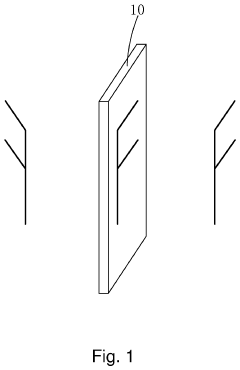
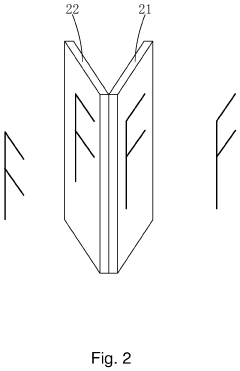
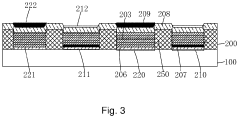
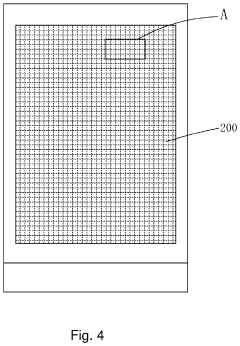
- An AMOLED double-sided display design featuring a substrate with alternating top-emitting and bottom-emitting OLED units, where the anode of top-emitting units is thicker and reflective, and the cathode of bottom-emitting units is thicker and light-transmissive, allowing for single IC control and eliminating mirrored images.
Active-matrix organic light emitting diode display module
PatentInactiveKR1020090117209A
Innovation
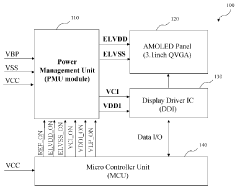
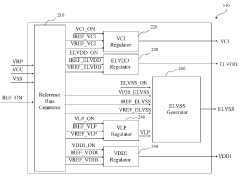
- An AMOLED display module comprising a Power Module Unit (PMU), an AMOLED panel, and a Display Driver IC (DDI) is provided, with the PMU generating panel driving and interface voltages using supply power sources in response to control signals, and the DDI driving the panel in response to display data, facilitated by a Micro Controller Unit (MCU).
Energy Efficiency Impact
AMOLED technology's contribution to energy efficiency in smart home environments is significant and multifaceted. The inherent characteristics of AMOLED displays make them particularly well-suited for energy-conscious smart home applications. Unlike traditional LCD screens, AMOLED displays can selectively illuminate individual pixels, allowing for true blacks by simply turning off the relevant pixels. This feature not only enhances visual quality but also substantially reduces power consumption in dark-themed interfaces or when displaying partial information.
In the context of smart home devices, this energy-saving capability translates to longer battery life for portable devices and reduced electricity consumption for stationary displays. Smart thermostats, for instance, can utilize AMOLED screens to show temperature and settings with minimal power draw, especially when employing dark backgrounds. Similarly, smart lighting control panels can maintain low energy usage while providing vibrant, easily readable interfaces.
The energy efficiency of AMOLED displays also extends to their quick response times and high refresh rates. These properties allow for smooth animations and transitions in smart home control interfaces without the need for constant full-screen refreshes, further conserving power. This is particularly beneficial in scenarios where users frequently interact with smart home controls, as the reduced energy consumption during these interactions accumulates to significant savings over time.
Moreover, AMOLED's ability to produce high contrast ratios and wide color gamuts contributes to energy efficiency by enabling clear visibility in various lighting conditions. This means that smart home displays can operate at lower brightness levels while maintaining readability, directly impacting power consumption. For outdoor smart home devices like security cameras or doorbell displays, this translates to improved battery life and reduced need for frequent charging or replacement.
The thin and flexible nature of AMOLED panels also plays a role in energy conservation within smart home ecosystems. These displays can be integrated into curved or unconventional surfaces, allowing for more ergonomic and space-efficient device designs. This flexibility can lead to smaller overall device footprints, which in turn requires less material and energy for production and operation.
As smart home technologies continue to evolve, the energy efficiency benefits of AMOLED displays are likely to become even more pronounced. Future developments may include further optimizations in pixel architecture and driving methods, potentially leading to even lower power consumption without compromising on display quality or functionality. This ongoing improvement in energy efficiency aligns well with the broader trend towards sustainable and eco-friendly smart home solutions, making AMOLED an increasingly attractive option for manufacturers and consumers alike.
In the context of smart home devices, this energy-saving capability translates to longer battery life for portable devices and reduced electricity consumption for stationary displays. Smart thermostats, for instance, can utilize AMOLED screens to show temperature and settings with minimal power draw, especially when employing dark backgrounds. Similarly, smart lighting control panels can maintain low energy usage while providing vibrant, easily readable interfaces.
The energy efficiency of AMOLED displays also extends to their quick response times and high refresh rates. These properties allow for smooth animations and transitions in smart home control interfaces without the need for constant full-screen refreshes, further conserving power. This is particularly beneficial in scenarios where users frequently interact with smart home controls, as the reduced energy consumption during these interactions accumulates to significant savings over time.
Moreover, AMOLED's ability to produce high contrast ratios and wide color gamuts contributes to energy efficiency by enabling clear visibility in various lighting conditions. This means that smart home displays can operate at lower brightness levels while maintaining readability, directly impacting power consumption. For outdoor smart home devices like security cameras or doorbell displays, this translates to improved battery life and reduced need for frequent charging or replacement.
The thin and flexible nature of AMOLED panels also plays a role in energy conservation within smart home ecosystems. These displays can be integrated into curved or unconventional surfaces, allowing for more ergonomic and space-efficient device designs. This flexibility can lead to smaller overall device footprints, which in turn requires less material and energy for production and operation.
As smart home technologies continue to evolve, the energy efficiency benefits of AMOLED displays are likely to become even more pronounced. Future developments may include further optimizations in pixel architecture and driving methods, potentially leading to even lower power consumption without compromising on display quality or functionality. This ongoing improvement in energy efficiency aligns well with the broader trend towards sustainable and eco-friendly smart home solutions, making AMOLED an increasingly attractive option for manufacturers and consumers alike.
User Experience Design
AMOLED technology plays a crucial role in enhancing user experience design for immersive smart home environments. The high contrast ratios and deep blacks offered by AMOLED displays create a visually stunning interface that seamlessly blends with the surrounding environment. This integration allows for more natural and intuitive interactions between users and their smart home devices.
The ability of AMOLED screens to display true blacks by turning off individual pixels contributes to energy efficiency and reduces eye strain, especially in low-light conditions. This feature is particularly beneficial for smart home control panels and displays that are often used throughout the day and night. The improved visibility and readability in various lighting conditions ensure a consistent and pleasant user experience.
AMOLED's wide color gamut and high color accuracy enable the creation of vibrant and lifelike user interfaces. This visual richness enhances the overall aesthetic appeal of smart home systems, making them more engaging and enjoyable to use. The technology's capability to render fine details and smooth gradients allows for the implementation of sophisticated design elements that can convey complex information in an easily digestible manner.
The flexibility of AMOLED displays opens up new possibilities for innovative form factors in smart home devices. Curved or even foldable displays can be seamlessly integrated into various surfaces within the home, providing a more organic and less intrusive presence of technology. This adaptability allows designers to create user interfaces that complement the home's interior design, rather than standing out as separate technological entities.
AMOLED's fast response times and high refresh rates contribute to a more responsive and fluid user interface. This responsiveness is crucial for creating a sense of immediacy and control in smart home interactions, where even slight delays can be frustrating. The smooth animations and transitions made possible by AMOLED technology enhance the perceived quality and sophistication of the smart home system.
The technology's ability to display always-on information with minimal power consumption enables the design of ambient displays that provide subtle, glanceable information without being obtrusive. This feature is particularly useful for displaying environmental data, notifications, or status updates in a smart home context, allowing users to stay informed without actively engaging with devices.
In conclusion, AMOLED technology significantly enhances user experience design in immersive smart home environments by providing visually appealing, energy-efficient, and versatile display solutions. Its unique characteristics enable designers to create intuitive, responsive, and aesthetically pleasing interfaces that seamlessly integrate with the home environment, ultimately leading to a more natural and enjoyable smart home experience.
The ability of AMOLED screens to display true blacks by turning off individual pixels contributes to energy efficiency and reduces eye strain, especially in low-light conditions. This feature is particularly beneficial for smart home control panels and displays that are often used throughout the day and night. The improved visibility and readability in various lighting conditions ensure a consistent and pleasant user experience.
AMOLED's wide color gamut and high color accuracy enable the creation of vibrant and lifelike user interfaces. This visual richness enhances the overall aesthetic appeal of smart home systems, making them more engaging and enjoyable to use. The technology's capability to render fine details and smooth gradients allows for the implementation of sophisticated design elements that can convey complex information in an easily digestible manner.
The flexibility of AMOLED displays opens up new possibilities for innovative form factors in smart home devices. Curved or even foldable displays can be seamlessly integrated into various surfaces within the home, providing a more organic and less intrusive presence of technology. This adaptability allows designers to create user interfaces that complement the home's interior design, rather than standing out as separate technological entities.
AMOLED's fast response times and high refresh rates contribute to a more responsive and fluid user interface. This responsiveness is crucial for creating a sense of immediacy and control in smart home interactions, where even slight delays can be frustrating. The smooth animations and transitions made possible by AMOLED technology enhance the perceived quality and sophistication of the smart home system.
The technology's ability to display always-on information with minimal power consumption enables the design of ambient displays that provide subtle, glanceable information without being obtrusive. This feature is particularly useful for displaying environmental data, notifications, or status updates in a smart home context, allowing users to stay informed without actively engaging with devices.
In conclusion, AMOLED technology significantly enhances user experience design in immersive smart home environments by providing visually appealing, energy-efficient, and versatile display solutions. Its unique characteristics enable designers to create intuitive, responsive, and aesthetically pleasing interfaces that seamlessly integrate with the home environment, ultimately leading to a more natural and enjoyable smart home experience.
Unlock deeper insights with PatSnap Eureka Quick Research — get a full tech report to explore trends and direct your research. Try now!
Generate Your Research Report Instantly with AI Agent
Supercharge your innovation with PatSnap Eureka AI Agent Platform!