How consumer preferences shape AMOLED's evolutionary path?
SEP 12, 20259 MIN READ
Generate Your Research Report Instantly with AI Agent
Patsnap Eureka helps you evaluate technical feasibility & market potential.
AMOLED Evolution and Consumer-Driven Goals
The evolution of AMOLED technology has been significantly influenced by consumer preferences, driving its development towards meeting and exceeding user expectations. Initially, AMOLED displays were introduced as a premium alternative to LCD screens, offering vibrant colors and deep blacks. As consumers began to appreciate these qualities, manufacturers focused on refining and enhancing these features.
One of the primary consumer-driven goals in AMOLED evolution has been the pursuit of higher display quality. Users have consistently demanded sharper, more vivid screens with better color accuracy. This preference has led to the development of higher pixel densities, wider color gamuts, and improved color calibration techniques. Manufacturers have responded by introducing innovations such as Diamond Pixel arrangements and advanced color management systems.
Energy efficiency has also been a key factor shaping AMOLED's path. As mobile devices became increasingly integral to daily life, consumers sought longer battery life without compromising on display quality. This demand has pushed AMOLED technology towards more power-efficient designs, including the development of variable refresh rates and pixel-level power management.
The trend towards larger screens and bezel-less designs has been another significant consumer preference influencing AMOLED evolution. Users have shown a clear preference for immersive viewing experiences, leading to the development of flexible and foldable AMOLED displays. These innovations have enabled manufacturers to create devices with expandable screen sizes while maintaining portability.
Durability and longevity have also been important considerations for consumers. Early AMOLED displays were prone to burn-in and degradation over time, which led to user dissatisfaction. In response, manufacturers have invested in research to improve the lifespan of AMOLED panels, developing more stable organic materials and implementing advanced compensation algorithms to mitigate burn-in effects.
The increasing use of smartphones for multimedia consumption has driven AMOLED technology to support high dynamic range (HDR) content. Consumers' desire for a more cinematic experience on mobile devices has led to the implementation of HDR10 and HDR10+ standards in AMOLED displays, offering enhanced contrast and brightness capabilities.
As consumers become more environmentally conscious, there has been a growing demand for sustainable technologies. This preference has influenced AMOLED manufacturing processes, pushing for more eco-friendly production methods and materials. Manufacturers are now exploring ways to reduce the environmental impact of AMOLED production and improve the recyclability of display components.
In conclusion, consumer preferences have been instrumental in shaping AMOLED's evolutionary path, driving advancements in display quality, energy efficiency, form factor, durability, and sustainability. As user expectations continue to evolve, AMOLED technology is likely to further adapt and innovate to meet these changing demands.
One of the primary consumer-driven goals in AMOLED evolution has been the pursuit of higher display quality. Users have consistently demanded sharper, more vivid screens with better color accuracy. This preference has led to the development of higher pixel densities, wider color gamuts, and improved color calibration techniques. Manufacturers have responded by introducing innovations such as Diamond Pixel arrangements and advanced color management systems.
Energy efficiency has also been a key factor shaping AMOLED's path. As mobile devices became increasingly integral to daily life, consumers sought longer battery life without compromising on display quality. This demand has pushed AMOLED technology towards more power-efficient designs, including the development of variable refresh rates and pixel-level power management.
The trend towards larger screens and bezel-less designs has been another significant consumer preference influencing AMOLED evolution. Users have shown a clear preference for immersive viewing experiences, leading to the development of flexible and foldable AMOLED displays. These innovations have enabled manufacturers to create devices with expandable screen sizes while maintaining portability.
Durability and longevity have also been important considerations for consumers. Early AMOLED displays were prone to burn-in and degradation over time, which led to user dissatisfaction. In response, manufacturers have invested in research to improve the lifespan of AMOLED panels, developing more stable organic materials and implementing advanced compensation algorithms to mitigate burn-in effects.
The increasing use of smartphones for multimedia consumption has driven AMOLED technology to support high dynamic range (HDR) content. Consumers' desire for a more cinematic experience on mobile devices has led to the implementation of HDR10 and HDR10+ standards in AMOLED displays, offering enhanced contrast and brightness capabilities.
As consumers become more environmentally conscious, there has been a growing demand for sustainable technologies. This preference has influenced AMOLED manufacturing processes, pushing for more eco-friendly production methods and materials. Manufacturers are now exploring ways to reduce the environmental impact of AMOLED production and improve the recyclability of display components.
In conclusion, consumer preferences have been instrumental in shaping AMOLED's evolutionary path, driving advancements in display quality, energy efficiency, form factor, durability, and sustainability. As user expectations continue to evolve, AMOLED technology is likely to further adapt and innovate to meet these changing demands.
Market Demand Analysis for AMOLED Displays
The AMOLED display market has experienced significant growth in recent years, driven by increasing consumer demand for high-quality visual experiences across various devices. This demand is particularly evident in the smartphone sector, where AMOLED technology has become a key differentiator for premium devices. The superior color reproduction, contrast ratios, and energy efficiency of AMOLED displays have resonated strongly with consumers, leading to a surge in adoption by major smartphone manufacturers.
Consumer preferences for larger screens with higher resolutions have also played a crucial role in shaping the AMOLED market. As users increasingly consume media content on their mobile devices, the demand for displays that can deliver vibrant colors and deep blacks has grown substantially. This trend has extended beyond smartphones to other consumer electronics, including tablets, smartwatches, and televisions, further expanding the market potential for AMOLED technology.
The automotive industry represents another emerging market for AMOLED displays, driven by the growing integration of advanced infotainment systems and digital dashboards in vehicles. Consumers are showing a preference for sleek, modern interiors with high-quality displays, creating new opportunities for AMOLED technology in this sector.
In the wearable technology market, AMOLED displays have gained traction due to their ability to offer bright, clear visuals while consuming less power than traditional LCD screens. This is particularly important for devices like smartwatches, where battery life is a critical factor for consumers.
The gaming industry has also contributed to the increasing demand for AMOLED displays. Gamers value the fast response times and high refresh rates that AMOLED technology can provide, leading to its adoption in gaming smartphones and portable gaming devices.
Consumer awareness of environmental issues has further influenced the AMOLED market. The energy efficiency of AMOLED displays aligns with the growing preference for eco-friendly technologies, potentially driving long-term market growth as sustainability becomes an increasingly important factor in consumer purchasing decisions.
However, the AMOLED market faces challenges in terms of production costs and yield rates, which can impact product pricing and availability. As consumer expectations for affordable high-quality displays continue to rise, manufacturers are under pressure to improve production efficiencies and reduce costs to meet market demands.
Consumer preferences for larger screens with higher resolutions have also played a crucial role in shaping the AMOLED market. As users increasingly consume media content on their mobile devices, the demand for displays that can deliver vibrant colors and deep blacks has grown substantially. This trend has extended beyond smartphones to other consumer electronics, including tablets, smartwatches, and televisions, further expanding the market potential for AMOLED technology.
The automotive industry represents another emerging market for AMOLED displays, driven by the growing integration of advanced infotainment systems and digital dashboards in vehicles. Consumers are showing a preference for sleek, modern interiors with high-quality displays, creating new opportunities for AMOLED technology in this sector.
In the wearable technology market, AMOLED displays have gained traction due to their ability to offer bright, clear visuals while consuming less power than traditional LCD screens. This is particularly important for devices like smartwatches, where battery life is a critical factor for consumers.
The gaming industry has also contributed to the increasing demand for AMOLED displays. Gamers value the fast response times and high refresh rates that AMOLED technology can provide, leading to its adoption in gaming smartphones and portable gaming devices.
Consumer awareness of environmental issues has further influenced the AMOLED market. The energy efficiency of AMOLED displays aligns with the growing preference for eco-friendly technologies, potentially driving long-term market growth as sustainability becomes an increasingly important factor in consumer purchasing decisions.
However, the AMOLED market faces challenges in terms of production costs and yield rates, which can impact product pricing and availability. As consumer expectations for affordable high-quality displays continue to rise, manufacturers are under pressure to improve production efficiencies and reduce costs to meet market demands.
Current AMOLED Technology Challenges
AMOLED technology, while revolutionary in display quality, faces several challenges in meeting evolving consumer preferences. One of the primary issues is the high production cost, which translates to premium pricing for end-users. This cost barrier limits widespread adoption, particularly in mid-range and budget smartphone segments where consumers are price-sensitive.
Another significant challenge is the susceptibility of AMOLED displays to burn-in or image retention. This occurs when static elements, such as status bars or navigation buttons, are displayed for extended periods, potentially causing permanent damage to the screen. Consumers expect longevity from their devices, and this vulnerability can be a deterrent for some buyers.
Power consumption remains a concern, especially for always-on display features that are popular among users. While AMOLED can be more energy-efficient than LCD for displaying dark content, it can consume more power when displaying bright or white screens, which are common in many applications and user interfaces.
Color accuracy and consistency across different viewing angles present another challenge. AMOLED displays can sometimes exhibit color shifts when viewed from off-center angles, which may not meet the expectations of consumers who prioritize color fidelity, particularly in professional or creative contexts.
Durability is an ongoing issue, with AMOLED screens being more susceptible to physical damage compared to some LCD alternatives. This vulnerability conflicts with consumer desires for robust devices that can withstand daily wear and tear.
The challenge of blue light emission is also significant. AMOLED displays typically emit more blue light than LCDs, which has been associated with eye strain and potential sleep disruption. As consumers become more health-conscious, addressing this issue becomes crucial for widespread acceptance.
Manufacturing scalability poses a challenge in meeting growing demand. The complex production process of AMOLED displays can lead to supply constraints and yield issues, potentially affecting product availability and pricing stability.
Lastly, the environmental impact of AMOLED production and disposal is a growing concern among environmentally conscious consumers. The industry faces the challenge of developing more sustainable manufacturing processes and improving the recyclability of AMOLED components to align with increasing consumer demand for eco-friendly technologies.
Another significant challenge is the susceptibility of AMOLED displays to burn-in or image retention. This occurs when static elements, such as status bars or navigation buttons, are displayed for extended periods, potentially causing permanent damage to the screen. Consumers expect longevity from their devices, and this vulnerability can be a deterrent for some buyers.
Power consumption remains a concern, especially for always-on display features that are popular among users. While AMOLED can be more energy-efficient than LCD for displaying dark content, it can consume more power when displaying bright or white screens, which are common in many applications and user interfaces.
Color accuracy and consistency across different viewing angles present another challenge. AMOLED displays can sometimes exhibit color shifts when viewed from off-center angles, which may not meet the expectations of consumers who prioritize color fidelity, particularly in professional or creative contexts.
Durability is an ongoing issue, with AMOLED screens being more susceptible to physical damage compared to some LCD alternatives. This vulnerability conflicts with consumer desires for robust devices that can withstand daily wear and tear.
The challenge of blue light emission is also significant. AMOLED displays typically emit more blue light than LCDs, which has been associated with eye strain and potential sleep disruption. As consumers become more health-conscious, addressing this issue becomes crucial for widespread acceptance.
Manufacturing scalability poses a challenge in meeting growing demand. The complex production process of AMOLED displays can lead to supply constraints and yield issues, potentially affecting product availability and pricing stability.
Lastly, the environmental impact of AMOLED production and disposal is a growing concern among environmentally conscious consumers. The industry faces the challenge of developing more sustainable manufacturing processes and improving the recyclability of AMOLED components to align with increasing consumer demand for eco-friendly technologies.
Current AMOLED Display Solutions
01 Display panel structure improvements
AMOLED technology has evolved through improvements in display panel structures. This includes advancements in pixel arrangements, subpixel designs, and layer configurations to enhance display performance, efficiency, and image quality. These structural improvements have led to better color reproduction, higher resolution, and increased overall display quality.- Pixel circuit and driving method improvements: Advancements in AMOLED technology focus on enhancing pixel circuits and driving methods. These improvements aim to increase display performance, reduce power consumption, and improve overall image quality. Innovations include new compensation techniques, voltage programming methods, and current-driven pixel circuits.
- OLED material and structure enhancements: The evolution of AMOLED displays involves continuous improvements in OLED materials and structures. This includes developing new organic compounds, optimizing layer structures, and enhancing light-emitting efficiency. These advancements contribute to better color reproduction, longer lifespan, and increased brightness of AMOLED displays.
- Flexible and foldable AMOLED displays: A significant trend in AMOLED evolution is the development of flexible and foldable displays. This involves creating new substrate materials, developing bendable pixel structures, and designing innovative folding mechanisms. These advancements enable the creation of novel form factors for mobile devices and other applications.
- Integration of additional functionalities: AMOLED technology is evolving to incorporate additional functionalities within the display. This includes integrating touch sensors, fingerprint scanners, and cameras underneath the display panel. These advancements aim to create more streamlined and feature-rich devices while maintaining or improving display quality.
- Power efficiency and lifespan improvements: Ongoing research in AMOLED technology focuses on enhancing power efficiency and extending the lifespan of displays. This involves developing new power management techniques, optimizing refresh rates, and implementing advanced compensation algorithms to prevent issues like burn-in and color shift over time.
02 Driving and compensation techniques
The evolution of AMOLED displays has been marked by advancements in driving and compensation techniques. These include improved pixel driving circuits, voltage compensation methods, and current control mechanisms to address issues such as non-uniformity and degradation over time. These techniques have resulted in more stable and consistent display performance across the panel.Expand Specific Solutions03 Power efficiency and management
AMOLED technology has progressed in terms of power efficiency and management. This includes the development of low-power driving schemes, adaptive brightness control, and selective pixel activation techniques. These advancements have led to reduced power consumption, extended battery life in mobile devices, and improved overall energy efficiency of AMOLED displays.Expand Specific Solutions04 Flexible and foldable AMOLED displays
The evolution of AMOLED technology has enabled the development of flexible and foldable displays. This includes advancements in flexible substrates, bendable electrode materials, and stress-resistant pixel structures. These innovations have paved the way for new form factors in mobile devices and expanded the potential applications of AMOLED technology.Expand Specific Solutions05 Integration of additional functionalities
AMOLED displays have evolved to incorporate additional functionalities beyond basic image display. This includes the integration of touch sensors, fingerprint recognition, and under-display cameras. These advancements have led to more streamlined device designs and enhanced user experiences by combining multiple features within the display panel itself.Expand Specific Solutions
Key AMOLED Industry Players
The AMOLED market is in a growth phase, driven by increasing consumer demand for high-quality displays in smartphones, wearables, and other devices. The global AMOLED market size is projected to expand significantly in the coming years, with key players like BOE Technology, China Star Optoelectronics, and Everdisplay Optronics leading the charge. These companies are investing heavily in R&D and production capacity to meet evolving consumer preferences for brighter, more energy-efficient displays with enhanced color accuracy and contrast ratios. The technology's maturity is advancing rapidly, with innovations in flexible and foldable AMOLED displays shaping the industry's future direction and competitive landscape.
BOE Technology Group Co., Ltd.
Technical Solution: BOE has been at the forefront of AMOLED technology development, responding to consumer preferences for high-quality displays. They have developed flexible AMOLED panels that cater to the growing demand for foldable and rollable devices[1]. BOE's latest AMOLED displays feature high refresh rates up to 144Hz, meeting consumer desires for smoother visual experiences in gaming and video playback[2]. The company has also focused on improving color accuracy and brightness, with their latest panels achieving peak brightness levels of over 1500 nits[3]. To address concerns about eye strain, BOE has implemented low blue light technology in their AMOLED displays, which has become increasingly important for health-conscious consumers[4].
Strengths: Wide range of AMOLED products catering to various consumer needs, strong R&D capabilities, and large production capacity. Weaknesses: Fierce competition from other major players, potential supply chain disruptions affecting production.
Huawei Technologies Co., Ltd.
Technical Solution: Huawei has been leveraging AMOLED technology in its smartphones to meet consumer preferences for high-quality displays. They have developed AMOLED screens with high refresh rates, up to 120Hz, to provide smoother visual experiences for users[9]. Huawei's AMOLED displays feature advanced color management systems, offering multiple color modes to cater to different user preferences and scenarios[10]. To address concerns about eye comfort, Huawei has implemented dynamic refresh rate technology and DC dimming in their AMOLED panels, reducing eye strain during prolonged use[11]. The company has also focused on improving power efficiency in their AMOLED displays, incorporating adaptive brightness and dark mode features to extend battery life, which is a key consideration for many consumers[12].
Strengths: Strong integration of display technology with overall device design, advanced software optimization for AMOLED displays. Weaknesses: Geopolitical challenges affecting global market access, potential supply chain constraints for display components.
Core AMOLED Innovations Analysis
Organic light-emitting diode device and display apparatus
PatentActiveUS20210399251A1
Innovation
- Incorporating a first material with lower electron mobility in both the hole blocking and electron transport layers to reduce electron migration rate and shift the recombination area from the interface to the middle of the light emitting layer, thereby avoiding structural impact and prolonging the device's life.


Active matrix organic light emitting diode panel
PatentInactiveUS20200185645A1
Innovation
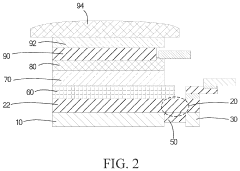
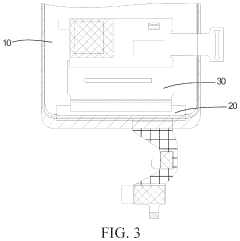
- An AMOLED panel design featuring a hydrogel layer coated between two backing plates at the bent portion, which is then solidified with ultraviolet light, providing structural strength and toughness to the fillet formed when the panel is folded, thereby preventing deformation and breakage.


Consumer Behavior Impact on AMOLED Development
Consumer preferences have played a pivotal role in shaping the evolutionary path of AMOLED (Active-Matrix Organic Light-Emitting Diode) technology. As consumers increasingly demand high-quality displays with vibrant colors, deep blacks, and energy efficiency, AMOLED has emerged as a leading display technology in various consumer electronics.
The rise of smartphones has been a significant driver in AMOLED development. Users' desire for larger screens with higher resolutions has pushed manufacturers to innovate, resulting in edge-to-edge displays and flexible AMOLED panels. This trend has led to the creation of foldable and rollable devices, catering to consumers' need for larger screens without compromising portability.
Color accuracy and vibrancy have become crucial factors in consumer decision-making. AMOLED's ability to produce rich, saturated colors and true blacks has made it a preferred choice for content consumption. This preference has driven manufacturers to focus on improving color gamut coverage and enhancing HDR capabilities in AMOLED displays.
Energy efficiency has also been a key concern for consumers, particularly in mobile devices. AMOLED's ability to selectively illuminate pixels has led to the development of features like Always-On Display, which provides information without significantly impacting battery life. This has prompted further research into reducing power consumption while maintaining display quality.
Durability and longevity have become increasingly important to consumers, leading to advancements in AMOLED panel construction and materials. Manufacturers have invested in developing more robust organic compounds and implementing technologies to mitigate issues like burn-in, which has been a historical concern for OLED-based displays.
The growing interest in wearable technology has also influenced AMOLED development. Consumers demand displays that are not only visually appealing but also flexible and power-efficient for use in smartwatches and fitness trackers. This has led to the creation of ultra-thin, curved AMOLED panels that can conform to various form factors.
As virtual and augmented reality technologies gain traction, consumer expectations for immersive visual experiences have driven AMOLED innovation in the direction of higher refresh rates and lower latency. These improvements are crucial for reducing motion sickness and enhancing the overall user experience in VR and AR applications.
In conclusion, consumer preferences have been instrumental in guiding the evolution of AMOLED technology. From smartphones to wearables and emerging technologies, the demands for better visual quality, energy efficiency, and innovative form factors continue to push the boundaries of what AMOLED can achieve, shaping its future development trajectory.
The rise of smartphones has been a significant driver in AMOLED development. Users' desire for larger screens with higher resolutions has pushed manufacturers to innovate, resulting in edge-to-edge displays and flexible AMOLED panels. This trend has led to the creation of foldable and rollable devices, catering to consumers' need for larger screens without compromising portability.
Color accuracy and vibrancy have become crucial factors in consumer decision-making. AMOLED's ability to produce rich, saturated colors and true blacks has made it a preferred choice for content consumption. This preference has driven manufacturers to focus on improving color gamut coverage and enhancing HDR capabilities in AMOLED displays.
Energy efficiency has also been a key concern for consumers, particularly in mobile devices. AMOLED's ability to selectively illuminate pixels has led to the development of features like Always-On Display, which provides information without significantly impacting battery life. This has prompted further research into reducing power consumption while maintaining display quality.
Durability and longevity have become increasingly important to consumers, leading to advancements in AMOLED panel construction and materials. Manufacturers have invested in developing more robust organic compounds and implementing technologies to mitigate issues like burn-in, which has been a historical concern for OLED-based displays.
The growing interest in wearable technology has also influenced AMOLED development. Consumers demand displays that are not only visually appealing but also flexible and power-efficient for use in smartwatches and fitness trackers. This has led to the creation of ultra-thin, curved AMOLED panels that can conform to various form factors.
As virtual and augmented reality technologies gain traction, consumer expectations for immersive visual experiences have driven AMOLED innovation in the direction of higher refresh rates and lower latency. These improvements are crucial for reducing motion sickness and enhancing the overall user experience in VR and AR applications.
In conclusion, consumer preferences have been instrumental in guiding the evolution of AMOLED technology. From smartphones to wearables and emerging technologies, the demands for better visual quality, energy efficiency, and innovative form factors continue to push the boundaries of what AMOLED can achieve, shaping its future development trajectory.
Sustainability in AMOLED Manufacturing
Sustainability in AMOLED manufacturing has become a critical focus as consumer preferences increasingly lean towards environmentally responsible products. This shift in consumer mindset is driving AMOLED manufacturers to adopt more sustainable practices throughout their production processes.
One of the primary areas of improvement is in the reduction of energy consumption during manufacturing. AMOLED production traditionally requires significant energy input, particularly in the deposition of organic materials and the creation of thin-film transistors. Manufacturers are now investing in more energy-efficient equipment and optimizing their production lines to minimize power usage without compromising on quality.
Water conservation is another key aspect of sustainable AMOLED manufacturing. The industry is developing innovative water recycling systems and implementing water-saving technologies to reduce the overall water footprint of production facilities. This not only aligns with consumer expectations for responsible resource management but also helps companies reduce operational costs in the long term.
Material efficiency and waste reduction are also at the forefront of sustainability efforts in AMOLED manufacturing. Companies are exploring ways to minimize material waste during production, including the implementation of more precise deposition techniques and the development of recycling processes for rare and precious materials used in AMOLED displays.
The use of hazardous substances in AMOLED production is being scrutinized and gradually phased out in response to consumer demands for safer, more environmentally friendly products. Manufacturers are researching alternative materials and processes that can deliver the same or better performance while reducing the environmental impact of their operations.
Carbon footprint reduction is another area where consumer preferences are shaping AMOLED manufacturing. Companies are increasingly adopting renewable energy sources to power their production facilities and implementing carbon offset programs to achieve carbon neutrality in their operations.
As consumers become more aware of the lifecycle impact of electronic devices, AMOLED manufacturers are also focusing on improving the recyclability and end-of-life management of their products. This includes designing displays that are easier to disassemble and recycle, as well as establishing take-back programs to ensure proper disposal and recycling of old devices.
The push for sustainability in AMOLED manufacturing is not only driven by consumer preferences but also by regulatory pressures and corporate social responsibility initiatives. As a result, the industry is seeing a gradual but significant shift towards more sustainable practices, which is likely to continue shaping the evolutionary path of AMOLED technology in the years to come.
One of the primary areas of improvement is in the reduction of energy consumption during manufacturing. AMOLED production traditionally requires significant energy input, particularly in the deposition of organic materials and the creation of thin-film transistors. Manufacturers are now investing in more energy-efficient equipment and optimizing their production lines to minimize power usage without compromising on quality.
Water conservation is another key aspect of sustainable AMOLED manufacturing. The industry is developing innovative water recycling systems and implementing water-saving technologies to reduce the overall water footprint of production facilities. This not only aligns with consumer expectations for responsible resource management but also helps companies reduce operational costs in the long term.
Material efficiency and waste reduction are also at the forefront of sustainability efforts in AMOLED manufacturing. Companies are exploring ways to minimize material waste during production, including the implementation of more precise deposition techniques and the development of recycling processes for rare and precious materials used in AMOLED displays.
The use of hazardous substances in AMOLED production is being scrutinized and gradually phased out in response to consumer demands for safer, more environmentally friendly products. Manufacturers are researching alternative materials and processes that can deliver the same or better performance while reducing the environmental impact of their operations.
Carbon footprint reduction is another area where consumer preferences are shaping AMOLED manufacturing. Companies are increasingly adopting renewable energy sources to power their production facilities and implementing carbon offset programs to achieve carbon neutrality in their operations.
As consumers become more aware of the lifecycle impact of electronic devices, AMOLED manufacturers are also focusing on improving the recyclability and end-of-life management of their products. This includes designing displays that are easier to disassemble and recycle, as well as establishing take-back programs to ensure proper disposal and recycling of old devices.
The push for sustainability in AMOLED manufacturing is not only driven by consumer preferences but also by regulatory pressures and corporate social responsibility initiatives. As a result, the industry is seeing a gradual but significant shift towards more sustainable practices, which is likely to continue shaping the evolutionary path of AMOLED technology in the years to come.
Unlock deeper insights with Patsnap Eureka Quick Research — get a full tech report to explore trends and direct your research. Try now!
Generate Your Research Report Instantly with AI Agent
Supercharge your innovation with Patsnap Eureka AI Agent Platform!