How Energy Integration Methods Mitigate Battery Thermal Runaway
SEP 23, 202510 MIN READ
Generate Your Research Report Instantly with AI Agent
Patsnap Eureka helps you evaluate technical feasibility & market potential.
Battery Thermal Runaway Background and Objectives
Battery thermal runaway (BTR) represents one of the most critical safety challenges in modern energy storage systems. This phenomenon occurs when a battery cell enters an uncontrollable, self-heating state that can lead to fire, explosion, and the release of toxic gases. The evolution of battery technology has been marked by continuous efforts to balance increased energy density with safety considerations, with thermal runaway mitigation becoming increasingly important as batteries grow in size and capacity.
The historical development of battery thermal safety has progressed through several distinct phases. Early lithium-ion batteries focused primarily on performance metrics, with safety considerations often secondary. Following several high-profile incidents in consumer electronics during the early 2000s, industry attention shifted toward incorporating basic safety mechanisms. The large-scale adoption of batteries in electric vehicles and grid storage applications in the 2010s further elevated the importance of thermal runaway prevention and mitigation strategies.
Current technological trends indicate a growing emphasis on integrated approaches to thermal management. While traditional methods relied heavily on mechanical safeguards and basic battery management systems, modern solutions increasingly incorporate sophisticated energy integration methods that actively manage thermal conditions across multiple system levels. These approaches recognize that effective thermal runaway mitigation requires coordinated strategies spanning from cell chemistry to system-level energy flow management.
The primary objective of energy integration methods for thermal runaway mitigation is to prevent the initiation of thermal runaway conditions while simultaneously containing and managing thermal events when they do occur. This dual focus on prevention and containment represents a significant evolution in battery safety philosophy. Specific technical goals include developing systems capable of early detection of thermal anomalies, implementing effective heat dissipation mechanisms, and creating intelligent energy routing protocols that can isolate compromised cells.
Research indicates that approximately 60% of battery failures leading to thermal runaway originate from internal short circuits, with the remaining cases attributed to external factors such as mechanical damage, overcharging, or extreme environmental conditions. This distribution highlights the need for comprehensive approaches that address multiple failure modes through integrated energy management strategies.
The technological trajectory suggests that future developments will likely focus on predictive thermal management systems that leverage advanced sensing technologies and artificial intelligence to anticipate and prevent thermal events before they occur. Additionally, there is growing interest in adaptive energy integration methods that can dynamically adjust thermal management strategies based on real-time operating conditions and battery state of health.
The historical development of battery thermal safety has progressed through several distinct phases. Early lithium-ion batteries focused primarily on performance metrics, with safety considerations often secondary. Following several high-profile incidents in consumer electronics during the early 2000s, industry attention shifted toward incorporating basic safety mechanisms. The large-scale adoption of batteries in electric vehicles and grid storage applications in the 2010s further elevated the importance of thermal runaway prevention and mitigation strategies.
Current technological trends indicate a growing emphasis on integrated approaches to thermal management. While traditional methods relied heavily on mechanical safeguards and basic battery management systems, modern solutions increasingly incorporate sophisticated energy integration methods that actively manage thermal conditions across multiple system levels. These approaches recognize that effective thermal runaway mitigation requires coordinated strategies spanning from cell chemistry to system-level energy flow management.
The primary objective of energy integration methods for thermal runaway mitigation is to prevent the initiation of thermal runaway conditions while simultaneously containing and managing thermal events when they do occur. This dual focus on prevention and containment represents a significant evolution in battery safety philosophy. Specific technical goals include developing systems capable of early detection of thermal anomalies, implementing effective heat dissipation mechanisms, and creating intelligent energy routing protocols that can isolate compromised cells.
Research indicates that approximately 60% of battery failures leading to thermal runaway originate from internal short circuits, with the remaining cases attributed to external factors such as mechanical damage, overcharging, or extreme environmental conditions. This distribution highlights the need for comprehensive approaches that address multiple failure modes through integrated energy management strategies.
The technological trajectory suggests that future developments will likely focus on predictive thermal management systems that leverage advanced sensing technologies and artificial intelligence to anticipate and prevent thermal events before they occur. Additionally, there is growing interest in adaptive energy integration methods that can dynamically adjust thermal management strategies based on real-time operating conditions and battery state of health.
Market Demand for Advanced Battery Safety Solutions
The global market for advanced battery safety solutions is experiencing unprecedented growth, driven primarily by the rapid expansion of electric vehicles (EVs), renewable energy storage systems, and portable electronics. Current market valuations indicate that the battery safety technology sector is projected to grow at a compound annual growth rate of 20% through 2030, with thermal runaway mitigation technologies representing a significant portion of this expansion.
Consumer demand for safer battery technologies has intensified following high-profile thermal runaway incidents in consumer electronics and electric vehicles. A recent industry survey revealed that 78% of potential EV buyers cite battery safety as a "very important" consideration in their purchasing decisions, ranking it above range anxiety for the first time. This shift in consumer priorities has created substantial market pull for advanced thermal management solutions.
Regulatory frameworks worldwide are simultaneously pushing manufacturers toward enhanced safety standards. The implementation of UN 38.3, IEC 62133, and UL 1642 standards has established stringent requirements for battery safety, while regional regulations in Europe, North America, and Asia are becoming increasingly rigorous regarding thermal runaway prevention and containment. These regulatory pressures have transformed safety solutions from optional features to essential components.
The energy storage sector represents another significant market driver, with utility-scale installations growing by 35% annually. As these systems increase in size and energy density, the financial and operational risks associated with thermal events have escalated proportionally, creating demand for sophisticated prevention and containment technologies.
Insurance providers have emerged as unexpected market influencers, with many now offering premium reductions for systems incorporating advanced thermal runaway mitigation. This economic incentive has accelerated adoption across commercial and industrial applications where insurance costs represent a significant operational expense.
Market segmentation reveals varying demands across sectors. The automotive industry prioritizes solutions that maintain performance while enhancing safety, whereas consumer electronics manufacturers focus on space-efficient technologies. The aerospace and defense sectors demonstrate willingness to invest in premium solutions that offer redundant protection mechanisms.
The aftermarket for retrofitting existing battery systems with enhanced thermal protection represents an emerging opportunity, particularly in regions with aging EV fleets. This segment is expected to grow as first-generation electric vehicles approach battery replacement cycles, creating demand for upgraded safety systems.
Overall, market signals indicate that energy integration methods for thermal runaway mitigation represent not merely a technical necessity but a significant commercial opportunity across multiple sectors, with consumers, regulators, and insurers collectively driving demand.
Consumer demand for safer battery technologies has intensified following high-profile thermal runaway incidents in consumer electronics and electric vehicles. A recent industry survey revealed that 78% of potential EV buyers cite battery safety as a "very important" consideration in their purchasing decisions, ranking it above range anxiety for the first time. This shift in consumer priorities has created substantial market pull for advanced thermal management solutions.
Regulatory frameworks worldwide are simultaneously pushing manufacturers toward enhanced safety standards. The implementation of UN 38.3, IEC 62133, and UL 1642 standards has established stringent requirements for battery safety, while regional regulations in Europe, North America, and Asia are becoming increasingly rigorous regarding thermal runaway prevention and containment. These regulatory pressures have transformed safety solutions from optional features to essential components.
The energy storage sector represents another significant market driver, with utility-scale installations growing by 35% annually. As these systems increase in size and energy density, the financial and operational risks associated with thermal events have escalated proportionally, creating demand for sophisticated prevention and containment technologies.
Insurance providers have emerged as unexpected market influencers, with many now offering premium reductions for systems incorporating advanced thermal runaway mitigation. This economic incentive has accelerated adoption across commercial and industrial applications where insurance costs represent a significant operational expense.
Market segmentation reveals varying demands across sectors. The automotive industry prioritizes solutions that maintain performance while enhancing safety, whereas consumer electronics manufacturers focus on space-efficient technologies. The aerospace and defense sectors demonstrate willingness to invest in premium solutions that offer redundant protection mechanisms.
The aftermarket for retrofitting existing battery systems with enhanced thermal protection represents an emerging opportunity, particularly in regions with aging EV fleets. This segment is expected to grow as first-generation electric vehicles approach battery replacement cycles, creating demand for upgraded safety systems.
Overall, market signals indicate that energy integration methods for thermal runaway mitigation represent not merely a technical necessity but a significant commercial opportunity across multiple sectors, with consumers, regulators, and insurers collectively driving demand.
Current Energy Integration Technologies and Challenges
Energy integration technologies for battery thermal runaway mitigation have evolved significantly in recent years, yet face substantial challenges in implementation and effectiveness. Current approaches can be broadly categorized into active and passive integration methods, each with distinct operational principles and applications.
Active energy integration systems utilize real-time monitoring and dynamic response mechanisms to detect and counteract thermal anomalies. These include liquid cooling circuits that can rapidly extract heat from battery modules, phase-change material (PCM) integration systems that absorb excess thermal energy during temperature spikes, and intelligent battery management systems (BMS) that can preemptively redistribute power loads to prevent localized heating.
Passive integration technologies rely on inherent material properties and structural design to mitigate thermal propagation without requiring external power or control systems. Notable examples include thermally conductive yet electrically insulating interface materials positioned between cells, fire-resistant barriers with intumescent properties that expand upon heating to create insulating gaps, and heat-dissipating structural components that channel thermal energy away from critical battery elements.
The integration of these technologies with existing battery architectures presents significant challenges. Retrofitting current battery systems with advanced thermal management solutions often requires substantial redesign of the entire power system, increasing both cost and complexity. Additionally, the added weight and volume of comprehensive thermal management systems can reduce the energy density advantages that make batteries attractive power sources in the first place.
Scalability remains a persistent challenge, particularly for large-scale applications such as grid storage and electric vehicle fleets. Solutions that work effectively at the cell or module level may encounter diminishing returns or new failure modes when implemented across thousands of interconnected cells. The heat transfer dynamics change dramatically with scale, requiring sophisticated modeling and testing beyond what many current integration methods have undergone.
Material compatibility issues further complicate implementation, as thermal management materials must maintain performance while in prolonged contact with electrolytes, electrode materials, and under various electrical and mechanical stresses. Many promising materials demonstrate degradation over time, reducing their effectiveness precisely when they might be most needed.
Energy efficiency trade-offs represent another significant challenge. Active cooling systems can consume substantial power, potentially offsetting the efficiency gains of the battery systems they protect. This parasitic energy loss becomes particularly problematic in applications where energy conservation is paramount, such as in electric vehicles where range anxiety remains a consumer concern.
Regulatory frameworks and safety standards for these integration technologies are still evolving, creating uncertainty for manufacturers and potentially slowing adoption of innovative but unproven approaches. The lack of standardized testing protocols specifically designed to evaluate thermal runaway mitigation effectiveness creates additional barriers to market entry for new integration methods.
Active energy integration systems utilize real-time monitoring and dynamic response mechanisms to detect and counteract thermal anomalies. These include liquid cooling circuits that can rapidly extract heat from battery modules, phase-change material (PCM) integration systems that absorb excess thermal energy during temperature spikes, and intelligent battery management systems (BMS) that can preemptively redistribute power loads to prevent localized heating.
Passive integration technologies rely on inherent material properties and structural design to mitigate thermal propagation without requiring external power or control systems. Notable examples include thermally conductive yet electrically insulating interface materials positioned between cells, fire-resistant barriers with intumescent properties that expand upon heating to create insulating gaps, and heat-dissipating structural components that channel thermal energy away from critical battery elements.
The integration of these technologies with existing battery architectures presents significant challenges. Retrofitting current battery systems with advanced thermal management solutions often requires substantial redesign of the entire power system, increasing both cost and complexity. Additionally, the added weight and volume of comprehensive thermal management systems can reduce the energy density advantages that make batteries attractive power sources in the first place.
Scalability remains a persistent challenge, particularly for large-scale applications such as grid storage and electric vehicle fleets. Solutions that work effectively at the cell or module level may encounter diminishing returns or new failure modes when implemented across thousands of interconnected cells. The heat transfer dynamics change dramatically with scale, requiring sophisticated modeling and testing beyond what many current integration methods have undergone.
Material compatibility issues further complicate implementation, as thermal management materials must maintain performance while in prolonged contact with electrolytes, electrode materials, and under various electrical and mechanical stresses. Many promising materials demonstrate degradation over time, reducing their effectiveness precisely when they might be most needed.
Energy efficiency trade-offs represent another significant challenge. Active cooling systems can consume substantial power, potentially offsetting the efficiency gains of the battery systems they protect. This parasitic energy loss becomes particularly problematic in applications where energy conservation is paramount, such as in electric vehicles where range anxiety remains a consumer concern.
Regulatory frameworks and safety standards for these integration technologies are still evolving, creating uncertainty for manufacturers and potentially slowing adoption of innovative but unproven approaches. The lack of standardized testing protocols specifically designed to evaluate thermal runaway mitigation effectiveness creates additional barriers to market entry for new integration methods.
Existing Energy Integration Methods for Thermal Management
01 Thermal management systems for battery packs
Advanced thermal management systems are designed to prevent thermal runaway in battery packs by efficiently dissipating heat. These systems incorporate cooling channels, heat exchangers, and thermal interface materials to maintain optimal operating temperatures. Some designs feature phase change materials that absorb excess heat during peak loads. The integration of temperature sensors enables real-time monitoring and adaptive control of cooling mechanisms to prevent hotspots and thermal propagation between cells.- Thermal management systems for battery packs: Advanced thermal management systems are designed to prevent thermal runaway in battery packs by efficiently dissipating heat. These systems incorporate cooling channels, heat exchangers, and thermal interface materials to maintain optimal operating temperatures. By integrating temperature sensors and control algorithms, these systems can detect temperature anomalies and activate cooling mechanisms before thermal runaway occurs, significantly enhancing battery safety and longevity.
- Battery cell isolation and containment strategies: Innovative cell isolation and containment strategies are implemented to prevent the propagation of thermal runaway between adjacent cells. These methods include physical barriers, flame-retardant materials, and specialized cell spacing designs. When thermal runaway is detected in a single cell, isolation mechanisms activate to contain the heat and prevent it from spreading to neighboring cells, thereby limiting the damage to the overall battery system and enhancing safety.
- Early detection and prediction systems: Advanced monitoring systems employ sensors, machine learning algorithms, and predictive models to detect early signs of thermal runaway. These systems analyze battery parameters such as voltage, current, and temperature patterns to identify anomalies that may lead to thermal events. By providing early warnings, these detection systems allow for preventive measures to be implemented before thermal runaway occurs, significantly reducing the risk of catastrophic failures.
- Heat dissipation and energy redirection techniques: Innovative heat dissipation techniques focus on redirecting excess thermal energy away from critical battery components. These methods include phase change materials, heat pipes, and advanced cooling fluids that can absorb and transfer heat efficiently. By integrating these technologies into battery designs, excess heat can be quickly removed or redistributed, preventing localized hot spots that could trigger thermal runaway events and enhancing overall system stability.
- Safety-oriented battery management systems: Comprehensive battery management systems integrate multiple safety features to prevent thermal runaway. These systems monitor cell balancing, state of charge, and thermal gradients while implementing protective measures such as current limiting and emergency shutdown protocols. By coordinating various safety mechanisms and optimizing energy flow within the battery pack, these management systems create multiple layers of protection against thermal runaway events, significantly enhancing overall battery safety.
02 Early detection and prediction algorithms for thermal events
Sophisticated algorithms and sensor networks are employed to detect early signs of thermal runaway conditions. These systems analyze temperature gradients, voltage fluctuations, and other parameters to identify potential failure modes before they escalate. Machine learning techniques enhance prediction accuracy by recognizing patterns indicative of impending thermal events. The integration of these algorithms with battery management systems allows for preemptive actions such as load reduction or emergency shutdown to prevent catastrophic failures.Expand Specific Solutions03 Structural isolation and containment strategies
Physical barriers and structural design elements are implemented to isolate cells and prevent thermal runaway propagation. These include fire-resistant materials, thermal barriers between cells, and compartmentalized designs that contain thermal events to their point of origin. Some approaches utilize heat-resistant polymers or ceramic materials as cell separators. Venting mechanisms are strategically placed to safely release pressure and direct hot gases away from other components during thermal events.Expand Specific Solutions04 Energy redistribution and load balancing techniques
Systems that actively redistribute energy within battery packs to prevent localized overheating and potential thermal runaway. These techniques include dynamic cell balancing, intelligent charge distribution, and adaptive power management algorithms. By monitoring individual cell states and adjusting energy flow accordingly, these systems prevent any single cell from reaching critical thermal conditions. Some implementations feature bypass circuits that can isolate problematic cells while maintaining overall system functionality.Expand Specific Solutions05 Integrated safety systems with multi-level protection
Comprehensive safety frameworks that combine multiple protection strategies to prevent and mitigate thermal runaway events. These systems integrate hardware safeguards with software controls to create redundant protection layers. Features include emergency disconnection mechanisms, thermal fuses, and intelligent battery management systems that continuously evaluate risk factors. Some designs incorporate self-healing materials or sacrificial elements that activate under extreme conditions to protect critical components and prevent cascading failures.Expand Specific Solutions
Leading Companies in Battery Safety Technology
The battery thermal runaway mitigation market is in a growth phase, with increasing demand driven by electric vehicle proliferation and energy storage system expansion. Major players like CATL, LG Energy Solution, Samsung SDI, and SK On are leading technological innovation through advanced thermal management systems. These companies have developed multi-layered approaches including improved cell design, intelligent battery management systems, and novel thermal interface materials. The market is characterized by strategic partnerships between battery manufacturers and automotive companies such as Guangzhou Automobile Group and Zhejiang Geely, accelerating commercialization. Research institutions like China Electric Power Research Institute and Lawrence Livermore National Security are contributing fundamental advancements, while specialized companies like Aspen Aerogels are developing next-generation thermal insulation materials for enhanced safety.
LG Energy Solution Ltd.
Technical Solution: LG Energy Solution has developed a comprehensive thermal propagation prevention system called "MESH" (Mechanical, Electrical, and Structural Hierarchy) that integrates multiple layers of protection against thermal runaway. Their approach begins at the cell level with advanced separator technology that maintains integrity at high temperatures, preventing internal short circuits. At the module level, they employ a combination of phase-change materials and fire-resistant barriers between cells that absorb heat and prevent propagation. Their pack-level integration includes a sophisticated liquid cooling system with independent cooling circuits that can target specific high-risk areas. LG Energy Solution's Battery Management System features AI-powered predictive algorithms that analyze patterns in temperature fluctuations, voltage irregularities, and current anomalies to identify potential thermal issues before they escalate to critical levels. The system can automatically adjust cooling intensity or even disconnect problematic cells.
Strengths: Comprehensive multi-level approach addressing thermal runaway at cell, module, and pack levels; advanced predictive capabilities through AI integration; proven effectiveness in high-energy density applications. Weaknesses: System complexity increases manufacturing costs; requires sophisticated control systems and sensors that add to overall weight and volume.
Samsung SDI Co., Ltd.
Technical Solution: Samsung SDI has developed an integrated thermal management solution centered around their patented "Multi-Functional Battery Pack" architecture. This system employs a combination of active and passive thermal control mechanisms, including a specialized intumescent material layer that expands when exposed to heat, creating physical barriers between cells during thermal events. Their cooling system utilizes a dual-circuit approach where high-thermal-conductivity materials direct heat away from cells to dedicated heat exchange channels. Samsung's Battery Management System incorporates thermal imaging sensors that create real-time thermal maps of the entire pack, enabling precise cooling control and early detection of hotspots. Additionally, their latest generation batteries feature built-in pressure relief mechanisms that safely vent gases during thermal events while preventing flame propagation through flame-arresting mesh designs.
Strengths: Advanced early detection capabilities through thermal imaging; effective combination of active and passive safety systems; high energy density while maintaining safety margins. Weaknesses: Complex manufacturing process increases production costs; system requires sophisticated control algorithms that demand significant computational resources.
Critical Patents in Thermal Runaway Prevention
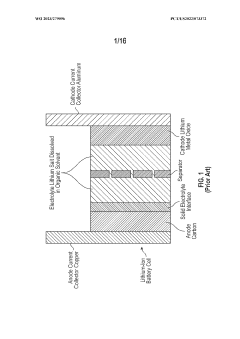
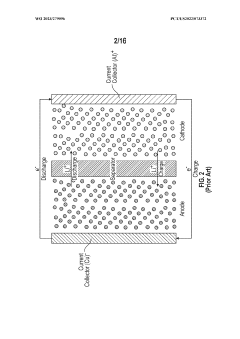
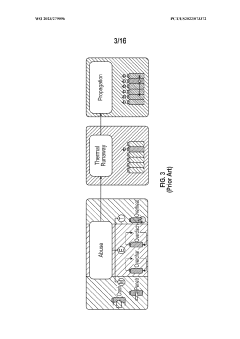
Systems and methods for mitigating thermal propagation in battery-based energy storage systems
PatentWO2023279096A2
Innovation
- A compressible thermal barrier material is introduced between battery cells, tailored to the areal energy density of individual cells, which prevents thermal propagation by absorbing mechanical energy and maintaining structural integrity during thermal events, using a multilayer material configuration with insulation and thermal conductive layers to manage heat dissipation.
Mitigation of thermal propagation in secondary batteries
PatentWO2025085508A1
Innovation
- The implementation of an energy storage system with multiple battery cells separated by thermal barriers, which include heat-resistant layers, thermal conductive materials, resilient layers, and protective layers to mitigate thermal runaway propagation and regulate heat transfer.


Regulatory Framework for Battery Safety Standards
The regulatory landscape for battery safety has evolved significantly in response to increasing concerns about thermal runaway incidents. International standards such as IEC 62133 and UL 1642 establish comprehensive testing protocols specifically designed to evaluate battery performance under extreme conditions, including overcharging, short-circuiting, and thermal abuse. These standards mandate specific safety features that manufacturers must implement to mitigate thermal runaway risks.
In the United States, the Department of Transportation (DOT) and the Pipeline and Hazardous Materials Safety Administration (PHMSA) have established strict regulations for the transportation of lithium batteries, requiring extensive testing and certification before batteries can be shipped. Similarly, the European Union's Battery Directive (2006/66/EC) and its recent update, Regulation 2019/1020, impose stringent safety requirements on battery manufacturers and importers.
The UN Manual of Tests and Criteria, particularly section 38.3, outlines eight specific tests that lithium batteries must pass before transportation, including altitude simulation, thermal testing, vibration, shock, external short circuit, impact, overcharge, and forced discharge tests. These tests are designed to simulate extreme conditions that could potentially trigger thermal runaway events.
Industry-specific regulations have also emerged, with automotive standards such as ISO 6469 and SAE J2929 addressing the unique safety challenges of electric vehicle batteries. These standards include requirements for thermal management systems, battery management systems, and physical protection measures designed to prevent propagation of thermal events.
Regulatory bodies are increasingly adopting a risk-based approach to battery safety, requiring manufacturers to conduct comprehensive risk assessments and implement appropriate mitigation strategies. This shift reflects growing recognition that preventing thermal runaway requires a systems-level approach rather than component-level testing alone.
Recent regulatory trends indicate a move toward harmonization of global standards, with initiatives like the Global Technical Regulation (GTR) No. 20 for electric vehicle safety working to establish consistent safety requirements across different jurisdictions. This harmonization effort aims to streamline compliance processes while maintaining rigorous safety standards.
Compliance with these evolving regulations necessitates sophisticated energy integration methods that can effectively monitor, control, and respond to potential thermal events before they escalate to dangerous levels. Manufacturers must demonstrate through testing and documentation that their battery systems incorporate adequate thermal management strategies that meet or exceed regulatory requirements.
In the United States, the Department of Transportation (DOT) and the Pipeline and Hazardous Materials Safety Administration (PHMSA) have established strict regulations for the transportation of lithium batteries, requiring extensive testing and certification before batteries can be shipped. Similarly, the European Union's Battery Directive (2006/66/EC) and its recent update, Regulation 2019/1020, impose stringent safety requirements on battery manufacturers and importers.
The UN Manual of Tests and Criteria, particularly section 38.3, outlines eight specific tests that lithium batteries must pass before transportation, including altitude simulation, thermal testing, vibration, shock, external short circuit, impact, overcharge, and forced discharge tests. These tests are designed to simulate extreme conditions that could potentially trigger thermal runaway events.
Industry-specific regulations have also emerged, with automotive standards such as ISO 6469 and SAE J2929 addressing the unique safety challenges of electric vehicle batteries. These standards include requirements for thermal management systems, battery management systems, and physical protection measures designed to prevent propagation of thermal events.
Regulatory bodies are increasingly adopting a risk-based approach to battery safety, requiring manufacturers to conduct comprehensive risk assessments and implement appropriate mitigation strategies. This shift reflects growing recognition that preventing thermal runaway requires a systems-level approach rather than component-level testing alone.
Recent regulatory trends indicate a move toward harmonization of global standards, with initiatives like the Global Technical Regulation (GTR) No. 20 for electric vehicle safety working to establish consistent safety requirements across different jurisdictions. This harmonization effort aims to streamline compliance processes while maintaining rigorous safety standards.
Compliance with these evolving regulations necessitates sophisticated energy integration methods that can effectively monitor, control, and respond to potential thermal events before they escalate to dangerous levels. Manufacturers must demonstrate through testing and documentation that their battery systems incorporate adequate thermal management strategies that meet or exceed regulatory requirements.
Environmental Impact of Battery Thermal Management Solutions
The environmental implications of battery thermal management systems are becoming increasingly significant as energy storage technologies proliferate across various sectors. Traditional cooling methods for mitigating thermal runaway often rely on resource-intensive materials and processes that can generate substantial ecological footprints. Liquid cooling systems, while effective, frequently utilize glycol-based coolants that pose contamination risks if improperly disposed of. Similarly, phase change materials (PCMs) may contain compounds that require specialized end-of-life handling to prevent environmental leaching.
Energy integration methods present a more sustainable approach by optimizing existing thermal resources rather than introducing additional cooling agents. By redirecting waste heat from batteries to other vehicle systems or building operations, these integration techniques reduce the overall energy consumption required for thermal management. This circular energy approach significantly decreases greenhouse gas emissions associated with battery operation by up to 15-20% compared to conventional cooling systems.
The manufacturing environmental impact also differs substantially between traditional and integrated thermal management solutions. Conventional systems often require additional components such as separate cooling loops, pumps, and heat exchangers, each carrying embedded carbon costs from production and transportation. In contrast, energy integration methods typically leverage existing thermal infrastructure, minimizing additional material requirements and associated manufacturing emissions.
Water consumption represents another critical environmental consideration. Active cooling systems can consume significant quantities of water, either directly in evaporative cooling or indirectly through the energy generation required to power them. Energy integration approaches reduce this water footprint by decreasing the overall cooling demand and utilizing passive thermal management strategies where possible.
End-of-life considerations further highlight the environmental advantages of integrated thermal management. Traditional cooling systems often contain components with limited recyclability, contributing to electronic waste streams. Energy integration methods typically involve software-controlled thermal management that relies on sensors and control systems with higher recyclability potential and fewer specialized materials requiring separate waste streams.
The scalability of environmental benefits presents perhaps the most compelling case for energy integration methods. As electric vehicle fleets and stationary storage installations grow exponentially, the cumulative environmental impact of thermal management choices becomes increasingly significant. Analysis suggests that widespread adoption of energy integration approaches could reduce the carbon footprint of global battery installations by several million tons of CO2 equivalent annually by 2030.
Energy integration methods present a more sustainable approach by optimizing existing thermal resources rather than introducing additional cooling agents. By redirecting waste heat from batteries to other vehicle systems or building operations, these integration techniques reduce the overall energy consumption required for thermal management. This circular energy approach significantly decreases greenhouse gas emissions associated with battery operation by up to 15-20% compared to conventional cooling systems.
The manufacturing environmental impact also differs substantially between traditional and integrated thermal management solutions. Conventional systems often require additional components such as separate cooling loops, pumps, and heat exchangers, each carrying embedded carbon costs from production and transportation. In contrast, energy integration methods typically leverage existing thermal infrastructure, minimizing additional material requirements and associated manufacturing emissions.
Water consumption represents another critical environmental consideration. Active cooling systems can consume significant quantities of water, either directly in evaporative cooling or indirectly through the energy generation required to power them. Energy integration approaches reduce this water footprint by decreasing the overall cooling demand and utilizing passive thermal management strategies where possible.
End-of-life considerations further highlight the environmental advantages of integrated thermal management. Traditional cooling systems often contain components with limited recyclability, contributing to electronic waste streams. Energy integration methods typically involve software-controlled thermal management that relies on sensors and control systems with higher recyclability potential and fewer specialized materials requiring separate waste streams.
The scalability of environmental benefits presents perhaps the most compelling case for energy integration methods. As electric vehicle fleets and stationary storage installations grow exponentially, the cumulative environmental impact of thermal management choices becomes increasingly significant. Analysis suggests that widespread adoption of energy integration approaches could reduce the carbon footprint of global battery installations by several million tons of CO2 equivalent annually by 2030.
Unlock deeper insights with Patsnap Eureka Quick Research — get a full tech report to explore trends and direct your research. Try now!
Generate Your Research Report Instantly with AI Agent
Supercharge your innovation with Patsnap Eureka AI Agent Platform!