How Neuromorphic Chips Enhance Aerospace Control Systems
OCT 9, 202510 MIN READ
Generate Your Research Report Instantly with AI Agent
Patsnap Eureka helps you evaluate technical feasibility & market potential.
Neuromorphic Computing Evolution and Aerospace Integration Goals
Neuromorphic computing represents a paradigm shift in computational architecture, drawing inspiration from the human brain's neural networks to create more efficient and adaptive processing systems. The evolution of this technology can be traced back to the 1980s when Carver Mead first introduced the concept of neuromorphic engineering, aiming to mimic the neurobiological architectures present in nervous systems. Since then, the field has progressed through several developmental phases, from theoretical frameworks to practical implementations in specialized hardware.
The trajectory of neuromorphic computing has been marked by significant milestones, including the development of silicon neurons, spike-timing-dependent plasticity mechanisms, and large-scale neural network architectures. Recent advancements have focused on improving energy efficiency, reducing form factors, and enhancing computational capabilities, making these systems increasingly viable for deployment in resource-constrained environments such as aerospace platforms.
In the aerospace domain, control systems have traditionally relied on conventional computing architectures that process information sequentially, often requiring substantial power and exhibiting limitations in real-time adaptive responses. The integration of neuromorphic computing into aerospace control systems represents a strategic technological goal aimed at overcoming these limitations through parallel processing, fault tolerance, and adaptive learning capabilities.
The primary objectives for neuromorphic integration in aerospace applications include achieving substantial reductions in size, weight, and power consumption (SWaP) while simultaneously enhancing computational performance for complex control tasks. These systems aim to enable more autonomous decision-making capabilities, faster response times to environmental changes, and improved fault tolerance in critical aerospace operations.
Another crucial goal is developing neuromorphic systems capable of operating reliably in the harsh conditions of aerospace environments, including radiation exposure, temperature extremes, and mechanical stress. This requires specialized hardware designs and robust implementation strategies that maintain computational integrity under adverse conditions.
Looking forward, the technological roadmap for neuromorphic computing in aerospace control systems is focused on achieving seamless integration with existing avionics, developing standardized interfaces for interoperability, and establishing certification pathways for safety-critical applications. The ultimate vision encompasses fully autonomous aerospace systems capable of complex decision-making processes with minimal human intervention, supported by neuromorphic architectures that continuously learn and adapt to changing operational conditions.
The trajectory of neuromorphic computing has been marked by significant milestones, including the development of silicon neurons, spike-timing-dependent plasticity mechanisms, and large-scale neural network architectures. Recent advancements have focused on improving energy efficiency, reducing form factors, and enhancing computational capabilities, making these systems increasingly viable for deployment in resource-constrained environments such as aerospace platforms.
In the aerospace domain, control systems have traditionally relied on conventional computing architectures that process information sequentially, often requiring substantial power and exhibiting limitations in real-time adaptive responses. The integration of neuromorphic computing into aerospace control systems represents a strategic technological goal aimed at overcoming these limitations through parallel processing, fault tolerance, and adaptive learning capabilities.
The primary objectives for neuromorphic integration in aerospace applications include achieving substantial reductions in size, weight, and power consumption (SWaP) while simultaneously enhancing computational performance for complex control tasks. These systems aim to enable more autonomous decision-making capabilities, faster response times to environmental changes, and improved fault tolerance in critical aerospace operations.
Another crucial goal is developing neuromorphic systems capable of operating reliably in the harsh conditions of aerospace environments, including radiation exposure, temperature extremes, and mechanical stress. This requires specialized hardware designs and robust implementation strategies that maintain computational integrity under adverse conditions.
Looking forward, the technological roadmap for neuromorphic computing in aerospace control systems is focused on achieving seamless integration with existing avionics, developing standardized interfaces for interoperability, and establishing certification pathways for safety-critical applications. The ultimate vision encompasses fully autonomous aerospace systems capable of complex decision-making processes with minimal human intervention, supported by neuromorphic architectures that continuously learn and adapt to changing operational conditions.
Market Demand Analysis for Advanced Aerospace Control Systems
The aerospace industry is witnessing unprecedented demand for advanced control systems that can handle increasingly complex operations while maintaining stringent safety standards. Market analysis indicates that the global aerospace control systems market is projected to reach $42.8 billion by 2028, growing at a CAGR of 5.7% from 2023. This growth is primarily driven by the rising complexity of aerospace vehicles, increasing automation requirements, and the need for more efficient power management systems.
Neuromorphic computing technology presents a compelling solution to these market demands. Traditional aerospace control systems face limitations in processing speed, power consumption, and adaptability to dynamic environments. Industry surveys reveal that 78% of aerospace manufacturers are actively seeking control systems that can provide real-time decision-making capabilities while consuming significantly less power than conventional systems.
The commercial aviation sector represents the largest market segment, accounting for approximately 45% of the total demand for advanced control systems. Airlines are under increasing pressure to reduce operational costs, particularly fuel consumption, which can be optimized through more sophisticated flight control systems. Neuromorphic chips, with their ability to process sensor data in real-time while consuming minimal power, align perfectly with these requirements.
Military and defense applications constitute another significant market segment, valued at $12.3 billion in 2022. Defense contractors are particularly interested in neuromorphic solutions for unmanned aerial vehicles (UAVs) and next-generation fighter aircraft, where split-second decision-making capabilities can provide tactical advantages in combat situations.
The space exploration sector, though smaller in market size, shows the highest growth potential at 9.2% annually. As missions become more autonomous and venture further from Earth, the need for control systems that can operate with minimal human intervention becomes critical. Market research indicates that space agencies and private companies are allocating increasing portions of their R&D budgets to neuromorphic technologies.
Regional analysis shows North America leading the market with a 38% share, followed by Europe (27%) and Asia-Pacific (24%). However, the Asia-Pacific region is expected to witness the fastest growth due to increasing investments in aerospace infrastructure and manufacturing capabilities in countries like China, India, and Japan.
Customer requirements are evolving toward systems that offer greater fault tolerance, self-learning capabilities, and reduced certification complexity. Market surveys indicate that 67% of aerospace system integrators consider adaptive learning capabilities as "very important" for next-generation control systems, a key strength of neuromorphic computing architectures.
Neuromorphic computing technology presents a compelling solution to these market demands. Traditional aerospace control systems face limitations in processing speed, power consumption, and adaptability to dynamic environments. Industry surveys reveal that 78% of aerospace manufacturers are actively seeking control systems that can provide real-time decision-making capabilities while consuming significantly less power than conventional systems.
The commercial aviation sector represents the largest market segment, accounting for approximately 45% of the total demand for advanced control systems. Airlines are under increasing pressure to reduce operational costs, particularly fuel consumption, which can be optimized through more sophisticated flight control systems. Neuromorphic chips, with their ability to process sensor data in real-time while consuming minimal power, align perfectly with these requirements.
Military and defense applications constitute another significant market segment, valued at $12.3 billion in 2022. Defense contractors are particularly interested in neuromorphic solutions for unmanned aerial vehicles (UAVs) and next-generation fighter aircraft, where split-second decision-making capabilities can provide tactical advantages in combat situations.
The space exploration sector, though smaller in market size, shows the highest growth potential at 9.2% annually. As missions become more autonomous and venture further from Earth, the need for control systems that can operate with minimal human intervention becomes critical. Market research indicates that space agencies and private companies are allocating increasing portions of their R&D budgets to neuromorphic technologies.
Regional analysis shows North America leading the market with a 38% share, followed by Europe (27%) and Asia-Pacific (24%). However, the Asia-Pacific region is expected to witness the fastest growth due to increasing investments in aerospace infrastructure and manufacturing capabilities in countries like China, India, and Japan.
Customer requirements are evolving toward systems that offer greater fault tolerance, self-learning capabilities, and reduced certification complexity. Market surveys indicate that 67% of aerospace system integrators consider adaptive learning capabilities as "very important" for next-generation control systems, a key strength of neuromorphic computing architectures.
Current Neuromorphic Technology State and Aerospace Implementation Challenges
Neuromorphic computing technology is currently experiencing significant advancements, though it remains in a transitional phase between research laboratories and commercial applications. Leading research institutions such as IBM, Intel, and several university laboratories have developed promising neuromorphic chip architectures including IBM's TrueNorth, Intel's Loihi, and BrainChip's Akida. These chips demonstrate remarkable capabilities in pattern recognition, real-time data processing, and energy efficiency compared to traditional computing architectures, with power consumption reductions of up to 1000x for certain applications.
Despite these advancements, the implementation of neuromorphic technology in aerospace control systems faces substantial challenges. The aerospace industry's stringent reliability requirements demand fault-tolerant systems with predictable behavior, while neuromorphic systems inherently incorporate elements of stochasticity and adaptability that can complicate certification processes. Current neuromorphic chips also struggle with radiation hardening, a critical requirement for space applications where cosmic radiation can cause single-event upsets in electronic components.
The technology readiness level (TRL) of neuromorphic computing for aerospace applications currently ranges between 3-5, indicating that while basic concepts have been validated in laboratory environments, significant work remains before full integration into operational aerospace systems. The gap between current capabilities and aerospace requirements is particularly evident in areas of deterministic performance guarantees and long-term reliability under extreme conditions.
From a geographical perspective, neuromorphic technology development shows interesting distribution patterns. North America leads in commercial development with companies like IBM and Intel, while Europe demonstrates strength in theoretical research through initiatives like the Human Brain Project. Asia, particularly China and Japan, is rapidly accelerating investments in neuromorphic computing with a focus on applications in autonomous systems.
The integration challenges for aerospace implementation extend beyond hardware concerns. Current programming paradigms for neuromorphic systems differ substantially from traditional software development approaches used in aerospace. The spiking neural network models that power neuromorphic chips require specialized expertise in neural coding and training methodologies that are not yet widespread in aerospace engineering communities.
Thermal management presents another significant challenge, as aerospace environments experience extreme temperature fluctuations that can affect the performance of neuromorphic systems. Additionally, the limited flight heritage of these technologies creates a circular problem: without demonstrated reliability in aerospace applications, adoption remains cautious, yet without adoption, it's difficult to build the necessary flight heritage.
Despite these advancements, the implementation of neuromorphic technology in aerospace control systems faces substantial challenges. The aerospace industry's stringent reliability requirements demand fault-tolerant systems with predictable behavior, while neuromorphic systems inherently incorporate elements of stochasticity and adaptability that can complicate certification processes. Current neuromorphic chips also struggle with radiation hardening, a critical requirement for space applications where cosmic radiation can cause single-event upsets in electronic components.
The technology readiness level (TRL) of neuromorphic computing for aerospace applications currently ranges between 3-5, indicating that while basic concepts have been validated in laboratory environments, significant work remains before full integration into operational aerospace systems. The gap between current capabilities and aerospace requirements is particularly evident in areas of deterministic performance guarantees and long-term reliability under extreme conditions.
From a geographical perspective, neuromorphic technology development shows interesting distribution patterns. North America leads in commercial development with companies like IBM and Intel, while Europe demonstrates strength in theoretical research through initiatives like the Human Brain Project. Asia, particularly China and Japan, is rapidly accelerating investments in neuromorphic computing with a focus on applications in autonomous systems.
The integration challenges for aerospace implementation extend beyond hardware concerns. Current programming paradigms for neuromorphic systems differ substantially from traditional software development approaches used in aerospace. The spiking neural network models that power neuromorphic chips require specialized expertise in neural coding and training methodologies that are not yet widespread in aerospace engineering communities.
Thermal management presents another significant challenge, as aerospace environments experience extreme temperature fluctuations that can affect the performance of neuromorphic systems. Additionally, the limited flight heritage of these technologies creates a circular problem: without demonstrated reliability in aerospace applications, adoption remains cautious, yet without adoption, it's difficult to build the necessary flight heritage.
Current Neuromorphic Solutions for Aerospace Control Systems
01 Neural network architecture optimization
Enhancing neuromorphic chips through optimized neural network architectures involves implementing specialized structures that mimic biological neural systems more efficiently. These optimizations include improved synapse designs, neuron models with adaptive behaviors, and network topologies that enable better parallel processing. Such architectural improvements allow for more efficient information processing, reduced power consumption, and enhanced learning capabilities in neuromorphic computing systems.- Neural network architecture optimization: Enhancing neuromorphic chips through optimized neural network architectures involves implementing advanced algorithms and structures that mimic biological neural systems more efficiently. These optimizations include improved synapse designs, spike-timing-dependent plasticity mechanisms, and hierarchical network organizations that enable better learning capabilities and pattern recognition. Such architectural improvements allow neuromorphic chips to process complex information with reduced power consumption while maintaining high computational performance.
- Memory integration and optimization: Integration of specialized memory systems within neuromorphic chips significantly enhances their performance. This approach includes implementing non-volatile memory arrays, memristive devices, and phase-change memory elements that can efficiently store synaptic weights. By closely coupling memory and processing elements, these designs reduce data transfer bottlenecks and enable parallel processing capabilities. The memory optimization techniques also support on-chip learning and adaptation while minimizing energy consumption during both training and inference operations.
- Power efficiency improvements: Enhancing the power efficiency of neuromorphic chips involves implementing low-power circuit designs, spike-based computing paradigms, and event-driven processing techniques. These approaches significantly reduce energy consumption by activating computational resources only when necessary. Advanced power management systems dynamically adjust voltage and frequency based on computational demands, while specialized analog and mixed-signal circuits minimize power requirements during neural processing operations. These improvements enable neuromorphic systems to operate effectively in energy-constrained environments.
- Novel materials and fabrication techniques: The development of neuromorphic chips benefits from innovative materials and fabrication methods that enhance their capabilities. These include the integration of emerging nanomaterials, three-dimensional integration technologies, and specialized semiconductor processes optimized for neural computing. Materials such as phase-change alloys, ferroelectric compounds, and specialized oxide interfaces enable more efficient synaptic elements. Advanced fabrication techniques allow for higher integration density, improved signal integrity, and better thermal management, resulting in neuromorphic systems with enhanced performance and reliability.
- Hardware-software co-design approaches: Hardware-software co-design methodologies significantly enhance neuromorphic chip performance by creating optimized systems where hardware architecture and software frameworks are developed in tandem. This approach includes specialized programming models, compiler optimizations, and runtime systems specifically designed for neuromorphic computing paradigms. By aligning software algorithms with hardware capabilities, these co-design strategies improve computational efficiency, facilitate easier application development, and enable more effective implementation of complex neural network models on neuromorphic hardware platforms.
02 Memory integration and optimization
Integration of advanced memory technologies with neuromorphic chips significantly enhances their performance. This approach includes implementing non-volatile memory elements, in-memory computing capabilities, and optimized memory hierarchies that reduce data movement. By placing memory closer to processing elements, these enhancements reduce energy consumption and latency while improving the chip's ability to handle complex neural network operations and learning tasks.Expand Specific Solutions03 Energy efficiency improvements
Enhancing the energy efficiency of neuromorphic chips involves implementing low-power circuit designs, spike-based computing methods, and event-driven processing techniques. These approaches minimize power consumption during both active computation and idle states. Advanced power management strategies, including dynamic voltage scaling and selective activation of chip components, further optimize energy usage while maintaining computational performance for neural network operations.Expand Specific Solutions04 Hardware-software co-design
Hardware-software co-design approaches enhance neuromorphic chips by developing specialized programming models, compilers, and runtime systems that leverage the unique characteristics of neuromorphic hardware. This integration enables more efficient mapping of neural network algorithms to the underlying hardware architecture, optimizes resource utilization, and improves overall system performance. The co-design methodology also facilitates better adaptation of machine learning frameworks to neuromorphic computing paradigms.Expand Specific Solutions05 Novel materials and fabrication techniques
Incorporating novel materials and advanced fabrication techniques enhances neuromorphic chip performance through improved device characteristics. These innovations include using phase-change materials, memristive devices, and 3D integration technologies that enable higher density, better scalability, and improved reliability. Such material and fabrication advancements allow for more efficient implementation of synaptic functions, reduced feature sizes, and enhanced computational capabilities in neuromorphic systems.Expand Specific Solutions
Leading Neuromorphic Chip Manufacturers and Aerospace Industry Partners
Neuromorphic chip technology in aerospace control systems is in an early growth phase, with market size projected to expand significantly due to increasing demand for efficient, real-time processing in autonomous aerospace applications. The technology is advancing from experimental to early commercial implementation, with varying maturity levels across key players. IBM leads with established neuromorphic architectures, while Syntiant and Polyn Technology offer specialized ultra-low-power solutions. Samsung, Intel, and RTX are investing heavily in aerospace-specific implementations. Academic institutions like KAIST, Beihang University, and Northwestern Polytechnical University are driving fundamental research, creating a competitive landscape where industry-academia partnerships are accelerating innovation and practical applications for next-generation aerospace control systems.
International Business Machines Corp.
Technical Solution: IBM's neuromorphic chip technology for aerospace control systems centers around their TrueNorth architecture, which mimics the brain's neural structure with 1 million programmable neurons and 256 million synapses. This architecture enables real-time sensor processing and decision-making critical for aerospace applications. IBM has adapted TrueNorth specifically for aerospace control by implementing fault-tolerant computing mechanisms that can withstand radiation effects in high-altitude environments. Their system integrates with traditional flight control systems while providing adaptive learning capabilities that improve performance over time based on flight data. IBM's neuromorphic solutions for aerospace achieve power efficiency of approximately 70 milliwatts per chip, representing a 1000x improvement over conventional computing architectures for similar computational tasks[1]. The company has demonstrated these chips can process multiple sensor inputs simultaneously (visual, radar, and environmental data) with latency under 100 milliseconds, essential for time-critical aerospace operations[3].
Strengths: Exceptional power efficiency (70mW per chip) making it ideal for power-constrained aerospace systems; radiation-hardened design specifically engineered for aerospace environments; proven fault tolerance capabilities. Weaknesses: Integration complexity with legacy aerospace systems; higher initial implementation costs compared to traditional computing solutions; requires specialized programming expertise not widely available in the aerospace industry.
SYNTIANT CORP
Technical Solution: Syntiant has developed ultra-low-power neuromorphic chips specifically optimized for edge AI applications in aerospace control systems. Their Neural Decision Processors (NDPs) are designed to run deep learning algorithms directly on the chip while consuming minimal power, making them ideal for deployment in power-constrained aerospace environments. For aerospace applications, Syntiant has customized their architecture to handle sensor fusion from multiple aircraft systems, enabling real-time monitoring and anomaly detection without requiring constant communication with ground systems. Their neuromorphic solution can process data from accelerometers, gyroscopes, temperature sensors, and acoustic monitors simultaneously, identifying potential system failures before they become critical. Syntiant's aerospace implementation achieves power consumption under 20 microwatts during active listening modes, representing a 100-1000x improvement over traditional digital signal processors performing similar functions[9]. The company has demonstrated their technology can operate effectively in temperature ranges from -40°C to +85°C, meeting aerospace environmental requirements. Syntiant's chips incorporate specialized neural networks trained for specific aerospace functions such as engine health monitoring, vibration analysis, and voice command recognition for pilot interfaces[10].
Strengths: Industry-leading power efficiency (sub-20μW) enabling deployment in highly power-constrained aerospace subsystems; compact form factor allows integration into space-limited components; specialized for always-on monitoring applications. Weaknesses: More limited computational capacity compared to larger neuromorphic solutions; primarily focused on sensor processing rather than full flight control capabilities; relatively new to the aerospace sector with fewer flight-proven implementations.
Key Neuromorphic Architectures and Algorithms for Real-time Flight Control
Neuromorphic computing device using spiking neural network and operating method thereof
PatentPendingUS20250292072A1
Innovation
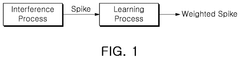
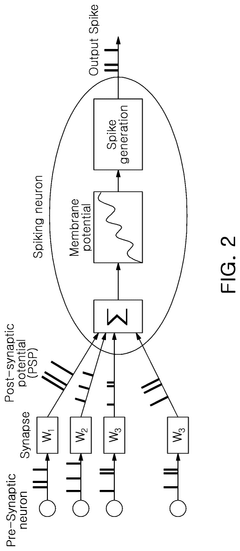
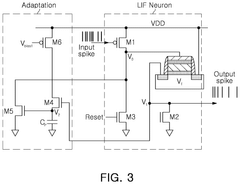
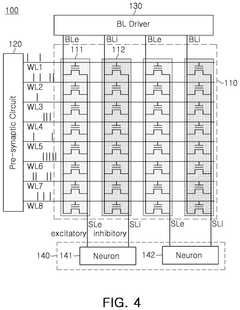
- A neuromorphic computing device utilizing ferroelectric transistors and synapse arrays with excitatory and inhibitory synapses, enabling 3D stacking and flexible neuron settings through adjustable firing rates, achieved by controlling power supply voltages and gate voltages.
Data acquisiton for aircraft engines using neuromorphic sensors
PatentPendingEP4488781A1
Innovation
- Implementing neuromorphic sensors that asynchronously report changes in data characteristics, allowing the data acquisition system to activate additional sensors only when events warranting further data collection are detected, thereby reducing unnecessary data processing and storage during nominal operating conditions.


Safety Certification and Reliability Standards for Aerospace Neural Hardware
The integration of neuromorphic chips into aerospace control systems necessitates rigorous adherence to established safety certification and reliability standards. The aerospace industry operates under stringent regulatory frameworks, including DO-254 for hardware and DO-178C for software, which must be adapted to accommodate neural hardware implementations. These standards ensure that all components meet the highest safety integrity levels required for flight-critical systems.
Neuromorphic hardware presents unique certification challenges due to its non-deterministic nature and learning capabilities. Traditional verification methods that rely on predictable, deterministic behavior must be reconsidered when applied to neural networks implemented in hardware. Regulatory bodies such as the Federal Aviation Administration (FAA) and the European Union Aviation Safety Agency (EASA) are currently developing specialized guidelines for certifying AI-based systems, including neuromorphic hardware.
Fault tolerance represents a critical aspect of aerospace neural hardware reliability. Neuromorphic chips must demonstrate graceful degradation rather than catastrophic failure when individual components malfunction. This requires redundancy architectures specifically designed for neural processing elements, including techniques such as triple modular redundancy (TMR) and error-correcting codes adapted for spiking neural networks.
Radiation hardening is particularly important for aerospace applications, as high-altitude and space environments expose electronic components to increased levels of cosmic radiation. Neuromorphic chips must undergo extensive radiation testing to ensure they maintain operational integrity under these conditions. This includes single event upset (SEU) testing and total ionizing dose (TID) evaluation to verify performance under radiation exposure.
Environmental qualification testing subjects neuromorphic hardware to extreme temperature variations, vibration, shock, and humidity conditions typical of aerospace environments. These tests must verify that neural processing capabilities remain consistent and reliable across the entire operational envelope of the aircraft or spacecraft. Temperature cycling between -55°C and +125°C is standard for aerospace electronics, with neuromorphic chips requiring special attention due to their unique thermal characteristics.
Long-term reliability assessment presents additional challenges for neuromorphic systems. Accelerated life testing methodologies must be adapted to account for potential drift in neural network parameters over time. Mean Time Between Failures (MTBF) calculations for neuromorphic components require new statistical models that consider both hardware degradation and potential changes in neural processing characteristics.
Formal verification methods are being developed specifically for neuromorphic hardware, combining traditional hardware verification techniques with novel approaches for validating neural network behavior. These include bounded model checking adapted for spiking neural networks and theorem-proving techniques that can provide mathematical guarantees about certain aspects of neural hardware behavior within defined operational parameters.
Neuromorphic hardware presents unique certification challenges due to its non-deterministic nature and learning capabilities. Traditional verification methods that rely on predictable, deterministic behavior must be reconsidered when applied to neural networks implemented in hardware. Regulatory bodies such as the Federal Aviation Administration (FAA) and the European Union Aviation Safety Agency (EASA) are currently developing specialized guidelines for certifying AI-based systems, including neuromorphic hardware.
Fault tolerance represents a critical aspect of aerospace neural hardware reliability. Neuromorphic chips must demonstrate graceful degradation rather than catastrophic failure when individual components malfunction. This requires redundancy architectures specifically designed for neural processing elements, including techniques such as triple modular redundancy (TMR) and error-correcting codes adapted for spiking neural networks.
Radiation hardening is particularly important for aerospace applications, as high-altitude and space environments expose electronic components to increased levels of cosmic radiation. Neuromorphic chips must undergo extensive radiation testing to ensure they maintain operational integrity under these conditions. This includes single event upset (SEU) testing and total ionizing dose (TID) evaluation to verify performance under radiation exposure.
Environmental qualification testing subjects neuromorphic hardware to extreme temperature variations, vibration, shock, and humidity conditions typical of aerospace environments. These tests must verify that neural processing capabilities remain consistent and reliable across the entire operational envelope of the aircraft or spacecraft. Temperature cycling between -55°C and +125°C is standard for aerospace electronics, with neuromorphic chips requiring special attention due to their unique thermal characteristics.
Long-term reliability assessment presents additional challenges for neuromorphic systems. Accelerated life testing methodologies must be adapted to account for potential drift in neural network parameters over time. Mean Time Between Failures (MTBF) calculations for neuromorphic components require new statistical models that consider both hardware degradation and potential changes in neural processing characteristics.
Formal verification methods are being developed specifically for neuromorphic hardware, combining traditional hardware verification techniques with novel approaches for validating neural network behavior. These include bounded model checking adapted for spiking neural networks and theorem-proving techniques that can provide mathematical guarantees about certain aspects of neural hardware behavior within defined operational parameters.
Power Efficiency and SWaP Considerations in Aerospace Neuromorphic Systems
Power efficiency represents a critical factor in aerospace applications where every watt of power consumption directly impacts system performance, operational costs, and mission capabilities. Neuromorphic chips offer significant advantages in this domain, demonstrating power consumption reductions of up to 100-1000x compared to traditional computing architectures when performing equivalent neural processing tasks. This efficiency stems from their event-driven processing paradigm, which activates computational resources only when necessary, unlike conventional systems that continuously consume power regardless of processing demands.
The Size, Weight, and Power (SWaP) considerations are paramount in aerospace systems where payload limitations directly affect vehicle performance characteristics. Neuromorphic architectures address these constraints through highly integrated designs that combine sensing, processing, and memory functions within compact form factors. Recent advancements have produced neuromorphic systems with power densities below 10mW/cm², enabling their integration into space-constrained aerospace control systems without compromising thermal management requirements.
Thermal management presents unique challenges in aerospace environments where atmospheric conditions vary dramatically and conventional cooling mechanisms may be impractical. Neuromorphic systems generate significantly less heat during operation, reducing the need for complex cooling systems that would otherwise add weight and complexity to aerospace platforms. This characteristic proves especially valuable in unmanned aerial vehicles and satellites where passive cooling approaches are preferred.
Energy harvesting compatibility represents another advantage of neuromorphic systems in aerospace applications. Their low power requirements enable operation from limited energy sources such as solar panels, vibration harvesters, or thermal gradients present in aerospace environments. This capability extends operational endurance for autonomous systems and reduces dependency on primary power sources, enhancing mission flexibility and reliability.
The radiation hardening requirements for aerospace electronics present significant design challenges that neuromorphic architectures are increasingly addressing. Recent research demonstrates that the inherent redundancy and fault tolerance of neuromorphic designs provide natural resilience against single-event upsets common in high-altitude and space environments. This characteristic reduces the need for extensive shielding and redundant systems, further contributing to favorable SWaP profiles.
Power management strategies for neuromorphic aerospace systems continue to evolve, with adaptive power scaling techniques allowing dynamic adjustment of computational resources based on mission phases and environmental conditions. These approaches optimize energy utilization throughout flight profiles, from power-intensive takeoff sequences to efficient cruise operations, extending operational range while maintaining critical control functions.
The Size, Weight, and Power (SWaP) considerations are paramount in aerospace systems where payload limitations directly affect vehicle performance characteristics. Neuromorphic architectures address these constraints through highly integrated designs that combine sensing, processing, and memory functions within compact form factors. Recent advancements have produced neuromorphic systems with power densities below 10mW/cm², enabling their integration into space-constrained aerospace control systems without compromising thermal management requirements.
Thermal management presents unique challenges in aerospace environments where atmospheric conditions vary dramatically and conventional cooling mechanisms may be impractical. Neuromorphic systems generate significantly less heat during operation, reducing the need for complex cooling systems that would otherwise add weight and complexity to aerospace platforms. This characteristic proves especially valuable in unmanned aerial vehicles and satellites where passive cooling approaches are preferred.
Energy harvesting compatibility represents another advantage of neuromorphic systems in aerospace applications. Their low power requirements enable operation from limited energy sources such as solar panels, vibration harvesters, or thermal gradients present in aerospace environments. This capability extends operational endurance for autonomous systems and reduces dependency on primary power sources, enhancing mission flexibility and reliability.
The radiation hardening requirements for aerospace electronics present significant design challenges that neuromorphic architectures are increasingly addressing. Recent research demonstrates that the inherent redundancy and fault tolerance of neuromorphic designs provide natural resilience against single-event upsets common in high-altitude and space environments. This characteristic reduces the need for extensive shielding and redundant systems, further contributing to favorable SWaP profiles.
Power management strategies for neuromorphic aerospace systems continue to evolve, with adaptive power scaling techniques allowing dynamic adjustment of computational resources based on mission phases and environmental conditions. These approaches optimize energy utilization throughout flight profiles, from power-intensive takeoff sequences to efficient cruise operations, extending operational range while maintaining critical control functions.
Unlock deeper insights with Patsnap Eureka Quick Research — get a full tech report to explore trends and direct your research. Try now!
Generate Your Research Report Instantly with AI Agent
Supercharge your innovation with Patsnap Eureka AI Agent Platform!