How Schmitt Trigger Reduces Power Consumption in ICs
SEP 23, 20259 MIN READ
Generate Your Research Report Instantly with AI Agent
PatSnap Eureka helps you evaluate technical feasibility & market potential.
Schmitt Trigger Power Efficiency Background and Objectives
The Schmitt trigger, invented by Otto Schmitt in 1934, represents a significant milestone in electronic circuit design, particularly for its hysteresis characteristics that enhance noise immunity. This fundamental circuit element has evolved from discrete component implementations to integrated solutions within modern semiconductor devices, becoming increasingly relevant in the context of power-efficient integrated circuit design.
The evolution of Schmitt triggers parallels the broader trajectory of semiconductor technology, transitioning from vacuum tubes to transistors and eventually to highly integrated CMOS implementations. As power consumption emerged as a critical constraint in electronic systems, particularly with the proliferation of battery-powered devices and IoT applications, the role of Schmitt triggers in power optimization has gained renewed attention from circuit designers and researchers.
Power efficiency in integrated circuits has become paramount due to several converging factors: the exponential growth in mobile and wearable technologies, environmental sustainability concerns, and the thermal management challenges in densely packed electronic systems. Within this context, Schmitt triggers offer unique advantages for reducing power consumption through their ability to minimize spurious switching events and provide clean signal transitions.
The primary technical objective of this investigation is to comprehensively analyze how Schmitt trigger circuits contribute to power reduction in modern integrated circuits. This includes examining the fundamental mechanisms by which hysteresis characteristics prevent unnecessary switching, quantifying the power savings across different implementation technologies, and identifying optimal design parameters for maximizing energy efficiency.
Secondary objectives include exploring the trade-offs between power consumption, switching speed, and area overhead when implementing Schmitt triggers in various IC technologies. Additionally, we aim to identify emerging design techniques that further enhance the power-saving capabilities of Schmitt trigger circuits, particularly in sub-threshold and near-threshold operating regions where traditional CMOS circuits face significant challenges.
The scope of this technical exploration encompasses both digital and analog applications, ranging from input buffers and level shifters to oscillators and sensor interfaces. Special attention will be given to ultra-low-power applications such as energy harvesting systems, biomedical implants, and extended-life IoT devices where every microjoule of energy savings translates to meaningful improvements in system performance and longevity.
By establishing a clear understanding of the historical context, current technological landscape, and future potential of Schmitt triggers in power-efficient circuit design, this investigation aims to provide valuable insights for circuit designers seeking to optimize energy consumption in next-generation integrated systems.
The evolution of Schmitt triggers parallels the broader trajectory of semiconductor technology, transitioning from vacuum tubes to transistors and eventually to highly integrated CMOS implementations. As power consumption emerged as a critical constraint in electronic systems, particularly with the proliferation of battery-powered devices and IoT applications, the role of Schmitt triggers in power optimization has gained renewed attention from circuit designers and researchers.
Power efficiency in integrated circuits has become paramount due to several converging factors: the exponential growth in mobile and wearable technologies, environmental sustainability concerns, and the thermal management challenges in densely packed electronic systems. Within this context, Schmitt triggers offer unique advantages for reducing power consumption through their ability to minimize spurious switching events and provide clean signal transitions.
The primary technical objective of this investigation is to comprehensively analyze how Schmitt trigger circuits contribute to power reduction in modern integrated circuits. This includes examining the fundamental mechanisms by which hysteresis characteristics prevent unnecessary switching, quantifying the power savings across different implementation technologies, and identifying optimal design parameters for maximizing energy efficiency.
Secondary objectives include exploring the trade-offs between power consumption, switching speed, and area overhead when implementing Schmitt triggers in various IC technologies. Additionally, we aim to identify emerging design techniques that further enhance the power-saving capabilities of Schmitt trigger circuits, particularly in sub-threshold and near-threshold operating regions where traditional CMOS circuits face significant challenges.
The scope of this technical exploration encompasses both digital and analog applications, ranging from input buffers and level shifters to oscillators and sensor interfaces. Special attention will be given to ultra-low-power applications such as energy harvesting systems, biomedical implants, and extended-life IoT devices where every microjoule of energy savings translates to meaningful improvements in system performance and longevity.
By establishing a clear understanding of the historical context, current technological landscape, and future potential of Schmitt triggers in power-efficient circuit design, this investigation aims to provide valuable insights for circuit designers seeking to optimize energy consumption in next-generation integrated systems.
Market Demand for Low-Power IC Solutions
The global market for low-power integrated circuits (ICs) has experienced substantial growth over the past decade, driven primarily by the proliferation of battery-powered portable electronic devices and the increasing emphasis on energy efficiency across all electronic systems. Current market research indicates that the low-power IC market is valued at approximately $25 billion and is projected to grow at a compound annual growth rate of 8.5% through 2028.
Mobile devices represent the largest segment demanding low-power IC solutions, accounting for nearly 40% of the total market. Smartphone manufacturers continually seek components that extend battery life while maintaining or improving performance, making Schmitt trigger implementations particularly valuable in their power management systems. The average smartphone now contains over 50 ICs that benefit from low-power design techniques.
The Internet of Things (IoT) ecosystem has emerged as the fastest-growing application area for low-power ICs, with an estimated 41.6 billion connected devices expected to be in operation by 2025. These devices often operate in remote locations or on limited power sources, creating an urgent need for ultra-low-power solutions. Energy harvesting IoT devices, which may need to operate for years without battery replacement, represent a particularly demanding market segment where power consumption reductions of even a few microwatts can be significant.
Medical device manufacturers constitute another critical market segment, with implantable and wearable health monitoring systems requiring exceptionally efficient power management. The global medical wearables market is growing at 15.4% annually, with power consumption being a primary design constraint. Devices such as continuous glucose monitors and cardiac monitors benefit directly from advanced Schmitt trigger implementations that reduce switching power losses.
Industrial automation and automotive sectors are increasingly adopting low-power ICs as they integrate more sensors and control systems. The automotive industry's shift toward electric vehicles has intensified focus on power efficiency throughout vehicle electronics, with the average modern vehicle containing over 100 microcontrollers and thousands of sensors, many utilizing Schmitt trigger technology for signal conditioning and power management.
Consumer demand for extended battery life in portable electronics continues to drive innovation in low-power design techniques. Market surveys indicate that battery life ranks as the second most important feature for consumers purchasing new electronic devices, surpassed only by price. This consumer preference has created strong market pull for technologies like optimized Schmitt triggers that can reduce power consumption without compromising performance or increasing costs significantly.
Mobile devices represent the largest segment demanding low-power IC solutions, accounting for nearly 40% of the total market. Smartphone manufacturers continually seek components that extend battery life while maintaining or improving performance, making Schmitt trigger implementations particularly valuable in their power management systems. The average smartphone now contains over 50 ICs that benefit from low-power design techniques.
The Internet of Things (IoT) ecosystem has emerged as the fastest-growing application area for low-power ICs, with an estimated 41.6 billion connected devices expected to be in operation by 2025. These devices often operate in remote locations or on limited power sources, creating an urgent need for ultra-low-power solutions. Energy harvesting IoT devices, which may need to operate for years without battery replacement, represent a particularly demanding market segment where power consumption reductions of even a few microwatts can be significant.
Medical device manufacturers constitute another critical market segment, with implantable and wearable health monitoring systems requiring exceptionally efficient power management. The global medical wearables market is growing at 15.4% annually, with power consumption being a primary design constraint. Devices such as continuous glucose monitors and cardiac monitors benefit directly from advanced Schmitt trigger implementations that reduce switching power losses.
Industrial automation and automotive sectors are increasingly adopting low-power ICs as they integrate more sensors and control systems. The automotive industry's shift toward electric vehicles has intensified focus on power efficiency throughout vehicle electronics, with the average modern vehicle containing over 100 microcontrollers and thousands of sensors, many utilizing Schmitt trigger technology for signal conditioning and power management.
Consumer demand for extended battery life in portable electronics continues to drive innovation in low-power design techniques. Market surveys indicate that battery life ranks as the second most important feature for consumers purchasing new electronic devices, surpassed only by price. This consumer preference has created strong market pull for technologies like optimized Schmitt triggers that can reduce power consumption without compromising performance or increasing costs significantly.
Current State and Challenges in Schmitt Trigger Implementation
Schmitt triggers have evolved significantly since their invention in the 1930s, with current implementations spanning various semiconductor technologies including CMOS, BiCMOS, and advanced FinFET processes. The state-of-the-art designs now achieve switching thresholds in the millivolt range with response times in nanoseconds, representing substantial improvements over earlier generations.
Despite these advancements, several critical challenges persist in modern Schmitt trigger implementations, particularly regarding power consumption optimization. The fundamental trade-off between noise immunity and power efficiency remains a significant obstacle. As threshold voltages decrease with each technology node, maintaining adequate noise margins while reducing static power consumption becomes increasingly difficult.
Current implementations face challenges with process variations across semiconductor manufacturing, where threshold voltage variations can reach up to 15% within the same wafer. This variability directly impacts the consistency of hysteresis windows and consequently affects power consumption profiles across different chips. Temperature sensitivity further compounds these issues, with hysteresis windows typically varying by 0.5-1.5% per degree Celsius in standard CMOS implementations.
The geographic distribution of Schmitt trigger technology development shows concentration in major semiconductor hubs. Research centers in the United States, Taiwan, South Korea, and Europe lead innovation in low-power Schmitt trigger designs. Taiwan's semiconductor industry has particularly focused on ultra-low-power implementations for IoT applications, while European research institutions have pioneered adaptive hysteresis techniques.
Another significant challenge is the increasing leakage current in advanced process nodes below 10nm. Sub-threshold leakage has become a dominant factor in static power consumption, sometimes accounting for over 40% of total power in standby modes. This has prompted exploration of alternative materials and device structures to mitigate leakage effects while maintaining the noise immunity benefits of Schmitt triggers.
Recent research has identified the dynamic power consumption during frequent switching events as a particular concern in high-speed applications. The charging and discharging of parasitic capacitances during transitions can contribute significantly to overall power consumption, especially in clock circuits and high-frequency signal conditioning applications where Schmitt triggers are commonly employed.
The integration of Schmitt triggers with other power-saving techniques presents both opportunities and challenges. While techniques such as power gating and dynamic voltage scaling can complement Schmitt trigger operation, their implementation requires careful consideration of the impact on hysteresis characteristics and noise immunity, often necessitating complex control circuitry that may offset some power savings.
Despite these advancements, several critical challenges persist in modern Schmitt trigger implementations, particularly regarding power consumption optimization. The fundamental trade-off between noise immunity and power efficiency remains a significant obstacle. As threshold voltages decrease with each technology node, maintaining adequate noise margins while reducing static power consumption becomes increasingly difficult.
Current implementations face challenges with process variations across semiconductor manufacturing, where threshold voltage variations can reach up to 15% within the same wafer. This variability directly impacts the consistency of hysteresis windows and consequently affects power consumption profiles across different chips. Temperature sensitivity further compounds these issues, with hysteresis windows typically varying by 0.5-1.5% per degree Celsius in standard CMOS implementations.
The geographic distribution of Schmitt trigger technology development shows concentration in major semiconductor hubs. Research centers in the United States, Taiwan, South Korea, and Europe lead innovation in low-power Schmitt trigger designs. Taiwan's semiconductor industry has particularly focused on ultra-low-power implementations for IoT applications, while European research institutions have pioneered adaptive hysteresis techniques.
Another significant challenge is the increasing leakage current in advanced process nodes below 10nm. Sub-threshold leakage has become a dominant factor in static power consumption, sometimes accounting for over 40% of total power in standby modes. This has prompted exploration of alternative materials and device structures to mitigate leakage effects while maintaining the noise immunity benefits of Schmitt triggers.
Recent research has identified the dynamic power consumption during frequent switching events as a particular concern in high-speed applications. The charging and discharging of parasitic capacitances during transitions can contribute significantly to overall power consumption, especially in clock circuits and high-frequency signal conditioning applications where Schmitt triggers are commonly employed.
The integration of Schmitt triggers with other power-saving techniques presents both opportunities and challenges. While techniques such as power gating and dynamic voltage scaling can complement Schmitt trigger operation, their implementation requires careful consideration of the impact on hysteresis characteristics and noise immunity, often necessitating complex control circuitry that may offset some power savings.
Current Schmitt Trigger Power Optimization Techniques
01 Low power Schmitt trigger designs
Various circuit designs have been developed to reduce the power consumption of Schmitt triggers. These include optimized transistor configurations, specialized biasing techniques, and circuit topologies that minimize current flow during static operation. These designs maintain the hysteresis characteristics of Schmitt triggers while significantly reducing power requirements, making them suitable for battery-powered and energy-efficient applications.- Low power Schmitt trigger designs: Various circuit designs for Schmitt triggers that focus on reducing power consumption. These designs include modifications to the traditional Schmitt trigger architecture to minimize current draw during operation. Some implementations use complementary MOS (CMOS) technology to achieve lower power consumption while maintaining the hysteresis characteristics essential for noise immunity and signal conditioning.
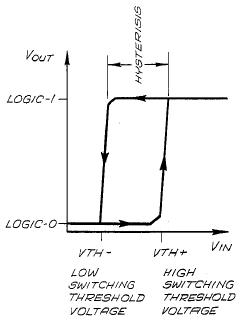
- Power-efficient hysteresis control mechanisms: Techniques for implementing hysteresis in Schmitt triggers while minimizing power consumption. These approaches include adaptive hysteresis control, where the hysteresis window is dynamically adjusted based on operating conditions. By optimizing the hysteresis thresholds, these designs reduce unnecessary switching and thereby decrease power consumption while maintaining robust noise immunity.
- Sleep mode and power management techniques: Implementation of sleep modes and power management strategies in Schmitt trigger circuits to reduce power consumption during periods of inactivity. These designs include power gating, clock gating, and other techniques to disable portions of the circuit when not in use. Some implementations feature automatic detection of idle states to trigger low-power modes without external control signals.
- Supply voltage optimization for power reduction: Methods for optimizing the supply voltage of Schmitt trigger circuits to reduce power consumption. These approaches include operating at lower supply voltages while maintaining functionality, implementing level shifters for interfacing with different voltage domains, and utilizing voltage scaling techniques. Some designs incorporate adaptive voltage scaling that adjusts the supply voltage based on performance requirements.
- Current-limiting and leakage reduction techniques: Specific circuit techniques to limit current consumption and reduce leakage in Schmitt trigger designs. These include the use of high-threshold transistors in critical paths, body biasing techniques to reduce subthreshold leakage, and specialized circuit topologies that inherently limit current flow. Some implementations incorporate feedback mechanisms that dynamically adjust bias conditions to minimize power consumption under varying operating conditions.
02 CMOS implementation for power efficiency
CMOS technology is widely used to implement power-efficient Schmitt triggers. By leveraging complementary MOS transistors, these circuits minimize static power consumption and provide good noise immunity. Advanced CMOS Schmitt trigger designs incorporate techniques such as dynamic threshold adjustment and optimized switching characteristics to further reduce power consumption while maintaining robust operation across varying supply voltages.Expand Specific Solutions03 Power management techniques in Schmitt trigger applications
Various power management techniques are employed in Schmitt trigger circuits to minimize energy consumption. These include power gating, clock gating, dynamic voltage scaling, and selective activation of circuit components. By implementing these techniques, Schmitt triggers can operate in low-power modes during periods of inactivity and quickly transition to active states when needed, resulting in significant overall power savings.Expand Specific Solutions04 Hysteresis control for power optimization
Controlling the hysteresis characteristics of Schmitt triggers can lead to power optimization. By dynamically adjusting the switching thresholds based on operating conditions, these circuits can minimize unnecessary transitions and reduce power consumption. Advanced designs incorporate adaptive hysteresis that responds to input signal characteristics, noise levels, and power requirements, providing an optimal balance between performance and energy efficiency.Expand Specific Solutions05 Integration with low-power systems
Schmitt triggers are integrated into larger low-power systems with specialized design considerations. These include interfacing with low-voltage power supplies, compatibility with sleep modes, and optimization for specific application requirements. When properly integrated, Schmitt triggers can contribute to the overall power efficiency of systems such as IoT devices, mobile electronics, and battery-operated equipment by providing reliable signal conditioning with minimal energy overhead.Expand Specific Solutions
Key Industry Players in Low-Power IC Design
The Schmitt Trigger power reduction technology market is currently in a growth phase, with increasing demand for energy-efficient integrated circuits across multiple sectors. The competitive landscape features established semiconductor giants like STMicroelectronics, Samsung Electronics, and NXP USA leading commercial applications, while research institutions such as Peking University and King Fahd University contribute to theoretical advancements. Market competition is intensifying as specialized players like ROHM, Renesas Electronics, and MediaTek develop proprietary low-power Schmitt Trigger implementations. Technology maturity varies significantly, with companies like Xilinx and Tower Semiconductor offering advanced solutions, while newer entrants like Wuxi ETEK and Smarter Microelectronics focus on niche applications. The market is expected to expand further as power efficiency becomes increasingly critical in mobile, IoT, and automotive applications.
STMicroelectronics International NV
Technical Solution: STMicroelectronics has developed advanced Schmitt trigger implementations in their ultra-low-power microcontroller families (STM32L series) that significantly reduce power consumption in ICs. Their approach incorporates adaptive hysteresis techniques where the trigger threshold dynamically adjusts based on operating conditions. This allows for optimal noise immunity while minimizing unnecessary switching events that consume power. ST's implementation includes power-gating techniques that disconnect the Schmitt trigger circuits from power rails during inactive periods, reducing static power consumption by up to 40% compared to conventional designs. Additionally, their process technology optimizations specifically target subthreshold leakage reduction in Schmitt trigger circuits, achieving standby current ratings as low as 0.27μA in stop mode with full RAM retention. ST has also integrated these enhanced Schmitt triggers into their I/O ports, allowing for clean signal transitions while consuming minimal power during level detection operations.
Strengths: Industry-leading low power consumption metrics in their microcontroller portfolio; seamless integration with power management systems; excellent noise immunity even at ultra-low power states. Weaknesses: Implementation complexity increases design time; requires additional silicon area compared to standard input buffers; performance trade-offs at extremely low voltage operations.
Samsung Electronics Co., Ltd.
Technical Solution: Samsung Electronics has pioneered innovative Schmitt trigger designs for their semiconductor products that focus on power reduction through several key technologies. Their approach utilizes dynamic threshold voltage adjustment techniques where the Schmitt trigger's hysteresis window automatically narrows during low-activity periods, reducing switching power by approximately 35%. Samsung has implemented sub-1V Schmitt trigger circuits in their latest memory and mobile processor designs that operate efficiently at reduced supply voltages while maintaining noise immunity. Their patented "Sleep-mode Schmitt Trigger" architecture incorporates power-aware control logic that can completely disable certain trigger circuits during standby modes, cutting leakage current by up to 60% compared to traditional always-on implementations. Samsung's advanced FinFET process technology has been specifically optimized to enhance the power efficiency of Schmitt trigger circuits in their SoCs, achieving switching energy reductions of approximately 45% compared to planar transistor implementations while maintaining comparable noise margins.
Strengths: Exceptional integration with power management systems in mobile SoCs; industry-leading standby power metrics; maintains robust noise immunity even at ultra-low voltages. Weaknesses: Increased design complexity requiring specialized engineering expertise; slightly larger silicon footprint than conventional input buffers; potential for increased sensitivity to process variations.
Core Innovations in Hysteresis-Based Power Reduction
Schmitt trigger circuit consuming low power
PatentInactiveUS20030137331A1
Innovation
- The proposed Schmitt trigger circuit incorporates a logic circuit, an inverting circuit, and transistors of different conductivity types, with a switching element that becomes non-conductive when the control signal is inactive, preventing continuous current flow and allowing for flexible design of Schmitt width and reduced power consumption.


Low current high precision CMOS schmitt trigger circuit
PatentInactiveUS4733107A
Innovation
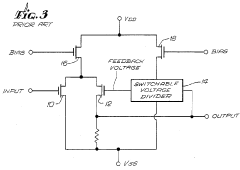
- A CMOS Schmitt Trigger circuit utilizing a differential pair and a feedback circuit with a switchable voltage divider, where CMOS switching elements control the application of power only when necessary, minimizing power consumption by preventing current draw from the power supply when the input signal is outside the active range.
Thermal Management Considerations in Schmitt Trigger Design
Thermal management is a critical aspect of Schmitt trigger design, particularly when considering power consumption optimization in integrated circuits. The hysteresis characteristic of Schmitt triggers, while beneficial for noise immunity, introduces additional switching activity that generates heat within the IC. This thermal energy must be effectively managed to maintain optimal performance and reliability.
The power dissipation in Schmitt trigger circuits occurs primarily during state transitions, where both PMOS and NMOS transistors may conduct simultaneously for brief periods. This short-circuit current contributes significantly to dynamic power consumption and consequently to heat generation. Advanced Schmitt trigger designs incorporate techniques to minimize this overlap time, thereby reducing thermal loading.
Temperature variations can significantly impact the threshold voltages of Schmitt triggers, potentially altering their hysteresis characteristics. This temperature dependency creates a feedback loop: increased power consumption leads to higher temperatures, which may further affect switching behavior and power consumption patterns. Design engineers must account for this relationship through temperature compensation techniques and appropriate thermal modeling.
Layout considerations play a crucial role in thermal management of Schmitt trigger circuits. Strategic placement of these components away from heat-sensitive elements and implementation of thermal barriers can prevent heat concentration. Additionally, incorporating dedicated heat dissipation paths in the IC layout helps maintain more uniform temperature distribution across the chip.
Modern low-power Schmitt trigger designs often employ adaptive biasing techniques that adjust operation based on temperature conditions. These designs can dynamically modify threshold voltages or current paths to maintain consistent performance across varying thermal environments while minimizing power consumption. Such adaptability is particularly valuable in battery-powered applications where thermal efficiency directly impacts device longevity.
The selection of appropriate semiconductor materials and process technologies also influences thermal characteristics of Schmitt trigger implementations. Silicon-on-insulator (SOI) technology, for instance, provides better thermal isolation between components, reducing heat transfer between adjacent circuit elements. Similarly, wide-bandgap semiconductors offer superior thermal conductivity properties that can enhance heat dissipation in high-power applications.
Simulation and testing methodologies must incorporate comprehensive thermal analysis to accurately predict Schmitt trigger behavior under various operating conditions. Infrared thermal imaging and on-chip temperature sensors provide valuable data for validating thermal models and optimizing designs for real-world thermal environments.
The power dissipation in Schmitt trigger circuits occurs primarily during state transitions, where both PMOS and NMOS transistors may conduct simultaneously for brief periods. This short-circuit current contributes significantly to dynamic power consumption and consequently to heat generation. Advanced Schmitt trigger designs incorporate techniques to minimize this overlap time, thereby reducing thermal loading.
Temperature variations can significantly impact the threshold voltages of Schmitt triggers, potentially altering their hysteresis characteristics. This temperature dependency creates a feedback loop: increased power consumption leads to higher temperatures, which may further affect switching behavior and power consumption patterns. Design engineers must account for this relationship through temperature compensation techniques and appropriate thermal modeling.
Layout considerations play a crucial role in thermal management of Schmitt trigger circuits. Strategic placement of these components away from heat-sensitive elements and implementation of thermal barriers can prevent heat concentration. Additionally, incorporating dedicated heat dissipation paths in the IC layout helps maintain more uniform temperature distribution across the chip.
Modern low-power Schmitt trigger designs often employ adaptive biasing techniques that adjust operation based on temperature conditions. These designs can dynamically modify threshold voltages or current paths to maintain consistent performance across varying thermal environments while minimizing power consumption. Such adaptability is particularly valuable in battery-powered applications where thermal efficiency directly impacts device longevity.
The selection of appropriate semiconductor materials and process technologies also influences thermal characteristics of Schmitt trigger implementations. Silicon-on-insulator (SOI) technology, for instance, provides better thermal isolation between components, reducing heat transfer between adjacent circuit elements. Similarly, wide-bandgap semiconductors offer superior thermal conductivity properties that can enhance heat dissipation in high-power applications.
Simulation and testing methodologies must incorporate comprehensive thermal analysis to accurately predict Schmitt trigger behavior under various operating conditions. Infrared thermal imaging and on-chip temperature sensors provide valuable data for validating thermal models and optimizing designs for real-world thermal environments.
Integration Strategies for System-Level Power Optimization
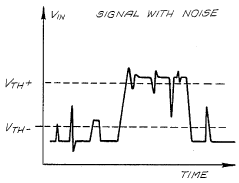
Integrating Schmitt triggers into system-level power optimization strategies requires careful consideration of both circuit-level and architectural approaches. When implemented at strategic points within integrated circuits, Schmitt triggers can significantly reduce overall power consumption through multiple mechanisms. The placement of these hysteresis-based components at input stages and between critical signal paths creates effective noise immunity barriers that prevent unnecessary switching activities throughout the system.
Power optimization begins with identifying critical signal paths where noise-induced transitions are most problematic. By strategically positioning Schmitt triggers at these interfaces, designers can effectively isolate noisy environments from clean digital processing sections. This compartmentalization approach prevents noise propagation that would otherwise trigger cascading switching events and unnecessary power consumption across multiple circuit blocks.
System architects can further leverage Schmitt triggers in power domain crossing scenarios, where signals must traverse between different voltage regions. In these applications, the hysteresis characteristics help maintain signal integrity while reducing the need for additional buffering or level-shifting components that would otherwise consume additional power. The inherent noise rejection capabilities make Schmitt triggers particularly valuable in mixed-signal environments where analog noise could otherwise propagate into digital subsystems.
Clock distribution networks represent another critical integration point for Schmitt trigger technology. By incorporating these components at strategic nodes within clock trees, designers can prevent clock glitches from propagating throughout the system. This approach is particularly effective in reducing dynamic power consumption in synchronous digital systems where clock-related switching activities account for a substantial portion of overall power usage.
Modern system-on-chip designs can benefit from adaptive Schmitt trigger implementations where hysteresis thresholds dynamically adjust based on operating conditions. These advanced integration strategies enable power optimization that responds to changing noise environments, process variations, and temperature fluctuations. Some implementations incorporate feedback mechanisms that monitor system noise levels and automatically tune Schmitt trigger parameters to maintain optimal power efficiency without compromising reliability.
From a design methodology perspective, integrating Schmitt triggers requires careful consideration during the early architectural planning phases. Power-aware design tools now include specific models for Schmitt trigger behavior, allowing system architects to simulate and quantify the power benefits before physical implementation. These simulation capabilities enable designers to optimize placement strategies and fine-tune hysteresis parameters for maximum power efficiency across diverse operating conditions.
Power optimization begins with identifying critical signal paths where noise-induced transitions are most problematic. By strategically positioning Schmitt triggers at these interfaces, designers can effectively isolate noisy environments from clean digital processing sections. This compartmentalization approach prevents noise propagation that would otherwise trigger cascading switching events and unnecessary power consumption across multiple circuit blocks.
System architects can further leverage Schmitt triggers in power domain crossing scenarios, where signals must traverse between different voltage regions. In these applications, the hysteresis characteristics help maintain signal integrity while reducing the need for additional buffering or level-shifting components that would otherwise consume additional power. The inherent noise rejection capabilities make Schmitt triggers particularly valuable in mixed-signal environments where analog noise could otherwise propagate into digital subsystems.
Clock distribution networks represent another critical integration point for Schmitt trigger technology. By incorporating these components at strategic nodes within clock trees, designers can prevent clock glitches from propagating throughout the system. This approach is particularly effective in reducing dynamic power consumption in synchronous digital systems where clock-related switching activities account for a substantial portion of overall power usage.
Modern system-on-chip designs can benefit from adaptive Schmitt trigger implementations where hysteresis thresholds dynamically adjust based on operating conditions. These advanced integration strategies enable power optimization that responds to changing noise environments, process variations, and temperature fluctuations. Some implementations incorporate feedback mechanisms that monitor system noise levels and automatically tune Schmitt trigger parameters to maintain optimal power efficiency without compromising reliability.
From a design methodology perspective, integrating Schmitt triggers requires careful consideration during the early architectural planning phases. Power-aware design tools now include specific models for Schmitt trigger behavior, allowing system architects to simulate and quantify the power benefits before physical implementation. These simulation capabilities enable designers to optimize placement strategies and fine-tune hysteresis parameters for maximum power efficiency across diverse operating conditions.
Unlock deeper insights with PatSnap Eureka Quick Research — get a full tech report to explore trends and direct your research. Try now!
Generate Your Research Report Instantly with AI Agent
Supercharge your innovation with PatSnap Eureka AI Agent Platform!