
How to Improve GC-MS Resolution for Complex Mixtures
SEP 22, 20259 MIN READ
Generate Your Research Report Instantly with AI Agent
Patsnap Eureka helps you evaluate technical feasibility & market potential.
GC-MS Resolution Enhancement Background and Objectives
Gas Chromatography-Mass Spectrometry (GC-MS) has evolved significantly since its inception in the 1950s, becoming an indispensable analytical technique for separating and identifying components in complex mixtures. The technique combines the separation capabilities of gas chromatography with the detection specificity of mass spectrometry, allowing for precise identification of compounds even in intricate matrices. Over the decades, technological advancements have continuously enhanced its resolution capabilities, from early packed columns to modern high-efficiency capillary columns.
Recent trends in GC-MS technology development focus on improving resolution through multidimensional separations, advanced column technologies, and sophisticated data processing algorithms. The evolution of detector sensitivity and mass accuracy has paralleled these advancements, enabling the identification of compounds at increasingly lower concentrations. This progression is particularly relevant as analytical demands grow more complex across pharmaceutical, environmental, and forensic applications.
The primary objective of enhancing GC-MS resolution for complex mixtures is to achieve complete separation of closely eluting compounds, thereby minimizing co-elution issues that compromise accurate identification and quantification. This becomes especially critical when analyzing samples containing hundreds or thousands of components with similar physicochemical properties, such as environmental pollutants, metabolomics samples, or petroleum products.
Secondary objectives include reducing analysis time without sacrificing separation quality, improving detection limits for trace components in complex backgrounds, and developing more robust methods that can be applied across different sample types with minimal modification. These goals align with broader industry trends toward higher throughput, greater sensitivity, and more versatile analytical platforms.
The technical challenges driving this research include the fundamental limitations of peak capacity in one-dimensional separations, the complexity of data interpretation from multidimensional techniques, and the need for specialized software solutions to process the resulting high-dimensional data. Additionally, there is growing demand for portable and field-deployable GC-MS systems that maintain high resolution capabilities despite size and power constraints.
From a strategic perspective, improvements in GC-MS resolution directly impact numerous high-value industries, including pharmaceutical development, environmental monitoring, food safety, and forensic science. The ability to definitively characterize complex mixtures translates to more effective drug discovery, more comprehensive environmental assessments, and more reliable forensic evidence, ultimately driving significant economic and societal benefits.
Recent trends in GC-MS technology development focus on improving resolution through multidimensional separations, advanced column technologies, and sophisticated data processing algorithms. The evolution of detector sensitivity and mass accuracy has paralleled these advancements, enabling the identification of compounds at increasingly lower concentrations. This progression is particularly relevant as analytical demands grow more complex across pharmaceutical, environmental, and forensic applications.
The primary objective of enhancing GC-MS resolution for complex mixtures is to achieve complete separation of closely eluting compounds, thereby minimizing co-elution issues that compromise accurate identification and quantification. This becomes especially critical when analyzing samples containing hundreds or thousands of components with similar physicochemical properties, such as environmental pollutants, metabolomics samples, or petroleum products.
Secondary objectives include reducing analysis time without sacrificing separation quality, improving detection limits for trace components in complex backgrounds, and developing more robust methods that can be applied across different sample types with minimal modification. These goals align with broader industry trends toward higher throughput, greater sensitivity, and more versatile analytical platforms.
The technical challenges driving this research include the fundamental limitations of peak capacity in one-dimensional separations, the complexity of data interpretation from multidimensional techniques, and the need for specialized software solutions to process the resulting high-dimensional data. Additionally, there is growing demand for portable and field-deployable GC-MS systems that maintain high resolution capabilities despite size and power constraints.
From a strategic perspective, improvements in GC-MS resolution directly impact numerous high-value industries, including pharmaceutical development, environmental monitoring, food safety, and forensic science. The ability to definitively characterize complex mixtures translates to more effective drug discovery, more comprehensive environmental assessments, and more reliable forensic evidence, ultimately driving significant economic and societal benefits.
Market Demand Analysis for High-Resolution GC-MS Systems
The global market for high-resolution GC-MS systems has experienced significant growth in recent years, driven primarily by increasing demands in pharmaceutical research, environmental monitoring, food safety testing, and forensic applications. Current market estimates value the high-resolution GC-MS sector at approximately 2.5 billion USD, with projections indicating a compound annual growth rate of 6.8% through 2028.
Pharmaceutical and biotechnology sectors represent the largest market segment, accounting for nearly 35% of the total demand. These industries require increasingly sensitive analytical tools to detect trace compounds in complex biological matrices, identify impurities in drug formulations, and support metabolomics research. The ability to resolve structurally similar compounds with minimal sample preparation has become a critical requirement for these users.
Environmental monitoring applications constitute the second-largest market segment at 28%. Government regulations worldwide continue to lower acceptable limits for environmental contaminants, necessitating instruments capable of detecting compounds at parts-per-trillion levels. Particularly, the analysis of emerging contaminants such as PFAS (per- and polyfluoroalkyl substances) in complex environmental samples has created urgent demand for higher resolution capabilities.
Food safety testing represents a rapidly growing segment with 22% market share. The increasing complexity of global food supply chains has heightened concerns about adulteration, contamination, and authenticity verification. High-resolution GC-MS systems capable of identifying hundreds of pesticides, mycotoxins, and other contaminants in a single analysis are becoming essential tools for regulatory compliance and consumer protection.
Regional analysis reveals North America as the dominant market (38%), followed by Europe (32%) and Asia-Pacific (24%). However, the Asia-Pacific region demonstrates the fastest growth rate at 8.2% annually, driven by expanding pharmaceutical manufacturing, stricter environmental regulations, and increased food safety concerns in China, India, and South Korea.
End-user surveys indicate that laboratories are willing to invest in premium-priced systems that offer superior resolution capabilities, provided they deliver tangible improvements in analytical performance. Key purchasing factors include resolution power (cited by 87% of respondents), sensitivity (82%), software integration capabilities (76%), and total cost of ownership (71%).
Market forecasts suggest particular growth potential for GC-MS systems that can effectively handle increasingly complex sample matrices without extensive sample preparation. The ability to resolve closely eluting peaks in natural product extracts, environmental samples, and biological fluids represents a significant competitive advantage in the current marketplace.
Pharmaceutical and biotechnology sectors represent the largest market segment, accounting for nearly 35% of the total demand. These industries require increasingly sensitive analytical tools to detect trace compounds in complex biological matrices, identify impurities in drug formulations, and support metabolomics research. The ability to resolve structurally similar compounds with minimal sample preparation has become a critical requirement for these users.
Environmental monitoring applications constitute the second-largest market segment at 28%. Government regulations worldwide continue to lower acceptable limits for environmental contaminants, necessitating instruments capable of detecting compounds at parts-per-trillion levels. Particularly, the analysis of emerging contaminants such as PFAS (per- and polyfluoroalkyl substances) in complex environmental samples has created urgent demand for higher resolution capabilities.
Food safety testing represents a rapidly growing segment with 22% market share. The increasing complexity of global food supply chains has heightened concerns about adulteration, contamination, and authenticity verification. High-resolution GC-MS systems capable of identifying hundreds of pesticides, mycotoxins, and other contaminants in a single analysis are becoming essential tools for regulatory compliance and consumer protection.
Regional analysis reveals North America as the dominant market (38%), followed by Europe (32%) and Asia-Pacific (24%). However, the Asia-Pacific region demonstrates the fastest growth rate at 8.2% annually, driven by expanding pharmaceutical manufacturing, stricter environmental regulations, and increased food safety concerns in China, India, and South Korea.
End-user surveys indicate that laboratories are willing to invest in premium-priced systems that offer superior resolution capabilities, provided they deliver tangible improvements in analytical performance. Key purchasing factors include resolution power (cited by 87% of respondents), sensitivity (82%), software integration capabilities (76%), and total cost of ownership (71%).
Market forecasts suggest particular growth potential for GC-MS systems that can effectively handle increasingly complex sample matrices without extensive sample preparation. The ability to resolve closely eluting peaks in natural product extracts, environmental samples, and biological fluids represents a significant competitive advantage in the current marketplace.
Current Limitations and Technical Challenges in GC-MS Resolution
Gas Chromatography-Mass Spectrometry (GC-MS) faces significant limitations when analyzing complex mixtures, particularly in environmental, metabolomic, and forensic applications. The primary challenge lies in chromatographic resolution, where closely eluting compounds with similar chemical properties create overlapping peaks that compromise accurate identification and quantification. This phenomenon becomes increasingly problematic as sample complexity increases, with thousands of components potentially present in biological or environmental samples.
Detector sensitivity presents another critical limitation, especially when target analytes exist at trace concentrations amid high-abundance interferents. The dynamic range constraints of most MS detectors (typically 104-106) often prove insufficient for complex mixtures where concentration differences can span several orders of magnitude, leading to either signal saturation for abundant compounds or missed detection of trace components.
Mass spectral resolution remains a persistent challenge, particularly with nominal mass instruments that cannot differentiate between compounds with identical nominal masses but different exact masses. This limitation severely impacts the analysis of complex mixtures containing isomers or isobars, which produce nearly identical fragmentation patterns yet represent distinct compounds requiring differentiation.
Data processing bottlenecks further complicate GC-MS analysis of complex mixtures. Current software solutions struggle with automated peak deconvolution when significant co-elution occurs, often requiring extensive manual intervention that introduces subjectivity and reduces throughput. The computational demands for processing high-resolution data from complex samples can be prohibitive, especially when implementing advanced algorithms for compound identification.
Sample preparation techniques also impose limitations, as traditional methods may not effectively isolate all compounds of interest while removing matrix interferents. This becomes particularly challenging when analyzing unknown mixtures where target analytes have not been predetermined, requiring non-selective extraction approaches that inevitably introduce additional complexity to the chromatographic separation.
Instrument configuration constraints further impact resolution capabilities. Column selection represents a compromise between separation efficiency, analysis time, and thermal stability. Similarly, ionization techniques must balance sensitivity with fragmentation patterns, while mass analyzers trade resolution for scan speed and sensitivity. These inherent trade-offs limit the comprehensive analysis of complex mixtures within a single analytical run.
Detector sensitivity presents another critical limitation, especially when target analytes exist at trace concentrations amid high-abundance interferents. The dynamic range constraints of most MS detectors (typically 104-106) often prove insufficient for complex mixtures where concentration differences can span several orders of magnitude, leading to either signal saturation for abundant compounds or missed detection of trace components.
Mass spectral resolution remains a persistent challenge, particularly with nominal mass instruments that cannot differentiate between compounds with identical nominal masses but different exact masses. This limitation severely impacts the analysis of complex mixtures containing isomers or isobars, which produce nearly identical fragmentation patterns yet represent distinct compounds requiring differentiation.
Data processing bottlenecks further complicate GC-MS analysis of complex mixtures. Current software solutions struggle with automated peak deconvolution when significant co-elution occurs, often requiring extensive manual intervention that introduces subjectivity and reduces throughput. The computational demands for processing high-resolution data from complex samples can be prohibitive, especially when implementing advanced algorithms for compound identification.
Sample preparation techniques also impose limitations, as traditional methods may not effectively isolate all compounds of interest while removing matrix interferents. This becomes particularly challenging when analyzing unknown mixtures where target analytes have not been predetermined, requiring non-selective extraction approaches that inevitably introduce additional complexity to the chromatographic separation.
Instrument configuration constraints further impact resolution capabilities. Column selection represents a compromise between separation efficiency, analysis time, and thermal stability. Similarly, ionization techniques must balance sensitivity with fragmentation patterns, while mass analyzers trade resolution for scan speed and sensitivity. These inherent trade-offs limit the comprehensive analysis of complex mixtures within a single analytical run.
Current Methodologies for Improving GC-MS Resolution
01 Improving GC-MS resolution through column technology
Advanced column technologies can significantly enhance GC-MS resolution. This includes specialized capillary columns with optimized stationary phases, column dimensions, and film thickness. These columns are designed to provide better separation of complex mixtures, reduce peak overlap, and improve the overall resolution of the chromatographic analysis. Innovations in column technology focus on increasing theoretical plate numbers and reducing band broadening effects.- Improving GC-MS resolution through column technology: Advanced column technologies can significantly enhance GC-MS resolution. These include specialized capillary columns with optimized stationary phases, column dimensions, and film thicknesses tailored for specific analytical applications. Innovations in column design focus on increasing separation efficiency, reducing peak broadening, and improving the resolution of complex mixtures, particularly for closely eluting compounds or isomers.
- Mass spectrometry detection and resolution enhancement techniques: Various techniques can enhance mass spectrometry detection and resolution in GC-MS systems. These include high-resolution mass analyzers, improved ion source designs, and advanced detector technologies. Time-of-flight (TOF) and quadrupole mass analyzers with optimized parameters can significantly improve mass resolution, allowing for better compound identification and quantification in complex samples.
- Data processing and analysis methods for improved GC-MS resolution: Advanced data processing algorithms and software solutions can enhance the effective resolution of GC-MS systems. These include deconvolution techniques for overlapping peaks, noise reduction algorithms, and advanced peak detection methods. Machine learning and artificial intelligence approaches are increasingly being applied to extract maximum information from GC-MS data, improving compound identification and quantification even in complex matrices.
- Sample preparation techniques for enhanced GC-MS resolution: Optimized sample preparation methods can significantly improve GC-MS resolution by reducing matrix interference and concentrating analytes of interest. Techniques include solid-phase extraction, liquid-liquid extraction, derivatization, and headspace sampling. These approaches can simplify complex samples, remove interfering compounds, and enhance the chromatographic separation, leading to better overall system resolution.
- Integrated GC-MS system design for resolution optimization: Comprehensive GC-MS system designs focus on optimizing all components to maximize resolution. These integrated approaches include temperature programming optimization, carrier gas flow control, interface design between the GC and MS components, and vacuum system improvements. Modern systems incorporate automated calibration and tuning functions to maintain optimal resolution throughout analytical runs, with specialized configurations for targeted applications requiring high resolution.
02 Enhanced mass spectrometry detection systems for improved resolution
Advancements in mass spectrometry detection systems contribute to better GC-MS resolution. These include high-resolution mass analyzers, improved ion source designs, and enhanced detector sensitivity. Modern MS systems can achieve better mass accuracy, higher scan rates, and improved signal-to-noise ratios, allowing for better differentiation between closely eluting compounds and more accurate identification of analytes in complex matrices.Expand Specific Solutions03 Sample preparation and injection techniques for resolution enhancement
Optimized sample preparation and injection techniques play a crucial role in achieving high GC-MS resolution. This includes methods for sample concentration, derivatization, and clean-up procedures that reduce matrix interference. Advanced injection techniques such as programmed temperature vaporization, cold on-column injection, and splitless injection can minimize band broadening at the column inlet, resulting in narrower peaks and improved resolution.Expand Specific Solutions04 Data processing and analysis methods for resolution improvement
Sophisticated data processing and analysis methods enhance the effective resolution of GC-MS systems. These include advanced peak deconvolution algorithms, automated background subtraction, and spectral matching techniques. Software solutions can mathematically separate overlapping peaks, extract ion chromatograms for specific compounds, and apply various filters to improve signal quality, thereby enhancing the apparent resolution of the system even when chromatographic separation is not optimal.Expand Specific Solutions05 Integrated GC-MS system design for optimized resolution
Comprehensive GC-MS system designs focus on optimizing all components to work together for maximum resolution. This includes integrated approaches to temperature programming, carrier gas flow control, interface design between the GC and MS components, and vacuum system optimization. These systems often incorporate two-dimensional GC (GC×GC) technology, which provides significantly enhanced separation power by using two columns with different selectivity in series, dramatically improving the resolution of complex samples.Expand Specific Solutions
Leading Manufacturers and Research Institutions in GC-MS Field
The GC-MS resolution improvement for complex mixtures market is currently in a growth phase, characterized by increasing demand for higher analytical precision across pharmaceutical, environmental, and petrochemical sectors. The global market size for advanced analytical instrumentation is estimated at $5-6 billion, with GC-MS systems representing a significant segment experiencing 5-7% annual growth. Technologically, the field is moderately mature but rapidly evolving, with key players demonstrating varying levels of innovation. Shimadzu, Thermo Finnigan, and Waters lead with comprehensive high-resolution solutions, while LECO and JEOL focus on specialized time-of-flight technologies. Research institutions like Purdue and EPFL collaborate with industry to advance separation techniques, while emerging companies like Guangzhou Molecular Information Technology represent new market entrants developing AI-enhanced data processing capabilities.
Shimadzu Corp.
Technical Solution: Shimadzu has developed advanced GC-MS systems featuring their proprietary Smart MRM technology that optimizes dwell times and loop times automatically based on chromatographic peak widths. Their GCMS-TQ8050 NX triple quadrupole system incorporates differential flow technology that maintains optimal vacuum conditions even with complex matrices, significantly improving resolution for complex mixtures. Their systems utilize high-efficiency ion source designs that maximize ionization efficiency while minimizing contamination effects. Shimadzu has also implemented advanced deconvolution algorithms in their LabSolutions software that can separate overlapping peaks with similar mass spectra, enhancing the resolution of complex mixtures. Additionally, their systems feature fast scanning capabilities (up to 20,000 u/sec) and rapid polarity switching, allowing comprehensive analysis of complex samples containing both positive and negative ions.
Strengths: Superior sensitivity with detection limits in the femtogram range; excellent software integration for automated method development; robust performance with minimal maintenance requirements. Weaknesses: Higher initial investment cost compared to some competitors; proprietary software may require specialized training; some advanced features may be underutilized in routine applications.
LECO Corp.
Technical Solution: LECO has pioneered comprehensive two-dimensional gas chromatography (GCxGC) technology coupled with time-of-flight mass spectrometry (TOF-MS) to dramatically improve resolution for complex mixtures. Their Pegasus GC-HRT 4D system combines GCxGC separation with high-resolution TOF-MS (resolution >50,000), enabling separation in four dimensions: first-dimension GC, second-dimension GC, mass spectral separation, and high-resolution mass accuracy. This multi-dimensional approach allows for the separation of thousands of compounds in a single analysis that would otherwise co-elute in conventional GC-MS. LECO's thermal modulation technology creates narrow second-dimension peaks (50-100 ms wide), significantly enhancing signal-to-noise ratios. Their ChromaTOF software incorporates advanced peak finding algorithms and automated deconvolution to identify compounds even when chromatographic separation is incomplete, making it particularly effective for complex environmental, metabolomic, and petrochemical samples.
Strengths: Unparalleled separation power through multi-dimensional analysis; exceptional mass accuracy for confident compound identification; comprehensive software for handling complex datasets. Weaknesses: Higher complexity requiring more specialized operator training; increased data processing demands; higher acquisition and operational costs compared to conventional GC-MS systems.
Key Innovations in Column Technology and Detection Systems
GC-TOF ms with improved detection limit
PatentWO2015153644A1
Innovation
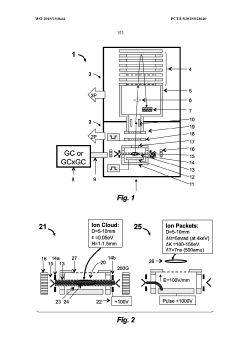
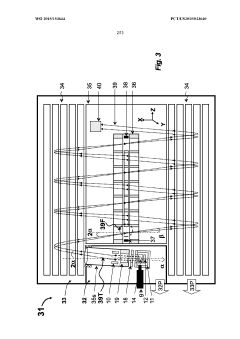
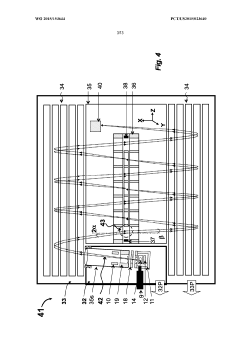
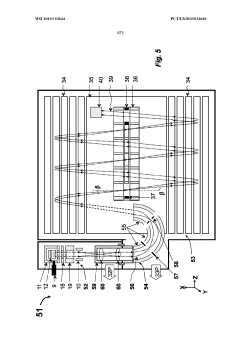
- The implementation of a semi-open electron impact ion source coupled with a high-resolution multi-reflecting time-of-flight analyzer, along with specific ion-optical elements and pulsing techniques, enhances ion transmission and reduces time-of-flight aberrations, allowing for improved differentiation between sample and chemical background.
Sample Preparation Techniques for Complex Mixture Analysis
Sample preparation represents a critical foundation for achieving high-resolution GC-MS analysis of complex mixtures. Traditional extraction methods such as liquid-liquid extraction (LLE) and solid-phase extraction (SPE) have evolved significantly, with modern adaptations incorporating automated systems that reduce manual handling errors and improve reproducibility. Microextraction techniques, including solid-phase microextraction (SPME) and stir bar sorptive extraction (SBSE), offer advantages in minimizing solvent usage while enhancing sensitivity for trace components in complex matrices.
Derivatization strategies play a pivotal role in improving chromatographic separation by modifying analyte properties. Silylation remains the most widely employed approach for enhancing volatility of polar compounds, while acylation and alkylation provide complementary options depending on target functional groups. Recent advances in derivatization reagents have focused on developing compounds that react more selectively with specific analyte classes within complex mixtures.
Sample clean-up procedures have become increasingly sophisticated, with selective sorbents enabling targeted removal of matrix interferents. QuEChERS (Quick, Easy, Cheap, Effective, Rugged, and Safe) methodology has gained prominence for multi-residue analysis in complex biological and environmental samples, offering efficient removal of lipids, pigments, and other co-extractives that can compromise chromatographic resolution.
Fractionation techniques represent another critical approach for complex mixture analysis. Two-dimensional fractionation strategies, where samples undergo sequential separation based on different physicochemical properties, have demonstrated remarkable improvements in resolving power. Comprehensive two-dimensional gas chromatography (GC×GC) sample preparation protocols have been specifically developed to maximize orthogonality between separation dimensions.
Miniaturization and automation of sample preparation workflows have addressed traditional bottlenecks in GC-MS analysis. Microfluidic devices capable of performing multiple sample preparation steps in integrated platforms show promise for standardizing complex mixture analysis while reducing solvent consumption and processing time. These systems often incorporate in-line filtration, concentration, and derivatization capabilities.
Emerging technologies in sample preparation include molecularly imprinted polymers (MIPs) designed to selectively extract structurally similar compounds from complex matrices, and nanomaterial-enhanced extraction media that provide unprecedented surface area and selectivity characteristics. These advanced materials demonstrate particular utility for isolating trace components from challenging matrices like biological fluids, environmental samples, and industrial mixtures.
Derivatization strategies play a pivotal role in improving chromatographic separation by modifying analyte properties. Silylation remains the most widely employed approach for enhancing volatility of polar compounds, while acylation and alkylation provide complementary options depending on target functional groups. Recent advances in derivatization reagents have focused on developing compounds that react more selectively with specific analyte classes within complex mixtures.
Sample clean-up procedures have become increasingly sophisticated, with selective sorbents enabling targeted removal of matrix interferents. QuEChERS (Quick, Easy, Cheap, Effective, Rugged, and Safe) methodology has gained prominence for multi-residue analysis in complex biological and environmental samples, offering efficient removal of lipids, pigments, and other co-extractives that can compromise chromatographic resolution.
Fractionation techniques represent another critical approach for complex mixture analysis. Two-dimensional fractionation strategies, where samples undergo sequential separation based on different physicochemical properties, have demonstrated remarkable improvements in resolving power. Comprehensive two-dimensional gas chromatography (GC×GC) sample preparation protocols have been specifically developed to maximize orthogonality between separation dimensions.
Miniaturization and automation of sample preparation workflows have addressed traditional bottlenecks in GC-MS analysis. Microfluidic devices capable of performing multiple sample preparation steps in integrated platforms show promise for standardizing complex mixture analysis while reducing solvent consumption and processing time. These systems often incorporate in-line filtration, concentration, and derivatization capabilities.
Emerging technologies in sample preparation include molecularly imprinted polymers (MIPs) designed to selectively extract structurally similar compounds from complex matrices, and nanomaterial-enhanced extraction media that provide unprecedented surface area and selectivity characteristics. These advanced materials demonstrate particular utility for isolating trace components from challenging matrices like biological fluids, environmental samples, and industrial mixtures.
Data Processing Algorithms for Peak Deconvolution
Data processing algorithms for peak deconvolution represent a critical advancement in addressing the analytical challenges posed by complex mixture analysis in GC-MS systems. These computational approaches have evolved significantly over the past decade, moving from simple mathematical models to sophisticated machine learning implementations.
Traditional deconvolution algorithms primarily relied on curve fitting techniques, where Gaussian or modified Gaussian functions were applied to model overlapping peaks. However, these methods often struggled with highly complex mixtures containing hundreds of compounds. Modern algorithms have incorporated more advanced mathematical frameworks, including wavelet transforms, which excel at separating signals at different frequency scales, making them particularly effective for resolving closely eluting compounds.
Matrix factorization techniques, particularly Multivariate Curve Resolution (MCR) and Non-negative Matrix Factorization (NMF), have emerged as powerful tools for peak deconvolution. These approaches decompose the complex GC-MS data matrix into chemically meaningful components, effectively separating overlapping peaks while preserving their spectral integrity. The incorporation of constraints such as non-negativity and unimodality has significantly improved the chemical relevance of the deconvolution results.
Machine learning approaches have revolutionized peak deconvolution in recent years. Supervised learning models trained on known compound libraries can recognize specific peak patterns even in complex backgrounds. Deep learning architectures, particularly convolutional neural networks (CNNs), have demonstrated remarkable capabilities in automatically extracting relevant features from raw GC-MS data and identifying hidden patterns that traditional algorithms might miss.
Bayesian statistical methods have introduced probabilistic frameworks to peak deconvolution, allowing for uncertainty quantification in the deconvolution process. These approaches are particularly valuable when dealing with noisy data or when the confidence in peak assignments needs to be assessed. Implementations like Bayesian Deconvolution have shown superior performance in distinguishing true peaks from instrumental noise.
Real-time deconvolution algorithms have also emerged, enabling on-the-fly data processing during acquisition. This development has been crucial for high-throughput applications and automated decision-making systems. Parallel computing implementations have further accelerated these algorithms, making them practical for routine laboratory use despite their computational complexity.
The integration of these advanced algorithms with comprehensive spectral libraries has created powerful hybrid systems that combine the pattern recognition capabilities of computational methods with the chemical knowledge embedded in reference databases, significantly improving both the speed and accuracy of compound identification in complex mixtures.
Traditional deconvolution algorithms primarily relied on curve fitting techniques, where Gaussian or modified Gaussian functions were applied to model overlapping peaks. However, these methods often struggled with highly complex mixtures containing hundreds of compounds. Modern algorithms have incorporated more advanced mathematical frameworks, including wavelet transforms, which excel at separating signals at different frequency scales, making them particularly effective for resolving closely eluting compounds.
Matrix factorization techniques, particularly Multivariate Curve Resolution (MCR) and Non-negative Matrix Factorization (NMF), have emerged as powerful tools for peak deconvolution. These approaches decompose the complex GC-MS data matrix into chemically meaningful components, effectively separating overlapping peaks while preserving their spectral integrity. The incorporation of constraints such as non-negativity and unimodality has significantly improved the chemical relevance of the deconvolution results.
Machine learning approaches have revolutionized peak deconvolution in recent years. Supervised learning models trained on known compound libraries can recognize specific peak patterns even in complex backgrounds. Deep learning architectures, particularly convolutional neural networks (CNNs), have demonstrated remarkable capabilities in automatically extracting relevant features from raw GC-MS data and identifying hidden patterns that traditional algorithms might miss.
Bayesian statistical methods have introduced probabilistic frameworks to peak deconvolution, allowing for uncertainty quantification in the deconvolution process. These approaches are particularly valuable when dealing with noisy data or when the confidence in peak assignments needs to be assessed. Implementations like Bayesian Deconvolution have shown superior performance in distinguishing true peaks from instrumental noise.
Real-time deconvolution algorithms have also emerged, enabling on-the-fly data processing during acquisition. This development has been crucial for high-throughput applications and automated decision-making systems. Parallel computing implementations have further accelerated these algorithms, making them practical for routine laboratory use despite their computational complexity.
The integration of these advanced algorithms with comprehensive spectral libraries has created powerful hybrid systems that combine the pattern recognition capabilities of computational methods with the chemical knowledge embedded in reference databases, significantly improving both the speed and accuracy of compound identification in complex mixtures.
Unlock deeper insights with Patsnap Eureka Quick Research — get a full tech report to explore trends and direct your research. Try now!
Generate Your Research Report Instantly with AI Agent
Supercharge your innovation with Patsnap Eureka AI Agent Platform!