How to Improve Lifecycle Performance with Topology Optimization Techniques
SEP 16, 202510 MIN READ
Generate Your Research Report Instantly with AI Agent
Patsnap Eureka helps you evaluate technical feasibility & market potential.
Topology Optimization Background and Objectives
Topology optimization has emerged as a transformative approach in engineering design, evolving from theoretical concepts in the 1980s to a practical design methodology widely adopted across industries today. This mathematical method determines the optimal material distribution within a defined design space, subject to specified constraints and performance criteria, ultimately creating structures that maximize performance while minimizing material usage. The fundamental principle behind topology optimization is to identify where material is most needed within a design domain to achieve desired performance characteristics.
The evolution of topology optimization has been closely linked with advancements in computational capabilities. Early implementations were limited to simple 2D problems with basic loading conditions, but modern algorithms can handle complex 3D geometries with multiple load cases, manufacturing constraints, and multiphysics considerations. The development of the Solid Isotropic Material with Penalization (SIMP) method in the 1990s represented a significant milestone, providing a practical framework for implementing topology optimization in commercial software.
Recent technological trends in topology optimization include integration with additive manufacturing technologies, which has removed many traditional manufacturing constraints and enabled the production of complex geometries previously impossible to fabricate. Additionally, multi-scale optimization approaches are gaining traction, allowing designers to optimize both macro-structure and material microstructure simultaneously for enhanced performance.
The primary objective of implementing topology optimization for lifecycle performance improvement is to create designs that maintain optimal performance throughout their operational life while minimizing resource consumption. This includes maximizing structural efficiency, reducing weight, enhancing thermal management, and improving fluid flow characteristics, all while considering the entire product lifecycle from manufacturing to disposal.
Secondary objectives include reducing development time through automated design exploration, decreasing material usage and associated environmental impacts, enhancing product durability through optimized stress distribution, and enabling design innovation by generating non-intuitive solutions that human designers might not conceive. These objectives align with broader industry trends toward sustainability, lightweighting, and performance optimization.
The integration of lifecycle considerations into topology optimization represents the frontier of this technology. Traditional approaches have focused primarily on initial performance metrics, but emerging methodologies incorporate factors such as fatigue resistance, thermal cycling effects, and degradation mechanisms to ensure optimized performance throughout the product's operational life. This holistic approach requires sophisticated multi-physics models and objective functions that balance immediate performance with long-term reliability and sustainability.
The evolution of topology optimization has been closely linked with advancements in computational capabilities. Early implementations were limited to simple 2D problems with basic loading conditions, but modern algorithms can handle complex 3D geometries with multiple load cases, manufacturing constraints, and multiphysics considerations. The development of the Solid Isotropic Material with Penalization (SIMP) method in the 1990s represented a significant milestone, providing a practical framework for implementing topology optimization in commercial software.
Recent technological trends in topology optimization include integration with additive manufacturing technologies, which has removed many traditional manufacturing constraints and enabled the production of complex geometries previously impossible to fabricate. Additionally, multi-scale optimization approaches are gaining traction, allowing designers to optimize both macro-structure and material microstructure simultaneously for enhanced performance.
The primary objective of implementing topology optimization for lifecycle performance improvement is to create designs that maintain optimal performance throughout their operational life while minimizing resource consumption. This includes maximizing structural efficiency, reducing weight, enhancing thermal management, and improving fluid flow characteristics, all while considering the entire product lifecycle from manufacturing to disposal.
Secondary objectives include reducing development time through automated design exploration, decreasing material usage and associated environmental impacts, enhancing product durability through optimized stress distribution, and enabling design innovation by generating non-intuitive solutions that human designers might not conceive. These objectives align with broader industry trends toward sustainability, lightweighting, and performance optimization.
The integration of lifecycle considerations into topology optimization represents the frontier of this technology. Traditional approaches have focused primarily on initial performance metrics, but emerging methodologies incorporate factors such as fatigue resistance, thermal cycling effects, and degradation mechanisms to ensure optimized performance throughout the product's operational life. This holistic approach requires sophisticated multi-physics models and objective functions that balance immediate performance with long-term reliability and sustainability.
Market Demand for Enhanced Lifecycle Performance
The global market for enhanced lifecycle performance solutions is experiencing significant growth, driven by increasing pressure on manufacturers to optimize resource utilization while extending product lifespans. According to industry analyses, the topology optimization software market reached approximately $2.3 billion in 2022 and is projected to grow at a CAGR of 15.7% through 2028, reflecting the strong demand for lifecycle performance enhancement technologies.
Manufacturing industries, particularly aerospace, automotive, and medical device sectors, are actively seeking solutions that can reduce material usage while maintaining or improving structural integrity. This demand stems from both economic imperatives and increasingly stringent environmental regulations worldwide that mandate reduced carbon footprints and improved sustainability metrics across product lifecycles.
The automotive industry represents one of the largest market segments, with manufacturers investing heavily in topology optimization to reduce vehicle weight while maintaining safety standards. Weight reduction of just 10% can improve fuel efficiency by 6-8% in conventional vehicles and extend range in electric vehicles by similar margins, creating substantial competitive advantages.
Aerospace manufacturers demonstrate perhaps the most urgent need for lifecycle performance enhancement, with material costs representing up to 60% of component expenses. Major aerospace companies report that topology optimization techniques have enabled weight reductions of 25-40% in non-critical components while maintaining required performance specifications, translating to millions in fuel savings over aircraft lifespans.
Consumer electronics manufacturers are increasingly adopting these technologies to address product durability concerns while minimizing material usage. The market shows particular interest in solutions that can optimize thermal management and structural integrity simultaneously, as thermal performance remains a critical factor in electronic device longevity.
Industrial equipment manufacturers seek topology optimization solutions that can enhance equipment durability under variable operating conditions, with particular emphasis on reducing maintenance requirements and extending service intervals. The industrial sector values solutions that can demonstrate clear ROI through reduced downtime and maintenance costs.
The market increasingly demands integrated solutions that combine topology optimization with other digital manufacturing technologies, including additive manufacturing, digital twins, and predictive maintenance systems. This integration trend reflects the broader industry movement toward comprehensive digital manufacturing ecosystems that address the entire product lifecycle rather than isolated design phases.
Regional analysis indicates that North America and Europe currently lead market adoption, though Asia-Pacific regions, particularly China and South Korea, are experiencing the fastest growth rates as their manufacturing sectors increasingly prioritize advanced design methodologies to enhance global competitiveness.
Manufacturing industries, particularly aerospace, automotive, and medical device sectors, are actively seeking solutions that can reduce material usage while maintaining or improving structural integrity. This demand stems from both economic imperatives and increasingly stringent environmental regulations worldwide that mandate reduced carbon footprints and improved sustainability metrics across product lifecycles.
The automotive industry represents one of the largest market segments, with manufacturers investing heavily in topology optimization to reduce vehicle weight while maintaining safety standards. Weight reduction of just 10% can improve fuel efficiency by 6-8% in conventional vehicles and extend range in electric vehicles by similar margins, creating substantial competitive advantages.
Aerospace manufacturers demonstrate perhaps the most urgent need for lifecycle performance enhancement, with material costs representing up to 60% of component expenses. Major aerospace companies report that topology optimization techniques have enabled weight reductions of 25-40% in non-critical components while maintaining required performance specifications, translating to millions in fuel savings over aircraft lifespans.
Consumer electronics manufacturers are increasingly adopting these technologies to address product durability concerns while minimizing material usage. The market shows particular interest in solutions that can optimize thermal management and structural integrity simultaneously, as thermal performance remains a critical factor in electronic device longevity.
Industrial equipment manufacturers seek topology optimization solutions that can enhance equipment durability under variable operating conditions, with particular emphasis on reducing maintenance requirements and extending service intervals. The industrial sector values solutions that can demonstrate clear ROI through reduced downtime and maintenance costs.
The market increasingly demands integrated solutions that combine topology optimization with other digital manufacturing technologies, including additive manufacturing, digital twins, and predictive maintenance systems. This integration trend reflects the broader industry movement toward comprehensive digital manufacturing ecosystems that address the entire product lifecycle rather than isolated design phases.
Regional analysis indicates that North America and Europe currently lead market adoption, though Asia-Pacific regions, particularly China and South Korea, are experiencing the fastest growth rates as their manufacturing sectors increasingly prioritize advanced design methodologies to enhance global competitiveness.
Current State and Challenges in Topology Optimization
Topology optimization has evolved significantly over the past three decades, transitioning from an academic concept to a practical industrial tool. Currently, the technology is widely implemented across various industries including aerospace, automotive, and medical device manufacturing. The primary computational methods in use today include the Solid Isotropic Material with Penalization (SIMP), level set methods, evolutionary structural optimization (ESO), and more recently, machine learning-augmented approaches. Commercial software platforms such as Altair OptiStruct, ANSYS Mechanical, and Siemens NX have integrated these capabilities, making topology optimization more accessible to engineers.
Despite these advancements, significant challenges persist in applying topology optimization to lifecycle performance improvement. One major limitation is the computational expense, particularly for complex multi-physics problems that consider multiple load cases and manufacturing constraints simultaneously. Large-scale optimization problems often require substantial computing resources and time, limiting real-time design exploration and iteration.
Manufacturing constraints represent another critical challenge. While topology optimization can generate theoretically optimal designs, these often include complex geometries that are difficult or impossible to manufacture using traditional methods. Although additive manufacturing has alleviated some of these concerns, issues related to material properties, surface finish, and dimensional accuracy remain problematic for high-performance applications.
Multi-objective optimization presents additional complexity. Engineers frequently need to balance competing objectives such as minimizing weight while maximizing stiffness, thermal performance, and fatigue life. Current algorithms struggle to efficiently navigate these complex trade-offs, particularly when lifecycle considerations like maintenance accessibility and end-of-life recyclability are included.
The integration of lifecycle performance metrics into topology optimization frameworks remains underdeveloped. Most current approaches focus primarily on static mechanical performance rather than dynamic behavior over time. Factors such as material degradation, fatigue, and wear are rarely incorporated into the initial optimization process, leading to suboptimal long-term performance.
Data availability poses another significant barrier. Accurate lifecycle performance prediction requires comprehensive material behavior data under various environmental conditions and loading scenarios. Such data is often proprietary, incomplete, or simply unavailable, particularly for newer materials or extreme operating conditions.
Geographically, topology optimization research and implementation are concentrated in North America, Western Europe, and East Asia, with significant contributions from academic institutions and industrial research centers in the United States, Germany, China, and Japan. This concentration has created knowledge gaps in other regions where manufacturing capabilities are expanding rapidly.
Despite these advancements, significant challenges persist in applying topology optimization to lifecycle performance improvement. One major limitation is the computational expense, particularly for complex multi-physics problems that consider multiple load cases and manufacturing constraints simultaneously. Large-scale optimization problems often require substantial computing resources and time, limiting real-time design exploration and iteration.
Manufacturing constraints represent another critical challenge. While topology optimization can generate theoretically optimal designs, these often include complex geometries that are difficult or impossible to manufacture using traditional methods. Although additive manufacturing has alleviated some of these concerns, issues related to material properties, surface finish, and dimensional accuracy remain problematic for high-performance applications.
Multi-objective optimization presents additional complexity. Engineers frequently need to balance competing objectives such as minimizing weight while maximizing stiffness, thermal performance, and fatigue life. Current algorithms struggle to efficiently navigate these complex trade-offs, particularly when lifecycle considerations like maintenance accessibility and end-of-life recyclability are included.
The integration of lifecycle performance metrics into topology optimization frameworks remains underdeveloped. Most current approaches focus primarily on static mechanical performance rather than dynamic behavior over time. Factors such as material degradation, fatigue, and wear are rarely incorporated into the initial optimization process, leading to suboptimal long-term performance.
Data availability poses another significant barrier. Accurate lifecycle performance prediction requires comprehensive material behavior data under various environmental conditions and loading scenarios. Such data is often proprietary, incomplete, or simply unavailable, particularly for newer materials or extreme operating conditions.
Geographically, topology optimization research and implementation are concentrated in North America, Western Europe, and East Asia, with significant contributions from academic institutions and industrial research centers in the United States, Germany, China, and Japan. This concentration has created knowledge gaps in other regions where manufacturing capabilities are expanding rapidly.
Existing Topology Optimization Solutions for Lifecycle Enhancement
01 Structural optimization for lifecycle performance enhancement
Topology optimization techniques are applied to structural design to enhance lifecycle performance by optimizing material distribution within a given design space. These methods consider various constraints such as weight, strength, and durability to create structures that maintain optimal performance throughout their lifecycle. Advanced algorithms analyze stress distributions and load paths to remove unnecessary material while maintaining structural integrity, resulting in lightweight yet durable components with extended service life and improved reliability.- Structural optimization for product lifecycle enhancement: Topology optimization techniques are applied to improve the structural integrity and performance of products throughout their lifecycle. These methods involve mathematical algorithms that optimize material distribution within a design space to achieve specific performance criteria such as weight reduction, strength enhancement, and durability improvement. By optimizing the structural topology at the design phase, manufacturers can create products with extended operational lifespans and improved reliability under various environmental conditions.
- Network topology optimization for system performance: Advanced techniques for optimizing network topologies to enhance system performance throughout the operational lifecycle. These methods involve analyzing network traffic patterns, resource utilization, and connectivity requirements to determine optimal network configurations. By implementing dynamic topology optimization algorithms, systems can adapt to changing conditions, balance loads effectively, and maintain high performance levels while minimizing resource consumption, resulting in improved lifecycle efficiency and reduced operational costs.
- Computational methods for lifecycle-oriented design optimization: Computational approaches that integrate lifecycle considerations into topology optimization processes. These methods incorporate multi-objective optimization algorithms that simultaneously consider manufacturing constraints, operational requirements, maintenance factors, and end-of-life scenarios. By employing advanced simulation techniques and predictive modeling, designers can evaluate the long-term performance implications of different topological configurations and make informed decisions that balance immediate performance needs with lifecycle sustainability objectives.
- AI-driven topology optimization for adaptive performance: Artificial intelligence and machine learning techniques applied to topology optimization that enable adaptive performance throughout a product's lifecycle. These approaches use neural networks, genetic algorithms, and reinforcement learning to continuously refine topological structures based on real-world performance data. By implementing self-learning optimization systems, products and networks can evolve their configurations in response to changing operational conditions, extending functional lifespans and maintaining optimal performance despite aging or environmental variations.
- Integrated lifecycle assessment in topology optimization frameworks: Comprehensive frameworks that integrate lifecycle assessment methodologies directly into topology optimization processes. These systems evaluate environmental impacts, resource consumption, energy efficiency, and economic factors throughout the entire product lifecycle from raw material extraction to disposal. By incorporating these assessments into the optimization algorithms, designers can create topologically optimized structures that not only perform well initially but maintain efficiency throughout their operational life while minimizing overall environmental footprint and lifecycle costs.
02 Network topology optimization for improved system performance
Optimization techniques are applied to network topologies to enhance system performance throughout the lifecycle of digital infrastructure. These methods involve strategic placement of network nodes, optimizing connection paths, and balancing load distribution to minimize latency and maximize throughput. The optimization considers future growth requirements, adaptability to changing conditions, and resilience against failures, ensuring that network performance remains optimal throughout its operational lifecycle.Expand Specific Solutions03 Computational methods for multi-objective topology optimization
Advanced computational methods enable multi-objective topology optimization that balances competing performance criteria throughout a product's lifecycle. These algorithms simultaneously consider factors such as structural integrity, thermal management, manufacturing constraints, and maintenance requirements. Machine learning and artificial intelligence techniques are employed to predict long-term performance under various operating conditions, allowing designers to create solutions that maintain optimal performance across multiple objectives throughout the entire lifecycle.Expand Specific Solutions04 Lifecycle-aware optimization for additive manufacturing
Topology optimization techniques specifically tailored for additive manufacturing processes consider the entire lifecycle performance of components. These methods incorporate manufacturing constraints, material behavior over time, and end-of-life considerations into the optimization process. By accounting for factors such as thermal cycling, fatigue, and environmental degradation during the design phase, components can be optimized not just for initial performance but for consistent operation throughout their intended service life, with appropriate considerations for recycling or disposal.Expand Specific Solutions05 Dynamic topology optimization for adaptive systems
Dynamic topology optimization techniques enable adaptive systems that can reconfigure their structure or behavior in response to changing conditions throughout their lifecycle. These methods incorporate sensors, actuators, and control algorithms to monitor performance metrics and environmental conditions, triggering structural or operational adjustments as needed. This approach allows systems to maintain optimal performance despite aging, wear, or changing operational requirements, effectively extending useful lifecycle and enhancing overall performance efficiency.Expand Specific Solutions
Leading Companies and Research Institutions in the Field
Topology optimization techniques are evolving rapidly in a market transitioning from early adoption to mainstream implementation. The global market is expanding significantly, driven by increasing demand for lightweight, high-performance components across industries. Technology maturity varies among key players, with Siemens AG, Dassault Systèmes, and Altair Engineering leading commercial implementation through advanced software solutions. Academic institutions like Georgia Tech, Zhejiang University, and Northwestern University contribute fundamental research advancements. Industrial adopters including ABB Group, Caterpillar, RTX Corp, and JFE Steel are integrating these techniques into product development workflows, while technology providers like Hewlett Packard Enterprise and Autodesk are enhancing computational capabilities to support more complex optimization scenarios.
ABB Group
Technical Solution: ABB has developed specialized topology optimization techniques focused on industrial equipment and power systems with extended lifecycle requirements. Their approach emphasizes reliability-based topology optimization that accounts for operational uncertainties and degradation mechanisms over decades-long service lives. ABB's methodology incorporates multi-physics optimization considering electrical, thermal, and mechanical performance simultaneously - critical for power equipment like transformers and switchgear[3]. Their platform includes specialized algorithms for optimizing electromagnetic components, addressing unique challenges in motor design, power electronics, and grid infrastructure. ABB has pioneered techniques for incorporating maintenance considerations into the optimization process, ensuring that optimized designs maintain accessibility for service throughout their operational life. Their solutions leverage digital twin technology to continuously refine topology optimization models based on operational data from installed equipment, creating a feedback loop that improves future designs[5]. ABB has also developed methods for optimizing thermal management in power electronics through topology optimization of cooling channels and heat exchangers, critical for extending component lifespan.
Strengths: Deep domain expertise in industrial equipment optimization; excellent integration of electrical and thermal considerations; strong focus on long-term reliability rather than just initial performance. Weaknesses: Solutions less generalized than pure-play CAE vendors; optimization capabilities sometimes siloed within specific application domains; limited public documentation of methodologies compared to academic-oriented competitors.
Siemens AG
Technical Solution: Siemens has developed an integrated approach to topology optimization through its Simcenter software suite, part of the Xcelerator portfolio. Their solution emphasizes a closed-loop digital twin approach where topology optimization is connected to both design and manufacturing processes. Siemens' technology incorporates multi-disciplinary optimization that simultaneously considers structural performance, thermal management, and fluid dynamics[1]. Their platform features advanced algorithms that can optimize for multiple load cases and operating conditions throughout a product's lifecycle, ensuring performance across various scenarios. Siemens has pioneered techniques for incorporating manufacturing constraints directly into the optimization process, including specialized approaches for additive manufacturing that consider build orientation, support structures, and thermal distortion[3]. Their solution includes capabilities for lattice structure optimization that creates lightweight components with superior mechanical properties. Siemens has also developed methods for topology optimization that consider lifecycle factors like fatigue performance, maintenance accessibility, and end-of-life disassembly requirements[5].
Strengths: Comprehensive digital thread from design through manufacturing; excellent integration with manufacturing systems; strong capabilities for optimizing assemblies rather than just individual components. Weaknesses: Complex software ecosystem requiring significant implementation expertise; optimization results sometimes require substantial manual refinement; higher computational requirements compared to some specialized solutions.
Key Algorithms and Mathematical Frameworks Analysis
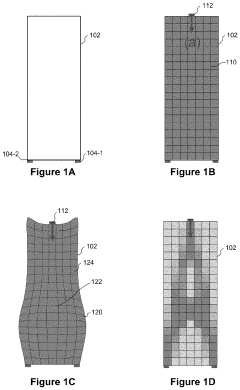
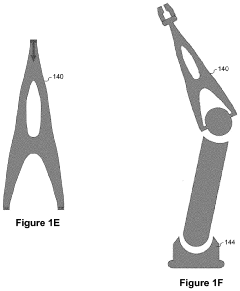
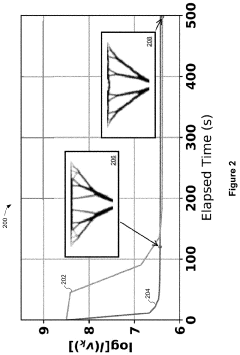
Structural design using finite-element analysis
PatentPendingUS20230315947A1
Innovation
- The approach reformulates the problem as a bilevel optimization using a first-order algorithm and the Solid Isotropic Material with Penalization (SIMP) model, allowing for approximate solutions and reducing iterative costs, enabling faster design updates and convergence to locally optimal structures.

Automated design and optimization for accessibility in subtractive manufacturing
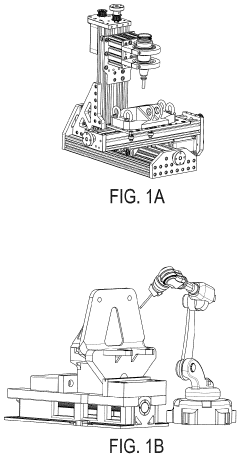
PatentActiveUS20210390229A1
Innovation
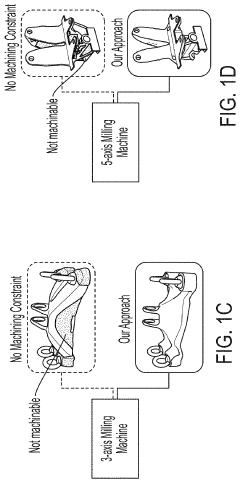
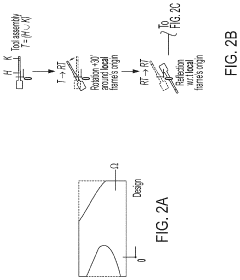
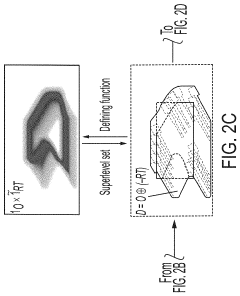
- A methodology that incorporates accessibility constraints through the definition of an inaccessibility measure field, which quantifies the spatial inaccessibility of design features by subtractive manufacturing tools, coupled with sensitivity fields to prevent the formation of inaccessible regions, ensuring designs can be manufactured via multi-axis machining.
Integration with Digital Twin and Simulation Technologies
The integration of topology optimization with digital twin and simulation technologies represents a significant advancement in product lifecycle management. Digital twins—virtual replicas of physical assets—provide real-time data collection and analysis capabilities that, when combined with topology optimization techniques, create powerful synergies for performance enhancement throughout a product's lifecycle. This integration enables continuous optimization based on actual operational data rather than just initial design assumptions.
Simulation technologies serve as the computational backbone of this integration, allowing engineers to test multiple topology optimization scenarios against real-world conditions captured by digital twins. Advanced finite element analysis (FEA) and computational fluid dynamics (CFD) simulations can incorporate data streams from operational assets, creating a feedback loop that refines optimization parameters based on actual performance metrics. This dynamic approach transcends traditional static optimization methods by adapting to changing conditions and requirements over time.
The implementation architecture typically involves three interconnected layers: the physical asset equipped with sensors, the digital twin platform collecting and processing operational data, and the topology optimization engine that leverages this data to suggest design improvements. Cloud computing resources often support this architecture, providing the necessary computational power for complex simulations and optimization algorithms while enabling collaborative access across engineering teams.
Several pioneering case studies demonstrate the effectiveness of this integration. Aerospace manufacturers have reported 15-20% improvements in component durability by implementing topology optimization adjustments based on digital twin flight data. Similarly, automotive companies utilizing this approach have achieved 8-12% weight reductions in structural components while maintaining or improving performance specifications, directly translating to fuel efficiency gains.
The integration also facilitates predictive maintenance strategies by identifying potential failure points before they manifest. By analyzing stress patterns and material fatigue data from digital twins, topology optimization algorithms can suggest targeted reinforcements or material redistributions that extend component lifespan without complete redesigns. This capability significantly reduces maintenance costs and downtime across the operational lifecycle.
Looking forward, machine learning algorithms are increasingly being incorporated into this integration framework, enabling systems to autonomously identify optimization opportunities based on operational patterns. These self-improving systems represent the next frontier in lifecycle performance optimization, potentially revolutionizing how products evolve throughout their service life.
Simulation technologies serve as the computational backbone of this integration, allowing engineers to test multiple topology optimization scenarios against real-world conditions captured by digital twins. Advanced finite element analysis (FEA) and computational fluid dynamics (CFD) simulations can incorporate data streams from operational assets, creating a feedback loop that refines optimization parameters based on actual performance metrics. This dynamic approach transcends traditional static optimization methods by adapting to changing conditions and requirements over time.
The implementation architecture typically involves three interconnected layers: the physical asset equipped with sensors, the digital twin platform collecting and processing operational data, and the topology optimization engine that leverages this data to suggest design improvements. Cloud computing resources often support this architecture, providing the necessary computational power for complex simulations and optimization algorithms while enabling collaborative access across engineering teams.
Several pioneering case studies demonstrate the effectiveness of this integration. Aerospace manufacturers have reported 15-20% improvements in component durability by implementing topology optimization adjustments based on digital twin flight data. Similarly, automotive companies utilizing this approach have achieved 8-12% weight reductions in structural components while maintaining or improving performance specifications, directly translating to fuel efficiency gains.
The integration also facilitates predictive maintenance strategies by identifying potential failure points before they manifest. By analyzing stress patterns and material fatigue data from digital twins, topology optimization algorithms can suggest targeted reinforcements or material redistributions that extend component lifespan without complete redesigns. This capability significantly reduces maintenance costs and downtime across the operational lifecycle.
Looking forward, machine learning algorithms are increasingly being incorporated into this integration framework, enabling systems to autonomously identify optimization opportunities based on operational patterns. These self-improving systems represent the next frontier in lifecycle performance optimization, potentially revolutionizing how products evolve throughout their service life.
Sustainability Impact and Material Efficiency Considerations
Topology optimization techniques offer significant potential for enhancing sustainability across product lifecycles. By optimizing material distribution within a given design space, these techniques can reduce material consumption by up to 30-50% while maintaining structural integrity and performance requirements. This material efficiency directly translates to reduced environmental impact through decreased raw material extraction, processing energy, and associated carbon emissions.
The environmental benefits extend throughout the product lifecycle. During manufacturing, optimized designs require less material input and often result in shorter production times with reduced energy consumption. The lightweight structures produced through topology optimization contribute to operational efficiency, particularly in transportation applications where each kilogram of weight reduction can save thousands of liters of fuel over a vehicle's lifetime.
Material selection considerations become increasingly important when implementing topology optimization for sustainability. The technique allows designers to strategically incorporate recycled or renewable materials in non-critical areas while reserving high-performance materials for regions under maximum stress. This hybrid material approach maximizes resource efficiency without compromising structural performance.
End-of-life considerations can also be addressed through topology optimization by designing for disassembly and material recovery. By creating structures with clearly defined material boundaries and separation points, the recovery and recycling of valuable materials becomes more economically viable. Some advanced algorithms now incorporate recyclability parameters directly into the optimization process.
Quantitative lifecycle assessment (LCA) studies demonstrate that topology-optimized components can reduce overall environmental impact by 15-40% compared to conventional designs. These improvements stem from combined benefits in material reduction, operational efficiency, and enhanced product longevity. The most significant gains typically occur in applications with high operational energy demands, such as aerospace and automotive sectors.
Recent advancements in multi-objective optimization algorithms allow designers to simultaneously consider environmental impact metrics alongside traditional performance parameters. These approaches enable explicit trade-off analysis between mechanical performance, manufacturing constraints, and sustainability goals, providing decision-makers with transparent options for balancing competing priorities.
The integration of topology optimization with circular economy principles represents a promising frontier. By designing components that maintain value throughout multiple lifecycles, these techniques contribute to closing material loops and reducing dependence on virgin resource extraction. This systemic approach to design optimization may ultimately transform how industries conceptualize product development and material efficiency.
The environmental benefits extend throughout the product lifecycle. During manufacturing, optimized designs require less material input and often result in shorter production times with reduced energy consumption. The lightweight structures produced through topology optimization contribute to operational efficiency, particularly in transportation applications where each kilogram of weight reduction can save thousands of liters of fuel over a vehicle's lifetime.
Material selection considerations become increasingly important when implementing topology optimization for sustainability. The technique allows designers to strategically incorporate recycled or renewable materials in non-critical areas while reserving high-performance materials for regions under maximum stress. This hybrid material approach maximizes resource efficiency without compromising structural performance.
End-of-life considerations can also be addressed through topology optimization by designing for disassembly and material recovery. By creating structures with clearly defined material boundaries and separation points, the recovery and recycling of valuable materials becomes more economically viable. Some advanced algorithms now incorporate recyclability parameters directly into the optimization process.
Quantitative lifecycle assessment (LCA) studies demonstrate that topology-optimized components can reduce overall environmental impact by 15-40% compared to conventional designs. These improvements stem from combined benefits in material reduction, operational efficiency, and enhanced product longevity. The most significant gains typically occur in applications with high operational energy demands, such as aerospace and automotive sectors.
Recent advancements in multi-objective optimization algorithms allow designers to simultaneously consider environmental impact metrics alongside traditional performance parameters. These approaches enable explicit trade-off analysis between mechanical performance, manufacturing constraints, and sustainability goals, providing decision-makers with transparent options for balancing competing priorities.
The integration of topology optimization with circular economy principles represents a promising frontier. By designing components that maintain value throughout multiple lifecycles, these techniques contribute to closing material loops and reducing dependence on virgin resource extraction. This systemic approach to design optimization may ultimately transform how industries conceptualize product development and material efficiency.
Unlock deeper insights with Patsnap Eureka Quick Research — get a full tech report to explore trends and direct your research. Try now!
Generate Your Research Report Instantly with AI Agent
Supercharge your innovation with Patsnap Eureka AI Agent Platform!