How to Validate Dynamic Light Scattering Results in Quality Control
SEP 5, 20259 MIN READ
Generate Your Research Report Instantly with AI Agent
Patsnap Eureka helps you evaluate technical feasibility & market potential.
DLS Technology Background and Validation Objectives
Dynamic Light Scattering (DLS) emerged in the 1960s as a powerful analytical technique for characterizing particles in suspension. The technology leverages the Brownian motion principle, where particles in suspension move randomly due to collisions with solvent molecules. By analyzing the scattered light intensity fluctuations from these moving particles, DLS provides critical information about particle size distribution, polydispersity, and molecular weight.
Over the past decades, DLS has evolved from complex laboratory setups requiring significant expertise to modern, user-friendly instruments capable of rapid measurements with minimal sample preparation. This evolution has positioned DLS as an essential quality control tool across pharmaceutical, biotechnology, and nanotechnology industries, particularly for characterizing nanoparticles, proteins, liposomes, and other colloidal systems.
The fundamental objective of DLS validation in quality control environments is to ensure measurement accuracy, precision, and reliability across different samples and operating conditions. This validation process must verify that DLS instruments consistently deliver reproducible results that accurately reflect the true characteristics of the analyzed samples, thereby supporting critical quality decisions in manufacturing processes.
Key validation objectives include establishing measurement repeatability under identical conditions, reproducibility across different operators and instruments, accuracy verification against certified reference materials, and determination of detection limits and measurement ranges. Additionally, validation must address the robustness of DLS measurements against common variables such as temperature fluctuations, sample concentration variations, and potential contaminants.
The technology continues to advance with improvements in laser stability, detector sensitivity, and data processing algorithms. Modern DLS systems incorporate sophisticated correlation techniques and mathematical models to extract meaningful size distribution data from complex samples. Machine learning approaches are increasingly being integrated to enhance data interpretation and reduce operator dependency.
Current technological trends focus on miniaturization for point-of-use applications, integration with complementary techniques like Raman spectroscopy or static light scattering, and development of automated validation protocols to streamline quality control processes. These advancements aim to address persistent challenges in analyzing polydisperse samples, differentiating between monomers and small aggregates, and maintaining measurement consistency across different instrument platforms.
As regulatory requirements become more stringent, particularly for pharmaceutical and medical device industries, establishing standardized DLS validation protocols has become increasingly important to ensure compliance with quality standards such as USP, Ph. Eur., and ISO guidelines.
Over the past decades, DLS has evolved from complex laboratory setups requiring significant expertise to modern, user-friendly instruments capable of rapid measurements with minimal sample preparation. This evolution has positioned DLS as an essential quality control tool across pharmaceutical, biotechnology, and nanotechnology industries, particularly for characterizing nanoparticles, proteins, liposomes, and other colloidal systems.
The fundamental objective of DLS validation in quality control environments is to ensure measurement accuracy, precision, and reliability across different samples and operating conditions. This validation process must verify that DLS instruments consistently deliver reproducible results that accurately reflect the true characteristics of the analyzed samples, thereby supporting critical quality decisions in manufacturing processes.
Key validation objectives include establishing measurement repeatability under identical conditions, reproducibility across different operators and instruments, accuracy verification against certified reference materials, and determination of detection limits and measurement ranges. Additionally, validation must address the robustness of DLS measurements against common variables such as temperature fluctuations, sample concentration variations, and potential contaminants.
The technology continues to advance with improvements in laser stability, detector sensitivity, and data processing algorithms. Modern DLS systems incorporate sophisticated correlation techniques and mathematical models to extract meaningful size distribution data from complex samples. Machine learning approaches are increasingly being integrated to enhance data interpretation and reduce operator dependency.
Current technological trends focus on miniaturization for point-of-use applications, integration with complementary techniques like Raman spectroscopy or static light scattering, and development of automated validation protocols to streamline quality control processes. These advancements aim to address persistent challenges in analyzing polydisperse samples, differentiating between monomers and small aggregates, and maintaining measurement consistency across different instrument platforms.
As regulatory requirements become more stringent, particularly for pharmaceutical and medical device industries, establishing standardized DLS validation protocols has become increasingly important to ensure compliance with quality standards such as USP, Ph. Eur., and ISO guidelines.
Market Demand for DLS in Quality Control Applications
Dynamic Light Scattering (DLS) has emerged as a critical analytical technique in quality control processes across multiple industries, with market demand showing robust growth trajectories. The global market for DLS instrumentation and services was valued at approximately $300 million in 2022, with projections indicating a compound annual growth rate of 6-8% through 2028. This growth is primarily driven by increasing quality standards in pharmaceutical manufacturing, biotechnology research, and nanomaterial production.
In the pharmaceutical sector, DLS has become indispensable for characterizing protein formulations, liposomal drug delivery systems, and vaccine components. The COVID-19 pandemic significantly accelerated adoption, as manufacturers of mRNA vaccines relied heavily on DLS for lipid nanoparticle characterization. Industry reports indicate that over 85% of biopharmaceutical companies now incorporate DLS in their quality control protocols for protein-based therapeutics.
The food and beverage industry represents another rapidly expanding market for DLS applications, particularly for emulsion stability testing and ingredient quality verification. Consumer demand for clean-label products with consistent texture and appearance has pushed manufacturers to implement more sophisticated analytical methods, with DLS adoption increasing by approximately 12% annually in this sector since 2019.
Academic and contract research organizations constitute a substantial market segment, utilizing DLS for both fundamental research and commercial testing services. The global expansion of nanomaterial applications has created parallel demand for reliable particle characterization methods, with DLS being favored for its non-destructive nature and rapid analysis capabilities.
Regulatory factors significantly influence market demand, with agencies like the FDA and EMA increasingly requiring comprehensive particle characterization data for new drug approvals. This regulatory pressure has transformed DLS from an optional research tool to a mandatory quality control component for many manufacturers, driving investment in validated DLS systems and standardized protocols.
Regional analysis reveals that North America currently holds the largest market share at approximately 40%, followed by Europe (30%) and Asia-Pacific (25%). However, the fastest growth is occurring in emerging markets, particularly in India and China, where expanding pharmaceutical manufacturing capabilities and increasing quality standards are creating new demand centers for advanced analytical technologies like DLS.
The market is further characterized by a growing preference for integrated analytical systems that combine DLS with complementary techniques such as Raman spectroscopy or size-exclusion chromatography, allowing for more comprehensive particle characterization within unified quality control workflows.
In the pharmaceutical sector, DLS has become indispensable for characterizing protein formulations, liposomal drug delivery systems, and vaccine components. The COVID-19 pandemic significantly accelerated adoption, as manufacturers of mRNA vaccines relied heavily on DLS for lipid nanoparticle characterization. Industry reports indicate that over 85% of biopharmaceutical companies now incorporate DLS in their quality control protocols for protein-based therapeutics.
The food and beverage industry represents another rapidly expanding market for DLS applications, particularly for emulsion stability testing and ingredient quality verification. Consumer demand for clean-label products with consistent texture and appearance has pushed manufacturers to implement more sophisticated analytical methods, with DLS adoption increasing by approximately 12% annually in this sector since 2019.
Academic and contract research organizations constitute a substantial market segment, utilizing DLS for both fundamental research and commercial testing services. The global expansion of nanomaterial applications has created parallel demand for reliable particle characterization methods, with DLS being favored for its non-destructive nature and rapid analysis capabilities.
Regulatory factors significantly influence market demand, with agencies like the FDA and EMA increasingly requiring comprehensive particle characterization data for new drug approvals. This regulatory pressure has transformed DLS from an optional research tool to a mandatory quality control component for many manufacturers, driving investment in validated DLS systems and standardized protocols.
Regional analysis reveals that North America currently holds the largest market share at approximately 40%, followed by Europe (30%) and Asia-Pacific (25%). However, the fastest growth is occurring in emerging markets, particularly in India and China, where expanding pharmaceutical manufacturing capabilities and increasing quality standards are creating new demand centers for advanced analytical technologies like DLS.
The market is further characterized by a growing preference for integrated analytical systems that combine DLS with complementary techniques such as Raman spectroscopy or size-exclusion chromatography, allowing for more comprehensive particle characterization within unified quality control workflows.
Current Challenges in DLS Result Validation
Despite significant advancements in Dynamic Light Scattering (DLS) technology, several persistent challenges impede reliable validation of results in quality control environments. The inherent sensitivity of DLS measurements to environmental factors represents a primary obstacle. Temperature fluctuations, even minor ones, can significantly alter particle Brownian motion, leading to inconsistent size distribution readings. Similarly, vibrations from nearby equipment can introduce artifacts that compromise measurement accuracy.
Sample preparation inconsistencies further complicate validation efforts. Variations in concentration, inadequate dispersion, or the presence of large contaminants can dramatically skew results. This is particularly problematic in routine quality control settings where standardized sample preparation protocols may not account for product-specific requirements.
Interpretation of polydisperse samples presents another substantial challenge. When samples contain particles of varying sizes, DLS algorithms may struggle to accurately resolve distinct populations, often favoring larger particles due to their disproportionate scattering intensity. This bias can mask critical quality attributes related to smaller particles or aggregates that may impact product performance or stability.
Data analysis complexity compounds these issues. Different mathematical models and algorithms employed by various DLS instruments can yield divergent results from identical samples. The lack of standardized approaches to data processing creates significant barriers to establishing universal validation criteria across different laboratories or manufacturing sites.
Reference material limitations further hinder validation efforts. The scarcity of certified reference materials that accurately mimic the complex compositions of real-world samples makes it difficult to establish reliable calibration standards. This gap is particularly evident in specialized applications such as biopharmaceuticals, where protein aggregation monitoring requires highly specific reference materials.
Regulatory uncertainty adds another layer of complexity. While DLS is widely used in quality control, regulatory guidelines regarding validation protocols remain inconsistent across different industries and regions. This regulatory ambiguity complicates efforts to establish standardized validation approaches that satisfy compliance requirements across global markets.
Instrument-to-instrument variability presents additional validation hurdles. Even identical DLS models from the same manufacturer may produce different results due to subtle variations in optical components, detector sensitivity, or laser stability. This inherent variability necessitates robust cross-validation protocols that many quality control laboratories struggle to implement effectively.
Sample preparation inconsistencies further complicate validation efforts. Variations in concentration, inadequate dispersion, or the presence of large contaminants can dramatically skew results. This is particularly problematic in routine quality control settings where standardized sample preparation protocols may not account for product-specific requirements.
Interpretation of polydisperse samples presents another substantial challenge. When samples contain particles of varying sizes, DLS algorithms may struggle to accurately resolve distinct populations, often favoring larger particles due to their disproportionate scattering intensity. This bias can mask critical quality attributes related to smaller particles or aggregates that may impact product performance or stability.
Data analysis complexity compounds these issues. Different mathematical models and algorithms employed by various DLS instruments can yield divergent results from identical samples. The lack of standardized approaches to data processing creates significant barriers to establishing universal validation criteria across different laboratories or manufacturing sites.
Reference material limitations further hinder validation efforts. The scarcity of certified reference materials that accurately mimic the complex compositions of real-world samples makes it difficult to establish reliable calibration standards. This gap is particularly evident in specialized applications such as biopharmaceuticals, where protein aggregation monitoring requires highly specific reference materials.
Regulatory uncertainty adds another layer of complexity. While DLS is widely used in quality control, regulatory guidelines regarding validation protocols remain inconsistent across different industries and regions. This regulatory ambiguity complicates efforts to establish standardized validation approaches that satisfy compliance requirements across global markets.
Instrument-to-instrument variability presents additional validation hurdles. Even identical DLS models from the same manufacturer may produce different results due to subtle variations in optical components, detector sensitivity, or laser stability. This inherent variability necessitates robust cross-validation protocols that many quality control laboratories struggle to implement effectively.
Established DLS Validation Protocols
01 DLS validation methods for particle size analysis
Dynamic Light Scattering (DLS) validation techniques for accurate particle size measurement and distribution analysis. These methods include calibration procedures using standard reference materials, validation protocols to ensure measurement accuracy, and techniques to verify instrument performance. The validation process ensures reliable characterization of nanoparticles, colloids, and other particulate systems across various applications.- DLS validation methods for particle size analysis: Dynamic Light Scattering (DLS) validation techniques for accurate particle size measurement and distribution analysis. These methods include calibration procedures using standard reference materials, validation protocols to ensure measurement accuracy, and quality control processes to maintain instrument performance. The validation approaches help ensure reliable characterization of nanoparticles, colloids, and other particulate systems across various applications.
- DLS data processing and algorithm validation: Advanced algorithms and data processing techniques for validating Dynamic Light Scattering measurements. These include computational methods for signal processing, correlation function analysis, and statistical validation of DLS data. The approaches focus on improving measurement accuracy, reducing noise, and enhancing the reliability of particle size distribution results through mathematical modeling and software validation procedures.
- DLS validation for biological and pharmaceutical applications: Validation protocols specifically designed for Dynamic Light Scattering applications in biological and pharmaceutical research. These methods focus on validating DLS measurements for protein formulations, drug delivery systems, and biological macromolecules. The validation approaches ensure accurate characterization of biomolecules, stability assessment, and quality control in pharmaceutical development and production processes.
- Automated DLS validation systems: Automated systems and technologies for validating Dynamic Light Scattering measurements with minimal human intervention. These systems incorporate automated calibration, data analysis, and quality control features to ensure consistent and reliable DLS results. The automation approaches include instrument self-validation routines, continuous monitoring of system performance, and automated reporting of validation metrics.
- Multi-parameter DLS validation techniques: Comprehensive validation approaches that combine Dynamic Light Scattering with complementary analytical techniques for enhanced measurement validation. These methods integrate multiple measurement parameters such as zeta potential, molecular weight, and concentration to provide more robust validation of particle characterization results. The multi-parameter approaches enable cross-validation of DLS measurements against other analytical methods for improved accuracy and reliability.
02 DLS data processing and algorithm validation
Validation approaches for DLS data processing algorithms that transform raw scattering data into meaningful size distribution information. These include mathematical models for correlation function analysis, statistical methods to validate calculation accuracy, and software validation protocols. Advanced algorithms help eliminate artifacts, improve resolution between particle populations, and ensure the reliability of size measurements across different sample types.Expand Specific Solutions03 DLS validation for pharmaceutical and biological applications
Validation methodologies specifically designed for pharmaceutical and biological samples analyzed by DLS. These include protocols for validating protein formulations, drug delivery systems, and biological nanoparticles. The validation approaches ensure accurate characterization of biomolecules, stability assessment of pharmaceutical formulations, and quality control of biological products while addressing the unique challenges posed by complex biological matrices.Expand Specific Solutions04 Automated DLS validation systems
Automated systems and approaches for DLS validation that reduce human intervention and increase throughput. These systems incorporate automated calibration checks, performance verification routines, and continuous monitoring of instrument parameters. The automation helps maintain data integrity, ensures consistent validation across multiple instruments, and provides audit trails for regulatory compliance in various industries.Expand Specific Solutions05 Multi-parameter DLS validation techniques
Comprehensive validation approaches that combine DLS with complementary techniques for enhanced particle characterization. These multi-parameter methods integrate DLS with techniques such as zeta potential measurement, microscopy, or spectroscopic methods to provide more complete validation of particle properties. The combined approach offers more robust validation by cross-verifying results through independent measurement principles, particularly valuable for complex or heterogeneous samples.Expand Specific Solutions
Key Industry Players in DLS Instrumentation
Dynamic Light Scattering (DLS) validation in quality control is evolving within a maturing market characterized by sophisticated technological applications and growing demand across pharmaceutical and materials science sectors. The global market for DLS instrumentation continues to expand, driven by increasing requirements for nanoparticle characterization and protein analysis. Leading players like Malvern Panalytical, Wyatt Technology, and Shimadzu have established strong technological foundations, while companies such as LS Instruments and Postnova Analytics offer specialized solutions. The technology has reached considerable maturity with standardized protocols, though innovations continue in data processing algorithms and multi-angle detection systems. Integration with complementary techniques and automation represents the current competitive frontier as manufacturers seek to enhance reliability and reproducibility for quality control applications.
Wyatt Technology LLC
Technical Solution: Wyatt Technology has developed comprehensive validation protocols for Dynamic Light Scattering (DLS) results in quality control environments. Their approach centers on their DYNAMICS software platform which incorporates multiple validation algorithms including cumulants analysis, regularization methods, and CONTIN analysis to ensure accurate particle size distribution measurements. The company's validation methodology includes automated instrument performance verification using NIST-traceable standards, statistical process control charts for trending instrument performance over time, and multi-angle DLS measurements that provide enhanced resolution and accuracy compared to conventional single-angle systems. Their technology enables real-time data validation through built-in quality metrics such as count rate stability, correlation function analysis, and polydispersity index thresholds that automatically flag potentially unreliable measurements. For pharmaceutical applications, Wyatt has implemented 21 CFR Part 11 compliant validation procedures with comprehensive audit trails and electronic signatures to meet regulatory requirements.
Strengths: Industry-leading multi-angle DLS technology provides superior resolution for complex samples and more robust validation capabilities than single-angle systems. Their software incorporates multiple analysis algorithms allowing cross-validation of results. Weaknesses: Their systems tend to be more expensive than competitors, and the validation protocols may be overly complex for routine quality control applications in smaller organizations.
Malvern Panalytical Ltd.
Technical Solution: Malvern Panalytical has pioneered an integrated approach to DLS validation in quality control settings through their Zetasizer series instruments. Their validation technology incorporates automated Standard Operating Procedure (SOP) functionality that guides operators through predefined measurement protocols to ensure consistency across different users and laboratories. The company's DLS validation framework includes built-in reference material databases with expected values for common standards, allowing automatic verification against established criteria. Their adaptive correlation algorithm automatically optimizes data collection parameters based on sample characteristics, improving measurement reliability for challenging samples. Malvern's validation approach includes sophisticated data quality assessment tools that evaluate signal-to-noise ratios, intercept values, and count rate stability to automatically flag measurements that fall outside acceptable quality parameters. For regulated environments, they've developed IQ/OQ/PQ validation packages that provide documented evidence of instrument performance in accordance with USP <729> and ISO 22412 standards, with automated compliance reporting capabilities that significantly reduce validation documentation burden.
Strengths: User-friendly software with extensive built-in validation tools makes implementation straightforward even for non-expert users. Their systems offer excellent reproducibility and have become the de facto industry standard in many sectors. Weaknesses: Their standard algorithms may sometimes struggle with highly polydisperse or complex biological samples, requiring additional validation steps or complementary techniques.
Critical Technical Standards for DLS Measurements
Method and device for determining the static and/or dynamic scattering of light
PatentInactiveEP2526406A1
Innovation
- A method involving multiple parallel measurements across independent scattering volumes using single-photon detectors and time-multiplexed illumination with synchronized detection, allowing for simultaneous analysis of scattered light from different zones, thereby increasing measurement accuracy and reducing the impact of multiple scattering and environmental fluctuations.
Devices and methods for analyzing and filtering light scattering data from a sample potentially containing a non-target compound
PatentActiveUS20210270712A1
Innovation
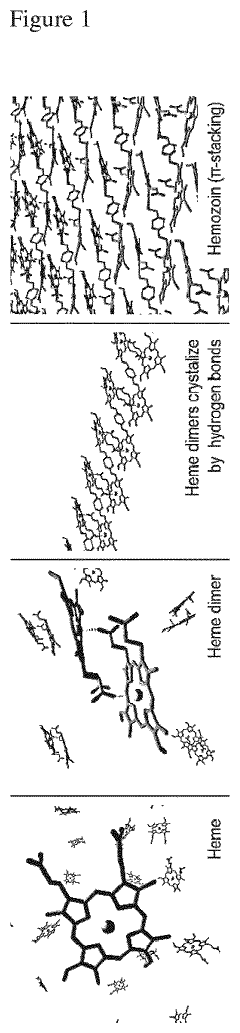
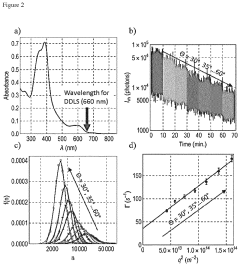
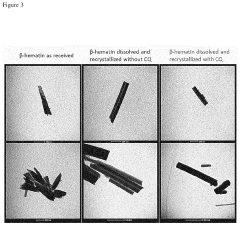
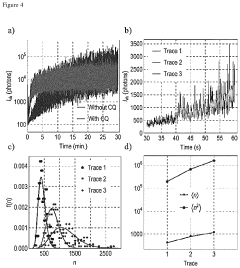
- The method involves analyzing light scattering data, specifically through static, dynamic, and depolarized dynamic light scattering, to identify and quantify the mode of photon count distribution, allowing for the elimination of outliers and providing insights into crystal growth rates and concentrations by using statistical analysis of photon counts.
Regulatory Compliance for DLS in QC Environments
Dynamic Light Scattering (DLS) implementation in quality control environments necessitates strict adherence to regulatory frameworks established by various international bodies. The FDA's guidance for industry on analytical procedures and methods validation specifically addresses particle characterization techniques, requiring documented evidence of method suitability, reliability, and reproducibility for DLS applications in pharmaceutical quality control.
The European Medicines Agency (EMA) provides complementary guidelines through ICH Q2(R1) for analytical method validation, which although not specifically mentioning DLS, establishes principles applicable to particle size analysis. These guidelines mandate validation parameters including accuracy, precision, specificity, detection limit, quantitation limit, linearity, and robustness—all critical for DLS validation in quality control settings.
ISO standards play a pivotal role in DLS regulatory compliance, particularly ISO 22412:2017, which outlines specific procedures for particle size analysis using dynamic light scattering. This standard provides detailed protocols for instrument qualification, measurement procedures, and data interpretation that quality control laboratories must follow to ensure compliance.
For biopharmaceutical applications, USP <429> provides specific guidance on light scattering techniques for particle characterization, establishing acceptance criteria and system suitability requirements. Compliance with these standards is essential for regulatory submissions and ongoing quality assurance programs.
Documentation requirements represent a significant aspect of regulatory compliance for DLS in QC environments. Standard Operating Procedures (SOPs) must detail instrument qualification (IQ/OQ/PQ), calibration schedules, reference material certification, and analyst training programs. These documents serve as evidence of compliance during regulatory inspections and audits.
Risk assessment frameworks, such as those outlined in ICH Q9, must be integrated into DLS validation protocols to identify critical measurement parameters and establish appropriate control strategies. This risk-based approach helps prioritize validation efforts and ensures that the most critical aspects of DLS measurements receive appropriate scrutiny.
Global harmonization efforts are underway to standardize DLS requirements across regulatory jurisdictions, with initiatives from organizations like the Global Harmonization Task Force (GHTF) and the International Council for Harmonisation (ICH) working to establish consistent expectations for particle characterization methods. These efforts aim to streamline compliance activities for multinational organizations implementing DLS in quality control environments.
The European Medicines Agency (EMA) provides complementary guidelines through ICH Q2(R1) for analytical method validation, which although not specifically mentioning DLS, establishes principles applicable to particle size analysis. These guidelines mandate validation parameters including accuracy, precision, specificity, detection limit, quantitation limit, linearity, and robustness—all critical for DLS validation in quality control settings.
ISO standards play a pivotal role in DLS regulatory compliance, particularly ISO 22412:2017, which outlines specific procedures for particle size analysis using dynamic light scattering. This standard provides detailed protocols for instrument qualification, measurement procedures, and data interpretation that quality control laboratories must follow to ensure compliance.
For biopharmaceutical applications, USP <429> provides specific guidance on light scattering techniques for particle characterization, establishing acceptance criteria and system suitability requirements. Compliance with these standards is essential for regulatory submissions and ongoing quality assurance programs.
Documentation requirements represent a significant aspect of regulatory compliance for DLS in QC environments. Standard Operating Procedures (SOPs) must detail instrument qualification (IQ/OQ/PQ), calibration schedules, reference material certification, and analyst training programs. These documents serve as evidence of compliance during regulatory inspections and audits.
Risk assessment frameworks, such as those outlined in ICH Q9, must be integrated into DLS validation protocols to identify critical measurement parameters and establish appropriate control strategies. This risk-based approach helps prioritize validation efforts and ensures that the most critical aspects of DLS measurements receive appropriate scrutiny.
Global harmonization efforts are underway to standardize DLS requirements across regulatory jurisdictions, with initiatives from organizations like the Global Harmonization Task Force (GHTF) and the International Council for Harmonisation (ICH) working to establish consistent expectations for particle characterization methods. These efforts aim to streamline compliance activities for multinational organizations implementing DLS in quality control environments.
Statistical Methods for DLS Result Interpretation
Statistical analysis forms the cornerstone of reliable Dynamic Light Scattering (DLS) data interpretation in quality control environments. The inherent variability in DLS measurements necessitates robust statistical approaches to distinguish between normal measurement fluctuations and actual quality deviations. Fundamentally, three statistical methods have emerged as industry standards: repeatability analysis, outlier detection, and trend monitoring.
Repeatability analysis involves conducting multiple measurements of the same sample under identical conditions to establish measurement precision. The coefficient of variation (CV) serves as a critical metric, with values below 10% generally indicating acceptable measurement consistency for particle size distributions. For polydispersity index (PDI) measurements, tighter tolerances are typically required, with CV values below 5% considered optimal for quality control applications.
Outlier detection methodologies, including Grubbs' test and Dixon's Q-test, provide systematic approaches to identify anomalous measurements that may indicate instrument malfunction or sample contamination. These statistical tests evaluate the probability that an extreme value belongs to the same population as the remaining measurements, with significance levels typically set at 0.05 for quality control applications.
Trend monitoring through statistical process control (SPC) charts enables the detection of subtle shifts in DLS measurements over time. Control charts with established upper and lower control limits (typically set at ±3 standard deviations) facilitate the distinction between random variation and systematic changes in product quality. Moving average and exponentially weighted moving average (EWMA) techniques further enhance sensitivity to gradual drifts in particle characteristics.
Multivariate statistical approaches have gained prominence for complex formulations where multiple DLS parameters must be simultaneously monitored. Principal Component Analysis (PCA) reduces dimensionality while preserving critical information relationships, enabling more comprehensive quality assessments. Similarly, partial least squares (PLS) regression models correlate DLS measurements with critical quality attributes, providing predictive capabilities for product performance.
Bayesian statistical frameworks offer particular advantages for DLS validation by incorporating prior knowledge about expected particle distributions. This approach is especially valuable when reference materials with well-characterized properties are available, allowing for more nuanced interpretation of measurement deviations and reduced false rejection rates in quality control decisions.
Repeatability analysis involves conducting multiple measurements of the same sample under identical conditions to establish measurement precision. The coefficient of variation (CV) serves as a critical metric, with values below 10% generally indicating acceptable measurement consistency for particle size distributions. For polydispersity index (PDI) measurements, tighter tolerances are typically required, with CV values below 5% considered optimal for quality control applications.
Outlier detection methodologies, including Grubbs' test and Dixon's Q-test, provide systematic approaches to identify anomalous measurements that may indicate instrument malfunction or sample contamination. These statistical tests evaluate the probability that an extreme value belongs to the same population as the remaining measurements, with significance levels typically set at 0.05 for quality control applications.
Trend monitoring through statistical process control (SPC) charts enables the detection of subtle shifts in DLS measurements over time. Control charts with established upper and lower control limits (typically set at ±3 standard deviations) facilitate the distinction between random variation and systematic changes in product quality. Moving average and exponentially weighted moving average (EWMA) techniques further enhance sensitivity to gradual drifts in particle characteristics.
Multivariate statistical approaches have gained prominence for complex formulations where multiple DLS parameters must be simultaneously monitored. Principal Component Analysis (PCA) reduces dimensionality while preserving critical information relationships, enabling more comprehensive quality assessments. Similarly, partial least squares (PLS) regression models correlate DLS measurements with critical quality attributes, providing predictive capabilities for product performance.
Bayesian statistical frameworks offer particular advantages for DLS validation by incorporating prior knowledge about expected particle distributions. This approach is especially valuable when reference materials with well-characterized properties are available, allowing for more nuanced interpretation of measurement deviations and reduced false rejection rates in quality control decisions.
Unlock deeper insights with Patsnap Eureka Quick Research — get a full tech report to explore trends and direct your research. Try now!
Generate Your Research Report Instantly with AI Agent
Supercharge your innovation with Patsnap Eureka AI Agent Platform!