
Neuromorphic Chips for Enhanced Signal Processing Capabilities
OCT 9, 202510 MIN READ
Generate Your Research Report Instantly with AI Agent
Patsnap Eureka helps you evaluate technical feasibility & market potential.
Neuromorphic Computing Evolution and Objectives
Neuromorphic computing represents a paradigm shift in computational architecture, drawing inspiration from the structure and function of the human brain. This approach has evolved significantly since its conceptual inception in the late 1980s when Carver Mead first proposed using very-large-scale integration (VLSI) systems to mimic neurobiological architectures. The fundamental premise behind neuromorphic computing is to create hardware systems that process information in a manner analogous to biological neural networks, offering potential advantages in efficiency, parallelism, and adaptability.
The evolution of neuromorphic chips has progressed through several distinct phases. The initial phase focused on analog VLSI implementations that directly mimicked neural dynamics. This was followed by the development of digital neuromorphic systems in the early 2000s, which offered greater precision and programmability. The current generation represents a hybrid approach, combining analog and digital elements to optimize both energy efficiency and computational flexibility.
Key milestones in this evolution include IBM's TrueNorth chip (2014), which featured one million digital neurons; Intel's Loihi (2017), which introduced on-chip learning capabilities; and BrainChip's Akida (2019), which emphasized edge computing applications. Each generation has progressively improved in terms of energy efficiency, integration density, and computational capabilities, moving closer to the remarkable efficiency of the human brain.
The primary objective of neuromorphic computing in signal processing is to enable real-time processing of complex, noisy, and time-varying signals with minimal power consumption. Traditional von Neumann architectures face fundamental limitations when dealing with the massive parallelism required for advanced signal processing tasks, particularly in applications such as computer vision, speech recognition, and sensor fusion.
Neuromorphic chips aim to overcome these limitations by implementing massively parallel architectures that process information in a distributed manner. This approach offers several advantages for signal processing: inherent parallelism for real-time processing, adaptive learning capabilities for dynamic environments, and exceptional energy efficiency for deployment in resource-constrained settings.
The technological trajectory suggests several emerging trends, including the integration of novel materials such as memristors and phase-change memory to create more efficient synaptic elements, the development of 3D integration techniques to increase neural density, and the implementation of more biologically accurate learning algorithms that leverage spike-timing-dependent plasticity (STDP) and other neuromorphic learning rules.
As neuromorphic technology continues to mature, the objectives are increasingly focused on practical applications in signal processing domains that demand high performance with minimal power consumption, such as autonomous vehicles, advanced robotics, and edge computing devices for the Internet of Things (IoT).
The evolution of neuromorphic chips has progressed through several distinct phases. The initial phase focused on analog VLSI implementations that directly mimicked neural dynamics. This was followed by the development of digital neuromorphic systems in the early 2000s, which offered greater precision and programmability. The current generation represents a hybrid approach, combining analog and digital elements to optimize both energy efficiency and computational flexibility.
Key milestones in this evolution include IBM's TrueNorth chip (2014), which featured one million digital neurons; Intel's Loihi (2017), which introduced on-chip learning capabilities; and BrainChip's Akida (2019), which emphasized edge computing applications. Each generation has progressively improved in terms of energy efficiency, integration density, and computational capabilities, moving closer to the remarkable efficiency of the human brain.
The primary objective of neuromorphic computing in signal processing is to enable real-time processing of complex, noisy, and time-varying signals with minimal power consumption. Traditional von Neumann architectures face fundamental limitations when dealing with the massive parallelism required for advanced signal processing tasks, particularly in applications such as computer vision, speech recognition, and sensor fusion.
Neuromorphic chips aim to overcome these limitations by implementing massively parallel architectures that process information in a distributed manner. This approach offers several advantages for signal processing: inherent parallelism for real-time processing, adaptive learning capabilities for dynamic environments, and exceptional energy efficiency for deployment in resource-constrained settings.
The technological trajectory suggests several emerging trends, including the integration of novel materials such as memristors and phase-change memory to create more efficient synaptic elements, the development of 3D integration techniques to increase neural density, and the implementation of more biologically accurate learning algorithms that leverage spike-timing-dependent plasticity (STDP) and other neuromorphic learning rules.
As neuromorphic technology continues to mature, the objectives are increasingly focused on practical applications in signal processing domains that demand high performance with minimal power consumption, such as autonomous vehicles, advanced robotics, and edge computing devices for the Internet of Things (IoT).
Signal Processing Market Demand Analysis
The signal processing market is experiencing unprecedented growth driven by the increasing complexity of data processing requirements across multiple industries. Current market analysis indicates that the global signal processing market reached approximately $12.5 billion in 2022 and is projected to grow at a compound annual growth rate (CAGR) of 9.8% through 2028. This growth trajectory is particularly significant in sectors requiring real-time data analysis and processing, including telecommunications, automotive, healthcare, and consumer electronics.
Neuromorphic chips represent a revolutionary approach to signal processing that addresses critical limitations in conventional computing architectures. Market research reveals that industries are increasingly demanding solutions capable of handling complex signal processing tasks with greater efficiency and lower power consumption. The telecommunications sector, for instance, requires advanced signal processing capabilities to manage the exponential growth in data traffic, especially with the ongoing deployment of 5G networks and the anticipated transition to 6G technologies.
In the automotive industry, the rise of advanced driver-assistance systems (ADAS) and autonomous vehicles has created substantial demand for sophisticated signal processing solutions. These applications require real-time processing of multiple sensor inputs, including camera feeds, radar, and lidar data, creating a market segment valued at approximately $3.2 billion with projected annual growth exceeding 15%.
Healthcare applications represent another significant market opportunity for neuromorphic signal processing. Medical imaging, patient monitoring systems, and diagnostic equipment all require advanced signal processing capabilities. The healthcare signal processing market segment is currently valued at approximately $2.8 billion and is expected to grow substantially as precision medicine and AI-assisted diagnostics become more prevalent.
Consumer electronics manufacturers are also driving demand for enhanced signal processing capabilities, particularly for applications involving speech recognition, image processing, and augmented reality. This segment represents approximately 24% of the total signal processing market and continues to expand as devices become more intelligent and feature-rich.
Industrial IoT applications constitute an emerging but rapidly growing market for signal processing solutions. As manufacturing facilities deploy more sensors and edge computing devices, the need for efficient signal processing becomes increasingly critical. Market analysis indicates that this segment is growing at approximately 18% annually, outpacing most other application areas.
The defense and aerospace sectors maintain consistent demand for high-performance signal processing capabilities, particularly for radar systems, electronic warfare, and secure communications. While representing a smaller portion of the overall market at approximately 8%, this segment values reliability and performance over cost considerations, making it particularly suitable for early adoption of neuromorphic technologies.
Neuromorphic chips represent a revolutionary approach to signal processing that addresses critical limitations in conventional computing architectures. Market research reveals that industries are increasingly demanding solutions capable of handling complex signal processing tasks with greater efficiency and lower power consumption. The telecommunications sector, for instance, requires advanced signal processing capabilities to manage the exponential growth in data traffic, especially with the ongoing deployment of 5G networks and the anticipated transition to 6G technologies.
In the automotive industry, the rise of advanced driver-assistance systems (ADAS) and autonomous vehicles has created substantial demand for sophisticated signal processing solutions. These applications require real-time processing of multiple sensor inputs, including camera feeds, radar, and lidar data, creating a market segment valued at approximately $3.2 billion with projected annual growth exceeding 15%.
Healthcare applications represent another significant market opportunity for neuromorphic signal processing. Medical imaging, patient monitoring systems, and diagnostic equipment all require advanced signal processing capabilities. The healthcare signal processing market segment is currently valued at approximately $2.8 billion and is expected to grow substantially as precision medicine and AI-assisted diagnostics become more prevalent.
Consumer electronics manufacturers are also driving demand for enhanced signal processing capabilities, particularly for applications involving speech recognition, image processing, and augmented reality. This segment represents approximately 24% of the total signal processing market and continues to expand as devices become more intelligent and feature-rich.
Industrial IoT applications constitute an emerging but rapidly growing market for signal processing solutions. As manufacturing facilities deploy more sensors and edge computing devices, the need for efficient signal processing becomes increasingly critical. Market analysis indicates that this segment is growing at approximately 18% annually, outpacing most other application areas.
The defense and aerospace sectors maintain consistent demand for high-performance signal processing capabilities, particularly for radar systems, electronic warfare, and secure communications. While representing a smaller portion of the overall market at approximately 8%, this segment values reliability and performance over cost considerations, making it particularly suitable for early adoption of neuromorphic technologies.
Neuromorphic Chip Technology Landscape and Barriers
The neuromorphic chip landscape is currently dominated by several key players, including both established technology giants and specialized startups. Intel's Loihi chip represents one of the most advanced commercial neuromorphic processors, featuring self-learning capabilities and significantly reduced power consumption compared to traditional computing architectures. IBM's TrueNorth has demonstrated impressive pattern recognition capabilities while consuming minimal power. Meanwhile, BrainChip's Akida neural processor offers edge-based AI processing with unprecedented efficiency for signal processing applications.
Academic institutions like the University of Manchester with its SpiNNaker system and ETH Zurich with its Dynap-SE platform continue to push research boundaries, often collaborating with industry partners to accelerate development cycles. These research-driven initiatives frequently serve as technology incubators for commercial applications.
Despite significant progress, neuromorphic computing faces substantial barriers to widespread adoption. The most fundamental challenge remains the hardware-software integration gap. Current programming paradigms are poorly suited for neuromorphic architectures, requiring developers to adopt entirely new computational thinking models based on spiking neural networks rather than conventional algorithms. This necessitates specialized training and expertise that remains scarce in the industry.
Manufacturing scalability presents another significant hurdle. Many neuromorphic designs require novel materials and fabrication techniques that don't align with established semiconductor manufacturing processes. The integration of memristive elements, phase-change materials, and other emerging components introduces yield and reliability challenges that impact production costs and commercial viability.
Standardization issues further complicate the landscape. Unlike traditional computing, where clear standards exist for hardware interfaces and software development, neuromorphic computing lacks unified frameworks. This fragmentation creates ecosystem barriers where solutions developed for one neuromorphic platform cannot be easily transferred to another, limiting knowledge sharing and technology advancement.
Performance benchmarking represents another critical barrier. Traditional computing metrics like FLOPS are inadequate for measuring neuromorphic system capabilities, making it difficult to quantitatively compare solutions or demonstrate value propositions to potential adopters. The industry has yet to establish standardized benchmarks that accurately reflect the unique advantages of neuromorphic approaches for signal processing applications.
Energy efficiency, while theoretically superior in neuromorphic systems, faces implementation challenges in practical applications. Current designs still struggle to fully realize the theoretical power advantages when scaled to complex real-world signal processing tasks, particularly when interfacing with conventional computing infrastructure.
Academic institutions like the University of Manchester with its SpiNNaker system and ETH Zurich with its Dynap-SE platform continue to push research boundaries, often collaborating with industry partners to accelerate development cycles. These research-driven initiatives frequently serve as technology incubators for commercial applications.
Despite significant progress, neuromorphic computing faces substantial barriers to widespread adoption. The most fundamental challenge remains the hardware-software integration gap. Current programming paradigms are poorly suited for neuromorphic architectures, requiring developers to adopt entirely new computational thinking models based on spiking neural networks rather than conventional algorithms. This necessitates specialized training and expertise that remains scarce in the industry.
Manufacturing scalability presents another significant hurdle. Many neuromorphic designs require novel materials and fabrication techniques that don't align with established semiconductor manufacturing processes. The integration of memristive elements, phase-change materials, and other emerging components introduces yield and reliability challenges that impact production costs and commercial viability.
Standardization issues further complicate the landscape. Unlike traditional computing, where clear standards exist for hardware interfaces and software development, neuromorphic computing lacks unified frameworks. This fragmentation creates ecosystem barriers where solutions developed for one neuromorphic platform cannot be easily transferred to another, limiting knowledge sharing and technology advancement.
Performance benchmarking represents another critical barrier. Traditional computing metrics like FLOPS are inadequate for measuring neuromorphic system capabilities, making it difficult to quantitatively compare solutions or demonstrate value propositions to potential adopters. The industry has yet to establish standardized benchmarks that accurately reflect the unique advantages of neuromorphic approaches for signal processing applications.
Energy efficiency, while theoretically superior in neuromorphic systems, faces implementation challenges in practical applications. Current designs still struggle to fully realize the theoretical power advantages when scaled to complex real-world signal processing tasks, particularly when interfacing with conventional computing infrastructure.
Current Neuromorphic Signal Processing Solutions
01 Neuromorphic architecture for real-time signal processing
Neuromorphic chips are designed with architectures that mimic the human brain's neural networks, enabling efficient real-time signal processing. These architectures incorporate parallel processing capabilities that allow for simultaneous handling of multiple signals, making them particularly effective for applications requiring rapid response times. The neural network structure enables adaptive signal processing that can adjust to changing input conditions without explicit reprogramming, providing advantages over traditional computing architectures for dynamic signal environments.- Neuromorphic architecture for real-time signal processing: Neuromorphic chips are designed with architectures that mimic the human brain's neural networks, enabling efficient real-time signal processing. These architectures incorporate parallel processing capabilities that allow for simultaneous handling of multiple signals, making them particularly effective for applications requiring rapid response times. The neural network structure enables adaptive processing of complex signals with lower power consumption compared to traditional computing architectures.
- Energy-efficient signal processing in neuromorphic systems: Neuromorphic chips offer significant advantages in energy efficiency for signal processing tasks. By utilizing spike-based computing and event-driven processing, these chips can perform complex signal analysis while consuming substantially less power than conventional processors. This efficiency stems from their ability to process information only when needed, similar to biological neural systems, rather than continuously as in traditional computing architectures. This makes them particularly suitable for battery-powered devices and edge computing applications requiring signal processing capabilities.
- Advanced pattern recognition and signal classification: Neuromorphic chips excel at pattern recognition and signal classification tasks due to their neural network architecture. These chips can identify complex patterns in signals, adapt to new patterns through learning algorithms, and classify signals based on learned features. This capability makes them particularly effective for applications such as speech recognition, image processing, and sensor data analysis, where they can extract meaningful information from noisy or complex signal environments with greater accuracy than traditional signal processing approaches.
- Adaptive learning and signal processing optimization: Neuromorphic chips incorporate adaptive learning capabilities that allow them to optimize signal processing functions based on input data. Through mechanisms such as spike-timing-dependent plasticity and other biologically-inspired learning rules, these chips can continuously refine their signal processing algorithms to improve performance over time. This self-optimization capability enables neuromorphic systems to adapt to changing signal environments, compensate for noise, and enhance their processing efficiency without explicit reprogramming.
- Integration with sensor systems for enhanced signal processing: Neuromorphic chips can be directly integrated with various sensor systems to provide enhanced signal processing capabilities at the edge. This integration allows for preprocessing of sensor data before transmission, reducing bandwidth requirements and enabling real-time analysis. The neuromorphic architecture is particularly well-suited for processing signals from multiple heterogeneous sensors simultaneously, extracting relevant features, and making decisions based on the combined input. This capability is valuable in applications such as autonomous vehicles, industrial monitoring, and smart infrastructure where rapid processing of sensor signals is critical.
02 Energy-efficient signal processing in neuromorphic systems
Neuromorphic chips offer significant energy efficiency advantages for signal processing applications compared to conventional processors. By utilizing spike-based computing and event-driven processing, these chips can perform complex signal analysis while consuming minimal power. This energy efficiency makes neuromorphic systems particularly suitable for edge computing applications where power constraints are significant. The ability to process signals with low power consumption enables deployment in battery-operated devices and remote sensing applications where energy availability is limited.Expand Specific Solutions03 Spiking neural networks for advanced signal processing
Spiking neural networks (SNNs) implemented in neuromorphic hardware provide unique capabilities for processing complex signals. These networks communicate through discrete spikes rather than continuous values, enabling efficient encoding and processing of temporal information in signals. SNNs excel at pattern recognition in noisy signal environments and can extract meaningful features from complex waveforms. The temporal dynamics of spiking neurons allow for processing time-varying signals in ways that traditional digital signal processors cannot achieve, making them valuable for applications like audio processing, sensor fusion, and biomedical signal analysis.Expand Specific Solutions04 On-chip learning and adaptation for signal processing
Neuromorphic chips incorporate on-chip learning capabilities that allow them to adapt their signal processing functions based on input data. This adaptive capability enables the chips to improve performance over time without external training. Through mechanisms like spike-timing-dependent plasticity (STDP) and other biologically-inspired learning rules, these systems can automatically adjust their parameters to optimize signal processing for specific applications. The ability to learn directly from signals makes these chips particularly valuable for applications where signal characteristics may change over time or are not fully known in advance.Expand Specific Solutions05 Multi-modal signal fusion and processing
Neuromorphic chips excel at integrating and processing signals from multiple sources and modalities simultaneously. Their parallel architecture allows for efficient fusion of diverse sensor inputs such as visual, auditory, and tactile signals. This capability enables comprehensive analysis of complex environments through the correlation of different signal types. The brain-inspired processing approach facilitates contextual understanding of signals, allowing the system to extract higher-level meaning from combined inputs. This multi-modal processing capability is particularly valuable for applications in robotics, autonomous systems, and advanced human-machine interfaces.Expand Specific Solutions
Leading Neuromorphic Computing Industry Players
The neuromorphic chip market for enhanced signal processing is in its early growth phase, characterized by increasing R&D investments and emerging commercial applications. The market is projected to expand significantly as these chips offer superior energy efficiency and real-time processing capabilities for edge AI applications. Leading players represent diverse geographic regions and technological approaches: Intel, IBM, and Samsung bring substantial resources and established semiconductor expertise; specialized innovators like Syntiant, Polyn Technology, and Beijing Lingxi focus exclusively on neuromorphic architectures; while academic institutions such as Zhejiang University and research organizations like CASIA contribute fundamental breakthroughs. The technology is approaching commercial viability with early adopters in wearables, IoT, and automotive sectors, though widespread deployment remains several years away as standardization and ecosystem development continue.
SYNTIANT CORP
Technical Solution: Syntiant has developed a specialized neuromorphic Deep Learning Core (NDLC) architecture specifically optimized for audio and sensor signal processing at the edge. Their Neural Decision Processors (NDPs) implement a highly efficient analog-digital hybrid approach that enables always-on signal processing with extremely low power consumption—as little as 140μW for voice activation tasks[1]. Unlike more general-purpose neuromorphic chips, Syntiant's technology is application-specific, focusing on wake word detection, audio event recognition, and sensor data processing. The company's NDP120 processor can handle multiple concurrent audio streams and sensor inputs while consuming minimal power, making it ideal for battery-powered devices requiring sophisticated signal processing capabilities[2]. Syntiant's architecture employs weight-stationary processing that minimizes data movement, a key source of energy consumption in conventional processors. Their chips include dedicated hardware for feature extraction from raw signals, followed by efficient neural network processing that can identify complex patterns in audio and sensor data. The technology has been deployed in millions of commercial devices, demonstrating practical application of neuromorphic principles for real-world signal processing challenges[3].
Strengths: Extremely low power consumption (sub-milliwatt operation) ideal for battery-powered devices; commercially deployed at scale; optimized specifically for audio and sensor signal processing applications. Weaknesses: Less flexible than general-purpose neuromorphic architectures; primarily focused on specific application domains rather than general computing; limited to smaller-scale neural network implementations compared to research-oriented neuromorphic platforms.
International Business Machines Corp.
Technical Solution: IBM's neuromorphic chip technology, TrueNorth, represents a significant advancement in brain-inspired computing for signal processing. The architecture employs a network of neurosynaptic cores with 1 million digital neurons and 256 million synapses, consuming only 70mW during real-time operation[1]. IBM has further evolved this technology with their second-generation chip that integrates phase-change memory (PCM) for synaptic connections, enabling more efficient on-chip learning capabilities[2]. For signal processing applications, IBM's neuromorphic architecture implements spike-based processing that excels at temporal pattern recognition and anomaly detection in complex signals. The company has demonstrated TrueNorth's capabilities in real-time audio processing, visual pattern recognition, and sensor data analysis with power efficiency orders of magnitude better than conventional processors[3]. IBM's neuromorphic technology also incorporates advanced algorithms for unsupervised learning and adaptation to changing signal environments, making it particularly valuable for edge computing applications where power constraints are significant.
Strengths: Extremely low power consumption (70mW) while maintaining high computational capability; excellent for temporal pattern recognition in signals; proven scalability with multiple chips connected in arrays. Weaknesses: Digital implementation may lack some of the analog advantages of biological neurons; requires specialized programming approaches different from conventional computing paradigms; commercial deployment remains limited compared to traditional processors.
Breakthrough Patents in Brain-Inspired Computing
Neuromorphic chip for updating precise synaptic weight values
PatentPendingUS20230385619A1
Innovation
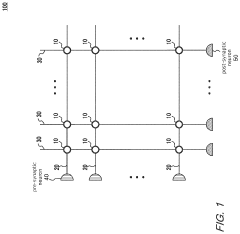
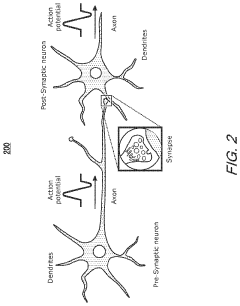
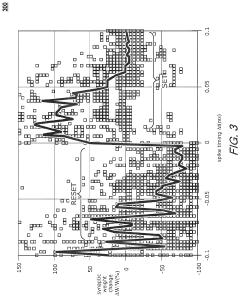
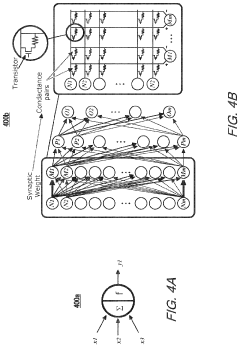
- The neuromorphic chip employs a crossbar array structure with resistive devices and switches that allow for the expression of a single synaptic weight using a variable number of resistive elements, enabling precise synaptic weight updates by dynamically connecting axon lines and aggregating resistive cells to compensate for device variability.
Systems and methods for sparsity exploiting
PatentActiveUS11868876B2
Innovation
- A neuromorphic integrated circuit with a multi-layered neural network in an analog multiplier array, where two-quadrant multipliers are wired to ground and draw negligible current when input signal or weight values are zero, promoting sparsity and minimizing power consumption, and a method to train the network to drive weight values toward zero for minimal power consumption.


Energy Efficiency Benchmarks and Optimization
Energy efficiency represents a critical benchmark for neuromorphic chips, particularly when deployed for signal processing applications. Current neuromorphic architectures demonstrate significant power advantages over traditional von Neumann processors, with leading designs achieving 100-1000x improvements in energy efficiency for specific signal processing tasks. The SpiNNaker system, for instance, operates at approximately 1 watt per million neurons, while IBM's TrueNorth consumes merely 70 milliwatts for one million neurons during real-time operation.
Benchmark comparisons reveal that neuromorphic solutions excel particularly in continuous signal monitoring scenarios where traditional processors would require constant high-power operation. For example, in audio signal processing applications, neuromorphic implementations have demonstrated power consumption reductions of up to 95% compared to conventional DSP approaches, while maintaining comparable signal quality metrics.
The optimization landscape for neuromorphic energy efficiency encompasses several key dimensions. At the hardware level, innovations in memristive materials and 3D integration techniques have yielded substantial improvements. Silicon photonics integration represents another promising frontier, with recent prototypes demonstrating 10-50x energy reductions for specific signal processing operations through optical rather than electrical signal propagation.
Algorithm-level optimizations focus on sparse coding techniques and event-driven processing paradigms. These approaches capitalize on the inherent efficiency of neuromorphic architectures by processing only meaningful signal changes rather than continuous data streams. Recent research demonstrates that optimized spike encoding schemes can further reduce energy requirements by 30-60% without compromising processing accuracy.
System-level energy optimization strategies include dynamic power scaling based on processing load and selective activation of neuromorphic cores. Intel's Loihi 2 chip exemplifies this approach with its fine-grained power management capabilities, allowing portions of the chip to enter ultra-low-power states when not actively processing signals.
Standardized benchmarking remains challenging due to the architectural diversity of neuromorphic systems. However, emerging frameworks such as the Neuromorphic Engineering Benchmarks (NEBench) are establishing consistent metrics for energy-per-inference, energy-per-spike, and latency-energy tradeoffs across different implementations. These benchmarks indicate that current neuromorphic designs achieve optimal energy efficiency in the 1-10 pJ per synaptic operation range for signal processing tasks, representing a significant advancement over conventional computing approaches.
Benchmark comparisons reveal that neuromorphic solutions excel particularly in continuous signal monitoring scenarios where traditional processors would require constant high-power operation. For example, in audio signal processing applications, neuromorphic implementations have demonstrated power consumption reductions of up to 95% compared to conventional DSP approaches, while maintaining comparable signal quality metrics.
The optimization landscape for neuromorphic energy efficiency encompasses several key dimensions. At the hardware level, innovations in memristive materials and 3D integration techniques have yielded substantial improvements. Silicon photonics integration represents another promising frontier, with recent prototypes demonstrating 10-50x energy reductions for specific signal processing operations through optical rather than electrical signal propagation.
Algorithm-level optimizations focus on sparse coding techniques and event-driven processing paradigms. These approaches capitalize on the inherent efficiency of neuromorphic architectures by processing only meaningful signal changes rather than continuous data streams. Recent research demonstrates that optimized spike encoding schemes can further reduce energy requirements by 30-60% without compromising processing accuracy.
System-level energy optimization strategies include dynamic power scaling based on processing load and selective activation of neuromorphic cores. Intel's Loihi 2 chip exemplifies this approach with its fine-grained power management capabilities, allowing portions of the chip to enter ultra-low-power states when not actively processing signals.
Standardized benchmarking remains challenging due to the architectural diversity of neuromorphic systems. However, emerging frameworks such as the Neuromorphic Engineering Benchmarks (NEBench) are establishing consistent metrics for energy-per-inference, energy-per-spike, and latency-energy tradeoffs across different implementations. These benchmarks indicate that current neuromorphic designs achieve optimal energy efficiency in the 1-10 pJ per synaptic operation range for signal processing tasks, representing a significant advancement over conventional computing approaches.
Hardware-Software Co-design Strategies
The effective integration of hardware and software components is crucial for maximizing the potential of neuromorphic chips in signal processing applications. Hardware-software co-design strategies represent a paradigm shift from traditional sequential development approaches, enabling simultaneous optimization of both elements to achieve superior performance, energy efficiency, and functionality.
Neuromorphic architectures present unique challenges that necessitate specialized co-design methodologies. The event-driven nature of these systems requires software frameworks capable of efficiently mapping neural algorithms to the underlying spike-based hardware. Leading frameworks such as IBM's TrueNorth Neurosynaptic System and Intel's Loihi SDK incorporate tools that abstract hardware complexities while preserving the performance benefits of neuromorphic computing.
A key aspect of successful co-design involves developing appropriate neural network models that can be efficiently implemented on neuromorphic hardware. Spiking Neural Networks (SNNs) must be adapted to account for hardware constraints such as limited precision, connectivity patterns, and memory resources. Techniques like network pruning, quantization, and sparse connectivity optimization have emerged as essential strategies for bridging the gap between algorithmic requirements and hardware capabilities.
Signal processing applications benefit significantly from hardware-specific optimizations. For instance, front-end preprocessing stages can be designed to convert conventional signals into spike trains optimized for neuromorphic processing. This conversion process must be carefully tuned to preserve information content while leveraging the temporal processing advantages of neuromorphic architectures.
Simulation environments play a critical role in the co-design process. Tools like NEST, Brian, and Nengo enable developers to model and test neuromorphic algorithms before hardware implementation, reducing development cycles and optimization costs. These environments increasingly incorporate hardware-in-the-loop capabilities, allowing for realistic performance assessment during the design phase.
Runtime adaptation represents another frontier in neuromorphic co-design. Dynamic reconfiguration capabilities enable systems to adjust their processing characteristics based on input signal properties or application requirements. This adaptability is particularly valuable for signal processing applications that must handle varying noise conditions, signal strengths, or feature extraction needs.
Standardization efforts are gradually emerging to facilitate hardware-software integration across different neuromorphic platforms. Initiatives like PyNN and the Neuro-Vector-Matrix (NVM) programming model aim to provide consistent abstractions that enable algorithm portability while still allowing for hardware-specific optimizations. These standards will be crucial for the broader adoption of neuromorphic technology in mainstream signal processing applications.
Neuromorphic architectures present unique challenges that necessitate specialized co-design methodologies. The event-driven nature of these systems requires software frameworks capable of efficiently mapping neural algorithms to the underlying spike-based hardware. Leading frameworks such as IBM's TrueNorth Neurosynaptic System and Intel's Loihi SDK incorporate tools that abstract hardware complexities while preserving the performance benefits of neuromorphic computing.
A key aspect of successful co-design involves developing appropriate neural network models that can be efficiently implemented on neuromorphic hardware. Spiking Neural Networks (SNNs) must be adapted to account for hardware constraints such as limited precision, connectivity patterns, and memory resources. Techniques like network pruning, quantization, and sparse connectivity optimization have emerged as essential strategies for bridging the gap between algorithmic requirements and hardware capabilities.
Signal processing applications benefit significantly from hardware-specific optimizations. For instance, front-end preprocessing stages can be designed to convert conventional signals into spike trains optimized for neuromorphic processing. This conversion process must be carefully tuned to preserve information content while leveraging the temporal processing advantages of neuromorphic architectures.
Simulation environments play a critical role in the co-design process. Tools like NEST, Brian, and Nengo enable developers to model and test neuromorphic algorithms before hardware implementation, reducing development cycles and optimization costs. These environments increasingly incorporate hardware-in-the-loop capabilities, allowing for realistic performance assessment during the design phase.
Runtime adaptation represents another frontier in neuromorphic co-design. Dynamic reconfiguration capabilities enable systems to adjust their processing characteristics based on input signal properties or application requirements. This adaptability is particularly valuable for signal processing applications that must handle varying noise conditions, signal strengths, or feature extraction needs.
Standardization efforts are gradually emerging to facilitate hardware-software integration across different neuromorphic platforms. Initiatives like PyNN and the Neuro-Vector-Matrix (NVM) programming model aim to provide consistent abstractions that enable algorithm portability while still allowing for hardware-specific optimizations. These standards will be crucial for the broader adoption of neuromorphic technology in mainstream signal processing applications.
Unlock deeper insights with Patsnap Eureka Quick Research — get a full tech report to explore trends and direct your research. Try now!
Generate Your Research Report Instantly with AI Agent
Supercharge your innovation with Patsnap Eureka AI Agent Platform!