

Optimize Schmitt Trigger for Precision Signal Processing
SEP 23, 20259 MIN READ
Generate Your Research Report Instantly with AI Agent
PatSnap Eureka helps you evaluate technical feasibility & market potential.
Schmitt Trigger Evolution and Precision Goals
The Schmitt trigger, first introduced by Otto Schmitt in 1937, represents a fundamental advancement in electronic circuit design, particularly for signal conditioning applications. Initially developed to mimic the neural impulse propagation in squid nerve fibers, this innovation has evolved significantly over decades to become an essential component in modern precision electronics.
The evolution of Schmitt trigger technology can be traced through several distinct phases. The early implementations utilized vacuum tubes, followed by discrete transistor designs in the 1950s and 1960s. The integration era began in the 1970s with the incorporation of Schmitt triggers into standard logic families such as TTL (Transistor-Transistor Logic) and CMOS (Complementary Metal-Oxide-Semiconductor), significantly expanding their accessibility and application scope.
Recent advancements have focused on enhancing the precision characteristics of Schmitt triggers, particularly in reducing hysteresis variability and improving temperature stability. The miniaturization trend has driven the development of low-power, high-speed variants suitable for portable and IoT devices, while maintaining robust noise immunity properties that originally defined the technology's value proposition.
In precision signal processing applications, contemporary Schmitt triggers face increasing demands for performance optimization. The primary technical objectives include achieving sub-nanosecond response times, minimizing power consumption to microwatt levels, and ensuring consistent hysteresis characteristics across wide temperature ranges (-55°C to +125°C) for industrial and automotive applications.
Another critical goal involves enhancing the adaptability of Schmitt trigger circuits to accommodate varying input signal characteristics. This includes developing programmable hysteresis thresholds that can be dynamically adjusted based on signal conditions, enabling more versatile signal conditioning capabilities in complex environments with fluctuating noise profiles.
The integration of Schmitt triggers with advanced analog-to-digital conversion systems represents a significant technical direction, particularly for applications requiring high-resolution signal acquisition in noisy environments. This integration aims to preserve signal integrity throughout the processing chain while minimizing latency and power overhead.
Emerging precision goals also include the development of radiation-hardened Schmitt trigger variants for aerospace and nuclear applications, where signal reliability under extreme conditions is paramount. Additionally, there is growing interest in creating ultra-low voltage Schmitt triggers capable of operating efficiently at sub-1V levels to support energy harvesting systems and ultra-low-power sensor networks.
The convergence of these evolutionary trends and precision goals defines the current technical landscape for Schmitt trigger optimization, establishing the foundation for next-generation designs that will address increasingly stringent requirements in modern signal processing applications.
The evolution of Schmitt trigger technology can be traced through several distinct phases. The early implementations utilized vacuum tubes, followed by discrete transistor designs in the 1950s and 1960s. The integration era began in the 1970s with the incorporation of Schmitt triggers into standard logic families such as TTL (Transistor-Transistor Logic) and CMOS (Complementary Metal-Oxide-Semiconductor), significantly expanding their accessibility and application scope.
Recent advancements have focused on enhancing the precision characteristics of Schmitt triggers, particularly in reducing hysteresis variability and improving temperature stability. The miniaturization trend has driven the development of low-power, high-speed variants suitable for portable and IoT devices, while maintaining robust noise immunity properties that originally defined the technology's value proposition.
In precision signal processing applications, contemporary Schmitt triggers face increasing demands for performance optimization. The primary technical objectives include achieving sub-nanosecond response times, minimizing power consumption to microwatt levels, and ensuring consistent hysteresis characteristics across wide temperature ranges (-55°C to +125°C) for industrial and automotive applications.
Another critical goal involves enhancing the adaptability of Schmitt trigger circuits to accommodate varying input signal characteristics. This includes developing programmable hysteresis thresholds that can be dynamically adjusted based on signal conditions, enabling more versatile signal conditioning capabilities in complex environments with fluctuating noise profiles.
The integration of Schmitt triggers with advanced analog-to-digital conversion systems represents a significant technical direction, particularly for applications requiring high-resolution signal acquisition in noisy environments. This integration aims to preserve signal integrity throughout the processing chain while minimizing latency and power overhead.
Emerging precision goals also include the development of radiation-hardened Schmitt trigger variants for aerospace and nuclear applications, where signal reliability under extreme conditions is paramount. Additionally, there is growing interest in creating ultra-low voltage Schmitt triggers capable of operating efficiently at sub-1V levels to support energy harvesting systems and ultra-low-power sensor networks.
The convergence of these evolutionary trends and precision goals defines the current technical landscape for Schmitt trigger optimization, establishing the foundation for next-generation designs that will address increasingly stringent requirements in modern signal processing applications.
Market Demand for High-Precision Signal Processing
The high-precision signal processing market has experienced substantial growth over the past decade, driven primarily by increasing demands across multiple industries for more accurate and reliable signal interpretation. The global market for precision signal processing components reached approximately $12.5 billion in 2022, with projections indicating a compound annual growth rate of 7.8% through 2028, potentially reaching $19.7 billion by that time.
Medical equipment represents one of the largest demand sectors, where precision signal processing is critical for diagnostic imaging, patient monitoring systems, and implantable medical devices. The healthcare industry's stringent requirements for noise immunity and accurate threshold detection have specifically increased demand for optimized Schmitt trigger implementations that can reliably process biological signals with minimal error rates.
Industrial automation and control systems constitute another significant market segment, valued at $3.2 billion in 2022. Manufacturing facilities increasingly rely on high-precision signal processing for quality control, process monitoring, and automated decision-making systems. In these environments, optimized Schmitt triggers provide essential hysteresis for clean signal transitions in noisy industrial settings, reducing false triggers and improving system reliability.
The automotive sector has emerged as a rapidly growing market for precision signal processing, particularly with the advancement of advanced driver assistance systems (ADAS) and autonomous vehicle technology. These applications require exceptionally reliable signal conditioning for sensor inputs, where optimized Schmitt triggers serve as critical components for processing signals from radar, lidar, and various proximity sensors.
Consumer electronics represents a high-volume market segment where miniaturization and power efficiency are paramount concerns. Modern smartphones, wearables, and IoT devices incorporate numerous sensors requiring signal conditioning, creating demand for Schmitt trigger designs that maintain precision while minimizing power consumption and silicon area.
Test and measurement equipment manufacturers constitute a specialized but significant market segment, where signal integrity is paramount. These devices often operate at the boundaries of precision, requiring Schmitt triggers with tightly controlled hysteresis bands and exceptional temperature stability.
Market research indicates that customers across all segments are increasingly prioritizing three key performance attributes in signal processing components: lower power consumption, higher operating frequencies, and improved noise immunity. Optimized Schmitt trigger designs that address these specific needs while maintaining precision across varying environmental conditions command premium pricing and market share.
Medical equipment represents one of the largest demand sectors, where precision signal processing is critical for diagnostic imaging, patient monitoring systems, and implantable medical devices. The healthcare industry's stringent requirements for noise immunity and accurate threshold detection have specifically increased demand for optimized Schmitt trigger implementations that can reliably process biological signals with minimal error rates.
Industrial automation and control systems constitute another significant market segment, valued at $3.2 billion in 2022. Manufacturing facilities increasingly rely on high-precision signal processing for quality control, process monitoring, and automated decision-making systems. In these environments, optimized Schmitt triggers provide essential hysteresis for clean signal transitions in noisy industrial settings, reducing false triggers and improving system reliability.
The automotive sector has emerged as a rapidly growing market for precision signal processing, particularly with the advancement of advanced driver assistance systems (ADAS) and autonomous vehicle technology. These applications require exceptionally reliable signal conditioning for sensor inputs, where optimized Schmitt triggers serve as critical components for processing signals from radar, lidar, and various proximity sensors.
Consumer electronics represents a high-volume market segment where miniaturization and power efficiency are paramount concerns. Modern smartphones, wearables, and IoT devices incorporate numerous sensors requiring signal conditioning, creating demand for Schmitt trigger designs that maintain precision while minimizing power consumption and silicon area.
Test and measurement equipment manufacturers constitute a specialized but significant market segment, where signal integrity is paramount. These devices often operate at the boundaries of precision, requiring Schmitt triggers with tightly controlled hysteresis bands and exceptional temperature stability.
Market research indicates that customers across all segments are increasingly prioritizing three key performance attributes in signal processing components: lower power consumption, higher operating frequencies, and improved noise immunity. Optimized Schmitt trigger designs that address these specific needs while maintaining precision across varying environmental conditions command premium pricing and market share.
Current Limitations and Challenges in Schmitt Trigger Design
Despite significant advancements in Schmitt trigger design over decades, several critical limitations persist that hinder optimal performance in precision signal processing applications. The fundamental challenge lies in the inherent trade-off between noise immunity and sensitivity. While increased hysteresis provides better noise rejection, it simultaneously reduces the circuit's ability to detect small signal variations, creating a design constraint that becomes particularly problematic in high-precision measurement systems.
Temperature dependency represents another significant limitation, as the threshold voltages in conventional Schmitt trigger designs exhibit considerable drift across operating temperature ranges. This thermal instability can cause unpredictable triggering behavior, especially in industrial or automotive applications where temperature fluctuations are common. Measurements indicate that standard CMOS-based Schmitt triggers can experience threshold variations of up to 10-15% across industrial temperature ranges (-40°C to 85°C).
Power supply sensitivity further complicates Schmitt trigger optimization. Traditional designs show threshold voltages that scale proportionally with supply voltage, making them vulnerable to power rail fluctuations. This dependency creates reliability issues in battery-powered devices or systems with unstable power sources, where consistent triggering thresholds are essential for accurate signal interpretation.
Speed limitations present additional challenges, particularly in high-frequency applications. The finite switching time of Schmitt triggers introduces propagation delays that can distort timing-critical signals. Current designs typically exhibit switching delays in the nanosecond range, which becomes problematic when processing signals above several hundred megahertz, creating timing uncertainties that compound in complex signal chains.
Asymmetry between rising and falling thresholds represents a persistent design challenge. Ideal Schmitt triggers should maintain precisely controlled hysteresis windows, but manufacturing variations and inherent semiconductor characteristics often result in asymmetrical threshold voltages. This asymmetry introduces directional bias in signal detection, potentially causing false triggers or missed events depending on signal direction.
Integration challenges also emerge when implementing Schmitt triggers in modern system-on-chip designs. As process nodes shrink below 10nm, maintaining consistent hysteresis characteristics becomes increasingly difficult due to process variations and reduced supply voltages. The diminishing signal headroom in advanced nodes further constrains the design space for effective hysteresis implementation.
Finally, current Schmitt trigger designs face significant limitations in ultra-low-power applications. The static current consumption during state maintenance and the dynamic current during transitions limit their applicability in energy-harvesting systems and long-life battery applications where power budgets are extremely constrained.
Temperature dependency represents another significant limitation, as the threshold voltages in conventional Schmitt trigger designs exhibit considerable drift across operating temperature ranges. This thermal instability can cause unpredictable triggering behavior, especially in industrial or automotive applications where temperature fluctuations are common. Measurements indicate that standard CMOS-based Schmitt triggers can experience threshold variations of up to 10-15% across industrial temperature ranges (-40°C to 85°C).
Power supply sensitivity further complicates Schmitt trigger optimization. Traditional designs show threshold voltages that scale proportionally with supply voltage, making them vulnerable to power rail fluctuations. This dependency creates reliability issues in battery-powered devices or systems with unstable power sources, where consistent triggering thresholds are essential for accurate signal interpretation.
Speed limitations present additional challenges, particularly in high-frequency applications. The finite switching time of Schmitt triggers introduces propagation delays that can distort timing-critical signals. Current designs typically exhibit switching delays in the nanosecond range, which becomes problematic when processing signals above several hundred megahertz, creating timing uncertainties that compound in complex signal chains.
Asymmetry between rising and falling thresholds represents a persistent design challenge. Ideal Schmitt triggers should maintain precisely controlled hysteresis windows, but manufacturing variations and inherent semiconductor characteristics often result in asymmetrical threshold voltages. This asymmetry introduces directional bias in signal detection, potentially causing false triggers or missed events depending on signal direction.
Integration challenges also emerge when implementing Schmitt triggers in modern system-on-chip designs. As process nodes shrink below 10nm, maintaining consistent hysteresis characteristics becomes increasingly difficult due to process variations and reduced supply voltages. The diminishing signal headroom in advanced nodes further constrains the design space for effective hysteresis implementation.
Finally, current Schmitt trigger designs face significant limitations in ultra-low-power applications. The static current consumption during state maintenance and the dynamic current during transitions limit their applicability in energy-harvesting systems and long-life battery applications where power budgets are extremely constrained.
Current Optimization Approaches for Schmitt Triggers
01 Hysteresis control techniques for Schmitt triggers
Various methods to control and adjust the hysteresis in Schmitt trigger circuits to improve precision. These techniques include using resistor networks, feedback mechanisms, and voltage references to set precise switching thresholds. Controlled hysteresis helps eliminate noise-induced false triggering while maintaining accurate threshold detection, which is crucial for precision applications.- Hysteresis control techniques for Schmitt triggers: Various methods to precisely control the hysteresis in Schmitt trigger circuits, which is crucial for improving noise immunity and preventing oscillation at threshold crossings. These techniques include using resistor networks, feedback mechanisms, and specialized circuit configurations to set accurate switching thresholds. Precise hysteresis control allows for more reliable operation in noisy environments and applications requiring exact trigger points.
- Temperature compensation in precision Schmitt triggers: Implementation of temperature compensation techniques to maintain consistent Schmitt trigger performance across varying operating temperatures. These designs incorporate components with complementary temperature coefficients, bandgap reference circuits, or other compensation networks to stabilize threshold voltages despite temperature fluctuations. This ensures reliable operation in environments with temperature variations or in precision applications where threshold stability is critical.
- Low-power precision Schmitt trigger designs: Circuit configurations optimized for both precision operation and low power consumption, suitable for battery-powered devices and energy-efficient applications. These designs employ techniques such as current limiting, power gating, and specialized biasing schemes to reduce power consumption while maintaining accurate switching thresholds. The circuits achieve a balance between power efficiency and precise triggering performance.
- CMOS implementation for high-precision Schmitt triggers: Specialized CMOS circuit designs that achieve high precision in Schmitt trigger operation through careful transistor sizing, advanced layout techniques, and optimized voltage references. These implementations provide well-defined and stable threshold voltages with minimal variation across process corners. The CMOS approach allows integration into modern integrated circuits while maintaining precise switching characteristics.
- Adjustable precision Schmitt trigger circuits: Schmitt trigger designs that allow for dynamic or programmable adjustment of threshold voltages and hysteresis windows. These circuits incorporate digital control interfaces, analog tuning mechanisms, or calibration circuits to enable precise setting of trigger points. The adjustability feature makes these circuits versatile for applications requiring adaptation to different input signal characteristics or operating conditions.
02 Temperature compensation in Schmitt trigger circuits
Implementation of temperature compensation techniques to maintain consistent Schmitt trigger performance across varying operating temperatures. These designs incorporate specialized bias circuits, bandgap references, or complementary components that counteract temperature-dependent parameter shifts. Temperature compensation is essential for high-precision applications where threshold stability must be maintained despite environmental variations.Expand Specific Solutions03 Low-power precision Schmitt trigger designs
Circuit architectures optimized for both precision operation and minimal power consumption. These designs employ techniques such as dynamic biasing, power gating, and specialized CMOS configurations to reduce current draw while maintaining accurate switching thresholds. Low-power precision Schmitt triggers are particularly valuable in battery-operated devices and energy-efficient systems requiring accurate signal conditioning.Expand Specific Solutions04 High-speed Schmitt trigger implementations
Circuit designs focused on minimizing propagation delay while maintaining precision in Schmitt trigger operation. These implementations use techniques such as current-mode sensing, reduced parasitic capacitance paths, and optimized transistor sizing to achieve faster response times. High-speed precision Schmitt triggers are critical in applications like high-frequency signal processing, data conversion, and digital communications.Expand Specific Solutions05 Precision threshold adjustment mechanisms
Methods for precisely setting and calibrating the switching thresholds in Schmitt trigger circuits. These include digitally-controlled threshold adjustment, trimming circuits, and reference voltage techniques that allow for fine-tuning of trigger points. Precise threshold control enables these circuits to be used in applications requiring exact voltage level detection, such as sensor interfaces, voltage monitoring, and analog-to-digital conversion front ends.Expand Specific Solutions
Key Industry Players in Precision Signal Processing
The Schmitt Trigger precision signal processing market is currently in a growth phase, with increasing demand across industrial automation and consumer electronics sectors. Major players include established semiconductor manufacturers like STMicroelectronics, Texas Instruments, and Siemens AG, alongside specialized signal processing companies such as SG Micro Corp. and Tektronix. Samsung Electronics and Huawei Technologies are leveraging Schmitt Trigger optimization in their consumer products, while research institutions like University of Electronic Science & Technology of China and Beijing Jiaotong University are advancing fundamental circuit innovations. The technology is reaching maturity in traditional applications but evolving rapidly for emerging precision requirements, with companies like MediaTek and Western Digital incorporating enhanced Schmitt Trigger designs in their latest product generations.
Samsung Electronics Co., Ltd.
Technical Solution: Samsung Electronics has developed specialized Schmitt trigger circuits optimized for their semiconductor products, particularly in memory interfaces and mobile processor designs. Their approach focuses on balancing power efficiency with high-speed operation, achieving transition times below 100ps in their advanced process nodes while maintaining power consumption under 50μW per trigger circuit. Samsung has implemented adaptive threshold control systems that automatically adjust hysteresis levels based on operating conditions, optimizing noise immunity while maximizing speed. Their designs incorporate specialized layout techniques that minimize parasitic capacitances, resulting in significantly reduced propagation delays compared to conventional implementations. For mobile applications, Samsung has developed ultra-low voltage Schmitt triggers capable of reliable operation down to 0.7V supply voltage, with power consumption scaling proportionally with operating frequency. The company has also integrated their optimized Schmitt triggers with on-chip power management systems, allowing dynamic adjustment of performance characteristics based on system power states.
Strengths: Excellent balance of speed and power efficiency; advanced process technology integration enabling miniaturization; adaptive performance characteristics based on operating conditions; optimized for battery-powered applications. Weaknesses: Some designs prioritize power efficiency over noise immunity; proprietary implementations may lack standardization; optimization for specific applications may limit general-purpose usability.
SG Micro Corp.
Technical Solution: SG Micro has developed specialized precision Schmitt trigger circuits focused on analog signal conditioning applications. Their approach emphasizes ultra-low offset voltage (typically below 0.5mV) and highly consistent hysteresis characteristics across temperature and supply voltage variations. SG Micro's implementation includes chopper-stabilized input stages that dramatically reduce input offset drift to less than 1μV/°C, critical for precision measurement applications. Their designs incorporate programmable hysteresis with 8-bit resolution, allowing application-specific optimization of noise immunity versus response time. For battery-powered applications, SG Micro has developed nano-power Schmitt triggers with current consumption as low as 900nA while maintaining response times suitable for human interface and sensor applications. The company has also implemented specialized variants with rail-to-rail inputs and outputs that maintain consistent performance characteristics across the entire common-mode input range, particularly valuable for systems operating from single low-voltage supplies.
Strengths: Exceptional input offset performance enabling precise threshold detection; extremely low power consumption suitable for battery-powered and energy harvesting applications; consistent performance across temperature and supply variations; excellent value proposition for precision analog applications. Weaknesses: Lower switching speed compared to high-performance alternatives; limited availability of advanced packaging options; smaller company with more limited application support resources than larger competitors.
Core Patents and Innovations in Hysteresis Control
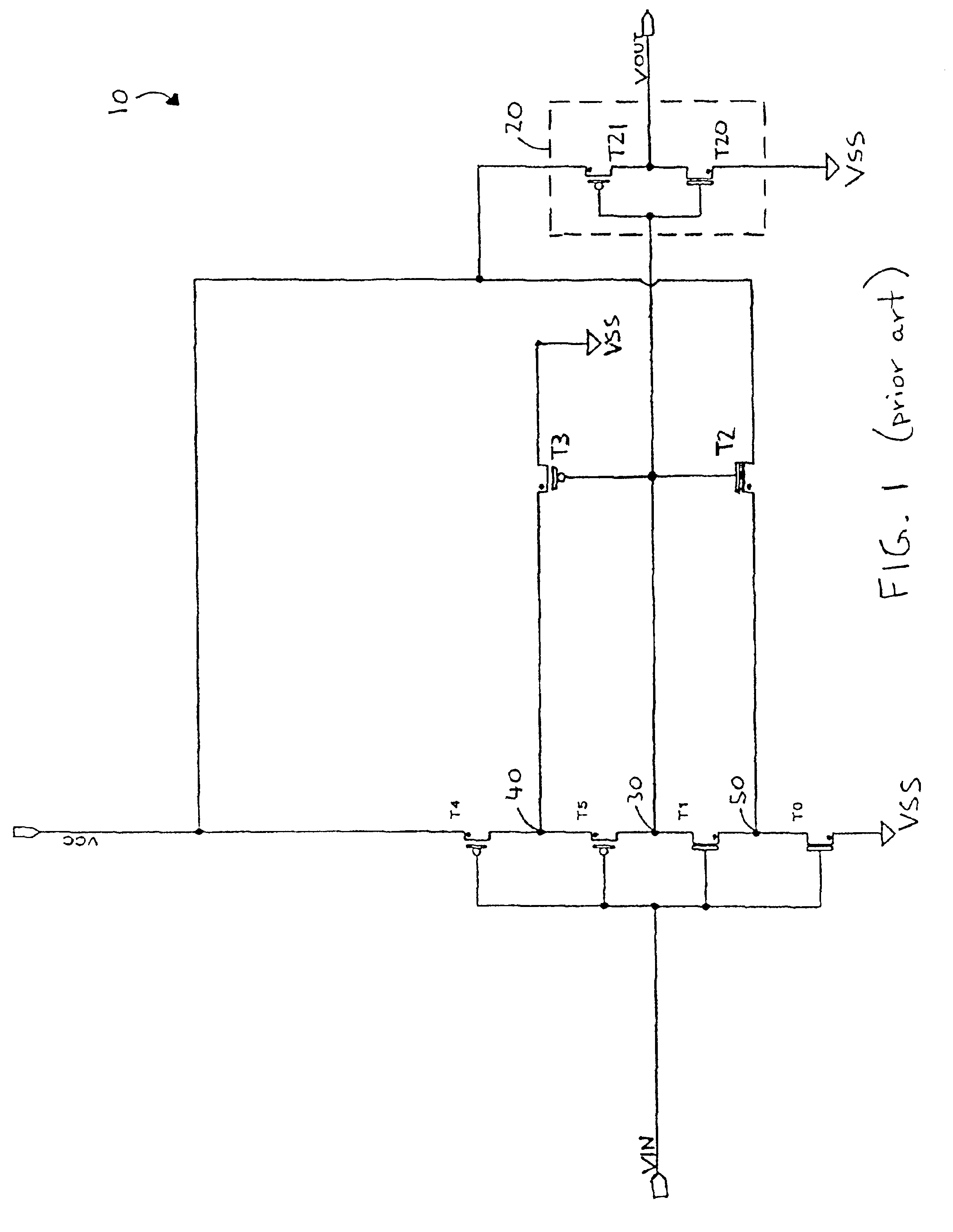
Low current high precision CMOS schmitt trigger circuit
PatentInactiveUS4733107A
Innovation
- A CMOS Schmitt Trigger circuit utilizing a differential pair and a feedback circuit with a switchable voltage divider, where CMOS switching elements control the application of power only when necessary, minimizing power consumption by preventing current draw from the power supply when the input signal is outside the active range.
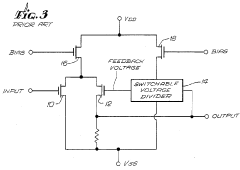
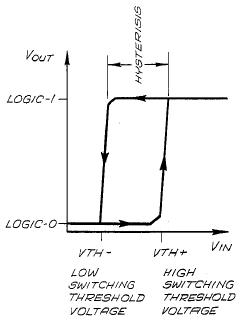
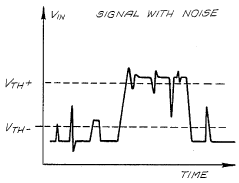
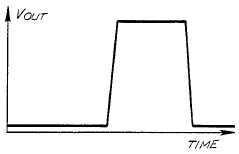
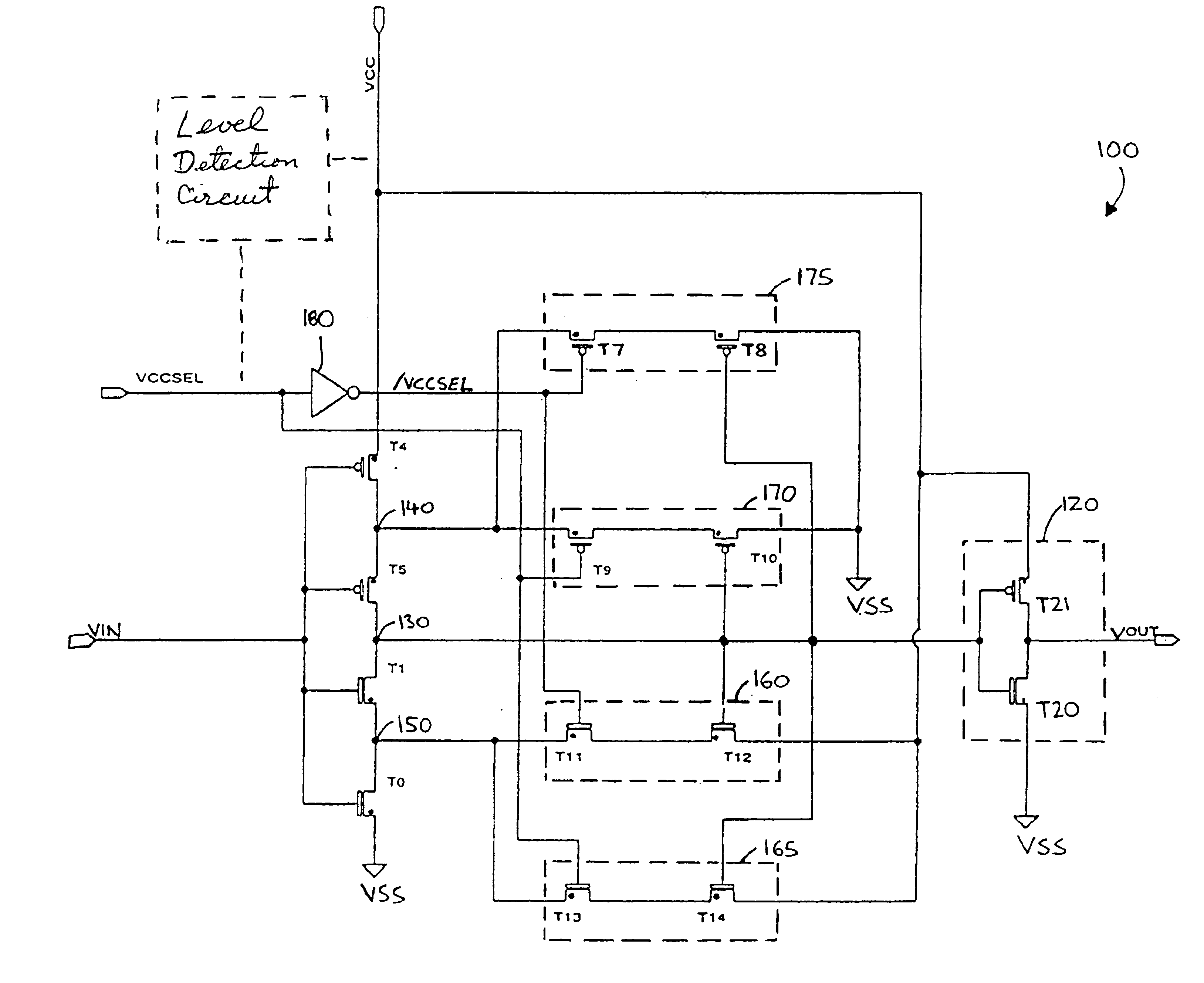
Schmitt trigger circuit with adjustable trip point voltages
PatentInactiveUS6870413B1
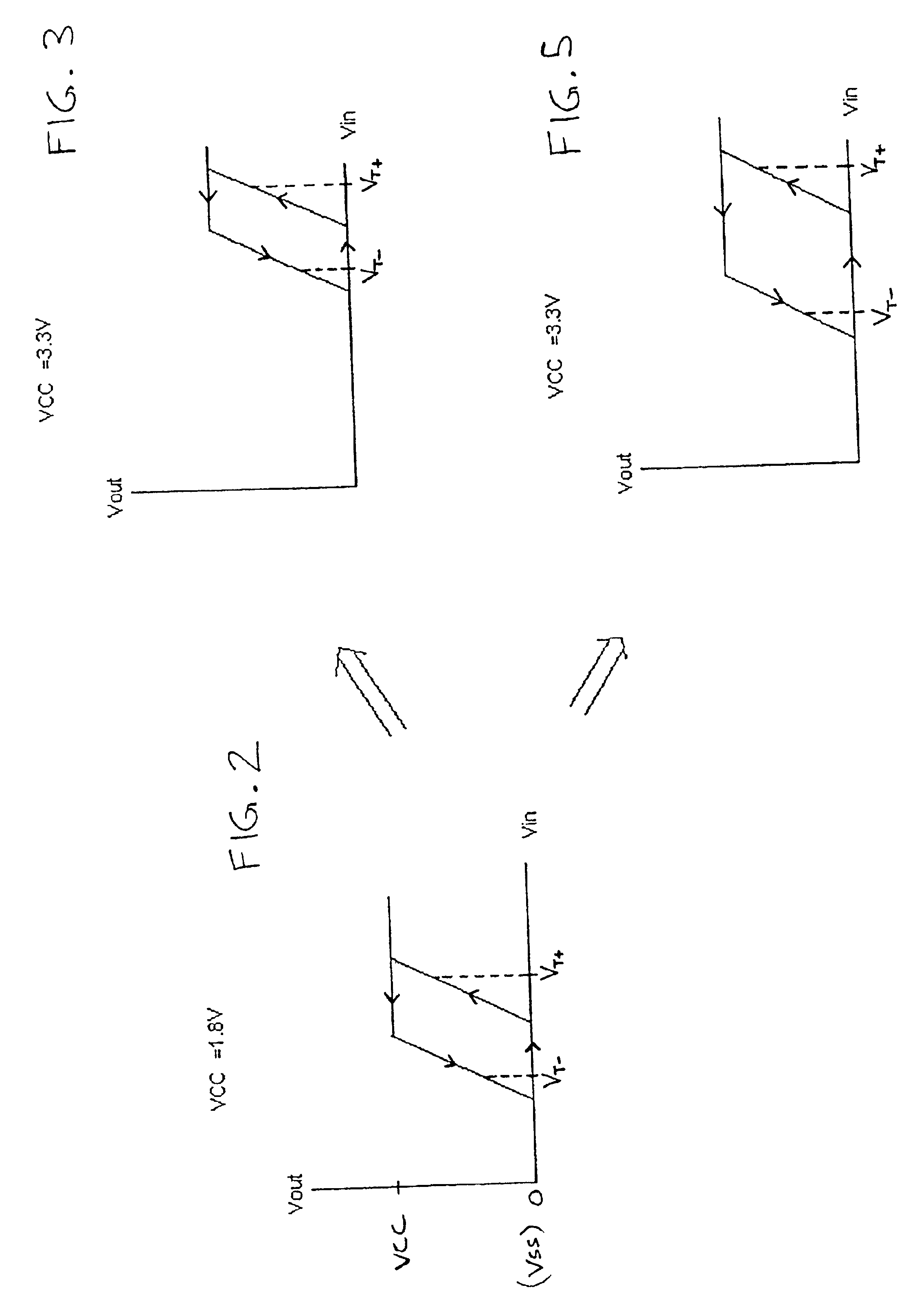
Innovation
- A Schmitt trigger circuit with adjustable hysteresis characteristics is achieved through a plurality of control circuits that allow for independent adjustment of the upper and lower trip point levels, using switchable NMOS and PMOS transistor control circuits to vary conductivity and threshold voltages, ensuring desired noise margin, delay, and input recognition criteria across different power supply levels.

Noise Immunity Techniques in Signal Processing
Noise immunity techniques represent a critical aspect of signal processing systems, particularly when implementing precision circuits like Schmitt triggers. These techniques focus on maintaining signal integrity in environments where electrical noise could otherwise compromise system performance. The fundamental approach involves creating robust signal conditioning methods that can distinguish between actual signals and unwanted noise components.
Signal filtering serves as the primary defense mechanism against noise interference. Low-pass, high-pass, and band-pass filters can be strategically implemented before the Schmitt trigger stage to attenuate noise frequencies while preserving the signal of interest. For Schmitt trigger optimization, adaptive filtering techniques that automatically adjust filter parameters based on detected noise characteristics have shown significant improvements in maintaining precision.
Differential signaling represents another powerful noise immunity technique applicable to Schmitt trigger circuits. By transmitting complementary signals across paired conductors, common-mode noise affecting both conductors equally can be effectively canceled when the differential receiver processes the signal. This approach has demonstrated up to 20dB improvement in noise immunity for precision applications.
Shielding and proper grounding techniques constitute essential physical implementations for noise immunity. Faraday cages, proper cable shielding, and strategic ground plane design can significantly reduce electromagnetic interference (EMI) that would otherwise affect Schmitt trigger thresholds. Research indicates that proper shielding can reduce noise coupling by up to 40dB in sensitive analog circuits.
Digital signal processing (DSP) techniques have emerged as sophisticated approaches to noise immunity. Techniques such as oversampling, averaging, and correlation analysis can be applied to signals before or after the Schmitt trigger stage. These methods effectively increase the signal-to-noise ratio (SNR) by spreading noise across a wider frequency spectrum while concentrating the signal energy.
Hysteresis optimization represents a direct approach to enhancing Schmitt trigger noise immunity. By carefully calibrating the upper and lower threshold voltages, the circuit can be made less susceptible to noise-induced false triggering. Advanced implementations include adaptive hysteresis that dynamically adjusts thresholds based on measured noise levels, providing optimal performance across varying environmental conditions.
Power supply conditioning techniques further enhance noise immunity by ensuring clean power delivery to sensitive components. Voltage regulators, decoupling capacitors, and power supply rejection ratio (PSRR) optimization prevent noise from propagating through power rails into signal processing circuits, maintaining the precision of Schmitt trigger operation even in electrically noisy environments.
Signal filtering serves as the primary defense mechanism against noise interference. Low-pass, high-pass, and band-pass filters can be strategically implemented before the Schmitt trigger stage to attenuate noise frequencies while preserving the signal of interest. For Schmitt trigger optimization, adaptive filtering techniques that automatically adjust filter parameters based on detected noise characteristics have shown significant improvements in maintaining precision.
Differential signaling represents another powerful noise immunity technique applicable to Schmitt trigger circuits. By transmitting complementary signals across paired conductors, common-mode noise affecting both conductors equally can be effectively canceled when the differential receiver processes the signal. This approach has demonstrated up to 20dB improvement in noise immunity for precision applications.
Shielding and proper grounding techniques constitute essential physical implementations for noise immunity. Faraday cages, proper cable shielding, and strategic ground plane design can significantly reduce electromagnetic interference (EMI) that would otherwise affect Schmitt trigger thresholds. Research indicates that proper shielding can reduce noise coupling by up to 40dB in sensitive analog circuits.
Digital signal processing (DSP) techniques have emerged as sophisticated approaches to noise immunity. Techniques such as oversampling, averaging, and correlation analysis can be applied to signals before or after the Schmitt trigger stage. These methods effectively increase the signal-to-noise ratio (SNR) by spreading noise across a wider frequency spectrum while concentrating the signal energy.
Hysteresis optimization represents a direct approach to enhancing Schmitt trigger noise immunity. By carefully calibrating the upper and lower threshold voltages, the circuit can be made less susceptible to noise-induced false triggering. Advanced implementations include adaptive hysteresis that dynamically adjusts thresholds based on measured noise levels, providing optimal performance across varying environmental conditions.
Power supply conditioning techniques further enhance noise immunity by ensuring clean power delivery to sensitive components. Voltage regulators, decoupling capacitors, and power supply rejection ratio (PSRR) optimization prevent noise from propagating through power rails into signal processing circuits, maintaining the precision of Schmitt trigger operation even in electrically noisy environments.
Power Efficiency Considerations for Precision Applications
Power efficiency has become a critical consideration in the optimization of Schmitt triggers for precision signal processing applications. As electronic devices continue to shrink in size while increasing in functionality, the demand for energy-efficient components has grown exponentially. Schmitt triggers, despite their robust noise immunity characteristics, traditionally consume significant power during state transitions, presenting a challenge for battery-powered and energy-conscious applications.
The power consumption in Schmitt trigger circuits primarily stems from three sources: static power dissipation during steady-state operation, dynamic power consumption during switching events, and short-circuit power during transitions. Recent advancements have focused on reducing these power components through innovative circuit topologies and process technologies. For instance, the implementation of sub-threshold operation techniques has demonstrated power reductions of up to 70% compared to conventional designs, albeit with some trade-offs in switching speed.
Voltage scaling represents another effective approach for power optimization. By carefully adjusting the supply voltage relative to the threshold voltages, designers can achieve quadratic reductions in power consumption. Advanced CMOS processes now enable Schmitt triggers to operate reliably at supply voltages as low as 0.6V, significantly below the traditional 1.8-3.3V range, while maintaining acceptable hysteresis characteristics for noise rejection.
Current-starving techniques have emerged as particularly promising for precision applications where both power efficiency and signal integrity are paramount. These designs strategically limit the current available during transitions, reducing power spikes without compromising the fundamental hysteresis behavior that makes Schmitt triggers valuable. Experimental implementations have demonstrated power savings of 40-60% with minimal impact on precision parameters.
The selection of appropriate semiconductor technologies also plays a crucial role in power optimization. Silicon-on-insulator (SOI) and FinFET technologies offer reduced parasitic capacitances and leakage currents compared to bulk CMOS, enabling Schmitt triggers with improved power efficiency. These advanced process technologies have enabled the development of Schmitt triggers with power consumption in the nano-watt range while maintaining microsecond response times.
For ultra-low-power applications such as implantable medical devices and remote sensors, adaptive biasing schemes have proven effective. These systems dynamically adjust the operating parameters of the Schmitt trigger based on input signal characteristics, optimizing power consumption in real-time. When combined with power gating techniques during periods of inactivity, these approaches can extend battery life by orders of magnitude while preserving signal processing precision.
The power consumption in Schmitt trigger circuits primarily stems from three sources: static power dissipation during steady-state operation, dynamic power consumption during switching events, and short-circuit power during transitions. Recent advancements have focused on reducing these power components through innovative circuit topologies and process technologies. For instance, the implementation of sub-threshold operation techniques has demonstrated power reductions of up to 70% compared to conventional designs, albeit with some trade-offs in switching speed.
Voltage scaling represents another effective approach for power optimization. By carefully adjusting the supply voltage relative to the threshold voltages, designers can achieve quadratic reductions in power consumption. Advanced CMOS processes now enable Schmitt triggers to operate reliably at supply voltages as low as 0.6V, significantly below the traditional 1.8-3.3V range, while maintaining acceptable hysteresis characteristics for noise rejection.
Current-starving techniques have emerged as particularly promising for precision applications where both power efficiency and signal integrity are paramount. These designs strategically limit the current available during transitions, reducing power spikes without compromising the fundamental hysteresis behavior that makes Schmitt triggers valuable. Experimental implementations have demonstrated power savings of 40-60% with minimal impact on precision parameters.
The selection of appropriate semiconductor technologies also plays a crucial role in power optimization. Silicon-on-insulator (SOI) and FinFET technologies offer reduced parasitic capacitances and leakage currents compared to bulk CMOS, enabling Schmitt triggers with improved power efficiency. These advanced process technologies have enabled the development of Schmitt triggers with power consumption in the nano-watt range while maintaining microsecond response times.
For ultra-low-power applications such as implantable medical devices and remote sensors, adaptive biasing schemes have proven effective. These systems dynamically adjust the operating parameters of the Schmitt trigger based on input signal characteristics, optimizing power consumption in real-time. When combined with power gating techniques during periods of inactivity, these approaches can extend battery life by orders of magnitude while preserving signal processing precision.
Unlock deeper insights with PatSnap Eureka Quick Research — get a full tech report to explore trends and direct your research. Try now!
Generate Your Research Report Instantly with AI Agent
Supercharge your innovation with PatSnap Eureka AI Agent Platform!