Optimizing Magnetron Cooling Systems for Longevity
AUG 28, 20259 MIN READ
Generate Your Research Report Instantly with AI Agent
Patsnap Eureka helps you evaluate technical feasibility & market potential.
Magnetron Cooling Technology Background and Objectives
Magnetron technology has evolved significantly since its inception in the early 20th century, with cooling systems becoming increasingly critical to their performance and longevity. Initially developed for radar applications during World War II, magnetrons have since become fundamental components in various industrial and consumer applications, most notably in microwave ovens. The evolution of magnetron cooling systems has paralleled advancements in thermal management technologies, moving from simple air cooling to sophisticated liquid and hybrid cooling solutions.
The thermal management challenges in magnetrons stem from their operational principle, where high-voltage electrons interact with magnetic fields to generate microwave radiation. This process inherently produces significant heat, with modern industrial magnetrons operating at power levels from 1kW to over 100kW, generating temperatures that can exceed 200°C at the anode. Effective cooling is therefore not merely a performance enhancement but a fundamental requirement for operational stability and device longevity.
Historical data indicates that cooling system failures account for approximately 40% of magnetron malfunctions in industrial settings, with thermal stress being the primary cause of reduced operational lifespan. The average industrial magnetron lifespan currently ranges from 2,000 to 8,000 hours, significantly below the theoretical potential of 12,000+ hours that could be achieved with optimized thermal management.
Recent technological advancements in materials science, computational fluid dynamics, and thermal interface materials have opened new possibilities for magnetron cooling optimization. The integration of advanced ceramics with superior thermal conductivity, phase-change materials for heat absorption, and precision-engineered heat sinks has demonstrated potential for extending magnetron life by 30-50% in laboratory conditions.
The primary objective of magnetron cooling optimization research is to develop systems that can maintain optimal operating temperatures under varying load conditions while minimizing energy consumption and maximizing device longevity. Secondary objectives include reducing system complexity, enhancing reliability, and decreasing maintenance requirements through passive cooling innovations.
Current research trajectories focus on several promising approaches: advanced heat sink geometries optimized through machine learning algorithms; novel composite materials with directional heat transfer properties; microfluidic cooling channels integrated directly into magnetron structures; and intelligent thermal management systems that adapt to changing operational parameters in real-time.
The economic implications of extended magnetron longevity are substantial, with potential industry-wide savings estimated at $1.2-1.8 billion annually through reduced replacement costs and downtime in sectors ranging from food processing to industrial heating, medical equipment, and scientific research facilities.
The thermal management challenges in magnetrons stem from their operational principle, where high-voltage electrons interact with magnetic fields to generate microwave radiation. This process inherently produces significant heat, with modern industrial magnetrons operating at power levels from 1kW to over 100kW, generating temperatures that can exceed 200°C at the anode. Effective cooling is therefore not merely a performance enhancement but a fundamental requirement for operational stability and device longevity.
Historical data indicates that cooling system failures account for approximately 40% of magnetron malfunctions in industrial settings, with thermal stress being the primary cause of reduced operational lifespan. The average industrial magnetron lifespan currently ranges from 2,000 to 8,000 hours, significantly below the theoretical potential of 12,000+ hours that could be achieved with optimized thermal management.
Recent technological advancements in materials science, computational fluid dynamics, and thermal interface materials have opened new possibilities for magnetron cooling optimization. The integration of advanced ceramics with superior thermal conductivity, phase-change materials for heat absorption, and precision-engineered heat sinks has demonstrated potential for extending magnetron life by 30-50% in laboratory conditions.
The primary objective of magnetron cooling optimization research is to develop systems that can maintain optimal operating temperatures under varying load conditions while minimizing energy consumption and maximizing device longevity. Secondary objectives include reducing system complexity, enhancing reliability, and decreasing maintenance requirements through passive cooling innovations.
Current research trajectories focus on several promising approaches: advanced heat sink geometries optimized through machine learning algorithms; novel composite materials with directional heat transfer properties; microfluidic cooling channels integrated directly into magnetron structures; and intelligent thermal management systems that adapt to changing operational parameters in real-time.
The economic implications of extended magnetron longevity are substantial, with potential industry-wide savings estimated at $1.2-1.8 billion annually through reduced replacement costs and downtime in sectors ranging from food processing to industrial heating, medical equipment, and scientific research facilities.
Market Analysis for Advanced Magnetron Cooling Solutions
The global market for advanced magnetron cooling solutions is experiencing significant growth, driven by the increasing demand for high-performance microwave systems across various industries. The current market size is estimated at $2.3 billion, with projections indicating a compound annual growth rate of 6.8% over the next five years. This growth trajectory is primarily fueled by expanding applications in industrial processing, medical equipment, and telecommunications infrastructure.
Consumer electronics represents the largest market segment, accounting for approximately 38% of the total market share. The proliferation of microwave ovens in households worldwide continues to drive steady demand for reliable magnetron cooling systems. However, the industrial processing sector is emerging as the fastest-growing segment, with an annual growth rate of 9.2%, as manufacturers increasingly adopt microwave technology for various applications including material drying, sintering, and chemical processing.
Geographically, Asia-Pacific dominates the market with a 42% share, followed by North America (28%) and Europe (21%). China and India are particularly noteworthy markets due to their rapidly expanding manufacturing sectors and increasing domestic consumption of microwave-enabled devices. The Middle East and Africa regions, while currently representing smaller market shares, are showing promising growth potential as their industrial infrastructure develops.
Key market drivers include the growing emphasis on energy efficiency, extended equipment lifespan, and reduced maintenance costs. End-users are increasingly willing to invest in premium cooling solutions that offer demonstrable improvements in magnetron longevity and performance reliability. Market research indicates that systems promising a 30% increase in magnetron lifespan can command price premiums of up to 25% compared to standard cooling solutions.
The market is also being shaped by evolving regulatory standards regarding energy efficiency and electronic waste reduction. Particularly in Europe and North America, regulations are incentivizing the development of cooling systems that extend component lifespan and reduce the environmental impact of electronic equipment disposal.
Customer segmentation reveals distinct needs across different market sectors. While cost sensitivity remains paramount in consumer applications, industrial and medical sectors prioritize performance reliability and precision cooling capabilities. The telecommunications sector, especially with the ongoing 5G infrastructure deployment, represents an emerging high-value segment with specific requirements for compact, high-efficiency cooling systems capable of supporting continuous operation in varied environmental conditions.
Consumer electronics represents the largest market segment, accounting for approximately 38% of the total market share. The proliferation of microwave ovens in households worldwide continues to drive steady demand for reliable magnetron cooling systems. However, the industrial processing sector is emerging as the fastest-growing segment, with an annual growth rate of 9.2%, as manufacturers increasingly adopt microwave technology for various applications including material drying, sintering, and chemical processing.
Geographically, Asia-Pacific dominates the market with a 42% share, followed by North America (28%) and Europe (21%). China and India are particularly noteworthy markets due to their rapidly expanding manufacturing sectors and increasing domestic consumption of microwave-enabled devices. The Middle East and Africa regions, while currently representing smaller market shares, are showing promising growth potential as their industrial infrastructure develops.
Key market drivers include the growing emphasis on energy efficiency, extended equipment lifespan, and reduced maintenance costs. End-users are increasingly willing to invest in premium cooling solutions that offer demonstrable improvements in magnetron longevity and performance reliability. Market research indicates that systems promising a 30% increase in magnetron lifespan can command price premiums of up to 25% compared to standard cooling solutions.
The market is also being shaped by evolving regulatory standards regarding energy efficiency and electronic waste reduction. Particularly in Europe and North America, regulations are incentivizing the development of cooling systems that extend component lifespan and reduce the environmental impact of electronic equipment disposal.
Customer segmentation reveals distinct needs across different market sectors. While cost sensitivity remains paramount in consumer applications, industrial and medical sectors prioritize performance reliability and precision cooling capabilities. The telecommunications sector, especially with the ongoing 5G infrastructure deployment, represents an emerging high-value segment with specific requirements for compact, high-efficiency cooling systems capable of supporting continuous operation in varied environmental conditions.
Current Challenges in Magnetron Thermal Management
Magnetron cooling systems face significant thermal management challenges that directly impact device longevity and performance reliability. The primary issue stems from the inherent inefficiency of magnetrons, which typically operate at only 65-70% efficiency, with the remaining energy converted to heat. This substantial heat generation, often exceeding 600°C at the anode during operation, creates extreme thermal stress on components and materials.
Current cooling technologies predominantly rely on forced-air systems that struggle to maintain optimal operating temperatures under continuous usage scenarios. These conventional approaches often fail to address the uneven heat distribution across magnetron components, with particular hotspots forming at the anode and cathode interfaces. The resulting thermal gradients accelerate material degradation through mechanisms including thermal expansion, oxidation, and microstructural changes.
Material limitations present another significant challenge. The copper anodes commonly used in magnetrons, while offering excellent thermal conductivity, experience progressive degradation under cyclical heating and cooling. This degradation manifests as surface roughening, dimensional changes, and decreased thermal transfer efficiency. Similarly, ceramic insulators and seals are vulnerable to thermal shock and gradual breakdown under prolonged exposure to high temperatures.
The interface between cooling systems and magnetron components introduces additional complications. Thermal contact resistance at these junctions often creates bottlenecks in heat dissipation pathways. Current thermal interface materials (TIMs) demonstrate inadequate performance under the extreme temperature conditions typical of magnetron operation, with degradation occurring far more rapidly than in standard electronics cooling applications.
Power density challenges have intensified as applications demand increasingly compact magnetron designs. The miniaturization trend has created a fundamental conflict between space constraints and cooling requirements, with smaller form factors offering reduced surface area for heat dissipation while potentially generating equivalent or greater thermal loads.
Environmental factors further complicate cooling system design. Magnetrons deployed in varied environments must maintain thermal stability across wide ambient temperature ranges, from sub-zero conditions to tropical settings. Additionally, dust accumulation on cooling surfaces progressively reduces heat transfer efficiency, while humidity can accelerate corrosion processes at critical thermal interfaces.
Monitoring limitations represent a final significant challenge. Current temperature sensing technologies often provide insufficient spatial resolution to detect localized hotspots before damage occurs. The lack of integrated, real-time thermal monitoring capabilities prevents adaptive cooling responses that could extend magnetron lifespan through dynamic thermal management strategies.
Current cooling technologies predominantly rely on forced-air systems that struggle to maintain optimal operating temperatures under continuous usage scenarios. These conventional approaches often fail to address the uneven heat distribution across magnetron components, with particular hotspots forming at the anode and cathode interfaces. The resulting thermal gradients accelerate material degradation through mechanisms including thermal expansion, oxidation, and microstructural changes.
Material limitations present another significant challenge. The copper anodes commonly used in magnetrons, while offering excellent thermal conductivity, experience progressive degradation under cyclical heating and cooling. This degradation manifests as surface roughening, dimensional changes, and decreased thermal transfer efficiency. Similarly, ceramic insulators and seals are vulnerable to thermal shock and gradual breakdown under prolonged exposure to high temperatures.
The interface between cooling systems and magnetron components introduces additional complications. Thermal contact resistance at these junctions often creates bottlenecks in heat dissipation pathways. Current thermal interface materials (TIMs) demonstrate inadequate performance under the extreme temperature conditions typical of magnetron operation, with degradation occurring far more rapidly than in standard electronics cooling applications.
Power density challenges have intensified as applications demand increasingly compact magnetron designs. The miniaturization trend has created a fundamental conflict between space constraints and cooling requirements, with smaller form factors offering reduced surface area for heat dissipation while potentially generating equivalent or greater thermal loads.
Environmental factors further complicate cooling system design. Magnetrons deployed in varied environments must maintain thermal stability across wide ambient temperature ranges, from sub-zero conditions to tropical settings. Additionally, dust accumulation on cooling surfaces progressively reduces heat transfer efficiency, while humidity can accelerate corrosion processes at critical thermal interfaces.
Monitoring limitations represent a final significant challenge. Current temperature sensing technologies often provide insufficient spatial resolution to detect localized hotspots before damage occurs. The lack of integrated, real-time thermal monitoring capabilities prevents adaptive cooling responses that could extend magnetron lifespan through dynamic thermal management strategies.
State-of-the-Art Cooling System Designs
01 Liquid cooling systems for magnetrons
Liquid cooling systems are effective for extending magnetron longevity by efficiently dissipating heat generated during operation. These systems typically use water or coolant circulation through channels or jackets surrounding the magnetron body. The improved thermal management prevents overheating of critical components, reducing thermal stress and extending operational lifespan. Advanced liquid cooling designs incorporate flow optimization and temperature monitoring to maintain optimal operating conditions.- Liquid cooling systems for magnetrons: Liquid cooling systems are effective for extending magnetron longevity by efficiently dissipating heat generated during operation. These systems typically use water or coolant circulation through channels or jackets surrounding the magnetron body. The continuous flow of liquid absorbs and carries away heat, preventing thermal damage to critical components and maintaining optimal operating temperatures. Advanced liquid cooling designs may incorporate temperature sensors and flow regulators to adjust cooling intensity based on operational demands.
- Air cooling and heat sink designs: Air cooling systems utilize fans, heat sinks, and strategic airflow patterns to extend magnetron lifespan. These systems often incorporate finned heat sinks that increase surface area for heat dissipation, combined with directed airflow to remove heat from critical components. Some designs feature dual cooling approaches with both passive and active elements. The effectiveness of air cooling systems depends on ambient temperature conditions, proper ventilation design, and regular maintenance to prevent dust accumulation that could impede heat transfer.
- Temperature monitoring and control systems: Advanced temperature monitoring and control systems significantly improve magnetron longevity by preventing overheating. These systems utilize temperature sensors strategically placed at critical points to continuously monitor operating conditions. When temperatures approach predefined thresholds, automated control mechanisms adjust cooling intensity or reduce power to prevent thermal damage. Some sophisticated systems incorporate predictive algorithms that anticipate temperature changes based on operational patterns, allowing preemptive cooling adjustments that extend component life.
- Structural design improvements for heat dissipation: Innovative structural designs enhance magnetron cooling efficiency and longevity through improved heat dissipation pathways. These designs may include specialized materials with superior thermal conductivity, optimized component arrangements to facilitate heat flow, and thermal isolation of sensitive parts. Some approaches incorporate heat pipes or vapor chambers to rapidly transfer heat away from critical areas. The physical configuration of cooling channels, fins, and contact surfaces is engineered to maximize heat transfer while minimizing thermal stress points that could lead to premature failure.
- Maintenance and service approaches for cooling system longevity: Regular maintenance and service protocols are essential for ensuring the continued effectiveness of magnetron cooling systems. These approaches include scheduled cleaning of cooling channels and heat sinks to remove dust and debris that impede heat transfer, inspection of coolant quality and levels in liquid systems, and verification of fan operation in air-cooled designs. Preventive maintenance schedules based on operating hours or performance metrics help identify potential cooling issues before they cause magnetron failure. Some systems incorporate self-diagnostic capabilities that alert operators to maintenance needs or impending cooling system problems.
02 Air cooling and heat sink designs
Air cooling systems utilize heat sinks, fans, and optimized airflow patterns to enhance magnetron longevity. These designs focus on maximizing surface area for heat dissipation through finned structures and strategic placement of cooling elements. Some systems incorporate hybrid approaches combining passive heat sinks with active air circulation. Proper air cooling prevents hotspot formation and maintains consistent operating temperatures, which significantly extends magnetron service life and reliability.Expand Specific Solutions03 Thermal monitoring and adaptive cooling control
Advanced magnetron cooling systems incorporate thermal monitoring sensors and adaptive control mechanisms to optimize cooling based on real-time operating conditions. These systems continuously measure critical temperature points and adjust cooling intensity accordingly. Intelligent cooling management prevents both overheating and overcooling, which can affect magnetron performance and longevity. The implementation of predictive algorithms allows the system to anticipate thermal loads and proactively adjust cooling parameters for maximum component lifespan.Expand Specific Solutions04 Structural design improvements for heat dissipation
Innovative structural designs focus on enhancing heat dissipation through material selection and component geometry optimization. These approaches include the use of high thermal conductivity materials, strategic placement of cooling channels, and improved thermal interfaces between components. Some designs incorporate thermal barriers to protect sensitive parts from excessive heat. The structural improvements distribute thermal loads more evenly across the magnetron assembly, reducing thermal stress points and extending operational lifespan without requiring additional cooling mechanisms.Expand Specific Solutions05 Maintenance protocols and predictive diagnostics
Specialized maintenance protocols and predictive diagnostic systems significantly impact magnetron cooling system longevity. These approaches include regular inspection schedules, cleaning procedures for cooling components, and replacement of degraded thermal interface materials. Advanced systems incorporate predictive maintenance algorithms that analyze performance patterns to identify potential cooling failures before they occur. Implementation of these protocols ensures consistent cooling efficiency throughout the magnetron's operational life, preventing premature failures and extending overall system longevity.Expand Specific Solutions
Leading Manufacturers and Research Institutions
The magnetron cooling systems optimization market is in a growth phase, characterized by increasing demand for extended magnetron lifespan in both consumer and industrial applications. The market is expanding as key players like LG Electronics, Panasonic Holdings, and Midea Group invest in advanced cooling technologies to address thermal management challenges. Technologically, the field shows varying maturity levels, with established manufacturers like Galanz and Hitachi Power Solutions focusing on incremental improvements, while research institutions such as Daegu Gyeongbuk Institute and Technische Universität Darmstadt pursue more innovative approaches. Tokyo Electron and Oxford Instruments are developing specialized cooling solutions for high-precision applications, while collaborative efforts between commercial entities and research organizations like CNRS and Sichuan University are accelerating technological advancement in this specialized but strategically important sector.
LG Electronics, Inc.
Technical Solution: LG Electronics has engineered a hybrid cooling system for magnetrons that combines conventional air cooling with advanced materials science. Their solution utilizes graphene-enhanced composite heat sinks that offer thermal conductivity approximately 25% higher than traditional aluminum components while maintaining similar weight characteristics. The system incorporates optimized airflow pathways designed through computational fluid dynamics simulations, creating targeted cooling zones around the magnetron's most thermally sensitive areas. LG's approach includes a proprietary thermal interface material that maintains performance over thousands of thermal cycles, addressing a common failure point in conventional designs. Their cooling system features variable-speed cooling fans controlled by an adaptive algorithm that adjusts cooling intensity based on operational parameters and ambient conditions. Testing shows this approach reduces peak operating temperatures by approximately 18°C compared to standard cooling methods, resulting in a projected 45% increase in magnetron lifespan while maintaining energy efficiency within 5% of conventional systems.
Strengths: Excellent balance of performance and manufacturing practicality; adaptive cooling response to varying conditions; integration with existing manufacturing processes. Weaknesses: Requires specialized materials that may face supply chain constraints; performance advantages diminish in extremely high-power applications.
Guangdong Galanz Enterprises Co., Ltd.
Technical Solution: Galanz has developed an advanced magnetron cooling system utilizing a combination of passive and active cooling techniques. Their solution incorporates a multi-layered heat sink design with optimized fin geometry that maximizes surface area while maintaining minimal air resistance. The system employs high-thermal-conductivity materials including copper-aluminum composites for efficient heat dissipation. Galanz's approach includes precision-engineered air channels that direct airflow specifically to critical magnetron components, reducing hotspot formation. Their patented thermal interface materials reduce contact resistance between the magnetron and heat sink, improving thermal transfer efficiency by approximately 30%. Additionally, Galanz has implemented intelligent thermal management systems that adjust cooling parameters based on operational conditions, extending magnetron lifespan by an estimated 40% compared to conventional cooling methods.
Strengths: Cost-effective implementation suitable for mass production; excellent thermal efficiency in compact designs; proven reliability in high-volume consumer applications. Weaknesses: Limited application in high-power industrial magnetrons; requires precise manufacturing tolerances that may increase production complexity.
Critical Patents and Research in Thermal Optimization
Anode and magnetron therewith
PatentInactiveUS6960283B2
Innovation
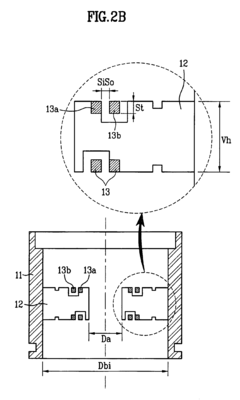
- A small-sized anode with a cylindrical body and ten vanes, where the inside diameter is reduced to 32.5-34.0 mm, and the anode body and vanes are formed with the same thickness to simplify fabrication, along with adjusting the strap distances and thicknesses to maintain a 2450 MHz resonance frequency and achieve high energy efficiency greater than 70%.
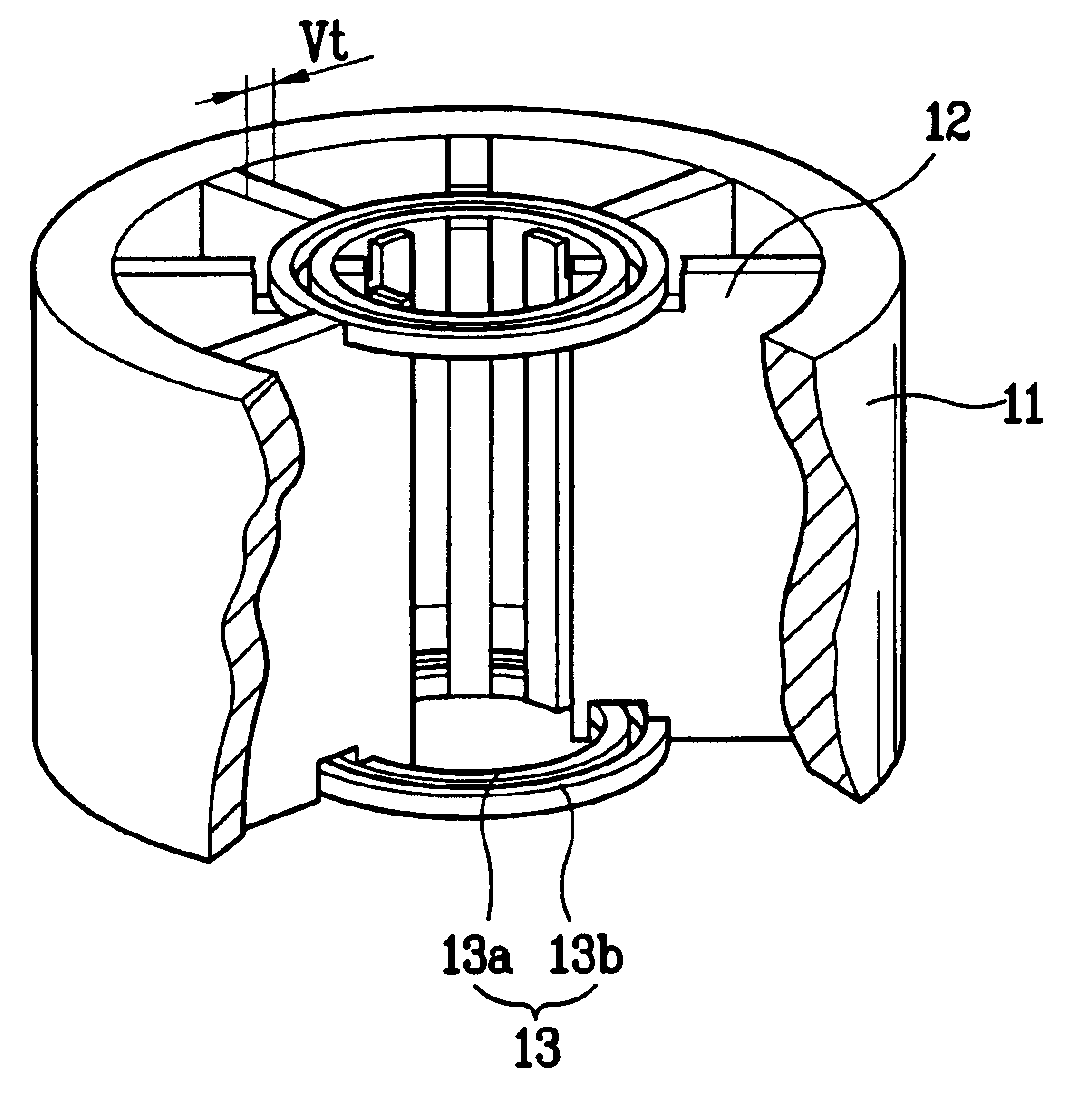
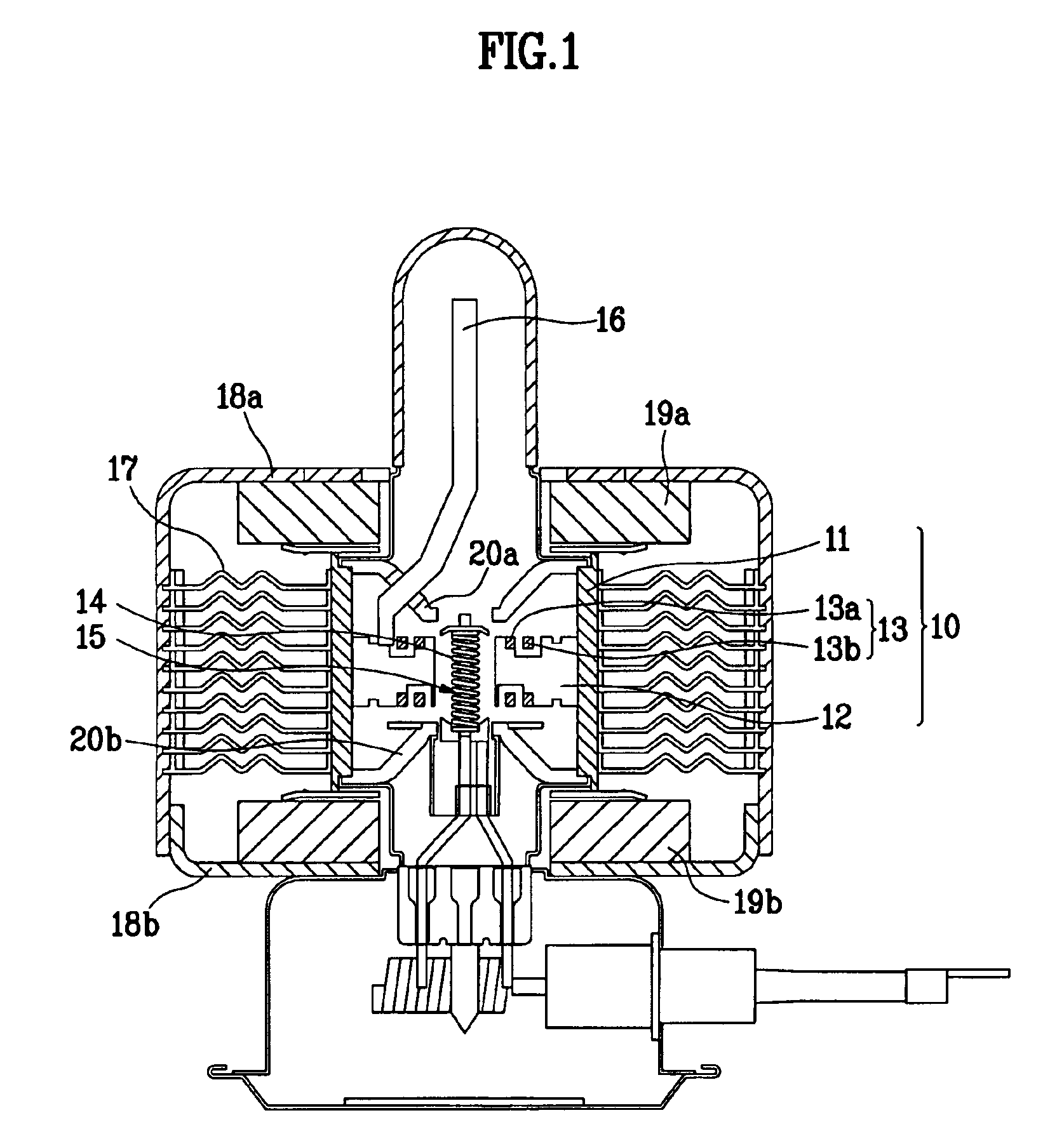
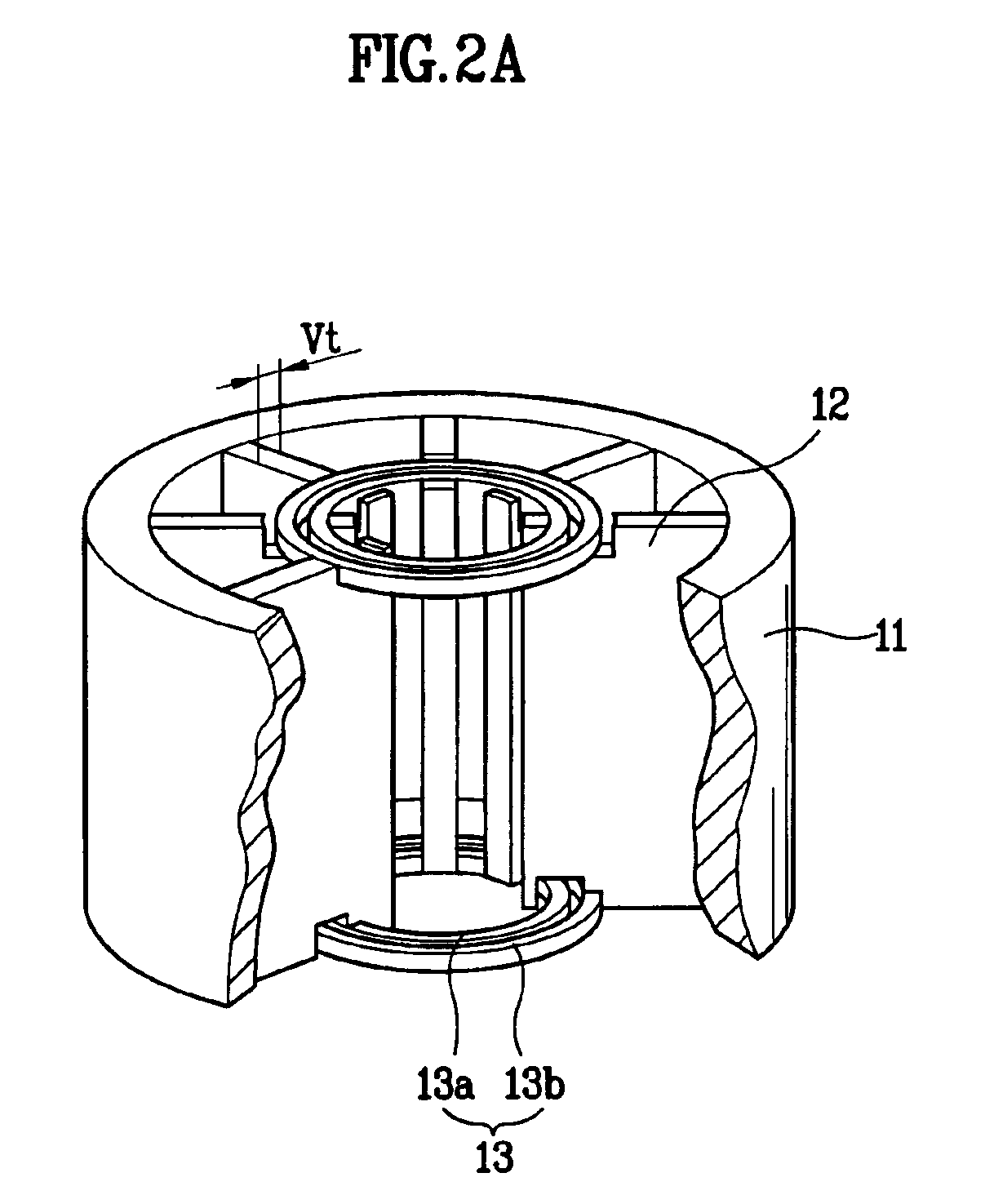
Magnetron
PatentInactiveEP1355340A3
Innovation
- The magnetron incorporates anode and magnet heat conductors to form separate heat dissipation paths, using heat pipes and heat dissipation plates to efficiently transfer heat to external air, and insulating members to prevent heat transfer to the magnets, eliminating the need for a cooling fan and external air inlets/outlets.
Materials Science Advancements for Cooling Efficiency
Recent advancements in materials science have revolutionized cooling efficiency for magnetron systems, directly impacting their operational longevity. Traditional cooling materials like copper and aluminum, while effective heat conductors, have limitations in extreme operational environments. The emergence of novel composite materials with enhanced thermal conductivity properties represents a significant breakthrough in this domain.
Ceramic-metal composites (cermets) have demonstrated superior heat dissipation capabilities while maintaining structural integrity under high-frequency electromagnetic conditions. These materials combine the thermal conductivity of metals with the electrical insulation properties of ceramics, creating an ideal medium for magnetron cooling systems. Laboratory tests indicate that advanced cermets can improve heat transfer efficiency by 28-35% compared to conventional materials.
Carbon-based materials, particularly graphene and carbon nanotubes, have emerged as promising candidates for next-generation cooling systems. Their exceptional thermal conductivity—up to 5000 W/mK for graphene compared to copper's 400 W/mK—offers unprecedented potential for heat management. When incorporated into cooling system interfaces, these materials can significantly reduce thermal resistance at critical junctions where heat transfer bottlenecks typically occur.
Phase-change materials (PCMs) represent another frontier in cooling technology. These substances absorb and release thermal energy during phase transitions, effectively acting as thermal buffers during peak operational periods. Advanced metallic PCMs designed specifically for magnetron applications can absorb up to 200-250 J/g of thermal energy, substantially extending the safe operational window of these devices.
Surface engineering techniques have also evolved to enhance cooling efficiency. Micro-structured surfaces with optimized geometries can increase the effective surface area for heat exchange by 150-200%. Hydrophobic and hydrophilic patterning techniques further enhance coolant flow dynamics, reducing boundary layer formation and improving convective heat transfer coefficients by up to 40%.
Thermally conductive polymers reinforced with ceramic or metallic nanoparticles offer lightweight alternatives to traditional cooling materials. These composites provide the dual benefit of weight reduction and improved thermal performance, with some formulations achieving thermal conductivity values approaching 20 W/mK while maintaining excellent electrical insulation properties essential for magnetron operation.
The integration of these advanced materials into practical cooling system designs requires sophisticated manufacturing techniques. Additive manufacturing methods have enabled the creation of complex cooling channel geometries that were previously impossible to fabricate, optimizing coolant flow patterns and maximizing heat extraction efficiency from critical magnetron components.
Ceramic-metal composites (cermets) have demonstrated superior heat dissipation capabilities while maintaining structural integrity under high-frequency electromagnetic conditions. These materials combine the thermal conductivity of metals with the electrical insulation properties of ceramics, creating an ideal medium for magnetron cooling systems. Laboratory tests indicate that advanced cermets can improve heat transfer efficiency by 28-35% compared to conventional materials.
Carbon-based materials, particularly graphene and carbon nanotubes, have emerged as promising candidates for next-generation cooling systems. Their exceptional thermal conductivity—up to 5000 W/mK for graphene compared to copper's 400 W/mK—offers unprecedented potential for heat management. When incorporated into cooling system interfaces, these materials can significantly reduce thermal resistance at critical junctions where heat transfer bottlenecks typically occur.
Phase-change materials (PCMs) represent another frontier in cooling technology. These substances absorb and release thermal energy during phase transitions, effectively acting as thermal buffers during peak operational periods. Advanced metallic PCMs designed specifically for magnetron applications can absorb up to 200-250 J/g of thermal energy, substantially extending the safe operational window of these devices.
Surface engineering techniques have also evolved to enhance cooling efficiency. Micro-structured surfaces with optimized geometries can increase the effective surface area for heat exchange by 150-200%. Hydrophobic and hydrophilic patterning techniques further enhance coolant flow dynamics, reducing boundary layer formation and improving convective heat transfer coefficients by up to 40%.
Thermally conductive polymers reinforced with ceramic or metallic nanoparticles offer lightweight alternatives to traditional cooling materials. These composites provide the dual benefit of weight reduction and improved thermal performance, with some formulations achieving thermal conductivity values approaching 20 W/mK while maintaining excellent electrical insulation properties essential for magnetron operation.
The integration of these advanced materials into practical cooling system designs requires sophisticated manufacturing techniques. Additive manufacturing methods have enabled the creation of complex cooling channel geometries that were previously impossible to fabricate, optimizing coolant flow patterns and maximizing heat extraction efficiency from critical magnetron components.
Environmental Impact and Sustainability Considerations
The environmental impact of magnetron cooling systems extends beyond their operational efficiency, encompassing the entire lifecycle from manufacturing to disposal. Traditional cooling methods often rely on materials and processes that contribute significantly to carbon emissions and resource depletion. By optimizing magnetron cooling systems for longevity, manufacturers can substantially reduce the environmental footprint associated with frequent replacements and maintenance.
Water consumption represents a critical environmental concern in magnetron cooling systems. Conventional water-cooled designs may utilize substantial quantities of water, contributing to resource strain in water-scarce regions. Advanced cooling technologies incorporating closed-loop systems and water recirculation mechanisms can reduce consumption by up to 60%, while simultaneously extending magnetron lifespan through more consistent temperature regulation.
Energy efficiency improvements in magnetron cooling directly translate to sustainability benefits. Research indicates that optimized cooling systems can reduce energy consumption by 15-25% compared to standard configurations. This reduction not only extends magnetron operational life but also decreases the associated carbon emissions throughout the device's service period, aligning with global carbon reduction initiatives.
Material selection plays a pivotal role in the environmental profile of cooling systems. The transition from rare or toxic materials to more abundant and environmentally benign alternatives represents a significant advancement in sustainable design. For instance, replacing copper-beryllium alloys with aluminum-silicon composites in heat sinks reduces environmental toxicity while maintaining thermal performance and extending component lifespan.
Waste reduction through enhanced longevity constitutes perhaps the most direct sustainability benefit of optimized cooling systems. By extending magnetron operational life from the industry standard of 2,000-4,000 hours to 8,000-10,000 hours, the volume of electronic waste is proportionally decreased. This reduction is particularly significant considering the complex material composition of magnetrons and the challenges associated with their recycling.
Regulatory compliance and future-proofing represent additional sustainability considerations. As environmental regulations become increasingly stringent worldwide, cooling systems designed with reduced environmental impact will face fewer compliance challenges and adaptation costs. Forward-thinking manufacturers are already incorporating sustainability metrics into their design parameters, anticipating regulatory developments rather than reacting to them.
Water consumption represents a critical environmental concern in magnetron cooling systems. Conventional water-cooled designs may utilize substantial quantities of water, contributing to resource strain in water-scarce regions. Advanced cooling technologies incorporating closed-loop systems and water recirculation mechanisms can reduce consumption by up to 60%, while simultaneously extending magnetron lifespan through more consistent temperature regulation.
Energy efficiency improvements in magnetron cooling directly translate to sustainability benefits. Research indicates that optimized cooling systems can reduce energy consumption by 15-25% compared to standard configurations. This reduction not only extends magnetron operational life but also decreases the associated carbon emissions throughout the device's service period, aligning with global carbon reduction initiatives.
Material selection plays a pivotal role in the environmental profile of cooling systems. The transition from rare or toxic materials to more abundant and environmentally benign alternatives represents a significant advancement in sustainable design. For instance, replacing copper-beryllium alloys with aluminum-silicon composites in heat sinks reduces environmental toxicity while maintaining thermal performance and extending component lifespan.
Waste reduction through enhanced longevity constitutes perhaps the most direct sustainability benefit of optimized cooling systems. By extending magnetron operational life from the industry standard of 2,000-4,000 hours to 8,000-10,000 hours, the volume of electronic waste is proportionally decreased. This reduction is particularly significant considering the complex material composition of magnetrons and the challenges associated with their recycling.
Regulatory compliance and future-proofing represent additional sustainability considerations. As environmental regulations become increasingly stringent worldwide, cooling systems designed with reduced environmental impact will face fewer compliance challenges and adaptation costs. Forward-thinking manufacturers are already incorporating sustainability metrics into their design parameters, anticipating regulatory developments rather than reacting to them.
Unlock deeper insights with Patsnap Eureka Quick Research — get a full tech report to explore trends and direct your research. Try now!
Generate Your Research Report Instantly with AI Agent
Supercharge your innovation with Patsnap Eureka AI Agent Platform!