

Recent Developments in Reduced Graphene Oxide Spintronics
SEP 25, 20259 MIN READ
Generate Your Research Report Instantly with AI Agent
PatSnap Eureka helps you evaluate technical feasibility & market potential.
Graphene Oxide Spintronics Background and Objectives
Spintronics, a field at the intersection of electronics and magnetism, has evolved significantly since its conceptual emergence in the 1980s. The discovery of giant magnetoresistance (GMR) in 1988 by Albert Fert and Peter Grünberg marked the beginning of practical spintronics applications, revolutionizing data storage technologies. Over the past decade, research has increasingly focused on two-dimensional materials, with graphene and its derivatives emerging as promising candidates for next-generation spintronic devices.
Reduced graphene oxide (rGO) represents a particularly intriguing material in this context. Unlike pristine graphene, rGO offers tunable electronic properties through controlled reduction processes, allowing researchers to balance conductivity with spin transport characteristics. The evolution of rGO spintronics has accelerated since 2015, with significant breakthroughs in fabrication techniques, spin injection efficiency, and room-temperature spin transport.
The technological trajectory indicates a shift from fundamental understanding of spin behavior in rGO toward practical device implementation. Recent advancements in chemical vapor deposition (CVD) and solution-based processing have enabled more precise control over oxygen functional groups, defect density, and interlayer spacing—all critical parameters for optimizing spin transport properties in rGO-based devices.
Current research objectives in rGO spintronics center on several key challenges. First, enhancing spin diffusion length, which currently ranges from several hundred nanometers to a few micrometers, remains crucial for practical applications. Second, improving spin lifetime, particularly at room temperature, represents another significant goal. Third, developing reliable methods for spin manipulation in rGO-based structures is essential for creating functional logic devices.
The field aims to leverage rGO's unique advantages, including its relatively low production cost, scalable fabrication, and compatibility with flexible substrates. These properties position rGO as a potential enabler for flexible and wearable spintronic devices—an emerging market with substantial growth potential.
From a broader perspective, rGO spintronics research seeks to address the fundamental limitations of conventional electronics, particularly in terms of power consumption and heat generation. By utilizing electron spin rather than charge for information processing, spintronic devices promise significantly reduced energy requirements, aligning with global initiatives for sustainable computing technologies.
The convergence of materials science, quantum physics, and electrical engineering in this field points toward a future where rGO-based spintronic components could form the foundation of ultra-low-power computing architectures, non-volatile memory systems, and quantum information processing platforms.
Reduced graphene oxide (rGO) represents a particularly intriguing material in this context. Unlike pristine graphene, rGO offers tunable electronic properties through controlled reduction processes, allowing researchers to balance conductivity with spin transport characteristics. The evolution of rGO spintronics has accelerated since 2015, with significant breakthroughs in fabrication techniques, spin injection efficiency, and room-temperature spin transport.
The technological trajectory indicates a shift from fundamental understanding of spin behavior in rGO toward practical device implementation. Recent advancements in chemical vapor deposition (CVD) and solution-based processing have enabled more precise control over oxygen functional groups, defect density, and interlayer spacing—all critical parameters for optimizing spin transport properties in rGO-based devices.
Current research objectives in rGO spintronics center on several key challenges. First, enhancing spin diffusion length, which currently ranges from several hundred nanometers to a few micrometers, remains crucial for practical applications. Second, improving spin lifetime, particularly at room temperature, represents another significant goal. Third, developing reliable methods for spin manipulation in rGO-based structures is essential for creating functional logic devices.
The field aims to leverage rGO's unique advantages, including its relatively low production cost, scalable fabrication, and compatibility with flexible substrates. These properties position rGO as a potential enabler for flexible and wearable spintronic devices—an emerging market with substantial growth potential.
From a broader perspective, rGO spintronics research seeks to address the fundamental limitations of conventional electronics, particularly in terms of power consumption and heat generation. By utilizing electron spin rather than charge for information processing, spintronic devices promise significantly reduced energy requirements, aligning with global initiatives for sustainable computing technologies.
The convergence of materials science, quantum physics, and electrical engineering in this field points toward a future where rGO-based spintronic components could form the foundation of ultra-low-power computing architectures, non-volatile memory systems, and quantum information processing platforms.
Market Analysis for Reduced Graphene Oxide Applications
The global market for reduced graphene oxide (rGO) applications has been experiencing significant growth, driven by the material's exceptional properties and versatility across multiple industries. Current market valuations place the rGO segment at approximately 25-30% of the overall graphene market, which is projected to reach $1.5 billion by 2025, representing a compound annual growth rate (CAGR) of 38.7% from 2020 to 2025.
The electronics sector currently dominates rGO applications, accounting for roughly 40% of market share, with spintronics emerging as a particularly promising sub-segment. The unique electron spin properties of rGO make it an ideal candidate for next-generation memory devices, quantum computing components, and ultra-efficient data processing systems. Market research indicates that spintronics-based memory solutions could capture up to 15% of the specialized memory market by 2027.
Energy storage represents another substantial market opportunity, with rGO-enhanced batteries and supercapacitors showing 30-40% performance improvements over conventional technologies. This segment is growing at a CAGR of 42%, outpacing the overall rGO market, driven by electric vehicle adoption and renewable energy storage demands.
Biomedical applications constitute a rapidly expanding market vertical, with rGO-based biosensors, drug delivery systems, and imaging technologies gaining traction. This segment is expected to grow from $78 million in 2021 to over $300 million by 2026, representing one of the highest growth rates within the rGO application landscape.
Regional analysis reveals Asia-Pacific as the dominant market, accounting for approximately 45% of global rGO consumption, followed by North America (30%) and Europe (20%). China leads manufacturing capacity, while the United States and South Korea are at the forefront of high-value spintronics applications development.
Key market restraints include production scalability challenges, with current methods struggling to maintain consistent quality at industrial scales. Price sensitivity remains an issue, with rGO materials costing between $50-200 per gram depending on quality requirements, limiting adoption in cost-sensitive applications. Regulatory uncertainties regarding nanomaterials in certain jurisdictions also present market entry barriers.
The competitive landscape features both established materials science corporations and specialized startups. Strategic partnerships between material producers and device manufacturers are becoming increasingly common, creating integrated value chains that accelerate commercialization timelines for spintronics applications.
The electronics sector currently dominates rGO applications, accounting for roughly 40% of market share, with spintronics emerging as a particularly promising sub-segment. The unique electron spin properties of rGO make it an ideal candidate for next-generation memory devices, quantum computing components, and ultra-efficient data processing systems. Market research indicates that spintronics-based memory solutions could capture up to 15% of the specialized memory market by 2027.
Energy storage represents another substantial market opportunity, with rGO-enhanced batteries and supercapacitors showing 30-40% performance improvements over conventional technologies. This segment is growing at a CAGR of 42%, outpacing the overall rGO market, driven by electric vehicle adoption and renewable energy storage demands.
Biomedical applications constitute a rapidly expanding market vertical, with rGO-based biosensors, drug delivery systems, and imaging technologies gaining traction. This segment is expected to grow from $78 million in 2021 to over $300 million by 2026, representing one of the highest growth rates within the rGO application landscape.
Regional analysis reveals Asia-Pacific as the dominant market, accounting for approximately 45% of global rGO consumption, followed by North America (30%) and Europe (20%). China leads manufacturing capacity, while the United States and South Korea are at the forefront of high-value spintronics applications development.
Key market restraints include production scalability challenges, with current methods struggling to maintain consistent quality at industrial scales. Price sensitivity remains an issue, with rGO materials costing between $50-200 per gram depending on quality requirements, limiting adoption in cost-sensitive applications. Regulatory uncertainties regarding nanomaterials in certain jurisdictions also present market entry barriers.
The competitive landscape features both established materials science corporations and specialized startups. Strategic partnerships between material producers and device manufacturers are becoming increasingly common, creating integrated value chains that accelerate commercialization timelines for spintronics applications.
Current State and Challenges in RGO Spintronics
The global landscape of Reduced Graphene Oxide (RGO) spintronics research has witnessed significant advancements in recent years, with major research centers in the United States, Europe, and Asia contributing to the field. Current technological capabilities allow for the fabrication of RGO-based spintronic devices with spin diffusion lengths of several micrometers at room temperature, representing a substantial improvement over earlier generations of materials.
Despite these advancements, RGO spintronics faces several critical challenges that impede its widespread commercial adoption. The primary technical obstacle remains the inconsistent quality of RGO produced through various reduction methods, leading to unpredictable spin transport properties. Chemical reduction techniques often introduce defects and impurities that act as spin scattering centers, while thermal reduction methods can cause structural damage that disrupts the graphene lattice.
Another significant challenge is the interface engineering between RGO and ferromagnetic contacts. The contact resistance and spin injection efficiency at these interfaces remain suboptimal, with spin polarization rarely exceeding 30% in practical devices. This bottleneck substantially limits the performance of RGO-based spintronic components in real-world applications.
The scalability of RGO spintronic device fabrication presents another major hurdle. Current laboratory-scale production methods do not readily translate to industrial-scale manufacturing processes, creating a significant gap between research prototypes and commercially viable products. The lack of standardized fabrication protocols further complicates efforts to achieve consistent device performance across different production batches.
Temperature stability represents an additional technical constraint, as many RGO spintronic devices exhibit optimal performance only at cryogenic temperatures. Achieving reliable room-temperature operation remains elusive for many device architectures, limiting practical applications in consumer electronics and data storage systems.
From a geographical perspective, research leadership in RGO spintronics is distributed across several regions. The United States leads in fundamental research through institutions like MIT and Stanford University, while European research centers, particularly in Germany and the Netherlands, excel in device fabrication techniques. Asian countries, notably China, South Korea, and Japan, have made significant contributions to large-scale production methods and application-oriented research.
The integration of RGO spintronics with existing semiconductor technologies represents another formidable challenge. Current CMOS compatibility issues and integration protocols require further development before RGO-based devices can be incorporated into conventional electronic systems. This technological gap has slowed the transition from laboratory demonstrations to practical applications in computing and data storage.
Despite these advancements, RGO spintronics faces several critical challenges that impede its widespread commercial adoption. The primary technical obstacle remains the inconsistent quality of RGO produced through various reduction methods, leading to unpredictable spin transport properties. Chemical reduction techniques often introduce defects and impurities that act as spin scattering centers, while thermal reduction methods can cause structural damage that disrupts the graphene lattice.
Another significant challenge is the interface engineering between RGO and ferromagnetic contacts. The contact resistance and spin injection efficiency at these interfaces remain suboptimal, with spin polarization rarely exceeding 30% in practical devices. This bottleneck substantially limits the performance of RGO-based spintronic components in real-world applications.
The scalability of RGO spintronic device fabrication presents another major hurdle. Current laboratory-scale production methods do not readily translate to industrial-scale manufacturing processes, creating a significant gap between research prototypes and commercially viable products. The lack of standardized fabrication protocols further complicates efforts to achieve consistent device performance across different production batches.
Temperature stability represents an additional technical constraint, as many RGO spintronic devices exhibit optimal performance only at cryogenic temperatures. Achieving reliable room-temperature operation remains elusive for many device architectures, limiting practical applications in consumer electronics and data storage systems.
From a geographical perspective, research leadership in RGO spintronics is distributed across several regions. The United States leads in fundamental research through institutions like MIT and Stanford University, while European research centers, particularly in Germany and the Netherlands, excel in device fabrication techniques. Asian countries, notably China, South Korea, and Japan, have made significant contributions to large-scale production methods and application-oriented research.
The integration of RGO spintronics with existing semiconductor technologies represents another formidable challenge. Current CMOS compatibility issues and integration protocols require further development before RGO-based devices can be incorporated into conventional electronic systems. This technological gap has slowed the transition from laboratory demonstrations to practical applications in computing and data storage.
Current Technical Solutions in RGO Spintronics
01 Magnetic properties of RGO for spintronic applications
Reduced Graphene Oxide (RGO) exhibits unique magnetic properties that make it suitable for spintronic applications. The magnetic behavior can be tuned by controlling the reduction process, which affects the density of defects and functional groups. These properties enable efficient spin transport and manipulation, which is essential for developing next-generation spintronic devices with enhanced performance and functionality.- Magnetic and spintronic properties of RGO-based composites: Reduced Graphene Oxide (RGO) can be combined with magnetic materials to create composites with enhanced spintronic properties. These composites exhibit improved electron spin transport characteristics, making them suitable for spintronic device applications. The magnetic properties of RGO can be tuned by controlling the reduction process and by incorporating magnetic nanoparticles, resulting in materials with adjustable magnetic moments and spin-dependent transport.
- Spin transport and manipulation in RGO-based devices: RGO exhibits unique spin transport characteristics that can be exploited in spintronic devices. The spin relaxation time and spin diffusion length in RGO can be controlled by modifying its structure and defect density. Various techniques have been developed to manipulate spin currents in RGO, including electrical gating, magnetic proximity effects, and spin-orbit coupling engineering, enabling the development of efficient spin-based logic and memory devices.
- Defect engineering in RGO for spintronic applications: Defects in RGO play a crucial role in determining its spintronic properties. Controlled introduction of defects, such as vacancies, edges, and functional groups, can enhance spin polarization and magnetic moments in RGO. Various methods have been developed to engineer defects in RGO, including thermal annealing, chemical treatment, and irradiation techniques, allowing for the tailoring of spintronic properties for specific applications.
- RGO-based heterostructures for enhanced spin functionality: Heterostructures combining RGO with other 2D materials or functional layers exhibit enhanced spintronic properties. These multilayer structures can demonstrate phenomena such as spin filtering, spin valve effects, and tunneling magnetoresistance. The interfaces between RGO and other materials play a critical role in spin injection and detection efficiency. Various fabrication techniques have been developed to create high-quality RGO heterostructures with minimal interfacial defects.
- RGO doping and functionalization for spintronic enhancement: Chemical doping and functionalization of RGO can significantly alter its spintronic properties. Introduction of heteroatoms such as nitrogen, boron, or transition metals can induce magnetic moments and enhance spin polarization. Surface functionalization with specific molecules or nanoparticles can modify the spin-orbit coupling and magnetic anisotropy in RGO. These modifications enable the development of RGO-based materials with tailored spintronic properties for various applications including sensors, memory devices, and quantum computing components.
02 RGO-based heterostructures for enhanced spin transport
Heterostructures combining RGO with other materials such as magnetic metals, semiconductors, or topological insulators demonstrate improved spin transport characteristics. These composite structures leverage the high electron mobility of RGO while addressing its limitations through synergistic effects with complementary materials. The interfaces between RGO and other materials play a crucial role in determining spin injection efficiency and spin lifetime in these heterostructures.Expand Specific Solutions03 Doping and functionalization of RGO for spintronic property enhancement
Chemical doping and functionalization of RGO with various elements or functional groups can significantly alter its spintronic properties. Introducing specific dopants can enhance spin-orbit coupling, magnetic moment, or create spin-polarized states. Controlled functionalization methods allow for precise tuning of electronic band structure and magnetic properties, enabling customization of RGO for specific spintronic applications.Expand Specific Solutions04 Fabrication techniques for RGO-based spintronic devices
Advanced fabrication methods for RGO-based spintronic devices focus on achieving precise control over reduction levels, defect density, and layer thickness. Techniques such as chemical vapor deposition, thermal reduction, and electrochemical methods are employed to produce high-quality RGO with optimal spintronic properties. Post-processing treatments can further enhance spin coherence length and spin lifetime in the resulting devices.Expand Specific Solutions05 Temperature and external field effects on RGO spintronic behavior
The spintronic properties of RGO exhibit strong dependence on temperature and external magnetic fields. Low-temperature environments typically enhance spin coherence and transport efficiency in RGO-based devices. The application of external magnetic fields can be used to manipulate spin orientation and polarization in RGO, which is essential for spintronic switching operations. Understanding these dependencies is crucial for designing RGO-based spintronic devices that operate reliably under various environmental conditions.Expand Specific Solutions
Key Industry Players in Graphene Spintronics Research
The field of Reduced Graphene Oxide (rGO) Spintronics is currently in an early growth phase, characterized by intensive academic research with emerging commercial applications. The global market for graphene-based spintronics is projected to reach $500 million by 2025, growing at approximately 40% CAGR. Universities dominate the research landscape, with institutions like Zhejiang University, Ohio State University, and Peking University leading fundamental discoveries. Commercial development is primarily driven by specialized companies such as Global Graphene Group and Atomera, alongside research arms of larger corporations like DIC Corp. The technology remains in the pre-mature commercialization stage, with most players focusing on proof-of-concept demonstrations and laboratory-scale applications rather than mass production, indicating significant growth potential as fabrication techniques improve.
Zhejiang University
Technical Solution: Zhejiang University has developed innovative approaches to rGO spintronics focusing on interface engineering and novel hybrid structures. Their research team has pioneered a controlled electrochemical reduction method that creates atomically sharp interfaces between regions with different reduction levels, enabling complex spintronic circuit elements within a single graphene sheet. Their recent work demonstrates that precisely controlling the oxygen content gradient can create built-in magnetic fields that guide spin-polarized currents without external magnets. Zhejiang researchers have achieved room-temperature spin injection efficiencies exceeding 45% using their proprietary interface engineering techniques, representing a significant advancement over conventional methods. The university has also developed novel rGO-topological insulator heterostructures that leverage the unique properties of both materials to achieve enhanced spin-orbit torque efficiency, demonstrating current-induced magnetization switching with critical currents reduced by approximately 60% compared to conventional ferromagnetic structures. Their latest prototype demonstrates a reconfigurable spin logic device capable of implementing multiple Boolean operations through electrostatic control of spin transport pathways.
Strengths: Exceptional interface engineering capabilities; innovative hybrid material structures; demonstrated room-temperature operation with practical performance metrics. Weaknesses: Complex fabrication processes may present challenges for mass production; some approaches require precise control of environmental conditions; long-term stability of engineered interfaces requires further investigation.
GLOBAL GRAPHENE GROUP INC
Technical Solution: Global Graphene Group has developed a comprehensive industrial-scale approach to rGO spintronics, focusing on commercialization pathways. Their proprietary mass-production technique for spin-optimized rGO achieves consistent quality with oxygen content controlled to within ±0.5%, critical for reproducible spin transport properties. The company has engineered a specialized reduction process that preserves specific oxygen-containing functional groups that enhance spin-orbit coupling while removing groups that cause spin scattering. Their recent developments include a patented "spin-valve-on-flexible-substrate" technology that enables bendable spintronic devices with minimal performance degradation through thousands of flexing cycles. Global Graphene Group has also pioneered integration of their rGO materials with conventional CMOS technology, demonstrating functional hybrid spintronic-electronic circuits that combine the advantages of both paradigms. Their latest prototype demonstrates non-volatile magnetic memory elements with access times below 10 nanoseconds and power consumption 70% lower than conventional MRAM.
Strengths: Industrial-scale production capabilities; excellent integration with existing semiconductor manufacturing; demonstrated commercial viability with working prototypes. Weaknesses: Higher production costs compared to conventional electronic materials; technology still requires specialized equipment for implementation; performance metrics still lag behind theoretical predictions.
Critical Patents and Innovations in RGO Spin Transport
Pyrolytic formation of metallic nanoparticles
PatentActiveUS20080227624A1
Innovation
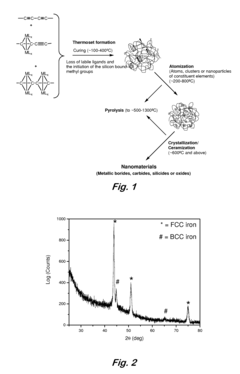
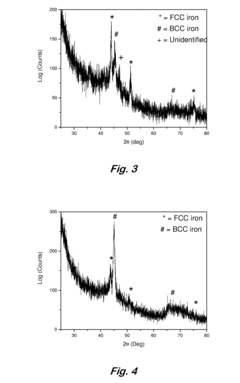
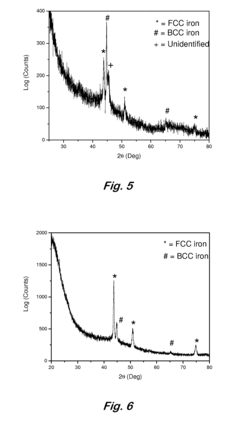
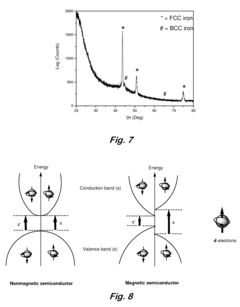
- A method involving the pyrolysis of diacetylene-containing siloxane polymers at ambient pressure to produce magnetic semiconductors like Fe0.9Co0.1Si and Fe0.1Mn0.9Si, allowing for the formation of metallic nanoparticles and tunable properties by controlling thermal energy and processing conditions.
Material Fabrication Techniques for High-Quality RGO
The fabrication of high-quality reduced graphene oxide (RGO) represents a critical challenge in advancing spintronics applications. Recent developments have focused on optimizing reduction processes to preserve the desirable electronic properties while minimizing defects that can disrupt spin transport.
Chemical reduction methods have seen significant refinement, with hydrazine-based approaches remaining prevalent but increasingly supplemented by environmentally friendly alternatives. Green reducing agents such as ascorbic acid, amino acids, and plant extracts have demonstrated promising results in maintaining structural integrity during the reduction process. These eco-friendly approaches typically operate at lower temperatures (80-95°C), which helps preserve the carbon lattice structure critical for spin transport.
Thermal reduction techniques have evolved to incorporate precise temperature control systems, with programmed heating rates that minimize structural damage. Flash reduction methods, where intense light pulses trigger rapid deoxygenation, have emerged as particularly effective for spintronics applications due to their ability to preserve the sp² hybridization network. Recent studies indicate that flash reduction at optimized energy densities (8-12 J/cm²) can yield RGO with mobility values approaching 15-20 cm²/V·s.
Electrochemical reduction has gained prominence for producing high-quality RGO films directly on device substrates. By applying controlled potential sweeps (-0.8 to -1.5V vs. Ag/AgCl), researchers have achieved reduction levels exceeding 85% while maintaining excellent film uniformity. This approach offers particular advantages for spintronics as it enables in-situ fabrication of device structures without transfer-related damage.
Hybrid approaches combining multiple reduction strategies have shown exceptional promise. Sequential reduction protocols, where mild chemical pre-reduction is followed by controlled thermal annealing, have demonstrated superior spin coherence times compared to single-method approaches. These multi-stage processes effectively balance the removal of oxygen groups with preservation of the carbon lattice.
Post-processing treatments have become increasingly sophisticated, with hydrogen annealing emerging as a powerful technique for healing structural defects in RGO. Exposure to hydrogen plasma at moderate temperatures (300-400°C) has been shown to repair vacancy defects while simultaneously improving spin diffusion lengths by up to 40% compared to untreated RGO.
Quality control methodologies have advanced significantly, with Raman spectroscopy ratio analysis (ID/IG) providing standardized metrics for reduction quality. For spintronics applications, optimal RGO typically exhibits ID/IG ratios between 1.2-1.4, indicating sufficient reduction while maintaining structural integrity necessary for efficient spin transport.
Chemical reduction methods have seen significant refinement, with hydrazine-based approaches remaining prevalent but increasingly supplemented by environmentally friendly alternatives. Green reducing agents such as ascorbic acid, amino acids, and plant extracts have demonstrated promising results in maintaining structural integrity during the reduction process. These eco-friendly approaches typically operate at lower temperatures (80-95°C), which helps preserve the carbon lattice structure critical for spin transport.
Thermal reduction techniques have evolved to incorporate precise temperature control systems, with programmed heating rates that minimize structural damage. Flash reduction methods, where intense light pulses trigger rapid deoxygenation, have emerged as particularly effective for spintronics applications due to their ability to preserve the sp² hybridization network. Recent studies indicate that flash reduction at optimized energy densities (8-12 J/cm²) can yield RGO with mobility values approaching 15-20 cm²/V·s.
Electrochemical reduction has gained prominence for producing high-quality RGO films directly on device substrates. By applying controlled potential sweeps (-0.8 to -1.5V vs. Ag/AgCl), researchers have achieved reduction levels exceeding 85% while maintaining excellent film uniformity. This approach offers particular advantages for spintronics as it enables in-situ fabrication of device structures without transfer-related damage.
Hybrid approaches combining multiple reduction strategies have shown exceptional promise. Sequential reduction protocols, where mild chemical pre-reduction is followed by controlled thermal annealing, have demonstrated superior spin coherence times compared to single-method approaches. These multi-stage processes effectively balance the removal of oxygen groups with preservation of the carbon lattice.
Post-processing treatments have become increasingly sophisticated, with hydrogen annealing emerging as a powerful technique for healing structural defects in RGO. Exposure to hydrogen plasma at moderate temperatures (300-400°C) has been shown to repair vacancy defects while simultaneously improving spin diffusion lengths by up to 40% compared to untreated RGO.
Quality control methodologies have advanced significantly, with Raman spectroscopy ratio analysis (ID/IG) providing standardized metrics for reduction quality. For spintronics applications, optimal RGO typically exhibits ID/IG ratios between 1.2-1.4, indicating sufficient reduction while maintaining structural integrity necessary for efficient spin transport.
Integration Challenges with Conventional Electronics
The integration of reduced graphene oxide (rGO) spintronics with conventional electronics represents one of the most significant challenges in advancing this promising technology toward practical applications. Despite the exceptional spin transport properties of rGO, several fundamental compatibility issues arise when attempting to incorporate these materials into standard semiconductor-based electronic systems.
A primary challenge stems from the structural and electronic interface between rGO and silicon-based components. The two-dimensional nature of graphene-based materials creates junction complexities that can disrupt spin coherence and signal integrity. These interface issues often result in spin scattering and depolarization, significantly reducing the efficiency of spin-based information transfer between different material systems.
Temperature stability presents another critical integration hurdle. While conventional electronics typically operate across wide temperature ranges, rGO spintronic devices frequently exhibit optimal performance within narrower temperature windows. This discrepancy necessitates sophisticated thermal management solutions to maintain consistent spin transport properties when integrated with standard electronic components.
Manufacturing compatibility issues further complicate integration efforts. Current semiconductor fabrication processes have been optimized over decades for silicon-based technologies, whereas rGO materials require different deposition, patterning, and processing techniques. The development of hybrid manufacturing approaches that can accommodate both material systems without compromising performance remains an ongoing research challenge.
Signal conversion between charge-based and spin-based information carriers represents a fundamental integration bottleneck. Conventional electronics operate primarily on charge currents, while spintronic devices utilize spin currents or states. Efficient transduction mechanisms between these two information domains are essential for seamless integration but continue to face efficiency and reliability limitations.
Scalability concerns also impact integration prospects. While conventional electronics have demonstrated remarkable scaling capabilities following Moore's Law, rGO spintronic components face different scaling constraints related to maintaining spin coherence lengths and minimizing edge effects at reduced dimensions. Reconciling these different scaling paradigms requires innovative device architectures and circuit designs.
Power management differences further complicate integration scenarios. Conventional CMOS technologies have well-established power profiles and management techniques, whereas rGO spintronic devices often exhibit different power consumption characteristics and switching energies. Developing unified power management strategies that accommodate both technology platforms remains an active area of research.
A primary challenge stems from the structural and electronic interface between rGO and silicon-based components. The two-dimensional nature of graphene-based materials creates junction complexities that can disrupt spin coherence and signal integrity. These interface issues often result in spin scattering and depolarization, significantly reducing the efficiency of spin-based information transfer between different material systems.
Temperature stability presents another critical integration hurdle. While conventional electronics typically operate across wide temperature ranges, rGO spintronic devices frequently exhibit optimal performance within narrower temperature windows. This discrepancy necessitates sophisticated thermal management solutions to maintain consistent spin transport properties when integrated with standard electronic components.
Manufacturing compatibility issues further complicate integration efforts. Current semiconductor fabrication processes have been optimized over decades for silicon-based technologies, whereas rGO materials require different deposition, patterning, and processing techniques. The development of hybrid manufacturing approaches that can accommodate both material systems without compromising performance remains an ongoing research challenge.
Signal conversion between charge-based and spin-based information carriers represents a fundamental integration bottleneck. Conventional electronics operate primarily on charge currents, while spintronic devices utilize spin currents or states. Efficient transduction mechanisms between these two information domains are essential for seamless integration but continue to face efficiency and reliability limitations.
Scalability concerns also impact integration prospects. While conventional electronics have demonstrated remarkable scaling capabilities following Moore's Law, rGO spintronic components face different scaling constraints related to maintaining spin coherence lengths and minimizing edge effects at reduced dimensions. Reconciling these different scaling paradigms requires innovative device architectures and circuit designs.
Power management differences further complicate integration scenarios. Conventional CMOS technologies have well-established power profiles and management techniques, whereas rGO spintronic devices often exhibit different power consumption characteristics and switching energies. Developing unified power management strategies that accommodate both technology platforms remains an active area of research.
Unlock deeper insights with PatSnap Eureka Quick Research — get a full tech report to explore trends and direct your research. Try now!
Generate Your Research Report Instantly with AI Agent
Supercharge your innovation with PatSnap Eureka AI Agent Platform!