

Adaptive lighting technologies within AMOLED applications.
JUL 17, 20259 MIN READ
Generate Your Research Report Instantly with AI Agent
PatSnap Eureka helps you evaluate technical feasibility & market potential.
AMOLED Adaptive Lighting Background and Objectives
AMOLED (Active-Matrix Organic Light-Emitting Diode) technology has revolutionized the display industry since its inception in the late 1990s. This advanced display technology offers superior image quality, energy efficiency, and flexibility compared to traditional LCD displays. As AMOLED displays have become increasingly prevalent in smartphones, tablets, and other consumer electronics, the demand for more sophisticated display features has grown exponentially.
Adaptive lighting technologies within AMOLED applications represent a significant advancement in display technology, aiming to enhance user experience by dynamically adjusting screen brightness and color temperature based on ambient lighting conditions and user preferences. This technology addresses the challenges of maintaining optimal visibility and reducing eye strain across various environments, from bright outdoor settings to dimly lit rooms.
The evolution of adaptive lighting in AMOLED displays can be traced back to early attempts at automatic brightness adjustment in mobile devices. However, the integration of more advanced sensors, improved algorithms, and the unique properties of AMOLED panels have opened up new possibilities for adaptive lighting solutions.
The primary objectives of research in adaptive lighting technologies for AMOLED applications include:
1. Enhancing visual comfort and reducing eye strain for users across diverse lighting conditions.
2. Optimizing power consumption to extend battery life in mobile devices.
3. Improving display readability and color accuracy in varying ambient light environments.
4. Developing more sophisticated algorithms for real-time adjustment of display parameters.
5. Integrating adaptive lighting with other display features such as high dynamic range (HDR) and variable refresh rates.
Current technological trends in this field focus on the development of more accurate ambient light sensors, machine learning algorithms for predicting user preferences, and the integration of additional environmental sensors to provide a more comprehensive adaptive lighting experience. Research is also being conducted on the potential health benefits of adaptive lighting, particularly in relation to circadian rhythm regulation and blue light exposure reduction.
As AMOLED technology continues to evolve, adaptive lighting is expected to play a crucial role in differentiating products in the competitive display market. The ongoing research aims to push the boundaries of what is possible in terms of display customization and user-centric design, ultimately leading to more intelligent and responsive display systems that can seamlessly adapt to users' needs and environmental conditions.
Adaptive lighting technologies within AMOLED applications represent a significant advancement in display technology, aiming to enhance user experience by dynamically adjusting screen brightness and color temperature based on ambient lighting conditions and user preferences. This technology addresses the challenges of maintaining optimal visibility and reducing eye strain across various environments, from bright outdoor settings to dimly lit rooms.
The evolution of adaptive lighting in AMOLED displays can be traced back to early attempts at automatic brightness adjustment in mobile devices. However, the integration of more advanced sensors, improved algorithms, and the unique properties of AMOLED panels have opened up new possibilities for adaptive lighting solutions.
The primary objectives of research in adaptive lighting technologies for AMOLED applications include:
1. Enhancing visual comfort and reducing eye strain for users across diverse lighting conditions.
2. Optimizing power consumption to extend battery life in mobile devices.
3. Improving display readability and color accuracy in varying ambient light environments.
4. Developing more sophisticated algorithms for real-time adjustment of display parameters.
5. Integrating adaptive lighting with other display features such as high dynamic range (HDR) and variable refresh rates.
Current technological trends in this field focus on the development of more accurate ambient light sensors, machine learning algorithms for predicting user preferences, and the integration of additional environmental sensors to provide a more comprehensive adaptive lighting experience. Research is also being conducted on the potential health benefits of adaptive lighting, particularly in relation to circadian rhythm regulation and blue light exposure reduction.
As AMOLED technology continues to evolve, adaptive lighting is expected to play a crucial role in differentiating products in the competitive display market. The ongoing research aims to push the boundaries of what is possible in terms of display customization and user-centric design, ultimately leading to more intelligent and responsive display systems that can seamlessly adapt to users' needs and environmental conditions.
Market Analysis for Adaptive AMOLED Displays
The adaptive AMOLED display market has experienced significant growth in recent years, driven by increasing demand for high-quality, energy-efficient displays in smartphones, tablets, and other consumer electronics. This technology combines the benefits of AMOLED (Active-Matrix Organic Light-Emitting Diode) displays with adaptive lighting capabilities, offering superior image quality and power efficiency.
Market research indicates that the global AMOLED display market is expected to continue its upward trajectory, with adaptive lighting technologies playing a crucial role in this growth. The automotive sector, in particular, has shown increasing interest in adaptive AMOLED displays for dashboard and infotainment systems, contributing to market expansion beyond traditional consumer electronics.
Consumer preferences for devices with longer battery life and enhanced visual experiences have been key drivers for the adoption of adaptive AMOLED displays. These displays can adjust brightness and color temperature based on ambient lighting conditions, resulting in improved readability and reduced eye strain for users. This feature has become particularly important as screen time on mobile devices continues to increase.
The market for adaptive AMOLED displays has also been influenced by the growing trend of foldable and flexible devices. Manufacturers are leveraging the inherent flexibility of OLED technology to create innovative form factors, with adaptive lighting playing a crucial role in optimizing display performance across various usage scenarios.
In terms of regional market dynamics, Asia-Pacific continues to dominate the adaptive AMOLED display market, with South Korea and China leading in production and adoption. However, North America and Europe are showing increased demand, particularly in high-end smartphones and automotive applications.
The competitive landscape of the adaptive AMOLED display market is characterized by intense rivalry among major players such as Samsung Display, LG Display, and BOE Technology. These companies are investing heavily in research and development to enhance adaptive lighting technologies and maintain their market positions.
Looking ahead, the market for adaptive AMOLED displays is poised for further growth, driven by advancements in AI-powered adaptive algorithms, integration with emerging technologies like AR and VR, and expansion into new application areas such as wearables and smart home devices. As manufacturers continue to innovate and improve upon existing technologies, the adaptive AMOLED display market is expected to offer significant opportunities for growth and technological advancement in the coming years.
Market research indicates that the global AMOLED display market is expected to continue its upward trajectory, with adaptive lighting technologies playing a crucial role in this growth. The automotive sector, in particular, has shown increasing interest in adaptive AMOLED displays for dashboard and infotainment systems, contributing to market expansion beyond traditional consumer electronics.
Consumer preferences for devices with longer battery life and enhanced visual experiences have been key drivers for the adoption of adaptive AMOLED displays. These displays can adjust brightness and color temperature based on ambient lighting conditions, resulting in improved readability and reduced eye strain for users. This feature has become particularly important as screen time on mobile devices continues to increase.
The market for adaptive AMOLED displays has also been influenced by the growing trend of foldable and flexible devices. Manufacturers are leveraging the inherent flexibility of OLED technology to create innovative form factors, with adaptive lighting playing a crucial role in optimizing display performance across various usage scenarios.
In terms of regional market dynamics, Asia-Pacific continues to dominate the adaptive AMOLED display market, with South Korea and China leading in production and adoption. However, North America and Europe are showing increased demand, particularly in high-end smartphones and automotive applications.
The competitive landscape of the adaptive AMOLED display market is characterized by intense rivalry among major players such as Samsung Display, LG Display, and BOE Technology. These companies are investing heavily in research and development to enhance adaptive lighting technologies and maintain their market positions.
Looking ahead, the market for adaptive AMOLED displays is poised for further growth, driven by advancements in AI-powered adaptive algorithms, integration with emerging technologies like AR and VR, and expansion into new application areas such as wearables and smart home devices. As manufacturers continue to innovate and improve upon existing technologies, the adaptive AMOLED display market is expected to offer significant opportunities for growth and technological advancement in the coming years.
Current Challenges in AMOLED Adaptive Lighting
AMOLED (Active-Matrix Organic Light-Emitting Diode) displays have revolutionized the mobile device industry with their superior image quality and energy efficiency. However, as the technology continues to evolve, several challenges persist in implementing adaptive lighting technologies within AMOLED applications.
One of the primary challenges is achieving uniform brightness across the entire display. AMOLED panels consist of individual pixels that emit light independently, which can lead to inconsistencies in brightness levels, especially when adapting to different ambient lighting conditions. This non-uniformity becomes more pronounced as displays age, with some pixels degrading faster than others, resulting in uneven brightness and potential image retention issues.
Power consumption remains a significant concern in AMOLED adaptive lighting. While AMOLED displays are generally more energy-efficient than their LCD counterparts, implementing adaptive brightness features can strain battery life, particularly when frequent adjustments are required in varying light conditions. Balancing power efficiency with optimal display performance is a delicate task that requires sophisticated algorithms and hardware optimizations.
Color accuracy and consistency pose another challenge in AMOLED adaptive lighting. As the display brightness changes to adapt to ambient light, maintaining color fidelity across different brightness levels is crucial. This is particularly challenging due to the inherent characteristics of OLED materials, which can exhibit shifts in color temperature and saturation as their intensity varies.
The response time of adaptive lighting systems in AMOLED displays is another area of concern. Rapid changes in ambient lighting conditions, such as moving from indoor to outdoor environments, require quick adjustments to maintain optimal visibility and user comfort. However, achieving fast response times without introducing visible flickering or abrupt changes in brightness remains a technical hurdle.
Sensor integration and calibration present additional challenges. Accurate ambient light sensing is critical for effective adaptive lighting, but integrating these sensors seamlessly into device designs while ensuring their reliability and precision across various usage scenarios is complex. Moreover, calibrating these sensors to work harmoniously with AMOLED displays' unique characteristics adds another layer of complexity to the adaptive lighting system.
Lastly, the challenge of implementing adaptive lighting technologies while preserving the thin profile and flexibility advantages of AMOLED displays cannot be overlooked. As devices trend towards slimmer designs and even foldable form factors, incorporating robust adaptive lighting systems without compromising the display's structural integrity or flexibility becomes increasingly difficult.
Addressing these challenges requires a multidisciplinary approach, combining advancements in materials science, display driver technology, sensor integration, and software algorithms. As research in this field progresses, overcoming these hurdles will be crucial in realizing the full potential of adaptive lighting technologies in AMOLED applications, ultimately enhancing user experience and device performance.
One of the primary challenges is achieving uniform brightness across the entire display. AMOLED panels consist of individual pixels that emit light independently, which can lead to inconsistencies in brightness levels, especially when adapting to different ambient lighting conditions. This non-uniformity becomes more pronounced as displays age, with some pixels degrading faster than others, resulting in uneven brightness and potential image retention issues.
Power consumption remains a significant concern in AMOLED adaptive lighting. While AMOLED displays are generally more energy-efficient than their LCD counterparts, implementing adaptive brightness features can strain battery life, particularly when frequent adjustments are required in varying light conditions. Balancing power efficiency with optimal display performance is a delicate task that requires sophisticated algorithms and hardware optimizations.
Color accuracy and consistency pose another challenge in AMOLED adaptive lighting. As the display brightness changes to adapt to ambient light, maintaining color fidelity across different brightness levels is crucial. This is particularly challenging due to the inherent characteristics of OLED materials, which can exhibit shifts in color temperature and saturation as their intensity varies.
The response time of adaptive lighting systems in AMOLED displays is another area of concern. Rapid changes in ambient lighting conditions, such as moving from indoor to outdoor environments, require quick adjustments to maintain optimal visibility and user comfort. However, achieving fast response times without introducing visible flickering or abrupt changes in brightness remains a technical hurdle.
Sensor integration and calibration present additional challenges. Accurate ambient light sensing is critical for effective adaptive lighting, but integrating these sensors seamlessly into device designs while ensuring their reliability and precision across various usage scenarios is complex. Moreover, calibrating these sensors to work harmoniously with AMOLED displays' unique characteristics adds another layer of complexity to the adaptive lighting system.
Lastly, the challenge of implementing adaptive lighting technologies while preserving the thin profile and flexibility advantages of AMOLED displays cannot be overlooked. As devices trend towards slimmer designs and even foldable form factors, incorporating robust adaptive lighting systems without compromising the display's structural integrity or flexibility becomes increasingly difficult.
Addressing these challenges requires a multidisciplinary approach, combining advancements in materials science, display driver technology, sensor integration, and software algorithms. As research in this field progresses, overcoming these hurdles will be crucial in realizing the full potential of adaptive lighting technologies in AMOLED applications, ultimately enhancing user experience and device performance.
Existing Adaptive Lighting Solutions for AMOLED
01 Adaptive lighting control systems
These systems adjust lighting based on environmental conditions, user preferences, or occupancy. They can include sensors to detect ambient light, motion, or time of day, and automatically adjust brightness and color temperature for optimal comfort and energy efficiency.- Adaptive lighting control systems: These systems adjust lighting based on environmental conditions, occupancy, or user preferences. They can include sensors to detect ambient light, motion, or time of day, and automatically adjust the intensity, color temperature, or direction of lighting to optimize comfort, energy efficiency, and productivity.
- Smart lighting networks: Interconnected lighting systems that can be controlled remotely or through centralized management. These networks often incorporate wireless communication protocols, allowing for seamless integration with other smart home or building automation systems. They can offer features like scheduling, scene setting, and energy usage monitoring.
- Color-tunable LED lighting: LED lighting systems that can adjust their color output to mimic natural daylight patterns or create specific ambiances. These systems often use a combination of different colored LEDs or phosphor-coated LEDs to produce a wide range of color temperatures and intensities, supporting circadian rhythms and enhancing visual comfort.
- Sensor-integrated lighting fixtures: Lighting fixtures with built-in sensors for occupancy detection, daylight harvesting, or environmental monitoring. These fixtures can automatically adjust their output based on the collected data, optimizing energy use and user comfort. They may also provide valuable data for building management systems.
- Human-centric lighting solutions: Lighting systems designed to support human health, well-being, and productivity by mimicking natural light patterns. These solutions often incorporate tunable white light, dynamic lighting scenes, and personalized lighting profiles. They may adjust throughout the day to support circadian rhythms and improve cognitive function.
02 Smart lighting networks
Interconnected lighting systems that can be controlled remotely or through a central management system. These networks allow for coordinated lighting control across multiple fixtures or spaces, enabling advanced features like scene setting, scheduling, and integration with other smart building systems.Expand Specific Solutions03 Color-tunable LED lighting
LED lighting systems that can adjust color temperature and spectrum to mimic natural daylight patterns or create specific ambiances. These systems often incorporate multiple LED types or phosphor combinations to achieve a wide range of color outputs, supporting applications in healthcare, productivity, and circadian rhythm management.Expand Specific Solutions04 Sensor-integrated lighting fixtures
Lighting fixtures with built-in sensors for occupancy detection, daylight harvesting, or environmental monitoring. These integrated designs can reduce installation complexity and improve overall system responsiveness, enabling more granular control of lighting in specific areas.Expand Specific Solutions05 Wireless lighting control protocols
Communication standards and protocols specifically designed for wireless control of lighting systems. These protocols enable seamless integration of various lighting components and allow for easy expansion and reconfiguration of lighting networks without the need for extensive wiring.Expand Specific Solutions
Key Players in AMOLED Adaptive Lighting
The adaptive lighting technology within AMOLED applications is in a growth phase, with increasing market size and evolving technical maturity. The global AMOLED market is expanding rapidly, driven by demand for high-quality displays in smartphones, TVs, and wearables. Key players like Samsung Electronics, LG Display, and BOE Technology are investing heavily in R&D to advance adaptive lighting capabilities. These companies are focusing on improving power efficiency, color accuracy, and brightness control in AMOLED displays. While the technology is progressing, there's still room for innovation in areas such as reducing power consumption and enhancing outdoor visibility, indicating ongoing development in this competitive field.
BOE Technology Group Co., Ltd.
Technical Solution: BOE has developed a range of adaptive lighting technologies for AMOLED displays, including their self-developed ADSDS (Advanced Super Dimension Switch) technology[9]. This allows for improved light transmission and more precise control over pixel illumination. BOE's adaptive lighting solutions incorporate ambient light sensors and AI algorithms to dynamically adjust display parameters based on environmental conditions[10]. They have also implemented local dimming techniques in their AMOLED panels to enhance contrast ratios and energy efficiency[11]. BOE's latest innovation includes a hybrid OLED technology that combines the benefits of RGBW and OLED for improved brightness and power efficiency[12].
Strengths: Large-scale production capacity, diverse product portfolio, and strong presence in the Chinese market. Weaknesses: Still catching up to Korean manufacturers in high-end OLED technology.
Samsung Electronics Co., Ltd.
Technical Solution: Samsung has developed advanced adaptive lighting technologies for AMOLED displays, including their Dynamic AMOLED 2X technology. This system utilizes real-time ambient light sensing to automatically adjust display brightness and color temperature[1]. Their adaptive pixel technology allows for individual pixel control, enabling precise local dimming and enhancing contrast ratios[2]. Samsung has also implemented AI-enhanced algorithms to optimize power consumption while maintaining image quality in varying lighting conditions[3]. Their latest innovation includes a Vision Booster feature that analyzes on-screen content and environmental conditions to enhance outdoor visibility[4].
Strengths: Industry-leading AMOLED technology, strong R&D capabilities, and vertical integration. Weaknesses: High production costs and potential for screen burn-in over time.
Core Innovations in AMOLED Adaptive Lighting
Active matrix organic light emitting diode pixel unit circuit, display panel and electronic product
PatentActiveUS9459721B2
Innovation
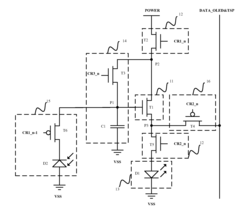
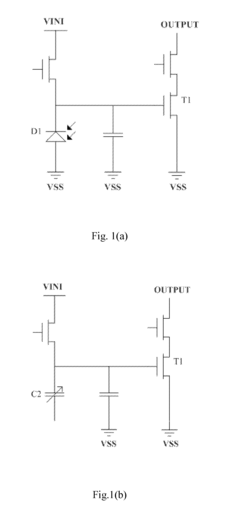
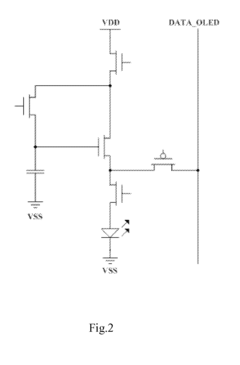
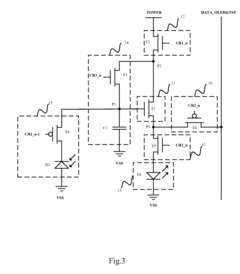
- The AMOLED pixel unit circuit is redesigned to include a light emitting module, a driving module, a threshold compensating module, a light emission controlling module, a touch sensing module, and an induction signal outputting module, which utilize existing data lines and control signals to integrate the TSP in Cell circuit, sharing circuit elements and control signals to minimize additional components.
Unit pixels and active matrix organic light emitting diode displays including the same
PatentInactiveUS20090201278A1
Innovation
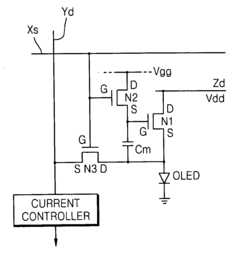
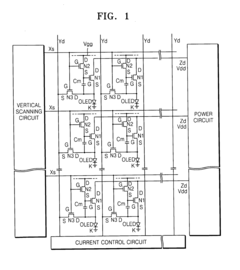
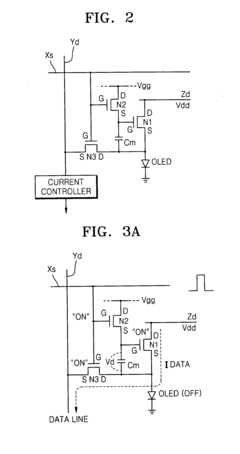
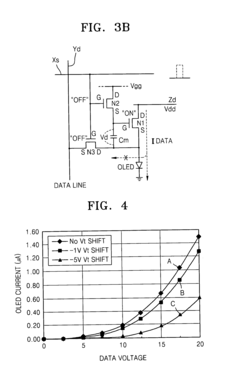
- The implementation of a current-programmable AMOLED display design using a simpler structure with fewer transistors, including a driving transistor, a programming transistor, and a switching transistor, where a memory capacitor is connected in parallel between the gate and one terminal of the driving transistor, and a current controller determines the current flowing through the transistors to maintain uniform brightness despite threshold voltage shifts.
Energy Efficiency Considerations
Energy efficiency is a critical consideration in the development and implementation of adaptive lighting technologies for AMOLED applications. As AMOLED displays continue to dominate the mobile device market, the need for power-efficient lighting solutions becomes increasingly important.
One of the primary advantages of adaptive lighting in AMOLED displays is its ability to dynamically adjust brightness and color temperature based on ambient lighting conditions. This not only enhances user experience but also contributes significantly to energy conservation. By reducing unnecessary brightness levels in low-light environments, adaptive lighting technologies can substantially decrease power consumption without compromising display quality.
The integration of ambient light sensors plays a crucial role in achieving optimal energy efficiency. These sensors continuously monitor the surrounding light conditions, allowing the display to make real-time adjustments. Advanced algorithms process this data to determine the most appropriate brightness and color settings, ensuring that the display consumes only the energy required for optimal visibility.
Another key aspect of energy efficiency in adaptive lighting for AMOLED displays is the implementation of local dimming techniques. Unlike traditional backlighting systems, AMOLED displays can selectively illuminate individual pixels. This granular control allows for precise power management, as dark or black areas of the screen can be completely turned off, resulting in significant energy savings.
The development of more efficient OLED materials also contributes to overall energy efficiency. Researchers are continually working on improving the quantum efficiency of OLED emitters, which directly impacts the amount of energy required to produce light. Higher efficiency materials not only reduce power consumption but also extend the lifespan of AMOLED displays.
Power management circuits play a vital role in optimizing energy usage in adaptive lighting systems. These circuits regulate voltage and current supply to the OLED pixels, ensuring that only the necessary power is delivered. Advanced power management techniques, such as dynamic voltage scaling, can further enhance energy efficiency by adjusting the supply voltage based on the display content and brightness requirements.
The implementation of machine learning algorithms in adaptive lighting systems presents exciting opportunities for energy optimization. These algorithms can learn user preferences and usage patterns over time, allowing for more intelligent and efficient lighting adjustments. By predicting user needs and environmental conditions, the system can proactively optimize display settings, further reducing unnecessary power consumption.
As the demand for longer battery life in mobile devices continues to grow, the importance of energy-efficient adaptive lighting technologies in AMOLED applications cannot be overstated. Ongoing research and development in this field are crucial for meeting the evolving needs of consumers while minimizing environmental impact.
One of the primary advantages of adaptive lighting in AMOLED displays is its ability to dynamically adjust brightness and color temperature based on ambient lighting conditions. This not only enhances user experience but also contributes significantly to energy conservation. By reducing unnecessary brightness levels in low-light environments, adaptive lighting technologies can substantially decrease power consumption without compromising display quality.
The integration of ambient light sensors plays a crucial role in achieving optimal energy efficiency. These sensors continuously monitor the surrounding light conditions, allowing the display to make real-time adjustments. Advanced algorithms process this data to determine the most appropriate brightness and color settings, ensuring that the display consumes only the energy required for optimal visibility.
Another key aspect of energy efficiency in adaptive lighting for AMOLED displays is the implementation of local dimming techniques. Unlike traditional backlighting systems, AMOLED displays can selectively illuminate individual pixels. This granular control allows for precise power management, as dark or black areas of the screen can be completely turned off, resulting in significant energy savings.
The development of more efficient OLED materials also contributes to overall energy efficiency. Researchers are continually working on improving the quantum efficiency of OLED emitters, which directly impacts the amount of energy required to produce light. Higher efficiency materials not only reduce power consumption but also extend the lifespan of AMOLED displays.
Power management circuits play a vital role in optimizing energy usage in adaptive lighting systems. These circuits regulate voltage and current supply to the OLED pixels, ensuring that only the necessary power is delivered. Advanced power management techniques, such as dynamic voltage scaling, can further enhance energy efficiency by adjusting the supply voltage based on the display content and brightness requirements.
The implementation of machine learning algorithms in adaptive lighting systems presents exciting opportunities for energy optimization. These algorithms can learn user preferences and usage patterns over time, allowing for more intelligent and efficient lighting adjustments. By predicting user needs and environmental conditions, the system can proactively optimize display settings, further reducing unnecessary power consumption.
As the demand for longer battery life in mobile devices continues to grow, the importance of energy-efficient adaptive lighting technologies in AMOLED applications cannot be overstated. Ongoing research and development in this field are crucial for meeting the evolving needs of consumers while minimizing environmental impact.
User Experience and Visual Comfort Analysis
Adaptive lighting technologies in AMOLED applications have a significant impact on user experience and visual comfort. These technologies aim to optimize display brightness and color temperature based on ambient lighting conditions and user preferences, enhancing overall viewing comfort and reducing eye strain.
One of the key aspects of adaptive lighting is its ability to adjust screen brightness automatically. AMOLED displays can dynamically alter their luminance levels to match the surrounding environment, ensuring optimal visibility in various lighting scenarios. This feature is particularly beneficial in outdoor settings where glare can be a significant issue, as well as in low-light environments where excessive brightness may cause discomfort.
Color temperature adaptation is another crucial element that contributes to improved visual comfort. By adjusting the display's color temperature to match the ambient light, adaptive lighting technologies can reduce the contrast between the screen and its surroundings. This harmonization helps minimize eye fatigue and promotes a more natural viewing experience, especially during extended usage periods.
The implementation of adaptive lighting technologies also considers the circadian rhythm of users. By gradually shifting the display's color temperature towards warmer tones in the evening, these systems can help reduce blue light exposure, which has been associated with sleep disturbances. This feature is particularly valuable for users who frequently interact with their devices before bedtime.
User customization options play a vital role in enhancing the effectiveness of adaptive lighting technologies. By allowing users to fine-tune brightness levels and color temperature preferences, AMOLED applications can cater to individual needs and preferences. This personalization aspect contributes to a more satisfying user experience and accommodates varying visual sensitivities among users.
The impact of adaptive lighting on battery life is another consideration in user experience. AMOLED displays can potentially conserve energy by dimming the screen in low-light conditions, extending device usage time between charges. This energy efficiency aspect adds to the overall user satisfaction, particularly for mobile devices where battery life is a critical factor.
Lastly, the seamless integration of adaptive lighting technologies into the user interface is crucial for maintaining a positive user experience. The transitions between different lighting modes should be smooth and unobtrusive, ensuring that users can focus on their tasks without distraction. Well-implemented adaptive lighting should enhance the viewing experience without drawing attention to itself, creating a more immersive and comfortable interaction with AMOLED devices.
One of the key aspects of adaptive lighting is its ability to adjust screen brightness automatically. AMOLED displays can dynamically alter their luminance levels to match the surrounding environment, ensuring optimal visibility in various lighting scenarios. This feature is particularly beneficial in outdoor settings where glare can be a significant issue, as well as in low-light environments where excessive brightness may cause discomfort.
Color temperature adaptation is another crucial element that contributes to improved visual comfort. By adjusting the display's color temperature to match the ambient light, adaptive lighting technologies can reduce the contrast between the screen and its surroundings. This harmonization helps minimize eye fatigue and promotes a more natural viewing experience, especially during extended usage periods.
The implementation of adaptive lighting technologies also considers the circadian rhythm of users. By gradually shifting the display's color temperature towards warmer tones in the evening, these systems can help reduce blue light exposure, which has been associated with sleep disturbances. This feature is particularly valuable for users who frequently interact with their devices before bedtime.
User customization options play a vital role in enhancing the effectiveness of adaptive lighting technologies. By allowing users to fine-tune brightness levels and color temperature preferences, AMOLED applications can cater to individual needs and preferences. This personalization aspect contributes to a more satisfying user experience and accommodates varying visual sensitivities among users.
The impact of adaptive lighting on battery life is another consideration in user experience. AMOLED displays can potentially conserve energy by dimming the screen in low-light conditions, extending device usage time between charges. This energy efficiency aspect adds to the overall user satisfaction, particularly for mobile devices where battery life is a critical factor.
Lastly, the seamless integration of adaptive lighting technologies into the user interface is crucial for maintaining a positive user experience. The transitions between different lighting modes should be smooth and unobtrusive, ensuring that users can focus on their tasks without distraction. Well-implemented adaptive lighting should enhance the viewing experience without drawing attention to itself, creating a more immersive and comfortable interaction with AMOLED devices.
Unlock deeper insights with PatSnap Eureka Quick Research — get a full tech report to explore trends and direct your research. Try now!
Generate Your Research Report Instantly with AI Agent
Supercharge your innovation with PatSnap Eureka AI Agent Platform!