Barium Hydroxide in Innovative Nanomaterial Development for Electronics
AUG 1, 20259 MIN READ
Generate Your Research Report Instantly with AI Agent
Patsnap Eureka helps you evaluate technical feasibility & market potential.
Barium Hydroxide Nanomaterial Background and Objectives
Barium hydroxide has emerged as a promising material in the field of innovative nanomaterial development for electronics. The evolution of this technology can be traced back to the early 2000s when researchers began exploring the potential of barium compounds in nanostructures. Over the past two decades, significant advancements have been made in synthesizing and manipulating barium hydroxide at the nanoscale, leading to its increased relevance in electronic applications.
The technological trajectory of barium hydroxide nanomaterials has been driven by the growing demand for high-performance electronic components. As traditional materials reach their physical limits, the unique properties of barium hydroxide nanostructures offer new possibilities for enhancing electronic device performance. These properties include high dielectric constants, piezoelectric effects, and tunable electronic band structures, which make them particularly attractive for applications in capacitors, sensors, and energy storage devices.
Recent trends in the field indicate a shift towards more precise control over the morphology and composition of barium hydroxide nanomaterials. Researchers are focusing on developing novel synthesis methods that allow for the creation of complex nanostructures with tailored properties. This includes the exploration of various templating techniques, hydrothermal processes, and sol-gel methods to produce nanoparticles, nanowires, and nanosheet configurations of barium hydroxide.
The primary technological objectives in this field revolve around optimizing the electrical and structural properties of barium hydroxide nanomaterials for specific electronic applications. Key goals include enhancing the dielectric strength, improving thermal stability, and increasing the surface area-to-volume ratio of these materials. Additionally, there is a strong focus on developing scalable production methods that can bridge the gap between laboratory research and industrial manufacturing.
Another critical objective is to address the environmental and safety concerns associated with barium compounds. Researchers are working on developing green synthesis routes and exploring ways to encapsulate or stabilize barium hydroxide nanostructures to mitigate potential toxicity issues. This aligns with the broader trend towards sustainable and environmentally friendly electronic materials.
Looking ahead, the field of barium hydroxide nanomaterials for electronics is expected to continue its rapid growth. Future research directions are likely to include the integration of these materials into flexible and wearable electronics, the development of hybrid nanocomposites combining barium hydroxide with other functional materials, and the exploration of quantum effects in ultra-small barium hydroxide nanostructures. These advancements promise to push the boundaries of electronic device performance and open up new possibilities for next-generation technologies.
The technological trajectory of barium hydroxide nanomaterials has been driven by the growing demand for high-performance electronic components. As traditional materials reach their physical limits, the unique properties of barium hydroxide nanostructures offer new possibilities for enhancing electronic device performance. These properties include high dielectric constants, piezoelectric effects, and tunable electronic band structures, which make them particularly attractive for applications in capacitors, sensors, and energy storage devices.
Recent trends in the field indicate a shift towards more precise control over the morphology and composition of barium hydroxide nanomaterials. Researchers are focusing on developing novel synthesis methods that allow for the creation of complex nanostructures with tailored properties. This includes the exploration of various templating techniques, hydrothermal processes, and sol-gel methods to produce nanoparticles, nanowires, and nanosheet configurations of barium hydroxide.
The primary technological objectives in this field revolve around optimizing the electrical and structural properties of barium hydroxide nanomaterials for specific electronic applications. Key goals include enhancing the dielectric strength, improving thermal stability, and increasing the surface area-to-volume ratio of these materials. Additionally, there is a strong focus on developing scalable production methods that can bridge the gap between laboratory research and industrial manufacturing.
Another critical objective is to address the environmental and safety concerns associated with barium compounds. Researchers are working on developing green synthesis routes and exploring ways to encapsulate or stabilize barium hydroxide nanostructures to mitigate potential toxicity issues. This aligns with the broader trend towards sustainable and environmentally friendly electronic materials.
Looking ahead, the field of barium hydroxide nanomaterials for electronics is expected to continue its rapid growth. Future research directions are likely to include the integration of these materials into flexible and wearable electronics, the development of hybrid nanocomposites combining barium hydroxide with other functional materials, and the exploration of quantum effects in ultra-small barium hydroxide nanostructures. These advancements promise to push the boundaries of electronic device performance and open up new possibilities for next-generation technologies.
Electronics Market Demand for Innovative Nanomaterials
The electronics industry is experiencing a surge in demand for innovative nanomaterials, driven by the relentless pursuit of miniaturization, enhanced performance, and energy efficiency. This market demand is particularly pronounced in sectors such as semiconductors, displays, energy storage, and flexible electronics.
In the semiconductor industry, nanomaterials are crucial for developing next-generation chips with higher transistor densities and improved electrical properties. The global semiconductor market, valued at over $500 billion, is continuously seeking novel materials to overcome the limitations of traditional silicon-based technologies. Nanomaterials offer potential solutions for challenges such as quantum tunneling and heat dissipation in advanced node processes.
The display technology sector is another area where nanomaterials are in high demand. With the growing market for OLED and microLED displays, there is a need for materials that can enhance color gamut, brightness, and energy efficiency. Quantum dots and nanoparticle-based phosphors are examples of nanomaterials that are revolutionizing display technologies.
Energy storage is a critical area where nanomaterials are making significant inroads. The global lithium-ion battery market, projected to reach $100 billion by 2025, is driving demand for nanostructured electrode materials and solid electrolytes. These materials promise higher energy densities, faster charging rates, and improved safety profiles for batteries used in electric vehicles and portable electronics.
Flexible and wearable electronics represent an emerging market with substantial growth potential. Nanomaterials such as carbon nanotubes, graphene, and metal nanowires are essential for developing stretchable conductors, sensors, and displays. The wearable technology market, expected to exceed $70 billion by 2026, is a key driver for these materials.
The demand for nanomaterials in electronics is also fueled by the growing Internet of Things (IoT) ecosystem. IoT devices require miniaturized sensors, low-power components, and efficient energy harvesting systems, all of which benefit from nanomaterial innovations. The global IoT market, projected to reach $1.5 trillion by 2025, presents a vast opportunity for nanomaterial applications.
As environmental concerns gain prominence, there is an increasing demand for sustainable and eco-friendly nanomaterials in electronics. This trend is driving research into biodegradable electronics, recyclable components, and materials with reduced environmental impact throughout their lifecycle.
In the semiconductor industry, nanomaterials are crucial for developing next-generation chips with higher transistor densities and improved electrical properties. The global semiconductor market, valued at over $500 billion, is continuously seeking novel materials to overcome the limitations of traditional silicon-based technologies. Nanomaterials offer potential solutions for challenges such as quantum tunneling and heat dissipation in advanced node processes.
The display technology sector is another area where nanomaterials are in high demand. With the growing market for OLED and microLED displays, there is a need for materials that can enhance color gamut, brightness, and energy efficiency. Quantum dots and nanoparticle-based phosphors are examples of nanomaterials that are revolutionizing display technologies.
Energy storage is a critical area where nanomaterials are making significant inroads. The global lithium-ion battery market, projected to reach $100 billion by 2025, is driving demand for nanostructured electrode materials and solid electrolytes. These materials promise higher energy densities, faster charging rates, and improved safety profiles for batteries used in electric vehicles and portable electronics.
Flexible and wearable electronics represent an emerging market with substantial growth potential. Nanomaterials such as carbon nanotubes, graphene, and metal nanowires are essential for developing stretchable conductors, sensors, and displays. The wearable technology market, expected to exceed $70 billion by 2026, is a key driver for these materials.
The demand for nanomaterials in electronics is also fueled by the growing Internet of Things (IoT) ecosystem. IoT devices require miniaturized sensors, low-power components, and efficient energy harvesting systems, all of which benefit from nanomaterial innovations. The global IoT market, projected to reach $1.5 trillion by 2025, presents a vast opportunity for nanomaterial applications.
As environmental concerns gain prominence, there is an increasing demand for sustainable and eco-friendly nanomaterials in electronics. This trend is driving research into biodegradable electronics, recyclable components, and materials with reduced environmental impact throughout their lifecycle.
Current State and Challenges in Barium Hydroxide Nanomaterials
The current state of barium hydroxide nanomaterials in electronics is characterized by significant advancements and persistent challenges. Recent research has demonstrated the potential of barium hydroxide as a precursor for synthesizing various nanostructures, including nanowires, nanoparticles, and thin films. These nanostructures exhibit unique properties that make them attractive for electronic applications, such as high dielectric constants, ferroelectric behavior, and piezoelectric effects.
One of the primary areas of focus has been the development of barium titanate (BaTiO3) nanoparticles using barium hydroxide as a starting material. These nanoparticles have shown promise in capacitor applications due to their high dielectric constant and low dielectric loss. However, controlling the size distribution and morphology of these nanoparticles remains a significant challenge, as these factors greatly influence the final electronic properties.
Another area of interest is the use of barium hydroxide in the synthesis of barium strontium titanate (BST) thin films. These films have potential applications in tunable microwave devices and dynamic random-access memory (DRAM) capacitors. While progress has been made in depositing uniform BST films, issues such as oxygen vacancies and interfacial defects continue to hinder their performance in practical devices.
The integration of barium hydroxide-derived nanomaterials into existing electronic manufacturing processes presents another set of challenges. Compatibility with standard semiconductor fabrication techniques, such as photolithography and etching, needs to be addressed to enable widespread adoption in the electronics industry.
Environmental and health concerns associated with barium compounds pose additional challenges. While barium hydroxide is less toxic than some other barium salts, proper handling and disposal protocols must be developed and implemented to ensure worker safety and environmental protection.
Scalability and cost-effectiveness of barium hydroxide-based nanomaterial production methods are also critical issues. Current synthesis techniques often involve complex processes or require expensive equipment, limiting their potential for large-scale industrial applications. Researchers are exploring more economical and scalable methods, such as solution-based processes and microwave-assisted synthesis, to overcome these limitations.
Despite these challenges, the potential benefits of barium hydroxide nanomaterials in electronics continue to drive research and development efforts. Ongoing work focuses on optimizing synthesis methods, improving material properties, and developing novel applications. As these challenges are addressed, barium hydroxide-based nanomaterials are expected to play an increasingly important role in next-generation electronic devices and systems.
One of the primary areas of focus has been the development of barium titanate (BaTiO3) nanoparticles using barium hydroxide as a starting material. These nanoparticles have shown promise in capacitor applications due to their high dielectric constant and low dielectric loss. However, controlling the size distribution and morphology of these nanoparticles remains a significant challenge, as these factors greatly influence the final electronic properties.
Another area of interest is the use of barium hydroxide in the synthesis of barium strontium titanate (BST) thin films. These films have potential applications in tunable microwave devices and dynamic random-access memory (DRAM) capacitors. While progress has been made in depositing uniform BST films, issues such as oxygen vacancies and interfacial defects continue to hinder their performance in practical devices.
The integration of barium hydroxide-derived nanomaterials into existing electronic manufacturing processes presents another set of challenges. Compatibility with standard semiconductor fabrication techniques, such as photolithography and etching, needs to be addressed to enable widespread adoption in the electronics industry.
Environmental and health concerns associated with barium compounds pose additional challenges. While barium hydroxide is less toxic than some other barium salts, proper handling and disposal protocols must be developed and implemented to ensure worker safety and environmental protection.
Scalability and cost-effectiveness of barium hydroxide-based nanomaterial production methods are also critical issues. Current synthesis techniques often involve complex processes or require expensive equipment, limiting their potential for large-scale industrial applications. Researchers are exploring more economical and scalable methods, such as solution-based processes and microwave-assisted synthesis, to overcome these limitations.
Despite these challenges, the potential benefits of barium hydroxide nanomaterials in electronics continue to drive research and development efforts. Ongoing work focuses on optimizing synthesis methods, improving material properties, and developing novel applications. As these challenges are addressed, barium hydroxide-based nanomaterials are expected to play an increasingly important role in next-generation electronic devices and systems.
Existing Applications of Barium Hydroxide in Electronics
01 Production and purification of barium hydroxide
Various methods for producing and purifying barium hydroxide are described. These processes often involve the treatment of barium-containing compounds with water or other reagents, followed by separation and purification steps to obtain high-quality barium hydroxide.- Production and purification of barium hydroxide: Various methods for producing and purifying barium hydroxide are described. These processes involve different raw materials and techniques to obtain high-quality barium hydroxide, which is used in various industrial applications.
- Use of barium hydroxide in chemical reactions: Barium hydroxide is utilized in various chemical reactions as a reagent or catalyst. It plays a role in processes such as neutralization, precipitation, and synthesis of other barium compounds.
- Applications in water treatment and environmental processes: Barium hydroxide finds applications in water treatment and environmental processes. It is used for removing impurities, adjusting pH, and in various pollution control methods.
- Use in the production of other barium compounds: Barium hydroxide serves as a precursor for the synthesis of other barium compounds. It is used in the manufacturing of various barium salts and materials for different industrial applications.
- Industrial and specialized applications: Barium hydroxide has diverse industrial and specialized applications. It is used in the production of lubricants, ceramics, glass, and in specific chemical processes requiring its unique properties.
02 Applications in chemical processes
Barium hydroxide is utilized in various chemical processes, including the production of other barium compounds, water treatment, and as a reagent in organic synthesis. Its alkaline properties make it suitable for neutralization reactions and pH adjustment in industrial applications.Expand Specific Solutions03 Use in material manufacturing
Barium hydroxide plays a role in the manufacturing of various materials, such as ceramics, glass, and specialty chemicals. It can be used as a precursor for barium-containing materials or as an additive to modify material properties.Expand Specific Solutions04 Environmental and waste treatment applications
Barium hydroxide is employed in environmental remediation and waste treatment processes. It can be used for the removal of sulfates from water, treatment of industrial effluents, and in flue gas desulfurization systems.Expand Specific Solutions05 Analytical and laboratory uses
In analytical chemistry and laboratory settings, barium hydroxide serves various purposes. It is used as a titrant in acid-base titrations, as a reagent in qualitative analysis, and in the preparation of other barium compounds for research and testing purposes.Expand Specific Solutions
Key Players in Barium Hydroxide Nanomaterial Research
The research on barium hydroxide in innovative nanomaterial development for electronics is in an emerging phase, with significant potential for growth. The market size is expanding as the demand for advanced electronic materials increases. The technology is still evolving, with varying degrees of maturity across different applications. Key players in this field include academic institutions like Rutgers State University, Boston College, and Tianjin University, alongside industry leaders such as Samsung SDI Co., Ltd. and DuPont de Nemours, Inc. These organizations are driving innovation through collaborative research efforts and strategic partnerships, aiming to develop novel nanomaterials with enhanced properties for next-generation electronics. The competitive landscape is characterized by a mix of established companies and emerging startups, all vying to capitalize on the growing opportunities in this sector.
Dalian Institute of Chemical Physics Chinese Academy of Sci
Technical Solution: Dalian Institute of Chemical Physics (DICP) has developed innovative nanomaterials using barium hydroxide for electronics applications. Their research focuses on synthesizing barium titanate (BaTiO3) nanoparticles with controlled size and morphology. They have implemented a hydrothermal method using Ba(OH)2 as a precursor, achieving uniform BaTiO3 nanoparticles with sizes ranging from 20-100 nm [1]. These nanoparticles exhibit excellent dielectric properties, with a high dielectric constant of over 1000 at room temperature [2]. DICP has also explored doping BaTiO3 with rare earth elements to enhance its piezoelectric properties for sensor and actuator applications [3].
Strengths: Precise control over nanoparticle size and morphology, high dielectric constant, potential for piezoelectric applications. Weaknesses: Complex synthesis process, potential scalability issues for large-scale production.
Samsung SDI Co., Ltd.
Technical Solution: Samsung SDI has leveraged barium hydroxide in developing advanced nanomaterials for next-generation batteries. Their research focuses on using Ba(OH)2 as a precursor for synthesizing barium-doped lithium nickel cobalt manganese oxide (NCM) cathode materials. This innovative approach has resulted in improved structural stability and enhanced electrochemical performance of high-nickel NCM cathodes [4]. The company has reported a 20% increase in capacity retention after 500 cycles compared to undoped NCM materials [5]. Additionally, Samsung SDI has explored the use of barium hydroxide in solid electrolyte interfaces (SEI) formation, leading to improved battery safety and longevity [6].
Strengths: Enhanced battery performance, improved safety features, potential for commercialization. Weaknesses: Higher production costs, potential supply chain issues for barium hydroxide.
Core Innovations in Barium Hydroxide Nanomaterial Synthesis
Manufacture of barium hydroxide
PatentInactiveGB917038A
Innovation
- A process involving the reaction of barium zincate and barium sulphide solutions with controlled additions of zinc oxide and barium sulphide, followed by treatment with hydrogen peroxide and hydrochloric or sulphuric acid to recover barium hydroxide and recycle zinc oxide, minimizing barium loss and maintaining reactivity.
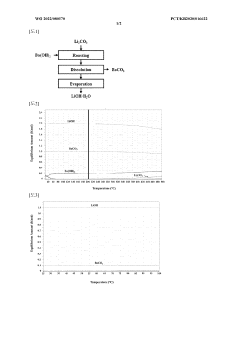
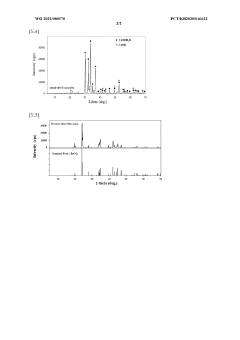
Method for producing lithium hydroxide by using lithium carbonate and barium hydroxide
PatentWO2022080570A1
Innovation
- A method involving the mixing of lithium carbonate and barium hydroxide at a specific ratio, followed by roasting to produce insoluble barium carbonate, which is then dissolved and separated to obtain high-purity lithium hydroxide through evaporation, eliminating the need for recrystallization and reducing waste.
Environmental Impact of Barium Hydroxide Nanomaterials
The environmental impact of barium hydroxide nanomaterials in electronics development is a critical consideration for sustainable innovation. These nanomaterials, while offering significant technological advancements, also pose potential risks to ecosystems and human health.
One primary concern is the release of barium ions into the environment. When barium hydroxide nanomaterials degrade or are improperly disposed of, they can leach barium ions into soil and water systems. These ions are known to be toxic to aquatic organisms and can accumulate in the food chain, potentially affecting higher-order species.
The production process of barium hydroxide nanomaterials also raises environmental issues. The synthesis often involves energy-intensive methods and the use of hazardous chemicals, contributing to increased carbon emissions and potential chemical pollution if not properly managed. Additionally, the small size of these nanomaterials makes them difficult to filter out of waste streams, potentially leading to their release into the environment.
Airborne nanoparticles of barium hydroxide present another environmental challenge. During manufacturing or when electronic devices containing these materials are disposed of or recycled, nanoparticles can become airborne. This can lead to air pollution and potential inhalation risks for both wildlife and humans in the vicinity.
The long-term persistence of barium hydroxide nanomaterials in the environment is not yet fully understood. Their unique properties at the nanoscale may lead to unexpected interactions with environmental systems, potentially altering soil chemistry or affecting microbial communities that play crucial roles in ecosystem functions.
However, it's important to note that the use of barium hydroxide nanomaterials in electronics can also have positive environmental impacts. Their application often leads to more efficient and longer-lasting electronic devices, which can reduce electronic waste and the need for frequent replacements. This indirectly contributes to resource conservation and reduced environmental impact from electronics manufacturing and disposal.
To mitigate these environmental concerns, researchers and manufacturers are exploring various strategies. These include developing green synthesis methods for barium hydroxide nanomaterials, improving containment and filtration systems in production facilities, and designing electronics for easier recycling and safer disposal of nanomaterial components. Additionally, life cycle assessments are being conducted to better understand and quantify the environmental impacts throughout the entire lifespan of products containing these nanomaterials.
One primary concern is the release of barium ions into the environment. When barium hydroxide nanomaterials degrade or are improperly disposed of, they can leach barium ions into soil and water systems. These ions are known to be toxic to aquatic organisms and can accumulate in the food chain, potentially affecting higher-order species.
The production process of barium hydroxide nanomaterials also raises environmental issues. The synthesis often involves energy-intensive methods and the use of hazardous chemicals, contributing to increased carbon emissions and potential chemical pollution if not properly managed. Additionally, the small size of these nanomaterials makes them difficult to filter out of waste streams, potentially leading to their release into the environment.
Airborne nanoparticles of barium hydroxide present another environmental challenge. During manufacturing or when electronic devices containing these materials are disposed of or recycled, nanoparticles can become airborne. This can lead to air pollution and potential inhalation risks for both wildlife and humans in the vicinity.
The long-term persistence of barium hydroxide nanomaterials in the environment is not yet fully understood. Their unique properties at the nanoscale may lead to unexpected interactions with environmental systems, potentially altering soil chemistry or affecting microbial communities that play crucial roles in ecosystem functions.
However, it's important to note that the use of barium hydroxide nanomaterials in electronics can also have positive environmental impacts. Their application often leads to more efficient and longer-lasting electronic devices, which can reduce electronic waste and the need for frequent replacements. This indirectly contributes to resource conservation and reduced environmental impact from electronics manufacturing and disposal.
To mitigate these environmental concerns, researchers and manufacturers are exploring various strategies. These include developing green synthesis methods for barium hydroxide nanomaterials, improving containment and filtration systems in production facilities, and designing electronics for easier recycling and safer disposal of nanomaterial components. Additionally, life cycle assessments are being conducted to better understand and quantify the environmental impacts throughout the entire lifespan of products containing these nanomaterials.
Intellectual Property Landscape in Nanomaterial Electronics
The intellectual property landscape in nanomaterial electronics, particularly concerning barium hydroxide applications, has witnessed significant growth and diversification in recent years. Patent filings in this domain have increased exponentially, reflecting the rising interest and investment in innovative nanomaterial solutions for electronic applications.
Major technology companies and research institutions have been actively securing their intellectual property rights in this field. Key players such as Samsung, IBM, and Intel have established strong patent portfolios related to barium hydroxide-based nanomaterials for electronics. These patents often cover novel synthesis methods, unique material compositions, and specific applications in electronic devices.
Universities and research institutes have also contributed substantially to the patent landscape. Institutions like MIT, Stanford, and the Chinese Academy of Sciences have filed numerous patents on fundamental research and potential applications of barium hydroxide in nanomaterial development for electronics.
The geographical distribution of patent filings shows a concentration in the United States, China, Japan, and South Korea. This distribution aligns with the global centers of electronics manufacturing and research, highlighting the strategic importance of these technologies in maintaining competitive advantages in the electronics industry.
Patent classifications related to barium hydroxide in nanomaterials for electronics primarily fall under categories such as H01L (semiconductor devices), B82Y (specific uses or applications of nanostructures), and C01F (compounds of barium). The diversity of these classifications underscores the multidisciplinary nature of research in this field.
Recent trends in patent filings indicate a growing focus on environmentally friendly synthesis methods and applications that enhance energy efficiency in electronic devices. Patents related to the use of barium hydroxide in the development of high-performance capacitors, advanced battery technologies, and novel display materials have seen a notable increase.
Collaborative patents between industry leaders and academic institutions are becoming more common, suggesting a trend towards open innovation and knowledge sharing in this complex technological domain. These collaborations often result in patents that bridge fundamental research with practical applications, accelerating the path from laboratory discoveries to marketable products.
The intellectual property landscape also reveals emerging areas of interest, such as the integration of barium hydroxide-based nanomaterials in flexible electronics, wearable devices, and next-generation computing architectures. These areas represent potential growth opportunities for companies looking to expand their patent portfolios and secure future market positions.
Major technology companies and research institutions have been actively securing their intellectual property rights in this field. Key players such as Samsung, IBM, and Intel have established strong patent portfolios related to barium hydroxide-based nanomaterials for electronics. These patents often cover novel synthesis methods, unique material compositions, and specific applications in electronic devices.
Universities and research institutes have also contributed substantially to the patent landscape. Institutions like MIT, Stanford, and the Chinese Academy of Sciences have filed numerous patents on fundamental research and potential applications of barium hydroxide in nanomaterial development for electronics.
The geographical distribution of patent filings shows a concentration in the United States, China, Japan, and South Korea. This distribution aligns with the global centers of electronics manufacturing and research, highlighting the strategic importance of these technologies in maintaining competitive advantages in the electronics industry.
Patent classifications related to barium hydroxide in nanomaterials for electronics primarily fall under categories such as H01L (semiconductor devices), B82Y (specific uses or applications of nanostructures), and C01F (compounds of barium). The diversity of these classifications underscores the multidisciplinary nature of research in this field.
Recent trends in patent filings indicate a growing focus on environmentally friendly synthesis methods and applications that enhance energy efficiency in electronic devices. Patents related to the use of barium hydroxide in the development of high-performance capacitors, advanced battery technologies, and novel display materials have seen a notable increase.
Collaborative patents between industry leaders and academic institutions are becoming more common, suggesting a trend towards open innovation and knowledge sharing in this complex technological domain. These collaborations often result in patents that bridge fundamental research with practical applications, accelerating the path from laboratory discoveries to marketable products.
The intellectual property landscape also reveals emerging areas of interest, such as the integration of barium hydroxide-based nanomaterials in flexible electronics, wearable devices, and next-generation computing architectures. These areas represent potential growth opportunities for companies looking to expand their patent portfolios and secure future market positions.
Unlock deeper insights with Patsnap Eureka Quick Research — get a full tech report to explore trends and direct your research. Try now!
Generate Your Research Report Instantly with AI Agent
Supercharge your innovation with Patsnap Eureka AI Agent Platform!