
Schmitt Trigger vs Comparator: Key Differences Explained
SEP 23, 20259 MIN READ
Generate Your Research Report Instantly with AI Agent
Patsnap Eureka helps you evaluate technical feasibility & market potential.
Signal Processing Technology Background and Objectives
Signal processing has evolved significantly over the past decades, transforming from simple analog circuits to sophisticated digital systems. Within this evolution, signal comparison and threshold detection technologies have played a pivotal role in numerous applications ranging from industrial automation to consumer electronics. The Schmitt trigger and comparator represent two fundamental building blocks in signal processing that have shaped modern electronic design approaches.
The development of these technologies can be traced back to the 1930s when Otto Schmitt invented the Schmitt trigger circuit while working on his doctoral research. This innovation addressed the critical need for reliable signal detection in noisy environments, a challenge that conventional threshold detectors could not adequately solve. Comparators emerged later as simpler alternatives for applications where hysteresis was not required, becoming widespread with the advent of operational amplifiers in the 1960s.
The technological trajectory has been driven by increasing demands for precision, speed, and power efficiency across various industries. Modern signal processing applications require components that can operate reliably under varying environmental conditions while maintaining strict performance parameters. This has led to continuous refinement in both Schmitt trigger and comparator designs, with significant improvements in switching speeds, noise immunity, and power consumption.
Current trends in signal processing technology point toward integration of these fundamental components into more complex systems-on-chip (SoC) solutions, enabling miniaturization and enhanced functionality. The emergence of IoT devices, autonomous systems, and high-speed communication networks has further accelerated the need for advanced signal conditioning and threshold detection capabilities.
The primary technical objective in this field is to understand the fundamental differences between Schmitt triggers and comparators, their respective advantages, limitations, and optimal application scenarios. This understanding is crucial for engineers to make informed design decisions that balance performance requirements with system constraints.
Secondary objectives include exploring recent innovations in both technologies, such as auto-zeroing techniques, programmable hysteresis, and ultra-low power implementations. Additionally, identifying emerging application areas where these technologies provide critical functionality will help guide future development efforts and investment decisions.
As we move toward more complex and demanding applications in fields like autonomous vehicles, medical devices, and industrial automation, the distinctions between these technologies become increasingly important. Understanding their behavior under various operating conditions and their integration with digital processing systems represents a key knowledge area for continued technological advancement.
The development of these technologies can be traced back to the 1930s when Otto Schmitt invented the Schmitt trigger circuit while working on his doctoral research. This innovation addressed the critical need for reliable signal detection in noisy environments, a challenge that conventional threshold detectors could not adequately solve. Comparators emerged later as simpler alternatives for applications where hysteresis was not required, becoming widespread with the advent of operational amplifiers in the 1960s.
The technological trajectory has been driven by increasing demands for precision, speed, and power efficiency across various industries. Modern signal processing applications require components that can operate reliably under varying environmental conditions while maintaining strict performance parameters. This has led to continuous refinement in both Schmitt trigger and comparator designs, with significant improvements in switching speeds, noise immunity, and power consumption.
Current trends in signal processing technology point toward integration of these fundamental components into more complex systems-on-chip (SoC) solutions, enabling miniaturization and enhanced functionality. The emergence of IoT devices, autonomous systems, and high-speed communication networks has further accelerated the need for advanced signal conditioning and threshold detection capabilities.
The primary technical objective in this field is to understand the fundamental differences between Schmitt triggers and comparators, their respective advantages, limitations, and optimal application scenarios. This understanding is crucial for engineers to make informed design decisions that balance performance requirements with system constraints.
Secondary objectives include exploring recent innovations in both technologies, such as auto-zeroing techniques, programmable hysteresis, and ultra-low power implementations. Additionally, identifying emerging application areas where these technologies provide critical functionality will help guide future development efforts and investment decisions.
As we move toward more complex and demanding applications in fields like autonomous vehicles, medical devices, and industrial automation, the distinctions between these technologies become increasingly important. Understanding their behavior under various operating conditions and their integration with digital processing systems represents a key knowledge area for continued technological advancement.
Market Applications and Demand Analysis
The market for electronic signal processing components has witnessed significant growth in recent years, with Schmitt triggers and comparators playing crucial roles in various applications. These components serve as fundamental building blocks in electronic circuits, particularly in signal conditioning and decision-making processes.
The global market for signal conditioning components, including Schmitt triggers and comparators, reached approximately $3.2 billion in 2022 and is projected to grow at a compound annual growth rate of 5.7% through 2028. This growth is primarily driven by increasing demand for precision electronics in automotive, industrial automation, consumer electronics, and telecommunications sectors.
In the automotive industry, both Schmitt triggers and comparators are extensively used in engine control units, safety systems, and advanced driver assistance systems (ADAS). The automotive electronics market, valued at $250 billion in 2022, continues to expand as vehicles incorporate more sophisticated electronic systems, creating substantial demand for these components.
Industrial automation represents another significant market segment, with an estimated value of $190 billion in 2022. Here, Schmitt triggers are preferred in environments with high noise levels due to their hysteresis characteristics, while comparators find applications in precision measurement systems and process control equipment.
Consumer electronics constitutes the largest application segment, accounting for approximately 35% of the total market share. The proliferation of smartphones, tablets, wearables, and smart home devices has significantly increased the demand for both components, with comparators being particularly valued in battery management systems and power monitoring circuits.
Medical electronics represents a rapidly growing application area, with a market size of $140 billion in 2022. In this sector, the demand for high-precision comparators has been increasing for applications in patient monitoring systems, diagnostic equipment, and medical imaging devices.
Regional analysis indicates that Asia-Pacific dominates the market with a 45% share, followed by North America (28%) and Europe (20%). China, Japan, South Korea, and Taiwan are the major manufacturing hubs for these components, while North America and Europe lead in research and development activities.
Market trends suggest a growing preference for integrated solutions that combine multiple functions, including Schmitt triggers and comparators, in single packages. Additionally, there is increasing demand for low-power versions of these components for battery-powered and energy-efficient applications, particularly in IoT devices and portable electronics.
The global market for signal conditioning components, including Schmitt triggers and comparators, reached approximately $3.2 billion in 2022 and is projected to grow at a compound annual growth rate of 5.7% through 2028. This growth is primarily driven by increasing demand for precision electronics in automotive, industrial automation, consumer electronics, and telecommunications sectors.
In the automotive industry, both Schmitt triggers and comparators are extensively used in engine control units, safety systems, and advanced driver assistance systems (ADAS). The automotive electronics market, valued at $250 billion in 2022, continues to expand as vehicles incorporate more sophisticated electronic systems, creating substantial demand for these components.
Industrial automation represents another significant market segment, with an estimated value of $190 billion in 2022. Here, Schmitt triggers are preferred in environments with high noise levels due to their hysteresis characteristics, while comparators find applications in precision measurement systems and process control equipment.
Consumer electronics constitutes the largest application segment, accounting for approximately 35% of the total market share. The proliferation of smartphones, tablets, wearables, and smart home devices has significantly increased the demand for both components, with comparators being particularly valued in battery management systems and power monitoring circuits.
Medical electronics represents a rapidly growing application area, with a market size of $140 billion in 2022. In this sector, the demand for high-precision comparators has been increasing for applications in patient monitoring systems, diagnostic equipment, and medical imaging devices.
Regional analysis indicates that Asia-Pacific dominates the market with a 45% share, followed by North America (28%) and Europe (20%). China, Japan, South Korea, and Taiwan are the major manufacturing hubs for these components, while North America and Europe lead in research and development activities.
Market trends suggest a growing preference for integrated solutions that combine multiple functions, including Schmitt triggers and comparators, in single packages. Additionally, there is increasing demand for low-power versions of these components for battery-powered and energy-efficient applications, particularly in IoT devices and portable electronics.
Current State and Technical Challenges
The global electronic components market has witnessed significant evolution in signal processing and conditioning technologies, with comparators and Schmitt triggers representing two fundamental building blocks. Currently, both technologies coexist in various applications, though their implementation and market adoption differ substantially across regions and industries.
In North America and Europe, high-precision comparators dominate in medical equipment and automotive safety systems, while Asia-Pacific markets show greater adoption of Schmitt triggers in consumer electronics due to their noise immunity characteristics. This geographical disparity reflects different design philosophies and application priorities across regions.
The primary technical challenge facing conventional comparators is their susceptibility to noise, particularly in environments with fluctuating signal conditions. When input signals hover near the threshold voltage, comparators can produce multiple unwanted transitions—a phenomenon known as "chattering." This limitation becomes critical in applications requiring definitive state changes, such as industrial control systems and automotive sensors.
Schmitt triggers address this noise sensitivity through hysteresis, but face challenges in applications requiring precise threshold detection. The inherent trade-off between noise immunity and precision represents a fundamental technical constraint. Modern Schmitt trigger designs struggle to maintain consistent hysteresis bands across varying temperatures and supply voltages, creating reliability concerns in extreme operating environments.
Power consumption presents another significant challenge, particularly for battery-operated devices. Traditional comparator designs typically consume less power than Schmitt triggers, which require additional circuitry to implement hysteresis. As IoT and wearable technologies proliferate, this power differential becomes increasingly important in design considerations.
Integration density poses challenges for both technologies. As semiconductor processes advance toward smaller nodes, maintaining analog performance while reducing size becomes increasingly difficult. Schmitt triggers, with their more complex architecture, face greater challenges in ultra-compact implementations compared to simpler comparator designs.
Speed limitations affect both technologies differently. High-speed comparators can achieve switching times in the nanosecond range but often sacrifice noise immunity. Conversely, Schmitt triggers provide better noise performance but typically operate at lower frequencies due to the additional time required for state transitions across hysteresis thresholds.
Recent technical literature indicates emerging hybrid approaches that aim to combine the advantages of both technologies, though these solutions often increase circuit complexity and cost. The industry continues to seek optimal balance points between noise immunity, precision, power consumption, and integration density.
In North America and Europe, high-precision comparators dominate in medical equipment and automotive safety systems, while Asia-Pacific markets show greater adoption of Schmitt triggers in consumer electronics due to their noise immunity characteristics. This geographical disparity reflects different design philosophies and application priorities across regions.
The primary technical challenge facing conventional comparators is their susceptibility to noise, particularly in environments with fluctuating signal conditions. When input signals hover near the threshold voltage, comparators can produce multiple unwanted transitions—a phenomenon known as "chattering." This limitation becomes critical in applications requiring definitive state changes, such as industrial control systems and automotive sensors.
Schmitt triggers address this noise sensitivity through hysteresis, but face challenges in applications requiring precise threshold detection. The inherent trade-off between noise immunity and precision represents a fundamental technical constraint. Modern Schmitt trigger designs struggle to maintain consistent hysteresis bands across varying temperatures and supply voltages, creating reliability concerns in extreme operating environments.
Power consumption presents another significant challenge, particularly for battery-operated devices. Traditional comparator designs typically consume less power than Schmitt triggers, which require additional circuitry to implement hysteresis. As IoT and wearable technologies proliferate, this power differential becomes increasingly important in design considerations.
Integration density poses challenges for both technologies. As semiconductor processes advance toward smaller nodes, maintaining analog performance while reducing size becomes increasingly difficult. Schmitt triggers, with their more complex architecture, face greater challenges in ultra-compact implementations compared to simpler comparator designs.
Speed limitations affect both technologies differently. High-speed comparators can achieve switching times in the nanosecond range but often sacrifice noise immunity. Conversely, Schmitt triggers provide better noise performance but typically operate at lower frequencies due to the additional time required for state transitions across hysteresis thresholds.
Recent technical literature indicates emerging hybrid approaches that aim to combine the advantages of both technologies, though these solutions often increase circuit complexity and cost. The industry continues to seek optimal balance points between noise immunity, precision, power consumption, and integration density.
Schmitt Trigger and Comparator Implementation Solutions
01 Hysteresis characteristics
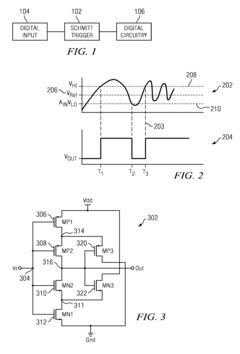
The primary difference between a Schmitt trigger and a comparator is the hysteresis characteristic. A Schmitt trigger incorporates hysteresis, which creates two different threshold voltages for rising and falling input signals. This hysteresis provides noise immunity and prevents oscillation when the input signal is near the threshold voltage. In contrast, a standard comparator has a single threshold point, making it more susceptible to noise and potential oscillation when the input signal hovers around the threshold.- Hysteresis characteristics: The primary difference between a Schmitt trigger and a comparator is the hysteresis characteristic. A Schmitt trigger incorporates hysteresis, which creates two different threshold voltages for rising and falling input signals. This hysteresis provides noise immunity and prevents oscillation when the input signal is near the threshold voltage. In contrast, a standard comparator has a single threshold voltage, making it more susceptible to noise and potential oscillation when the input signal hovers around the threshold.
- Circuit implementation differences: Schmitt triggers typically include additional feedback components that are not present in basic comparators. The feedback network in a Schmitt trigger creates the hysteresis window by using positive feedback to modify the reference voltage based on the current output state. Comparators generally have a simpler circuit design without this feedback mechanism. The implementation of a Schmitt trigger often involves additional transistors or components to create the hysteresis effect, resulting in a more complex circuit structure compared to a basic comparator.
- Application-specific advantages: Schmitt triggers are particularly advantageous in applications with noisy input signals or where clean switching between states is required. They are commonly used in signal conditioning, digital input circuits, and wave shaping applications where noise immunity is critical. Comparators are preferred in applications requiring precise threshold detection without hysteresis, such as zero-crossing detectors, level shifters, and high-speed analog-to-digital converters where response time is more important than noise immunity.
- Power consumption and speed considerations: Comparators generally offer faster response times and lower power consumption compared to Schmitt triggers due to their simpler circuit design. The additional feedback components in Schmitt triggers can introduce delays in the switching response and increase power consumption. However, the trade-off is that Schmitt triggers provide better noise immunity and more reliable switching behavior in noisy environments, which may ultimately improve system performance despite the slightly slower response time.
- Output stability and transition characteristics: Schmitt triggers provide cleaner, more stable output transitions compared to comparators when dealing with slowly changing input signals. The hysteresis in Schmitt triggers prevents multiple transitions or oscillations when the input signal changes slowly around the threshold voltage. Comparators may produce multiple output transitions or chattering when the input signal contains noise or changes slowly near the threshold point. This stability difference makes Schmitt triggers preferable in digital interfaces and signal conditioning applications where clean transitions are essential.
02 Circuit implementation differences
Schmitt triggers typically require additional components compared to basic comparators to implement the hysteresis function. While a basic comparator can be implemented with a simple differential amplifier, Schmitt triggers often incorporate positive feedback paths with resistor networks or additional transistors to create the dual threshold behavior. This results in different circuit topologies, with Schmitt triggers generally being more complex but offering improved stability in noisy environments.Expand Specific Solutions03 Application-specific optimizations
Schmitt triggers and comparators are optimized for different applications based on their characteristics. Schmitt triggers are commonly used in signal conditioning, digital input circuits, and oscillator designs where noise immunity is critical. Comparators are preferred in applications requiring precise threshold detection without hysteresis, such as zero-crossing detectors, level shifters, and high-speed analog-to-digital conversion front ends. The choice between them depends on whether the application benefits from hysteresis or requires a precise single threshold.Expand Specific Solutions04 Power consumption and speed considerations
Schmitt triggers and comparators exhibit different performance characteristics in terms of power consumption and operating speed. Due to their additional circuitry, Schmitt triggers typically consume more power than basic comparators. However, the trade-off is improved noise immunity. In high-speed applications, the additional components in Schmitt triggers can introduce delays, making basic comparators potentially faster for applications where speed is critical and the input signal is relatively clean.Expand Specific Solutions05 Integration in digital and mixed-signal systems
The integration of Schmitt triggers and comparators in digital and mixed-signal systems differs based on their characteristics. Schmitt triggers are often integrated at digital input pins of microcontrollers and other digital ICs to provide clean transitions from noisy external signals. They are also commonly used in clock generation circuits and reset circuits. Comparators are more frequently used in analog signal processing chains, voltage monitoring circuits, and precision measurement systems where exact threshold detection is required.Expand Specific Solutions
Key Semiconductor Manufacturers Analysis
The Schmitt Trigger versus Comparator technology landscape is currently in a mature development phase, with established applications across multiple industries. The market size is substantial, driven by growing demand in automotive electronics, industrial automation, and consumer devices, estimated to reach several billion dollars globally. From a technical maturity perspective, industry leaders like Texas Instruments, NXP, and Infineon Technologies have developed highly refined implementations with advanced features such as programmable hysteresis, ultra-low power consumption, and high-speed response. STMicroelectronics and Analog Devices offer specialized variants optimized for specific applications, while emerging players like Realtek and MediaTek are introducing innovative integrated solutions. The competitive landscape shows established semiconductor manufacturers maintaining dominance through comprehensive product portfolios while smaller companies focus on niche applications with customized performance characteristics.
Texas Instruments Incorporated
Technical Solution: Texas Instruments (TI) has developed advanced Schmitt trigger and comparator solutions with proprietary technology that enhances noise immunity and switching performance. Their Schmitt trigger implementations feature precisely controlled hysteresis thresholds that can be adjusted according to application requirements, particularly useful in industrial environments with significant electrical noise. TI's comparators, such as the TLV3201 family, offer ultra-fast response times (as low as 8ns) with rail-to-rail inputs and outputs. Their integrated circuit designs often combine both functionalities with additional features like programmable hysteresis for Schmitt triggers and push-pull outputs that eliminate the need for external pull-up resistors. TI has also pioneered low-power variants that maintain performance while consuming significantly less power (some operating below 1μA), making them suitable for battery-powered applications.
Strengths: Industry-leading precision in threshold control; extensive product portfolio covering various speed/power combinations; advanced integration capabilities with other analog functions. Weaknesses: Premium pricing compared to generic alternatives; some specialized variants require deeper technical expertise to implement correctly.
NXP USA, Inc.
Technical Solution: NXP has developed comprehensive solutions differentiating Schmitt triggers and comparators for specific application domains. Their Schmitt trigger technology incorporates "Dynamic Hysteresis Adjustment" that automatically calibrates the hysteresis window based on ambient noise conditions, particularly valuable in automotive and industrial environments. For high-speed applications, NXP's comparators achieve propagation delays below 4ns while maintaining low power consumption (typically under 1mA). Their LPC microcontroller family integrates configurable Schmitt triggers on I/O pins with software-selectable hysteresis levels, allowing dynamic adaptation to changing environmental conditions. NXP has also pioneered ultra-low-voltage Schmitt triggers operating down to 0.9V for battery-powered IoT applications, implementing proprietary circuit techniques that maintain noise immunity despite reduced voltage headroom.
Strengths: Excellent balance of speed and power consumption; advanced integration with microcontrollers; robust performance across wide voltage ranges. Weaknesses: Documentation sometimes lacks application-specific implementation details; limited options for ultra-high-precision applications requiring sub-millivolt accuracy.
Core Circuit Design Innovations
Device for comparing an input signal with a set value and corresponding electronic circuit
PatentInactiveUS20070040546A1
Innovation
- A comparison device incorporating a one-threshold comparator with an anti-bounce mechanism that utilizes a timeout mechanism to detect and block unstable signal sampling, preventing noise-induced oscillations and maintaining signal stability without delay, by reinitializing the timeout based on predetermined instability criteria and digital filtering of high-frequency noise.


Schmitt trigger with gated transition level control
PatentActiveUS20100327930A1
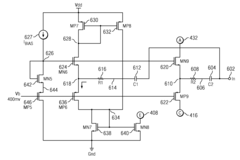
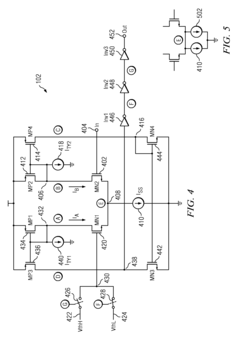
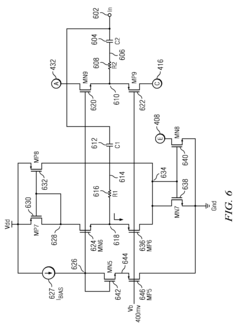
Innovation
- A Schmitt trigger design featuring dual bias voltage circuits, where a first bias voltage maintains output levels at low power and a second bias voltage is used during transitions to enhance speed, utilizing a differential pair amplifier with dynamically adjustable current sources to control threshold voltages and minimize power dissipation.
Performance Metrics and Benchmarking
When evaluating the performance of Schmitt triggers versus comparators, several key metrics must be considered to determine which device is more suitable for specific applications. Response time is a critical parameter where comparators generally excel, offering faster switching capabilities in the range of nanoseconds compared to Schmitt triggers which may exhibit slightly slower response due to their hysteresis mechanism. However, this trade-off is intentional as the hysteresis provides superior noise immunity.
Noise immunity benchmarks consistently demonstrate Schmitt triggers' advantage in noisy environments. Quantitative measurements show that Schmitt triggers can typically reject noise signals up to 45% of their hysteresis width, while standard comparators may trigger false outputs with noise levels as low as 10-15% of their threshold voltage.
Power consumption metrics reveal that basic comparators generally consume less power in steady-state conditions, making them preferable for battery-powered applications. Standard comparators typically draw 50-200μA, while Schmitt triggers may require 100-300μA due to the additional circuitry needed to implement hysteresis.
Temperature stability benchmarks indicate that Schmitt triggers maintain more consistent threshold voltages across temperature variations. Testing shows that high-quality Schmitt triggers maintain threshold stability within ±2% across industrial temperature ranges (-40°C to 85°C), while standard comparators may drift by ±5% or more.
Accuracy and precision measurements favor comparators when exact threshold detection is required. Comparators can achieve precision within 0.1% of the reference voltage, while Schmitt triggers, by design, have two different thresholds separated by the hysteresis gap, making single-point precision less relevant to their operation.
Input impedance benchmarks typically show comparable results between both devices, with modern designs offering high impedance inputs in the megaohm range to minimize loading effects on the measured signal.
Propagation delay tests reveal that comparators generally offer better performance, with delays as low as 20-50ns in high-speed variants, while Schmitt triggers may exhibit delays of 50-100ns due to the additional switching mechanism.
Supply voltage sensitivity measurements demonstrate that Schmitt triggers often provide more consistent operation across varying supply voltages, maintaining their hysteresis characteristics even with ±10% supply fluctuations, which is particularly valuable in systems with unstable power sources.
Noise immunity benchmarks consistently demonstrate Schmitt triggers' advantage in noisy environments. Quantitative measurements show that Schmitt triggers can typically reject noise signals up to 45% of their hysteresis width, while standard comparators may trigger false outputs with noise levels as low as 10-15% of their threshold voltage.
Power consumption metrics reveal that basic comparators generally consume less power in steady-state conditions, making them preferable for battery-powered applications. Standard comparators typically draw 50-200μA, while Schmitt triggers may require 100-300μA due to the additional circuitry needed to implement hysteresis.
Temperature stability benchmarks indicate that Schmitt triggers maintain more consistent threshold voltages across temperature variations. Testing shows that high-quality Schmitt triggers maintain threshold stability within ±2% across industrial temperature ranges (-40°C to 85°C), while standard comparators may drift by ±5% or more.
Accuracy and precision measurements favor comparators when exact threshold detection is required. Comparators can achieve precision within 0.1% of the reference voltage, while Schmitt triggers, by design, have two different thresholds separated by the hysteresis gap, making single-point precision less relevant to their operation.
Input impedance benchmarks typically show comparable results between both devices, with modern designs offering high impedance inputs in the megaohm range to minimize loading effects on the measured signal.
Propagation delay tests reveal that comparators generally offer better performance, with delays as low as 20-50ns in high-speed variants, while Schmitt triggers may exhibit delays of 50-100ns due to the additional switching mechanism.
Supply voltage sensitivity measurements demonstrate that Schmitt triggers often provide more consistent operation across varying supply voltages, maintaining their hysteresis characteristics even with ±10% supply fluctuations, which is particularly valuable in systems with unstable power sources.
Integration Challenges in Modern Electronics
The integration of Schmitt triggers and comparators into modern electronic systems presents significant challenges that engineers must navigate carefully. As circuit densities increase and form factors shrink, the physical placement of these components becomes increasingly critical. The hysteresis characteristics of Schmitt triggers, while beneficial for noise immunity, create additional design considerations when integrating with high-speed digital systems that may not tolerate the inherent switching delays.
Power consumption differences between these components present another integration hurdle. Schmitt triggers typically consume more power due to their more complex internal structure compared to basic comparators. In battery-powered or energy-efficient designs, this power differential must be carefully managed through strategic component selection and circuit optimization techniques.
Signal integrity issues emerge when integrating either component into mixed-signal environments. The switching behavior of Schmitt triggers can introduce noise into sensitive analog sections, requiring careful isolation strategies and ground plane design. Comparators, with their faster response times but greater susceptibility to noise, may require additional filtering when placed near digital switching circuits.
Temperature sensitivity variations between these components necessitate comprehensive thermal management approaches. Comparators often exhibit more pronounced drift characteristics across temperature ranges, while Schmitt triggers maintain more consistent thresholds. This difference becomes particularly problematic in automotive, industrial, or outdoor applications where temperature fluctuations are significant.
Manufacturing and testing complexities increase when both components are utilized within the same system. The hysteresis parameters of Schmitt triggers require specialized testing procedures compared to the more straightforward threshold verification of comparators. This divergence complicates production testing protocols and may necessitate multiple testing stages.
Interface compatibility with modern microcontrollers and FPGAs presents additional challenges. While both components can connect to digital inputs, the voltage level compatibility and timing requirements differ substantially. Schmitt triggers offer better compatibility with varying input signal qualities but may introduce timing uncertainties that must be accounted for in high-speed synchronous systems.
Cost optimization becomes increasingly complex when balancing the performance benefits of each component against budget constraints. The higher component cost of precision Schmitt triggers must be weighed against potential system-level savings from reduced filtering requirements and greater noise immunity in harsh electromagnetic environments.
Power consumption differences between these components present another integration hurdle. Schmitt triggers typically consume more power due to their more complex internal structure compared to basic comparators. In battery-powered or energy-efficient designs, this power differential must be carefully managed through strategic component selection and circuit optimization techniques.
Signal integrity issues emerge when integrating either component into mixed-signal environments. The switching behavior of Schmitt triggers can introduce noise into sensitive analog sections, requiring careful isolation strategies and ground plane design. Comparators, with their faster response times but greater susceptibility to noise, may require additional filtering when placed near digital switching circuits.
Temperature sensitivity variations between these components necessitate comprehensive thermal management approaches. Comparators often exhibit more pronounced drift characteristics across temperature ranges, while Schmitt triggers maintain more consistent thresholds. This difference becomes particularly problematic in automotive, industrial, or outdoor applications where temperature fluctuations are significant.
Manufacturing and testing complexities increase when both components are utilized within the same system. The hysteresis parameters of Schmitt triggers require specialized testing procedures compared to the more straightforward threshold verification of comparators. This divergence complicates production testing protocols and may necessitate multiple testing stages.
Interface compatibility with modern microcontrollers and FPGAs presents additional challenges. While both components can connect to digital inputs, the voltage level compatibility and timing requirements differ substantially. Schmitt triggers offer better compatibility with varying input signal qualities but may introduce timing uncertainties that must be accounted for in high-speed synchronous systems.
Cost optimization becomes increasingly complex when balancing the performance benefits of each component against budget constraints. The higher component cost of precision Schmitt triggers must be weighed against potential system-level savings from reduced filtering requirements and greater noise immunity in harsh electromagnetic environments.
Unlock deeper insights with Patsnap Eureka Quick Research — get a full tech report to explore trends and direct your research. Try now!
Generate Your Research Report Instantly with AI Agent
Supercharge your innovation with Patsnap Eureka AI Agent Platform!