TIM Outgassing And Contamination Risks: Mitigation For Sensitive Optics & Electronics
AUG 27, 202510 MIN READ
Generate Your Research Report Instantly with AI Agent
Patsnap Eureka helps you evaluate technical feasibility & market potential.
TIM Outgassing Background and Objectives
Thermal Interface Materials (TIMs) have evolved significantly over the past three decades, transitioning from simple thermal greases to sophisticated engineered composites. Initially developed for basic heat transfer applications in computing hardware, TIMs now play a critical role in advanced electronics, aerospace systems, and precision optical instruments where thermal management is paramount to system performance and longevity.
The evolution of TIMs has been driven by increasing power densities in electronic components and the growing need for efficient heat dissipation in miniaturized devices. Early materials focused primarily on thermal conductivity, while modern TIMs must balance multiple properties including electrical insulation, mechanical compliance, long-term stability, and minimal contamination potential.
Outgassing—the release of trapped gases or volatile compounds from materials under vacuum or elevated temperatures—has emerged as a significant concern in high-precision applications. This phenomenon was first documented in aerospace applications during the 1960s space race but has become increasingly relevant across multiple industries as component sensitivities have increased.
The technical objective of this research is to comprehensively evaluate outgassing characteristics of contemporary TIMs and develop mitigation strategies specifically for applications involving sensitive optics and precision electronics. We aim to establish quantifiable parameters for acceptable outgassing levels and create a framework for material selection based on application-specific requirements.
Current industry standards for outgassing, such as ASTM E595 and NASA SP-R-0022A, provide valuable baseline metrics but were not specifically designed for modern optical and electronic systems with nanometer-scale sensitivities. This research seeks to bridge this gap by correlating standard outgassing measurements with actual performance impacts in sensitive systems.
The technological trajectory indicates a growing demand for TIMs that combine excellent thermal performance with near-zero contamination risk. This trend is particularly evident in semiconductor manufacturing equipment, space-based optical systems, and quantum computing hardware where even microscopic contamination can cause catastrophic system failures.
Our investigation will focus on both immediate mitigation techniques for existing TIMs and the development of next-generation materials engineered specifically to minimize volatile organic compound (VOC) content while maintaining or improving thermal performance. The research will also explore novel characterization methods that can more accurately predict real-world contamination risks in specific application environments.
The evolution of TIMs has been driven by increasing power densities in electronic components and the growing need for efficient heat dissipation in miniaturized devices. Early materials focused primarily on thermal conductivity, while modern TIMs must balance multiple properties including electrical insulation, mechanical compliance, long-term stability, and minimal contamination potential.
Outgassing—the release of trapped gases or volatile compounds from materials under vacuum or elevated temperatures—has emerged as a significant concern in high-precision applications. This phenomenon was first documented in aerospace applications during the 1960s space race but has become increasingly relevant across multiple industries as component sensitivities have increased.
The technical objective of this research is to comprehensively evaluate outgassing characteristics of contemporary TIMs and develop mitigation strategies specifically for applications involving sensitive optics and precision electronics. We aim to establish quantifiable parameters for acceptable outgassing levels and create a framework for material selection based on application-specific requirements.
Current industry standards for outgassing, such as ASTM E595 and NASA SP-R-0022A, provide valuable baseline metrics but were not specifically designed for modern optical and electronic systems with nanometer-scale sensitivities. This research seeks to bridge this gap by correlating standard outgassing measurements with actual performance impacts in sensitive systems.
The technological trajectory indicates a growing demand for TIMs that combine excellent thermal performance with near-zero contamination risk. This trend is particularly evident in semiconductor manufacturing equipment, space-based optical systems, and quantum computing hardware where even microscopic contamination can cause catastrophic system failures.
Our investigation will focus on both immediate mitigation techniques for existing TIMs and the development of next-generation materials engineered specifically to minimize volatile organic compound (VOC) content while maintaining or improving thermal performance. The research will also explore novel characterization methods that can more accurately predict real-world contamination risks in specific application environments.
Market Analysis for Low-Outgassing TIM Solutions
The global market for low-outgassing Thermal Interface Materials (TIMs) is experiencing robust growth, driven primarily by increasing demands in aerospace, semiconductor manufacturing, and high-precision optical systems. Current market valuations place this specialized segment at approximately $1.2 billion in 2023, with projections indicating a compound annual growth rate of 8.7% through 2028.
The space industry represents the most established market for low-outgassing TIMs, where contamination control is mission-critical. NASA, ESA, and emerging private space companies maintain stringent outgassing requirements, typically demanding materials that demonstrate less than 1.0% Total Mass Loss (TML) and less than 0.1% Collected Volatile Condensable Materials (CVCM) when tested under ASTM E595 standards.
Semiconductor manufacturing constitutes the fastest-growing segment, with particularly strong demand coming from EUV lithography systems where even nanoscale contamination can significantly impact production yields. Market research indicates that semiconductor manufacturers are willing to pay premium prices—often 30-40% higher than standard TIMs—for materials that can guarantee minimal outgassing performance.
The medical imaging equipment sector has emerged as another significant market, particularly for MRI, PET, and other advanced diagnostic technologies where optical clarity and electronic stability are paramount. This segment is expected to grow at 9.3% annually through 2028, outpacing the overall market average.
Geographically, North America currently leads the market with approximately 38% share, followed by Asia-Pacific at 35% and Europe at 24%. However, the Asia-Pacific region is demonstrating the highest growth trajectory, driven by expansion in semiconductor manufacturing and increasing adoption of precision optical systems in countries like Taiwan, South Korea, and China.
From a materials perspective, silicone-free formulations are gaining market share most rapidly, with specialty polymers and metal-based TIMs showing particular promise. Customer surveys indicate that performance requirements are becoming increasingly stringent, with many applications now requiring TML values below 0.5% and CVCM below 0.05%.
Price sensitivity varies significantly by application. While consumer electronics manufacturers remain highly cost-conscious, aerospace and semiconductor industry customers prioritize performance over price, creating premium market segments where margins can exceed 60% for materials with exceptional outgassing characteristics.
Market fragmentation remains relatively high, with specialized manufacturers holding significant advantages over general thermal management companies. This fragmentation presents opportunities for innovation-driven companies to capture market share through superior technical performance and application-specific formulations.
The space industry represents the most established market for low-outgassing TIMs, where contamination control is mission-critical. NASA, ESA, and emerging private space companies maintain stringent outgassing requirements, typically demanding materials that demonstrate less than 1.0% Total Mass Loss (TML) and less than 0.1% Collected Volatile Condensable Materials (CVCM) when tested under ASTM E595 standards.
Semiconductor manufacturing constitutes the fastest-growing segment, with particularly strong demand coming from EUV lithography systems where even nanoscale contamination can significantly impact production yields. Market research indicates that semiconductor manufacturers are willing to pay premium prices—often 30-40% higher than standard TIMs—for materials that can guarantee minimal outgassing performance.
The medical imaging equipment sector has emerged as another significant market, particularly for MRI, PET, and other advanced diagnostic technologies where optical clarity and electronic stability are paramount. This segment is expected to grow at 9.3% annually through 2028, outpacing the overall market average.
Geographically, North America currently leads the market with approximately 38% share, followed by Asia-Pacific at 35% and Europe at 24%. However, the Asia-Pacific region is demonstrating the highest growth trajectory, driven by expansion in semiconductor manufacturing and increasing adoption of precision optical systems in countries like Taiwan, South Korea, and China.
From a materials perspective, silicone-free formulations are gaining market share most rapidly, with specialty polymers and metal-based TIMs showing particular promise. Customer surveys indicate that performance requirements are becoming increasingly stringent, with many applications now requiring TML values below 0.5% and CVCM below 0.05%.
Price sensitivity varies significantly by application. While consumer electronics manufacturers remain highly cost-conscious, aerospace and semiconductor industry customers prioritize performance over price, creating premium market segments where margins can exceed 60% for materials with exceptional outgassing characteristics.
Market fragmentation remains relatively high, with specialized manufacturers holding significant advantages over general thermal management companies. This fragmentation presents opportunities for innovation-driven companies to capture market share through superior technical performance and application-specific formulations.
Current Challenges in TIM Outgassing Control
The thermal interface materials (TIMs) industry faces significant challenges in controlling outgassing phenomena, which has become increasingly critical as electronic and optical systems advance toward higher performance and miniaturization. Outgassing—the release of trapped gases or volatile compounds from materials under vacuum or elevated temperatures—presents substantial risks to sensitive components, particularly in aerospace, semiconductor manufacturing, and high-precision optical systems.
Current TIM formulations, while optimized for thermal conductivity, often contain silicones, acrylates, and other polymer systems that inherently release volatile organic compounds (VOCs) during operation. These compounds can condense on critical surfaces, forming contamination layers as thin as several nanometers that significantly degrade optical transmission, electrical conductivity, and thermal performance. Industry testing has revealed that even "low-outgassing" rated materials can release sufficient volatiles to compromise sensitive equipment over extended operational periods.
Temperature cycling exacerbates the outgassing challenge, as many TIMs experience accelerated volatile release when subjected to thermal excursions beyond 85°C—a common occurrence in high-performance computing and power electronics applications. The rate of outgassing typically follows an Arrhenius relationship, approximately doubling with every 10°C increase in temperature, creating a compounding problem in thermally stressed environments.
Vacuum environments present particularly severe challenges, as the absence of atmospheric pressure accelerates the diffusion and release of volatile compounds. Space applications, semiconductor lithography systems, and vacuum-sealed optoelectronics all require TIMs that maintain stability under these demanding conditions, yet current materials struggle to meet these requirements without significant performance trade-offs.
The industry also faces a measurement standardization problem. While ASTM E595 provides a baseline for outgassing assessment (measuring Total Mass Loss and Collected Volatile Condensable Materials), these metrics often fail to characterize the specific compounds released or predict their impact on sensitive surfaces. More sophisticated analytical techniques such as thermal desorption gas chromatography-mass spectrometry (TD-GC-MS) reveal complex outgassing profiles that vary significantly between seemingly similar materials.
Material aging effects further complicate outgassing control. Many TIMs exhibit changing outgassing characteristics over time, with some materials showing reduced volatile release as they cure further, while others demonstrate increased outgassing as polymer chains degrade under thermal and environmental stress. This time-dependent behavior makes long-term performance prediction particularly challenging for mission-critical applications requiring multi-year reliability.
The balance between thermal performance and outgassing control represents perhaps the most fundamental challenge. Current approaches that minimize outgassing—such as pre-baking, advanced curing processes, or alternative material systems—typically compromise thermal conductivity, compliance, or ease of application, forcing engineers into difficult design trade-offs.
Current TIM formulations, while optimized for thermal conductivity, often contain silicones, acrylates, and other polymer systems that inherently release volatile organic compounds (VOCs) during operation. These compounds can condense on critical surfaces, forming contamination layers as thin as several nanometers that significantly degrade optical transmission, electrical conductivity, and thermal performance. Industry testing has revealed that even "low-outgassing" rated materials can release sufficient volatiles to compromise sensitive equipment over extended operational periods.
Temperature cycling exacerbates the outgassing challenge, as many TIMs experience accelerated volatile release when subjected to thermal excursions beyond 85°C—a common occurrence in high-performance computing and power electronics applications. The rate of outgassing typically follows an Arrhenius relationship, approximately doubling with every 10°C increase in temperature, creating a compounding problem in thermally stressed environments.
Vacuum environments present particularly severe challenges, as the absence of atmospheric pressure accelerates the diffusion and release of volatile compounds. Space applications, semiconductor lithography systems, and vacuum-sealed optoelectronics all require TIMs that maintain stability under these demanding conditions, yet current materials struggle to meet these requirements without significant performance trade-offs.
The industry also faces a measurement standardization problem. While ASTM E595 provides a baseline for outgassing assessment (measuring Total Mass Loss and Collected Volatile Condensable Materials), these metrics often fail to characterize the specific compounds released or predict their impact on sensitive surfaces. More sophisticated analytical techniques such as thermal desorption gas chromatography-mass spectrometry (TD-GC-MS) reveal complex outgassing profiles that vary significantly between seemingly similar materials.
Material aging effects further complicate outgassing control. Many TIMs exhibit changing outgassing characteristics over time, with some materials showing reduced volatile release as they cure further, while others demonstrate increased outgassing as polymer chains degrade under thermal and environmental stress. This time-dependent behavior makes long-term performance prediction particularly challenging for mission-critical applications requiring multi-year reliability.
The balance between thermal performance and outgassing control represents perhaps the most fundamental challenge. Current approaches that minimize outgassing—such as pre-baking, advanced curing processes, or alternative material systems—typically compromise thermal conductivity, compliance, or ease of application, forcing engineers into difficult design trade-offs.
Existing Contamination Mitigation Strategies
01 Low outgassing TIM compositions
Specialized thermal interface materials are formulated with components that minimize volatile organic compound (VOC) emissions. These compositions typically include silicone-free polymers, specific fillers, and cross-linking agents that create stable bonds, reducing the potential for outgassing at elevated temperatures. These materials are particularly important for sensitive electronic applications where contamination from outgassing can affect performance and reliability of components.- Low outgassing TIM compositions: Specific thermal interface material compositions are designed to minimize outgassing in electronic applications. These formulations typically include silicone-free polymers, specialized fillers, and cross-linking agents that create stable bonds resistant to volatilization under heat and vacuum conditions. These materials maintain thermal conductivity while significantly reducing contamination risks to sensitive components and optical surfaces in electronic devices.
- Testing and measurement methods for TIM outgassing: Various analytical techniques and testing protocols have been developed to quantify and characterize outgassing from thermal interface materials. These methods include thermal desorption spectroscopy, gas chromatography-mass spectrometry, and specialized environmental chamber testing. The testing procedures help identify volatile organic compounds and other contaminants released under operating conditions, allowing for better material selection and qualification for sensitive applications.
- Contamination prevention systems for semiconductor devices: Advanced systems and methods have been developed to prevent or mitigate contamination from TIM outgassing in semiconductor manufacturing and packaging. These include specialized barrier layers, getter materials that absorb volatile compounds, and controlled environment processing techniques. Such systems are particularly important in advanced packaging configurations where thermal management materials are in close proximity to sensitive components.
- Phase change materials with reduced outgassing: Phase change thermal interface materials have been formulated to address outgassing concerns while maintaining effective heat transfer properties. These materials typically transition from solid to semi-liquid state at operating temperatures, providing excellent thermal contact. Special formulations incorporate stabilizers and non-volatile components that minimize outgassing even during phase transitions, making them suitable for applications where contamination must be strictly controlled.
- Integration solutions for TIM in sensitive electronic assemblies: Specialized integration techniques have been developed for applying and containing thermal interface materials in sensitive electronic assemblies. These include encapsulation methods, selective application patterns, and hybrid material systems that create physical barriers to outgassing migration. Such integration approaches focus on directing any potential outgassing away from sensitive components while maintaining effective thermal management in electronic devices.
02 Testing and measurement methods for TIM outgassing
Various analytical techniques and testing protocols have been developed to quantify and characterize outgassing from thermal interface materials. These methods include thermal desorption spectroscopy, gas chromatography-mass spectrometry, and specialized environmental chamber testing. The testing procedures typically involve subjecting the TIM to operating or elevated temperatures while measuring the type and quantity of released volatile compounds, allowing for better selection of materials for sensitive applications.Expand Specific Solutions03 Contamination prevention strategies in semiconductor applications
Semiconductor manufacturing and packaging processes incorporate specific design features and material selection criteria to minimize contamination from TIM outgassing. These strategies include using barrier layers, optimizing curing processes, implementing purge systems, and creating controlled assembly environments. The approaches focus on preventing volatile compounds from reaching sensitive components like optical surfaces, electrical contacts, and MEMS structures where even minimal contamination can cause device failure.Expand Specific Solutions04 High-temperature stable TIM formulations
Advanced thermal interface materials designed for high-temperature applications incorporate thermally stable polymers, ceramic fillers, and specialized additives that maintain structural integrity and minimize degradation at elevated temperatures. These formulations typically feature strong chemical bonds that resist breaking down under thermal stress, thereby reducing the release of volatile compounds during operation. The materials balance thermal conductivity requirements with outgassing constraints for use in automotive, aerospace, and high-power electronics applications.Expand Specific Solutions05 Interface design for outgassing mitigation
Engineering approaches to thermal interface design incorporate structural elements and material combinations that provide pathways for controlled outgassing while preventing contamination of sensitive components. These designs may include venting channels, absorbent materials, getter materials, or specialized sealing techniques. The interface architectures are optimized to maintain thermal performance while directing potential outgassing products away from critical components, particularly in hermetically sealed or vacuum environments.Expand Specific Solutions
Leading Manufacturers and Research Institutions
The TIM (Thermal Interface Material) outgassing and contamination risk landscape is currently in a mature development phase, with the market expected to reach $4-5 billion by 2027. Companies like ASML, Carl Zeiss SMT, and Nikon dominate the high-end optical systems sector where contamination mitigation is critical, while materials specialists including Dow Silicones, Indium Corporation, and Sumitomo Electric lead in developing low-outgassing solutions. The technical maturity varies significantly across applications - aerospace and semiconductor industries (represented by Raytheon, Intel, and The Aerospace Corp) have established advanced mitigation protocols, while consumer electronics manufacturers (Samsung Display, Canon) are increasingly adopting similar standards as optical component sensitivity increases. Research institutions like Interuniversitair Micro-Electronica Centrum and Institute of Microelectronics of Chinese Academy of Sciences are driving innovation in next-generation contamination prevention technologies.
Carl Zeiss SMT GmbH
Technical Solution: Zeiss SMT has pioneered specialized contamination mitigation technologies for high-precision optical systems, particularly focusing on TIM applications in semiconductor manufacturing equipment. Their approach centers on a proprietary "Clean Processing" methodology that addresses outgassing risks throughout the entire product lifecycle. This includes careful material selection using a comprehensive database of characterized TIMs with known outgassing profiles, specialized application techniques that minimize contamination during assembly, and post-application treatments to reduce residual volatile compounds. Zeiss employs advanced analytical techniques including mass spectrometry and quartz crystal microbalance (QCM) measurements to quantify outgassing rates and identify specific molecular contaminants. Their systems incorporate specialized optical coatings with enhanced resistance to organic contamination and molecular-level protective barriers. Additionally, Zeiss has developed modular contamination control systems that can be integrated into existing optical assemblies, featuring temperature-controlled surfaces, molecular adsorbers, and directed purge flows to protect critical optical elements.
Strengths: Exceptional expertise in protecting high-precision optical systems; comprehensive material characterization capabilities; solutions that address both prevention and remediation of contamination. Weaknesses: Solutions often require significant engineering integration; higher implementation costs compared to standard TIM applications; some techniques require specialized equipment for proper implementation.
Dow Silicones Corp.
Technical Solution: Dow Silicones has developed specialized low-outgassing thermal interface materials specifically designed for applications with sensitive optical and electronic components. Their approach focuses on material formulation chemistry, creating silicone-based TIMs with significantly reduced volatile content through advanced polymer cross-linking technologies and specialized curing processes. Dow's "OptiBond" series of TIMs undergoes extensive pre-treatment including vacuum degassing and controlled pre-curing to remove volatile compounds before final application. Their materials are formulated with minimal low-molecular-weight siloxanes, which are common contaminants that can migrate to optical surfaces. Dow employs rigorous testing protocols including dynamic headspace analysis and thermal desorption gas chromatography-mass spectrometry (TD-GC-MS) to characterize outgassing profiles under various temperature conditions. For the most sensitive applications, they have developed hybrid organic-inorganic TIM formulations that combine the thermal performance of traditional silicones with significantly reduced outgassing characteristics. Additionally, Dow provides specialized application guidelines and processing recommendations to minimize contamination risks during assembly and operation.
Strengths: Industry-leading expertise in silicone chemistry; ability to custom-formulate materials for specific application requirements; comprehensive material characterization capabilities. Weaknesses: Even "low-outgassing" formulations still present some contamination risk for the most sensitive applications; optimal performance often requires following specific application and curing protocols that may complicate manufacturing processes.
Key Patents and Innovations in Low-Outgassing TIMs
Thermal Interface Material System
PatentActiveUS20160169598A1
Innovation
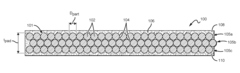
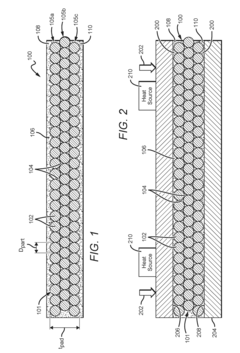
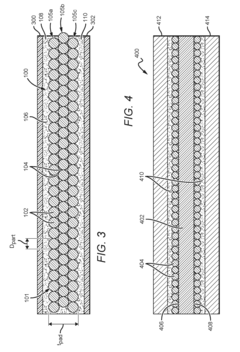
- A thermally conductive porous matrix with interstitial voids and a high-temperature resistant colloidal suspension applied on both sides, forming a porous thermal pad that inhibits thermal migration and maintains low thermal resistance.
Thermal interface material and solder preforms
PatentInactiveUS20070145546A1
Innovation
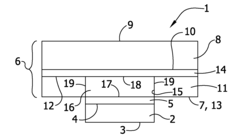
- A high-performance TIM comprising a solder component with a thermal conductivity enhancement component and a CTE modifying component, along with an intrinsic oxygen getter, which allows for bonding without extrinsic fluxing and enhances heat transfer while minimizing thermal stress.
Regulatory Standards for Outgassing in Sensitive Applications
The regulatory landscape for outgassing control in sensitive applications has evolved significantly over the past decades, driven by increasing awareness of contamination risks in high-precision industries. ASTM E595 stands as the cornerstone standard, establishing the foundational testing methodology for Total Mass Loss (TML) and Collected Volatile Condensable Materials (CVCM). This standard specifies maximum allowable values of 1.0% for TML and 0.1% for CVCM, serving as baseline requirements across multiple industries.
NASA has further refined these requirements through its own specifications, particularly NASA-STD-6016 and SP-R-0022A, which impose more stringent controls for space applications where outgassing risks are amplified by vacuum conditions. These standards have been widely adopted beyond aerospace, influencing practices in semiconductor manufacturing and medical device production.
The European Space Agency (ESA) has developed complementary standards, including ECSS-Q-ST-70-02C, which introduces additional parameters such as Recovered Mass Loss (RML) measurements. This provides a more comprehensive assessment of material behavior under thermal vacuum conditions, accounting for water vapor absorption characteristics.
In the electronics manufacturing sector, IPC standards (particularly IPC-J-STD-001) address outgassing concerns related to printed circuit board assembly and electronic components. These standards focus on flux residues and cleaning processes that might contribute to volatile organic compound (VOC) emissions in enclosed electronic assemblies.
The semiconductor industry follows SEMI standards, notably SEMI F49, which establishes outgassing requirements for materials used in semiconductor manufacturing environments. These standards are particularly stringent due to the extreme sensitivity of semiconductor processes to molecular contamination.
Medical device regulations, including ISO 10993-18, address outgassing concerns from a biocompatibility perspective, focusing on potential leachables and extractables that might affect patient safety. These standards employ different testing methodologies but share the fundamental goal of controlling volatile emissions.
Emerging regulations are increasingly addressing cumulative effects of multiple materials in complex assemblies. The trend is moving toward system-level outgassing assessment rather than component-level qualification alone. This holistic approach recognizes that interactions between materials can sometimes produce unexpected outgassing behaviors not predicted by individual material testing.
Compliance with these diverse regulatory frameworks requires comprehensive material selection strategies and testing protocols. Organizations developing sensitive optical or electronic systems must navigate this complex regulatory landscape while balancing performance requirements against contamination risk mitigation.
NASA has further refined these requirements through its own specifications, particularly NASA-STD-6016 and SP-R-0022A, which impose more stringent controls for space applications where outgassing risks are amplified by vacuum conditions. These standards have been widely adopted beyond aerospace, influencing practices in semiconductor manufacturing and medical device production.
The European Space Agency (ESA) has developed complementary standards, including ECSS-Q-ST-70-02C, which introduces additional parameters such as Recovered Mass Loss (RML) measurements. This provides a more comprehensive assessment of material behavior under thermal vacuum conditions, accounting for water vapor absorption characteristics.
In the electronics manufacturing sector, IPC standards (particularly IPC-J-STD-001) address outgassing concerns related to printed circuit board assembly and electronic components. These standards focus on flux residues and cleaning processes that might contribute to volatile organic compound (VOC) emissions in enclosed electronic assemblies.
The semiconductor industry follows SEMI standards, notably SEMI F49, which establishes outgassing requirements for materials used in semiconductor manufacturing environments. These standards are particularly stringent due to the extreme sensitivity of semiconductor processes to molecular contamination.
Medical device regulations, including ISO 10993-18, address outgassing concerns from a biocompatibility perspective, focusing on potential leachables and extractables that might affect patient safety. These standards employ different testing methodologies but share the fundamental goal of controlling volatile emissions.
Emerging regulations are increasingly addressing cumulative effects of multiple materials in complex assemblies. The trend is moving toward system-level outgassing assessment rather than component-level qualification alone. This holistic approach recognizes that interactions between materials can sometimes produce unexpected outgassing behaviors not predicted by individual material testing.
Compliance with these diverse regulatory frameworks requires comprehensive material selection strategies and testing protocols. Organizations developing sensitive optical or electronic systems must navigate this complex regulatory landscape while balancing performance requirements against contamination risk mitigation.
Environmental Impact of TIM Materials and Alternatives
The environmental impact of Thermal Interface Materials (TIMs) represents a growing concern as electronics manufacturing scales globally. Traditional TIMs often contain compounds that pose significant environmental hazards throughout their lifecycle. Silicone-based materials, while effective for thermal management, can release volatile organic compounds (VOCs) during curing and degradation processes. These emissions contribute to air pollution and may persist in the environment for extended periods.
Metal-based TIMs, particularly those containing gallium, indium, or mercury, present serious environmental concerns regarding resource extraction and end-of-life disposal. Mining operations for these metals often result in habitat destruction, soil contamination, and water pollution. Additionally, improper disposal can lead to heavy metal leaching into groundwater systems, creating long-term environmental damage and potential human health risks.
The manufacturing processes for TIMs frequently involve energy-intensive operations and chemical treatments that generate substantial carbon footprints. Production facilities may release greenhouse gases and other pollutants, contributing to climate change and local air quality degradation. Water usage in manufacturing represents another environmental challenge, particularly in regions experiencing water scarcity.
Recent regulatory frameworks have begun addressing these environmental concerns. The European Union's Restriction of Hazardous Substances (RoHS) and Registration, Evaluation, Authorization and Restriction of Chemicals (REACH) regulations have placed limitations on certain compounds commonly found in TIMs. These regulations have accelerated the development of environmentally friendly alternatives that maintain thermal performance while reducing ecological impact.
Promising eco-friendly alternatives include bio-based TIMs derived from renewable resources such as plant oils, cellulose, and other natural polymers. These materials offer biodegradability advantages while achieving competitive thermal conductivity values. Carbon-based alternatives, including graphene and carbon nanotubes, provide excellent thermal performance with potentially lower environmental impacts than metal-based options, though their full lifecycle assessment remains under investigation.
Phase change materials (PCMs) derived from sustainable sources represent another environmentally conscious direction. These materials can effectively manage thermal loads while minimizing environmental footprint compared to traditional options. Additionally, water-soluble TIMs that avoid harmful solvents during application and removal processes are gaining traction in environmentally sensitive applications.
The industry is increasingly adopting lifecycle assessment methodologies to evaluate the comprehensive environmental impact of TIM materials from production through disposal. This holistic approach is driving innovation toward truly sustainable thermal management solutions that balance performance requirements with environmental responsibility.
Metal-based TIMs, particularly those containing gallium, indium, or mercury, present serious environmental concerns regarding resource extraction and end-of-life disposal. Mining operations for these metals often result in habitat destruction, soil contamination, and water pollution. Additionally, improper disposal can lead to heavy metal leaching into groundwater systems, creating long-term environmental damage and potential human health risks.
The manufacturing processes for TIMs frequently involve energy-intensive operations and chemical treatments that generate substantial carbon footprints. Production facilities may release greenhouse gases and other pollutants, contributing to climate change and local air quality degradation. Water usage in manufacturing represents another environmental challenge, particularly in regions experiencing water scarcity.
Recent regulatory frameworks have begun addressing these environmental concerns. The European Union's Restriction of Hazardous Substances (RoHS) and Registration, Evaluation, Authorization and Restriction of Chemicals (REACH) regulations have placed limitations on certain compounds commonly found in TIMs. These regulations have accelerated the development of environmentally friendly alternatives that maintain thermal performance while reducing ecological impact.
Promising eco-friendly alternatives include bio-based TIMs derived from renewable resources such as plant oils, cellulose, and other natural polymers. These materials offer biodegradability advantages while achieving competitive thermal conductivity values. Carbon-based alternatives, including graphene and carbon nanotubes, provide excellent thermal performance with potentially lower environmental impacts than metal-based options, though their full lifecycle assessment remains under investigation.
Phase change materials (PCMs) derived from sustainable sources represent another environmentally conscious direction. These materials can effectively manage thermal loads while minimizing environmental footprint compared to traditional options. Additionally, water-soluble TIMs that avoid harmful solvents during application and removal processes are gaining traction in environmentally sensitive applications.
The industry is increasingly adopting lifecycle assessment methodologies to evaluate the comprehensive environmental impact of TIM materials from production through disposal. This holistic approach is driving innovation toward truly sustainable thermal management solutions that balance performance requirements with environmental responsibility.
Unlock deeper insights with Patsnap Eureka Quick Research — get a full tech report to explore trends and direct your research. Try now!
Generate Your Research Report Instantly with AI Agent
Supercharge your innovation with Patsnap Eureka AI Agent Platform!