
Dynamic virtual private network (DVPN) based data transmission method and device
A data transmission method and data technology, applied in the field of communication, can solve the problem of setting up a VPN, and the communication end cannot know the public network address in advance, etc., and achieve the effect of small overhead and reduced forwarding delay
- Summary
- Abstract
- Description
- Claims
- Application Information
AI Technical Summary
Problems solved by technology
Method used
Image

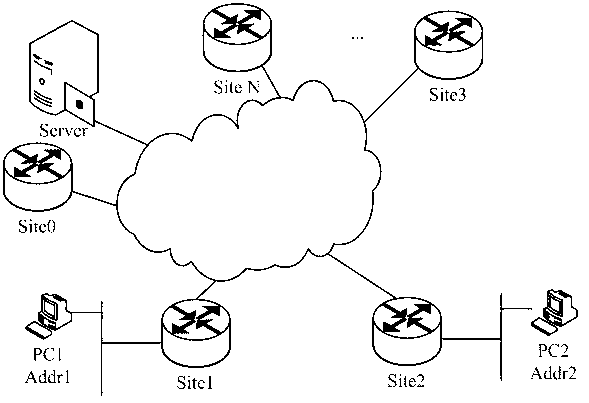
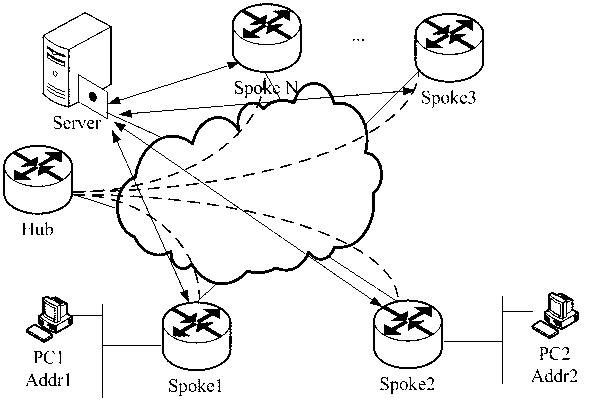
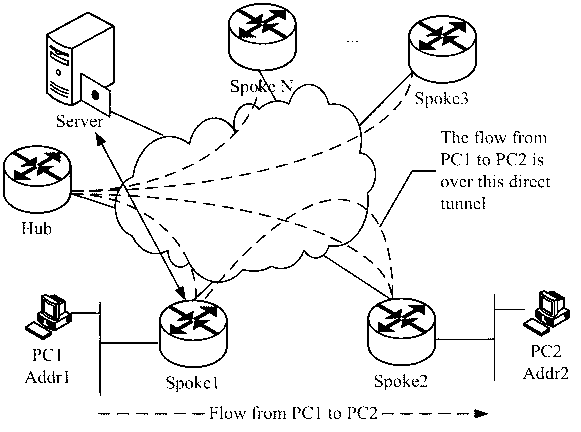
Examples
Embodiment approach
[0047] Specifically, in order to maintain the neighbor Cost table on each Spoke, a preferred implementation manner is as follows:
[0048] Each Spoke receives a registration response message (Register replay message) from the server during the process of initiating registration with the server. The registration response message carries a TTL (Time To Live, time to live) value N; the TTL value N is the TTL value of the Full-Mesh network, and the registration response message sent by the server to each Spoke in the Full-Mesh network carries the same TTL value N.
[0049] After each Spoke obtains the TTL value N from the server, if each Spoke establishes a Full-Mesh tunnel connection (that is, a direct tunnel is established between all Spokes), each Spoke sends a Keepalive (keep alive) report to the neighboring Spoke of the device. (Keepalive packets can be sent regularly), and the IP header of the Keepalive packet carries the TTL value N; for example, Spoke1 sends a Keepalive pa...
PUM
 Login to View More
 Abstract
Description
Claims
Application Information
 Login to View More