
Compounds reducing malodour perception and the use thereof
a technology of compounds and malodour, applied in the field of compounds, can solve the problems that blockers with flower notes can be used in perfumes or air fresheners, but would not be suitable for food additives
- Summary
- Abstract
- Description
- Claims
- Application Information
AI Technical Summary
Benefits of technology
Problems solved by technology
Method used
Image

Examples
example 1
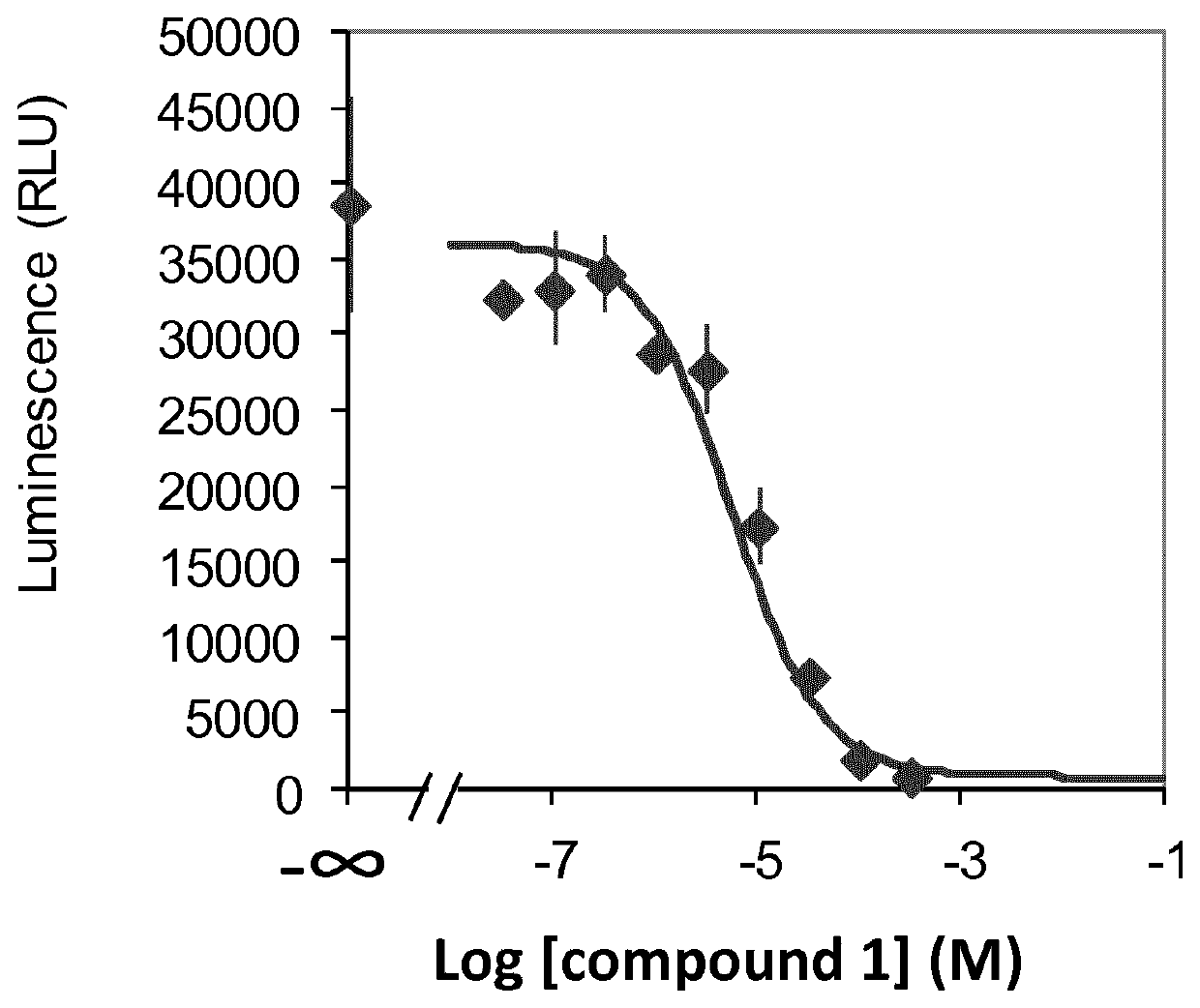
of ethyl (E)-4-((E)-benzylidene)-2-methyldec-2-enoate (Compound 1) (Scheme 2)
[0581]
[0582]To a stirred suspension of NaH (60% dispersion in mineral oil) (188 mg, 7.86 mmol) in THF (3 mL) was added ethyl 2-(diethoxyphosphoryl)propanoate (1.5 mL, 6.94 mmol) in THF (3 mL) drop wise at 20° C. under nitrogen atmosphere. After completion of the addition, the reaction mixture was stirred at 20° C. for 1 h. Again, the mixture was cooled to 5° C. and a solution of (E)-2-benzylideneoctanal in THF (4 mL) was added. After completion of the addition, the reaction mixture was stirred at 5° C. for 1 h. The reaction was monitored by TLC; after completion of the reaction, the reaction mixture was poured into 2N HCl solution (40 mL) and extracted with MTBE (2×30 mL). Separated organic layer was washed with saturated NaHCO3 solution (30 mL) and brine (30 mL). Organic layer was dried over sodium sulfate, filtered and concentrated under reduced pressure. Obtained crude material was purified through silic...
example 2
of ethyl (2E,4E)-5-(3-methoxyphenyl)-2-methylpenta-2,4-dienoate (Compound 2) (Scheme 3)
[0584]
Step 1
[0585]To a solution of 3-hydroxybenzaldehyde (5 g, 40.9 mmol) in acetone (50 mL) were added K2CO3 (11.3 g, 81.7 mmol) followed by MeI (2.5 mL, 40.9 mmol) at room temperature under nitrogen atmosphere. The resultant reaction mixture was heated to 60° C. and stirred for 16 h. The reaction was monitored by TLC; after completion of the reaction, the reaction mixture was cooled to RT and diluted with water (50 mL) and extracted with DCM (50 mL×2). Combined organic layers were dried over sodium sulfate, filtered and concentrated under reduced pressure. Obtained crude material was purified through silica gel column chromatography using 10% EtOAc / hexanes to afford 3-methoxybenzaldehyde (4.6 g, 82%) as light yellow syrup.
[0586]3-Methoxybenzaldehyde: 1H NMR (500 MHz, DMSO-d6): δ 9.98 (s, 1H), 7.52 (d, J=7.0 Hz, 1H), 7.50 (d, J=7.0 Hz, 1H), 7.42 (d, J=2.0 Hz, 1H), 7.28 (dt, J=7.0, 2.0 Hz, 1H), 3....
example 3
of ethyl (2E,4E)-5-(2-propylphenyl)penta-2,4-dienoate (Compound 3) and Compound 4 (Scheme 4)
[0595]
Step 1
[0596]To a stirred solution of o-Tolyl methanol (2 g, 16.37 mmol) in dry Et2O (20 mL) was added n-BuLi (1.6M solution in hexane) (30.7 mL, 49.11 mmol) at room temperature under nitrogen atmosphere. The resultant reaction mixture was heated to reflux and stirred for 4 h. The reaction mixture was cooled to room temperature; ethyl iodine (1.3 mL, 16.37 mmol) was added and the stirring was continued at room temperature for 16 h. The reaction was monitored by TLC; after completion of the reaction, the mixture was diluted with water (30 mL) and extracted with EtOAc (30 mL×2). Combined organic layers were dried over sodium sulfate, filtered and concentrated under reduced pressure. Obtained crude material was purified through silica gel column chromatography using 10% EtOAc / hexanes to afford (2-propylphenyl)methanol (1.1 g, 46%) as syrup.
[0597](2-propylphenyl)methanol: 1H NMR (500 MHz, DM...
PUM
| Property | Measurement | Unit |
|---|---|---|
| boiling point | aaaaa | aaaaa |
| boiling point | aaaaa | aaaaa |
| temperature | aaaaa | aaaaa |
Abstract
Description
Claims
Application Information
 Login to View More