Global property trading board game

a technology of global economics and board games, applied in the field of competitive amusement devices, can solve the problems of requiring a relatively long timeframe for game play, the game does not have a global economics theme, and the game is generally revenue-driven, so as to preserve the national economic sovereignty of the player, facilitate and efficiently manufacture and market, and maintain the effect of player interes

US20080111302A1Active Publication Date: 2008-05-15GRIFFITH MICHAEL
15 Cites 1 Cited by

Patent Information

Authority / Receiving Office
US · United States
Patent Type
Applications(United States)
Current Assignee / Owner
Publication Date
2008-05-15

Smart Images

  • Figure 1
    Figure 1
  • Figure 2
    Figure 2
  • Figure 3
    Figure 3
Patent Text Reader

Abstract

A global property trading board game having a game board with a continuous travel path divided into stations being associated with respective countries and having markings, including economic values representative of the respective countries' gross domestic product. Movement of a game-piece along the travel path is determined by a chance-controlled device. Each player is allocated a line of credit represented by international business cards in various monetary denominations. The respective players are further assigned a global region constituting a trade-bloc of countries. A player may acquire the assets of any country corresponding to the station in which the game-piece is located, assuming the assets are not owned by another player, by payment of the designated economic value utilizing the player's international business cards. When a competing player's game-piece is located within a station wherein the assets are owned by another player the competing player must pay a tax to that player. Several of the stations are keyed to playing cards that impose either a monetary penalty, or a monetary reward; other stations affect advancement of the respective player's game-piece. The player who acquires all or most of the countries' assets within its assigned trade-bloc and has successfully defended its home sovereignty is the victor.
Need to check novelty before this filing date? Find Prior Art

Description

BACKGROUND OF THE INVENTION

[0001] 1. Field of the Invention

[0002] The present invention relates to competitive amusement devices and especially to a board game involving movement of a game-piece on a board having a pattern wherein chance controls the amount of movement of the game-piece.

[0003] In particular, the board game of this invention concerns global property transactions involving the simulated acquisition of global assets and the defense of national sovereignty.

[0004] 2. Description of Related Art

[0005] Many board games involve a race wherein a player throws dice and moves a game-piece around a track in accordance with the numerical markings on the respective die; these games are primarily dependent on chance controlled movement. Another game category concerns strategy board games, an object of which is to capture territory; these games are usually more mind-engaging. Financial board games, such as games that include property transactions, can involve both chance dependency and m...

Examples

Embodiment Construction

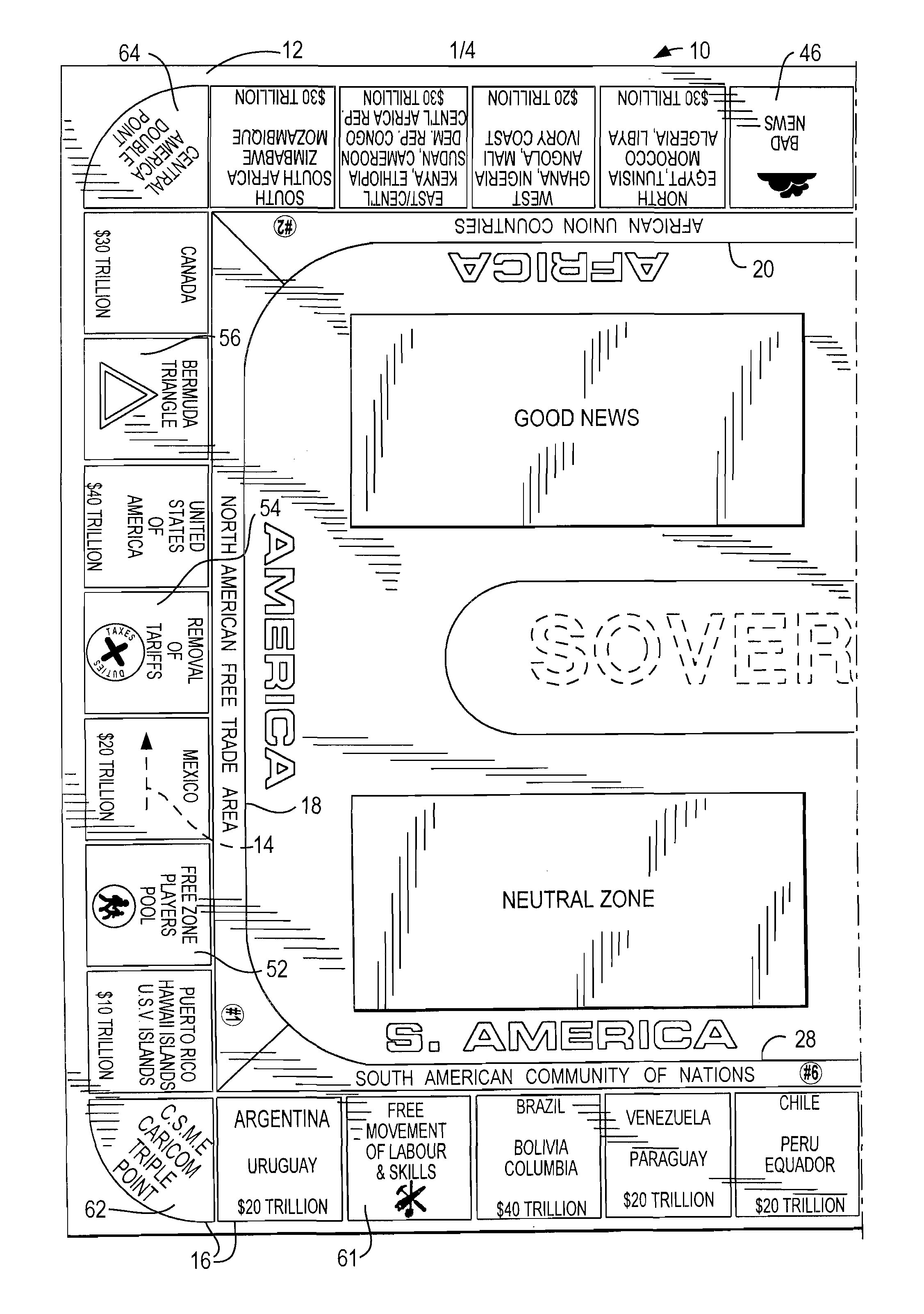
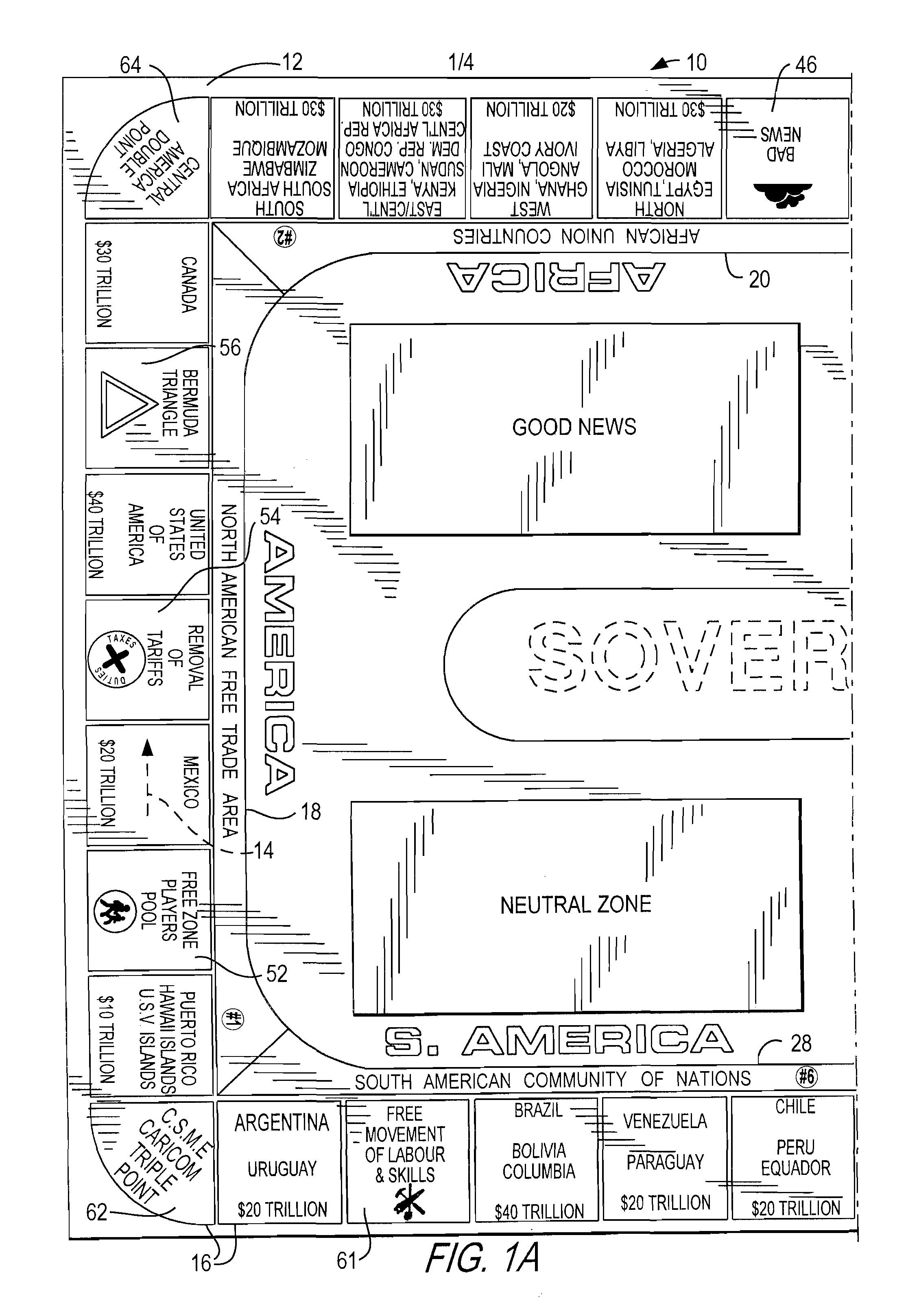
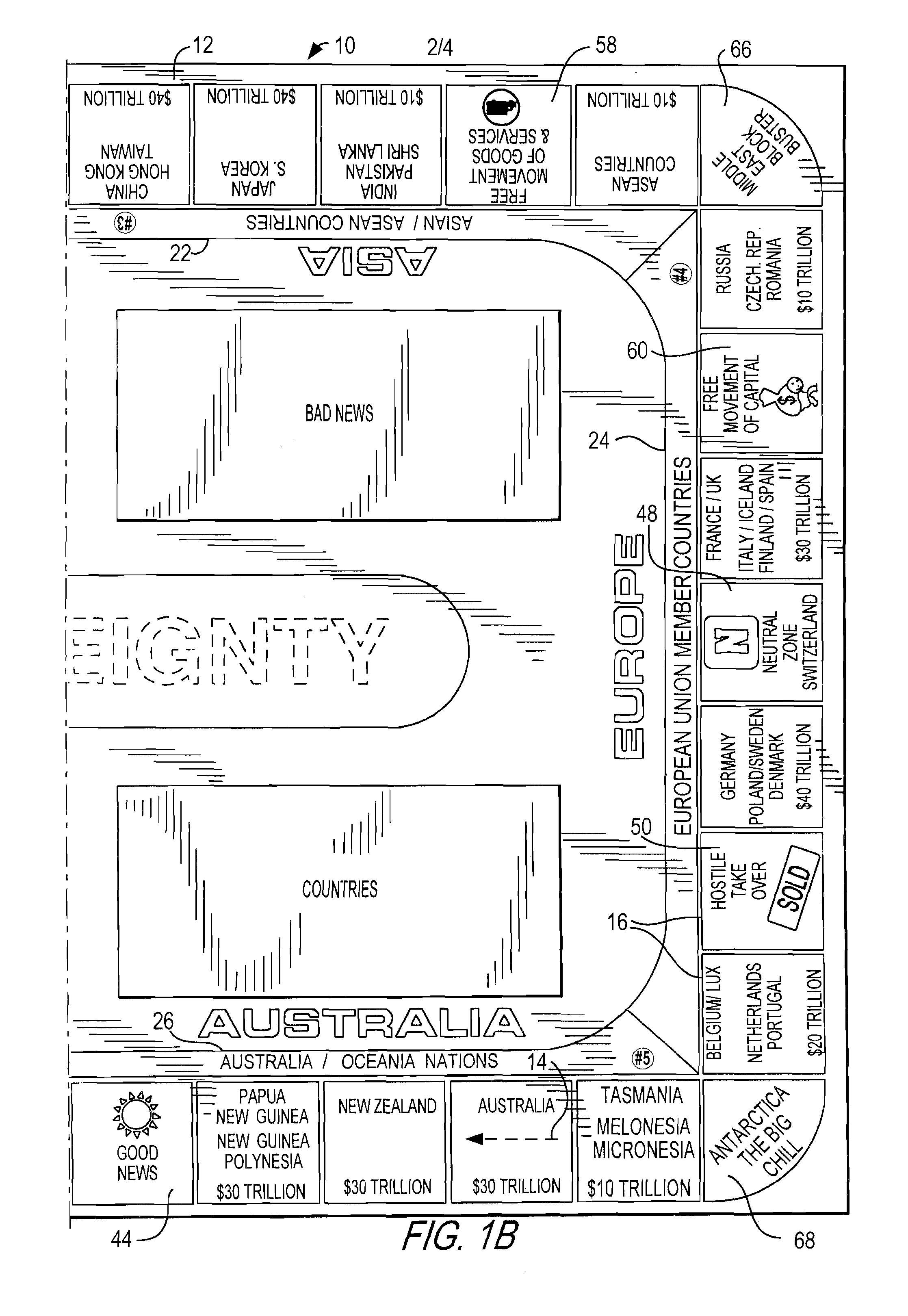
[0027]Referring now in detail to the drawings, the reference numeral 10 denotes generally a global property trading board game in accordance with this invention. The board game 10 includes a game board 12, as illustrated in FIGS. 1A and 1B, having a substantially smooth planar surface bearing a pattern on one face thereof which defines a travel path 14. The travel path 14 is segregated into spaces or stations 16 including stations associated with designated countries and having a designated asset evaluation based on its representative gross domestic product.

[0028]The game board 12 is further divided into six global regions, namely, North American Free Trade Area 18, African Union Countries 20, Asian / Asean Countries 22, European Union Member Countries 24; Austria / Oceania Nations 26, and South American Community of Nations 28. The several global regions 18-28 are readily distinguishable by color. For example, the North American Free Trade Area 18 is in the color “blue”; the African Un...