
Mutant ROS Expression In Human Cancer
a ros-kinase and human cancer technology, applied in the field of ros-kinase proteins and genes involved in cancer, can solve the problems of uncontrolled growth and proliferation of cells, aberrant control of cellular processes, etc., and achieve the effect of driving proliferation and survival
Patent Information
- Authority / Receiving Office
- US · United States
- Patent Type
- Applications(United States)
- Current Assignee / Owner
- Publication Date
- 2015-04-30
Smart Images
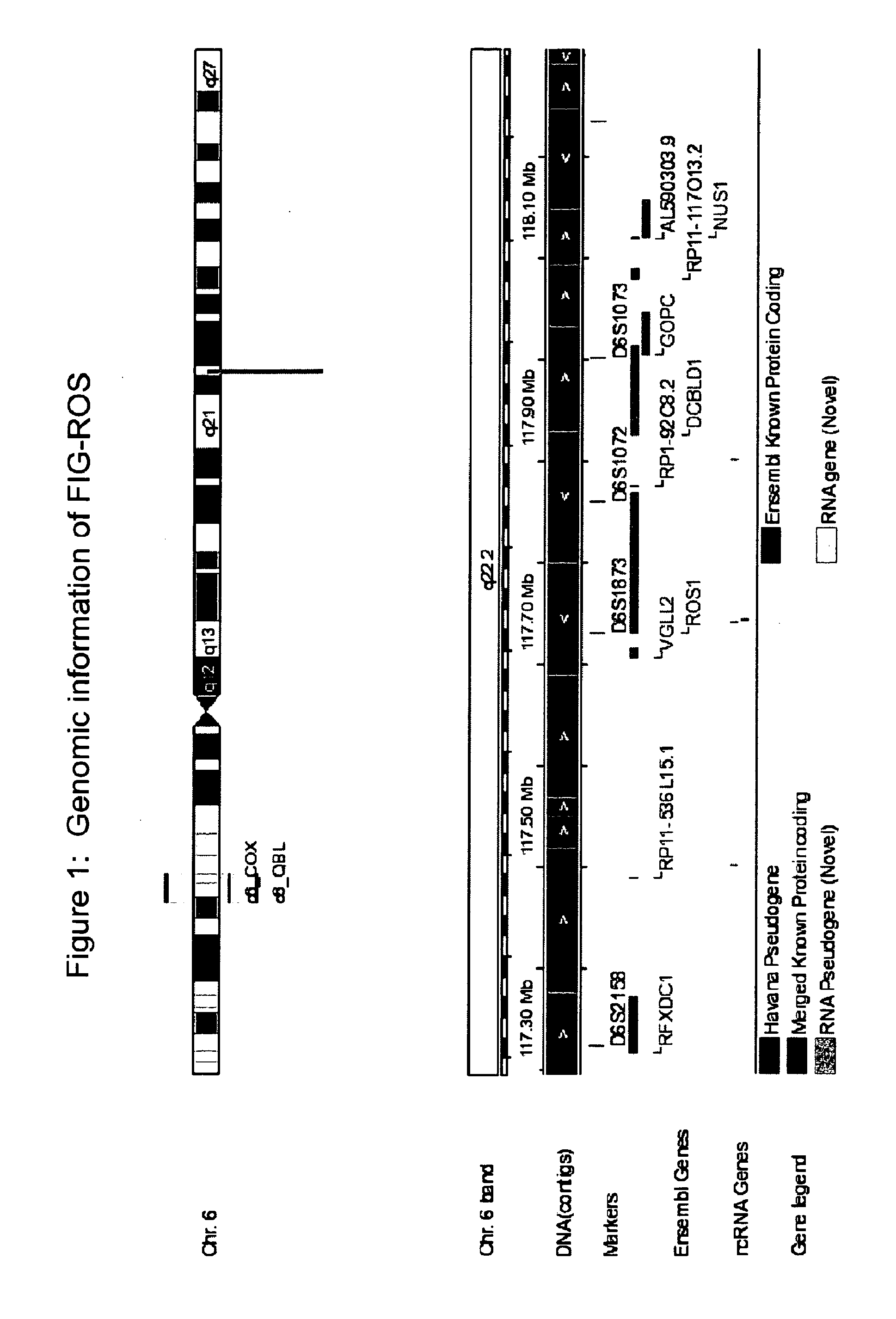
Figure 1 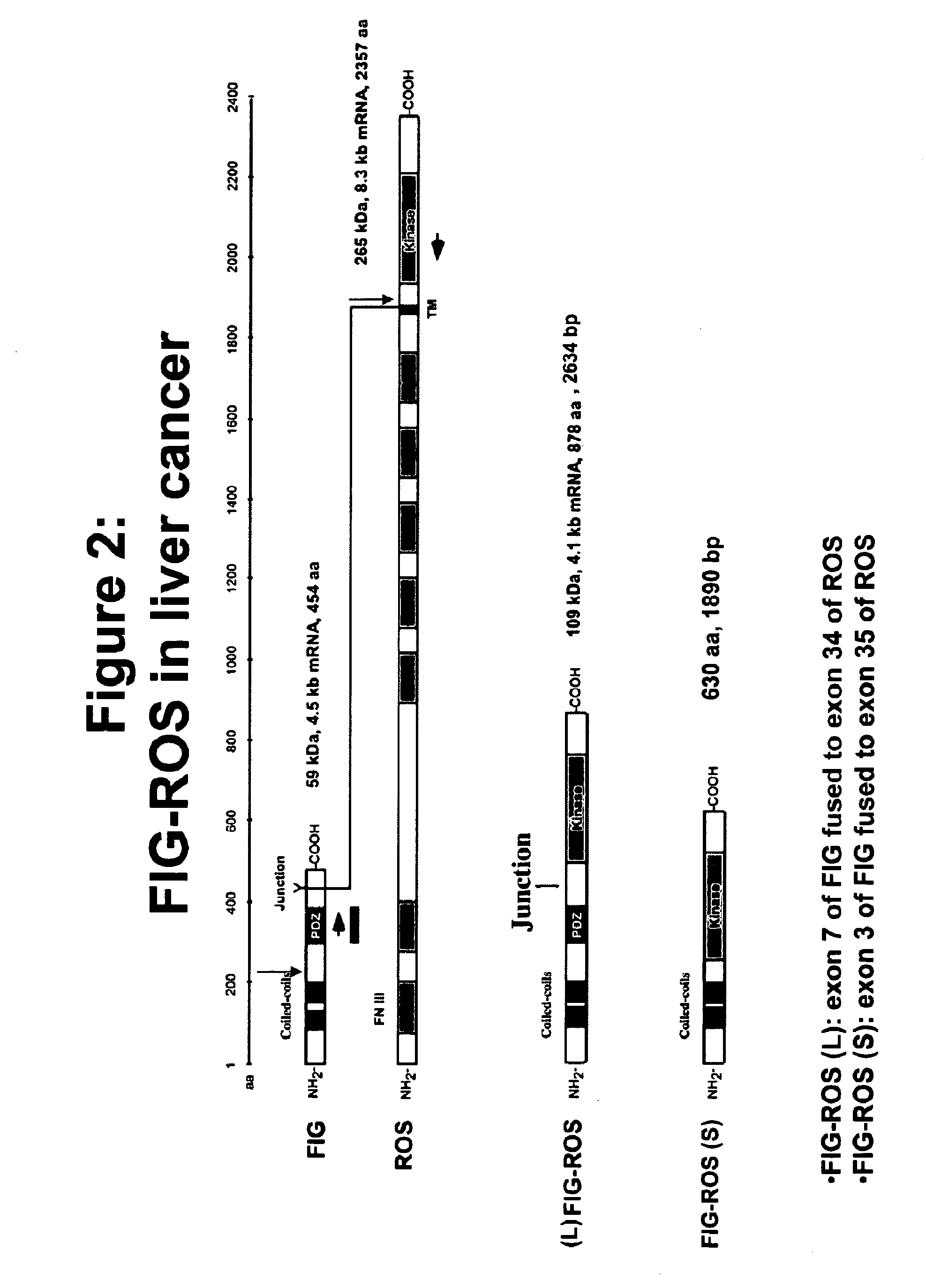
Figure 2 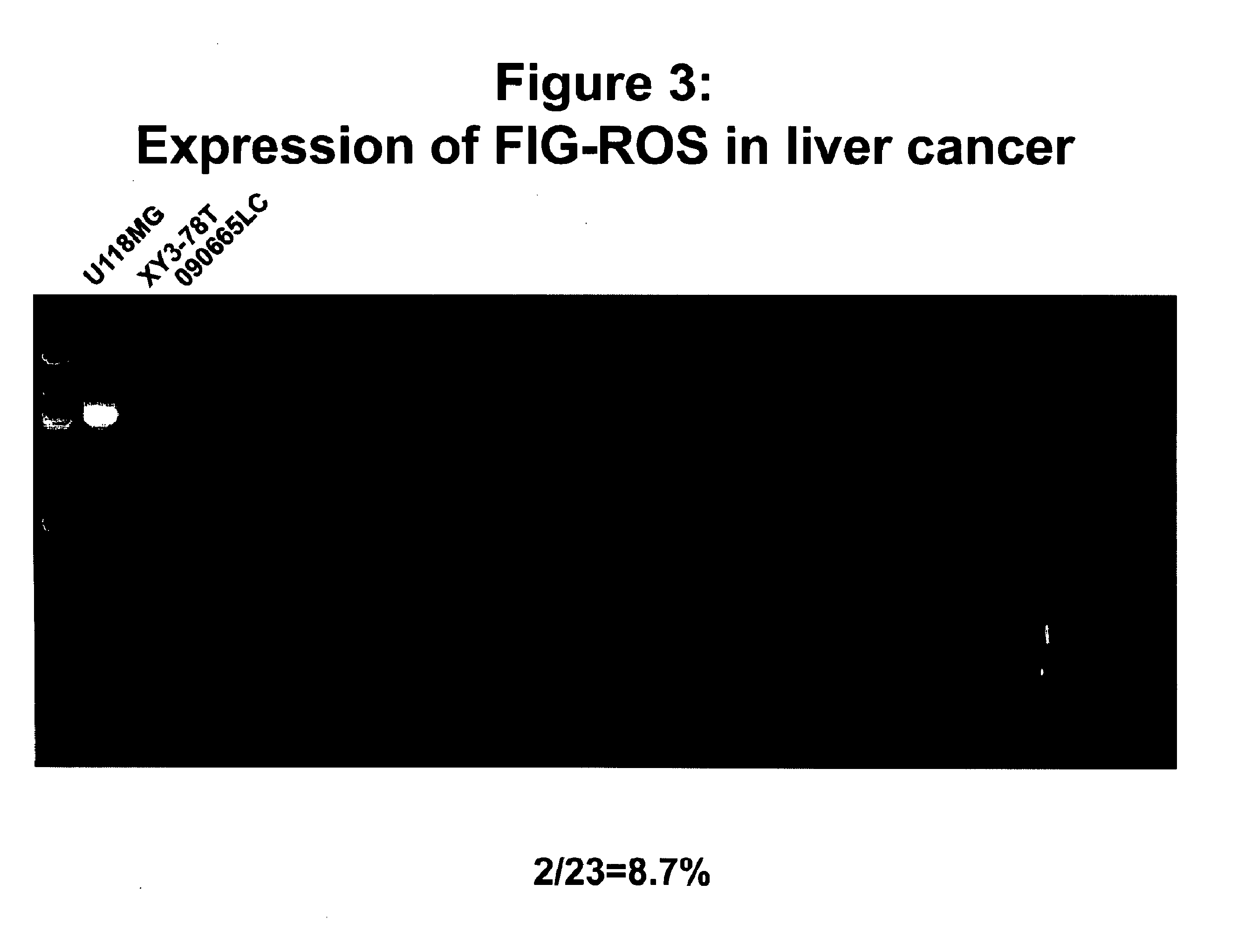
Figure 3
Abstract
Description
RELATED APPLICATIONS
[0001] This application is a continuation of U.S. patent application Ser. No. 13 / 146,705, filed Jul. 28, 2011, which is a national stage entry of International Application No. PCT / US2010 / 024109 filed Feb. 12, 2010, which itself claims priority to U.S. Provisional Application Ser. No. 61 / 207,484 filed Feb. 12, 2009, now expired, the entire contents of which are incorporated by reference herein.INCORPORATION BY REFERENCE OF SEQUENCE LISTING
[0002] The Sequence Listing in an ASCII text file, named as 28126_SEQ.txt of 147 KB, created on Jul. 12, 2013 in U.S. patent application Ser. No. 13 / 146,705, and submitted to the United States Patent and Trademark Office via EFS-Web, is incorporated herein by reference.FIELD OF THE INVENTION
[0003] The invention relates generally to ROS kinase proteins and genes involved in cancer, and to the detection, diagnosis and treatment of cancer.BACKGROUND OF THE INVENTION
[0004] Many cancers are characterized by disruptions in cellular signali...
Examples
example 1
Identification of ROS Kinase Activity in Liver Cancer Patients by Global Phosphopeptide Profiling
[0277]The global phosphorylation profile of kinase activation in several human liver cancer patients, including patients XY3-78T and 090665LC, were examined using a recently described and powerful technique for the isolation and mass spectrometric characterization of modified peptides from complex mixtures (the “IAP” technique, see U.S. Patent Publication No. 20030044848, Rush et al., “Immunoaffinity Isolation of Modified Peptides from Complex Mixtures”). The IAP technique was performed using a phosphotyrosine-specific antibody (CELL SIGNALING TECHNOLOGY, INC., Danvers, Mass., 2003 / 04 Cat. #9411) to isolate, and subsequently characterize, phosphotyrosine-containing peptides from extracts of liver cancer cells taken from 23 human patients and para-tumor tissues.
Liver Cancer Cell Samples
[0278]Liver tumors (n=23) were collected from surgical resections from patients when sufficient material...
example 2
Isolation & Sequencing of FIG-ROS Fusion Gene
[0290]Given the presence of the activated form of ROS kinase detected in two liver cancer patient samples, 5′ rapid amplification of cDNA ends on the sequence encoding the kinase domain of ROS was conducted in order to determine whether a chimeric ROS transcript was present.
Rapid Amplification of Complementary DNA Ends
[0291]RNeasy Mini Kit (Qiagen) was used to extract RNA from human tumor samples. DNA was extracted with the use of DNeasy Tissue Kit (Qiagen). Rapid amplification of cDNA ends was performed with the use of 5′ RACE system (Invitrogen) with primers ROS-GSP1 for cDNA synthesis and ROS-GSP2 and ROS-GSP3.1 for a nested PCR reaction, followed by cloning and sequencing PCR products.
[0292]For the 5′RACE system, the following primers were used:
ROS-GSP1:5′ ACCCTTCTCGGTTCTTCGTTTCCA
[0293]For the nested PCR reaction, the following primers were used.
ROS-GSP2:5′TCTGGCGAGTCCAAAGTCTCCAATROS-GSP3.1:5′CAGCAAGAGACGCAGAGTCAGTTT
[0294]Sequencing o...
example 3
Detection of Mutant ROS Kinase Expression in a Human Cancer Sample Using PCR Assay
[0296]The presence of mutant ROS kinase and / or a FIG-ROS fusion protein of the invention (e.g., FIG-ROS(S) or FIG-ROS(S)) in a human cancer sample was detected using cDNA or genomic reverse transcriptase (RT) and / or polymerase chain reaction (PCR). These methods have been previously described. See, e.g., Cools et al., N. Engl. J. Med. 348: 1201-1214 (2003).
[0297]To confirm that the FIG-ROS fusion had occurred, RT-PCR was performed on RNA extracted from the liver cancer cell samples of patients XY3-78T and 090665LC. For RT-PCR, first-strand cDNA was synthesized from 2.5 ug of total RNA with the use of SuperScript™ III first-strand synthesis system (Invitrogen) with oligo (dT)20. Then, the FIG-ROS fusion gene was amplified with the use of primer pairs FIG-F2 and ROS-GSP3.1. Their sequences are:
FIG-F2:5′ACTGGTCAAAGTGCTGACTCTGGTROS-GSP3.1:5′CAGCAAGAGACGCAGAGTCAGTTT
[0298]As shown on FIG. 3, patient...