

Home adaptive transceiver for home networking communication system
a technology of communication system and transceiver, which is applied in the field of network computers, can solve the problems of star networks that are subject to an entire network failure, different losses, different distortions, etc., and it is almost impossible to design a unique transceiver that is best suited to all homes or small businesses
- Summary
- Abstract
- Description
- Claims
- Application Information
AI Technical Summary
Problems solved by technology
Method used
Image



Examples
first embodiment
[0024]FIG. 1 shows a first embodiment in accordance with the principles of the present invention. FIG. 1 shows a home network transceiver that is self-learning and self-adjusting to optimize its communication performance with other home network transceivers.
[0025]In particular, FIG. 1 shows a home network transceiver 10 comprising a transceiver 75, a noise measurement module 65, a propagation delay measurement module 55, a bit rate error measurement module 45, a read station ID module 35, a processor 25, an ID and calibration memory 15, and a test signal generator module 85.
[0026]In operation, test signal generator module 85 initially generates a pre-established default test signal. The pre-established default test signal is transferred to transceiver 75. Transceiver 75 transmits the pre-established default test signal to a second home network transceiver over communication link 76.
[0027]The second home network transceiver returns the pre-established default test signal to home netw...
second embodiment
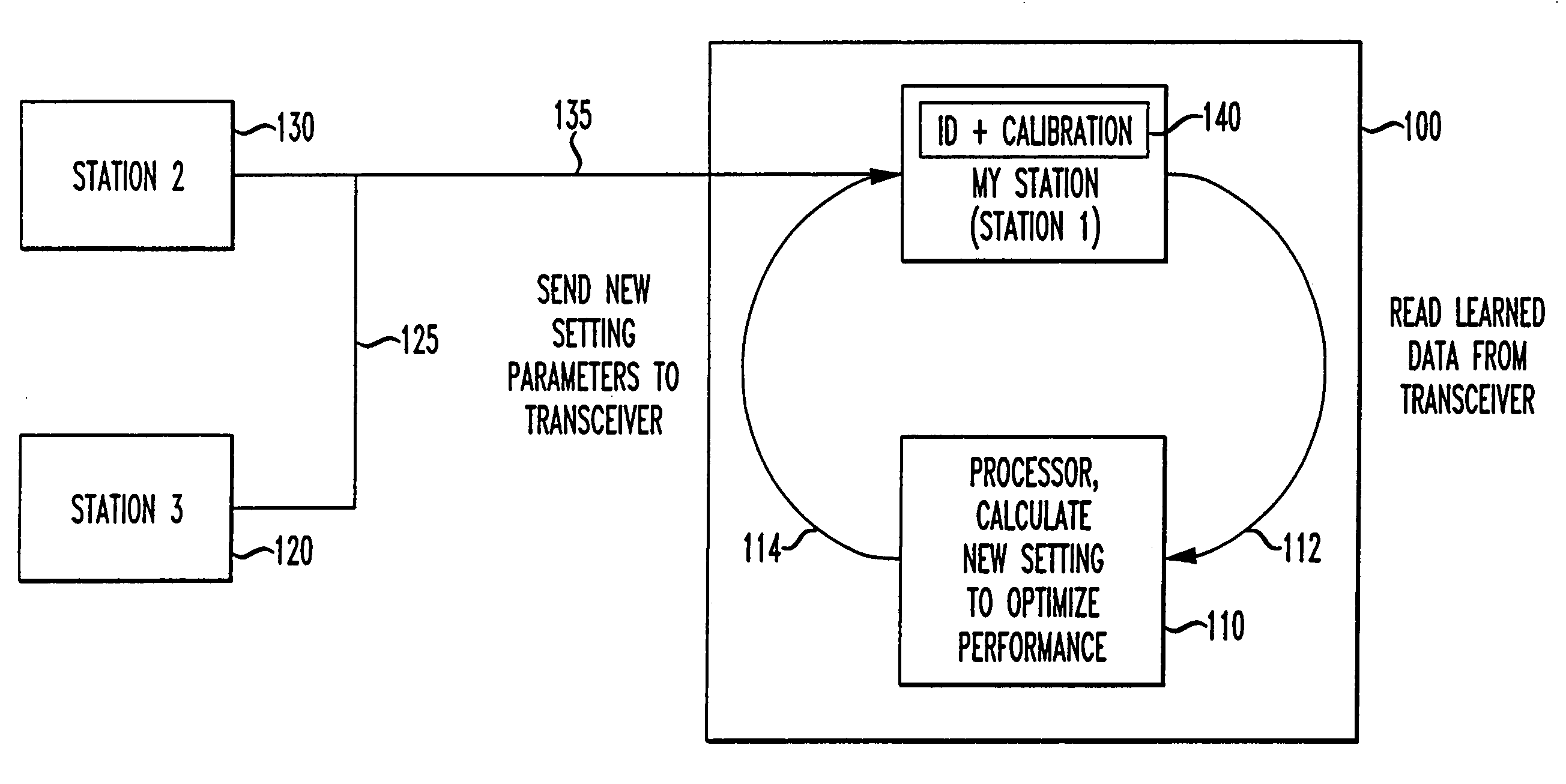
[0042]FIG. 2 shows a second embodiment in accordance with the principles of the present invention. FIG. 2 shows a home network transceiver connected to other transceivers that is self-learning and self-adjusting to optimize its communication performance with the other transceivers.
[0043]In particular, FIG. 2 shows node 100 connected to two other nodes, node 120 and node 130. Transmission line 135 connects node 100 with node 120 and node 130. Transmission line 125 connects node 120 to node 100 and 130. Communication lines 112 and 114 connects node 100 with processor 110, for respectively sending and receiving data. A calibration memory 140 within node 100 stores calibration values associated with a particular node identification (ID).
[0044]Although the exemplary embodiment shown in FIG. 2 discloses the connection of three nodes, the actual number of nodes that are connectable within the network is limited only by the hardware used to connect the nodes and the number of actual nodes. ...
PUM
 Login to View More
 Abstract
Description
Claims
Application Information
 Login to View More