
Deltamethrin antigen and antibody, as well as use thereof
A technology of deltamethrin and antigen, applied in the field of immunochemical analysis, can solve the problems of different hapten structures and methods, and achieve the effect of simple analysis method
Patent Information
- Authority / Receiving Office
- CN · China
- Patent Type
- Applications(China)
- Current Assignee / Owner
- Publication Date
- 2009-04-22
- Estimated Expiration
- Not applicable · inactive patent
Smart Images
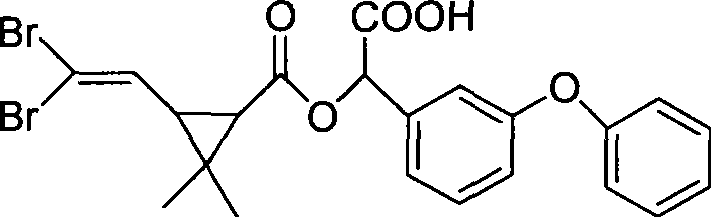
Figure 1 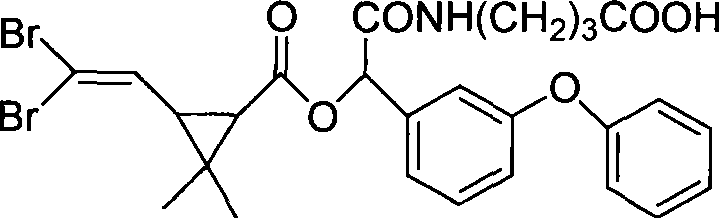
Figure 2 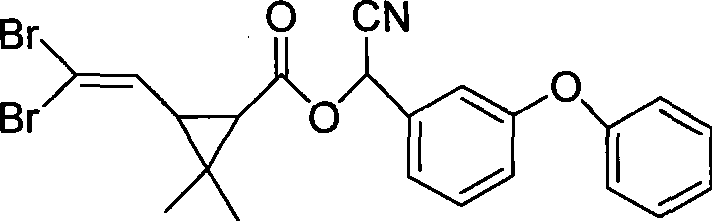
Figure 3
Abstract
Description
1. Technical field
[0001] The invention relates to a deltamethrin antigen, an antibody and applications thereof, belonging to the technical field of immunochemical analysis, and is specially used for the preparation of deltamethrin-specific antibodies and an enzyme-linked immunoassay method. 2. Background technology
[0002] Deltamethrin is a synthetic pyrethroid insecticide developed by ELLIOT et al. in 1974. Its trade name is Dixid. The chemical name and structure are shown in the figure below. The pure product is a white orthorhombic needle-like crystal, mp: 101~102℃, slightly soluble in water, soluble in most organic solvents, stable under acidic conditions. It has stomach poisoning and contact killing effects, fast knockdown and repelling activity. It is particularly effective against Lepidoptera larvae and is one of the most effective pyrethroid insecticides in the contemporary era.
[0003] At present, the residual analysis of deltamethrin is mainly performed by gas...
Examples
Embodiment Construction
[0039] 1 Synthesis of artificial hapten of deltamethrin
[0040] In order to fully expose the three-dimensional structural characteristics of deltamethrin and contain carboxyl groups that can be coupled with proteins, α-cyano-3-phenoxybenzyl alcohol, deltamethrin and sulfone chloride were used as raw materials to undergo three steps The reaction synthesized the hapten 1-carboxy-(3′-phenoxyphenyl)methyl-3-(2′,2′-dibromovinyl)-2,2-dimethylcyclopropylcarboxylate (Med for short). In order to improve the detection sensitivity through heterologous reaction, the hapten Med was reacted with 4-aminobutyric acid to synthesize N-2-(carboxypropyl)carbamoyl-(3′-phenoxyphenyl)methyl -3-(2',2'-dibromovinyl)-2,2-dimethylcyclopropylcarboxylate (abbreviated as Di). After purification, the products Med and Di were subjected to mass spectrometry (ESI) and H NMR spectroscopy ( 1 H-NMR) identification, and confirmed by comparison with similar known compound data.
[0041] The structure of the h...