
Method for preparing milk cow replacement cattle fermented TMR feed from gingko decoction dreg
A technology for heifers and medicinal residues, applied in animal feed, animal feed, application, etc., can solve the problems of random piles of ginkgo leaf residues, shortage of silage corn supply, unchanged feeding effect, etc., to improve anti-allergic, Conducive to handling and solving the effect of shortage of supply
Patent Information
- Authority / Receiving Office
- CN · China
- Patent Type
- Applications(China)
- Current Assignee / Owner
- Publication Date
- 2011-02-09
- Estimated Expiration
- Not applicable · inactive patent
Smart Images
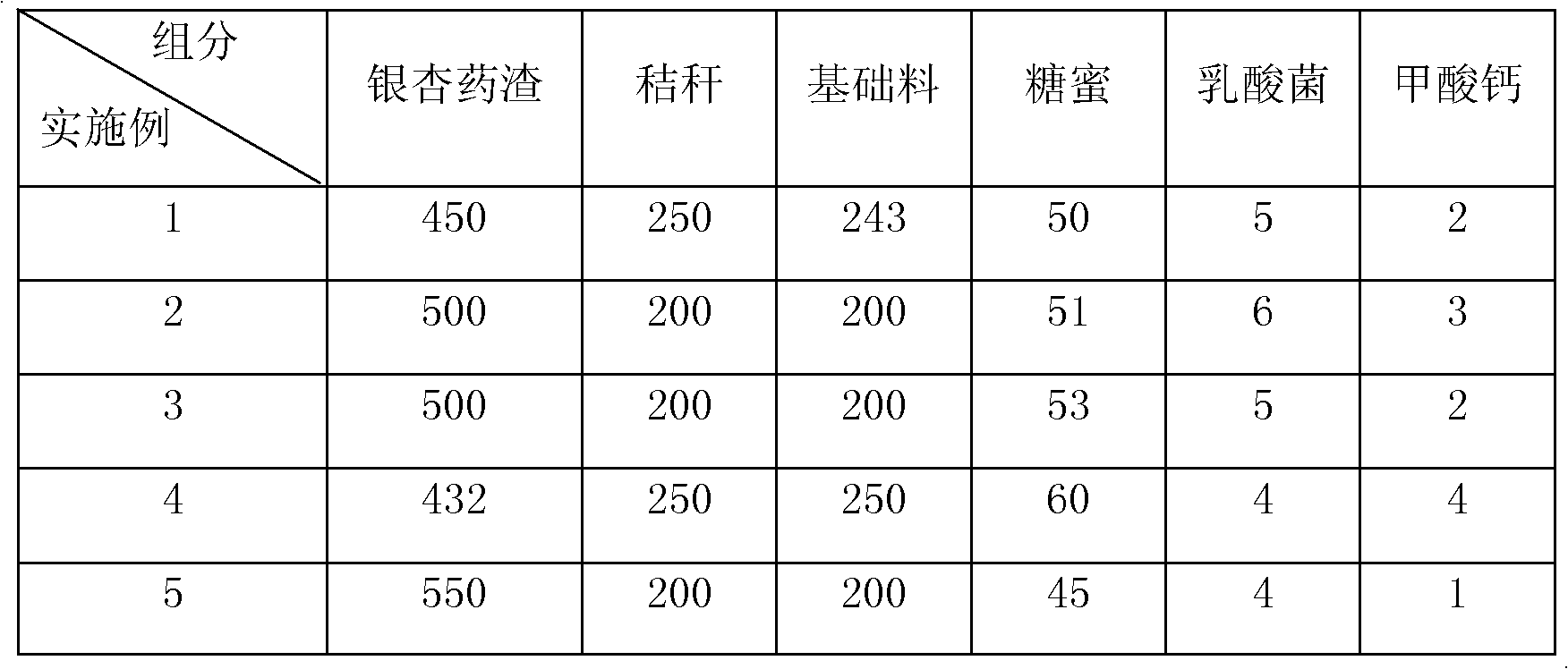
Figure 1 
Figure 2
Abstract
Description
technical field
[0001] The invention belongs to the technical field of fermenting TMR with ginkgo medicinal dregs, and in particular relates to a method for producing TMR fermented feed for back-up dairy cows by using ginkgo medicinal dregs as raw materials. Background technique
[0002] my country has adjusted the industrial structure of animal husbandry since the "Tenth Five-Year Plan", and has given great importance to the development of dairy industry. In recent years, dairy cattle breeding has been vigorously developed. However, the average milk yield of dairy cows in my country is not high, far lower than that of countries with developed dairy farming industries. To improve the milk production level of dairy cows, the nutritional supply of dairy cows, scientific management and environmental factors are all important, but the cultivation of back-up cows is more important, which involves whether the digestive system and immune system of dairy cows in the young animal sta...
Examples
Embodiment 1~5
[0039]
[0040] Add the components in the above fermentation raw material examples 1-5 into a TMR mixer (Start (Beijing) Animal Husbandry Equipment Co., Ltd.) and stir evenly, then adjust the water content to 45wt%-55wt%; pour into polyethylene film In the vacuum bag, reach the required density after vacuuming (500-800 kg / m 3 ), the bag is sealed and finished; after 10-50 days of fermentation, it can be fed to back cattle.
[0041] Each group of raw materials in the above-mentioned embodiment is feed grade, and is conventional commercially available product, and information is as follows:
[0042] Ginkgo biloba residue: Shanghai Xinyi Paluda Pharmaceutical Co., Ltd.
[0043] Straw: Shanghai Dingniu Feed Co., Ltd.
[0044] Basic material: Shanghai Dingniu Feed Co., Ltd.
[0045] Molasses: Shanghai Mengxin Animal Husbandry Co., Ltd.
[0046] Fermentation agent: French Laman company
[0047] Antifungal agent: Shanghai Luyuan Fine Chemical Co., Ltd.
Embodiment 1
[0049] The fermented raw material of Example 1 was used to test in the experimental pasture of Shanghai Dairy Cow Research Institute. After the fermented raw material was added to a TMR mixer (Start (Beijing) Animal Husbandry Equipment Co., Ltd.) and stirred evenly, the moisture was adjusted to 50wt%; Pour it into a polyethylene film vacuum bag, and reach the required density after vacuuming (500-800 kg / m 3 ), finished after the bag was sealed; fermented for 15 days.
[0050] Laboratory analysis: Ginkgo biloba dregs feed samples fermented for 0 days and 15 days were sent to Shanghai Dairy Cow Research Institute to test the content of dry matter, crude protein, crude fat, ADF, NDF and crude ash.
[0051] All detected raw data were statistically analyzed by SPSS17.0. The test results showed that compared with the ginkgo dregs feed fermented for 15 days, the dry matter was reduced by 0.8%, the crude protein was increased by 0.2%, the crude fat was significantly increased by 0.23...
Embodiment 2
[0053]The fermented raw material of Example 2 was used to test in the experimental ranch of the Shanghai Dairy Cow Research Institute, and the fermented raw material was added to a TMR mixer (Start (Beijing) Animal Husbandry Equipment Co., Ltd.) and stirred evenly, and the moisture was adjusted to 50wt%; Pour it into a polyethylene film vacuum bag, and reach the required density after vacuuming (500-800 kg / m 3 ), finished after the bag was sealed; fermented for 20 days.
[0054] Laboratory analysis: Ginkgo biloba dregs feed samples fermented for 0 days and 15 days were sent to Shanghai Dairy Cow Research Institute to test the content of dry matter, crude protein, crude fat, ADF, NDF and crude ash.
[0055] All detected raw data were statistically analyzed by SPSS17.0. The test results showed that compared with the ginkgo dregs feed fermented for 15 days, the dry matter decreased by 0.9%, the crude protein increased by 0.3%, the crude fat significantly increased by 0.26%, the ...