

Homogeneous phase photo-oxidation device capable of degrading aromatic compound waste water continuously and processing method thereof
An aromatic compound and reaction device technology, applied in the field of homogeneous photo-oxidation reaction devices, can solve the problems of large distance between light source and wastewater to be treated, low light energy utilization efficiency, unsuitable for continuous treatment and the like, and achieves adjustable and adjustable treatment effect. control, the wastewater treatment capacity is adjustable and controllable, and the light energy utilization efficiency is high.
Patent Information
- Authority / Receiving Office
- CN · China
- Patent Type
- Applications(China)
- Current Assignee / Owner
- Publication Date
- 2011-11-02
- Estimated Expiration
- Not applicable · inactive patent
Smart Images
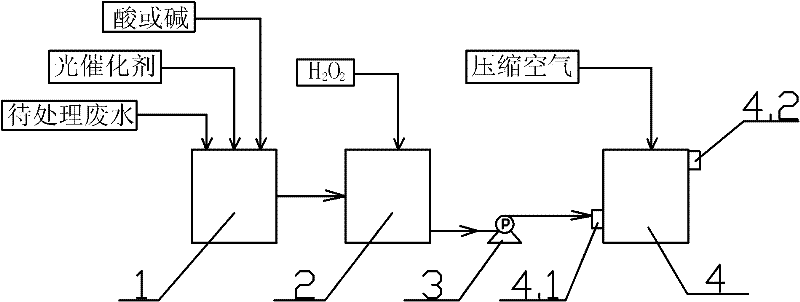
Figure 1 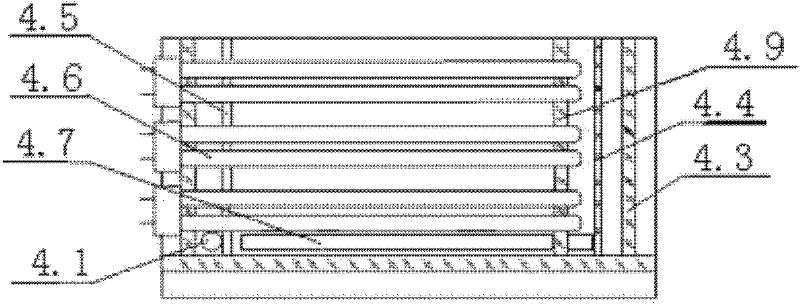
Figure 2 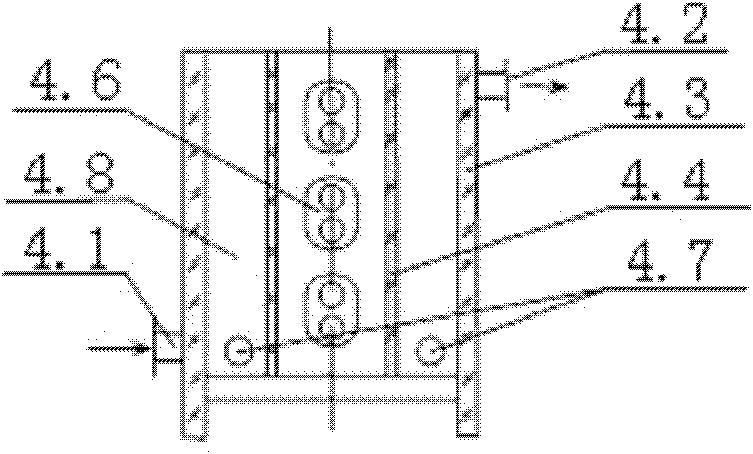
Figure 3
Abstract
Description
technical field
[0001] The invention relates to a device and method for homogeneous photooxidative degradation of wastewater, in particular to a homogeneous photooxidative reaction device capable of continuously degrading aromatic compound wastewater and a treatment method thereof. Background technique
[0002] The rapid development of modern industry has brought a large amount of industrial wastewater containing high concentrations of toxic organic pollutants, including a large amount of chemical wastewater containing aromatic compounds such as benzene, phenol, chlorophenol, aniline, benzoquinone, nitrobenzene, anthraquinone, and pharmaceutical Aromatic compound wastewater such as production wastewater, pesticide production wastewater, printing and dyeing wastewater has poor biodegradability, and the efficiency of traditional biological treatment technology is low. Secondary pollution and other issues. How to treat this kind of wastewater economically and effectively has a...
Examples
Embodiment 1
[0030] As shown in 2-4, the photoreactor 4 is an upright elongated open container, the bottom of the left side of the photoreactor 4 is provided with a feed port 4.1, and the upper part of the right side is provided with a discharge port 4.2. The photoreactor 4 is separated by the outer shell 4.3 and the inner groove 4.4 provided therein to form a Shaped reaction pool 4.8. The length of one side of the reaction pool 4.8 is 80 cm, the width of the reaction pool 4.8 is 2.5 cm, and the height is 40 cm. Inner groove 4.4 is hard colorless transparent glass, and shell 4.3 is organic glass. The material of the hard colorless transparent glass is a quartz glass plate, and the thickness of the glass plate is 3.4 mm. The artificial light source lamp tubes 4.6 of 3 55W ultraviolet germicidal lamps are horizontally placed in the inner groove 4.4 through the lamp holder 4.9. The length of the artificial light source lamp tube 4.6 is 70 centimeters, and the distance between the artificia...
Embodiment 2
[0033] Except that the dosage of hydrogen peroxide was reduced to 35% (1000 mg / L) of the theoretical dosage, other experimental conditions were the same as in Example 1. After photooxidative degradation, the COD of the effluent was 702.1mg / L, and the removal rate of COD was 49.1%; the concentration of volatile phenol in the effluent was 0.92mg / L, and the removal rate of volatile phenol was 99.69%; the BOD of the effluent 5 The ratio of / COD increased from 0.28 to 0.52 in the original wastewater, and the biodegradability of the treated effluent was significantly enhanced.
Embodiment 3
[0035] Except that the feed rate of the wastewater to be treated was increased to 180mL / min, other experimental conditions were the same as in Example 1. The COD of the effluent after photooxidative degradation was 139.5mg / L, and the removal rate of COD was 90.1%. The concentration of volatile phenol in the effluent was 0.26mg / L, and the removal rate of volatile phenol was 99.91%.