
A multi-pose facial expression recognition method based on semi-supervised learning
A technology of facial expression recognition and semi-supervised learning, applied in the field of facial expression recognition, can solve the problems of reduced recognition rate and poor algorithm robustness
Patent Information
- Authority / Receiving Office
- CN · China
- Patent Type
- Patents(China)
- Current Assignee / Owner
- Publication Date
- 2016-03-09
Smart Images
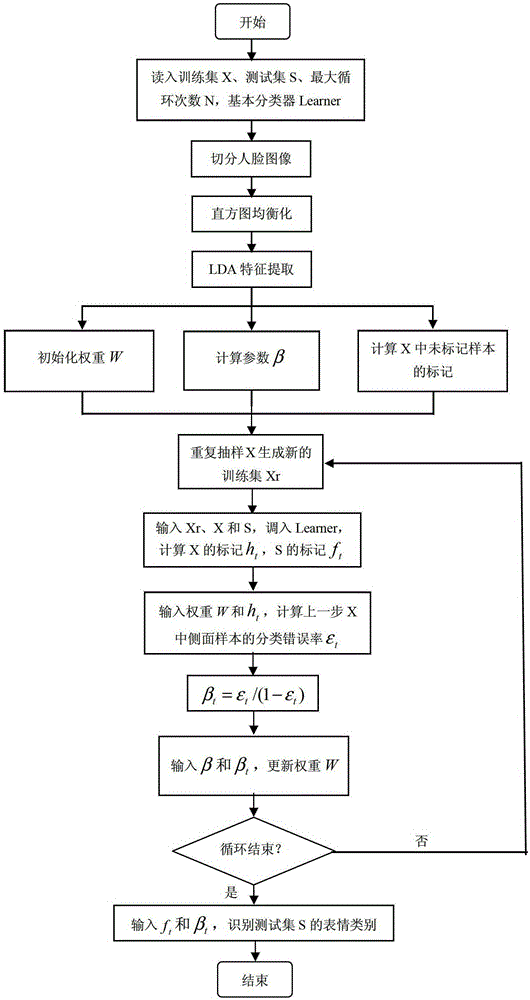
Figure 1 
Figure 2 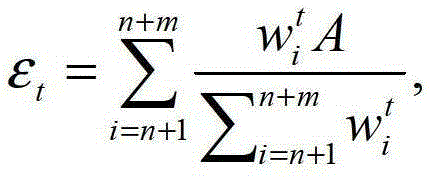
Figure 3
Abstract
Description
technical field
[0001] The invention relates to a human facial expression recognition method under the multi-pose condition based on semi-supervised learning. Background technique
[0002] Facial expression recognition is an important part of human-computer interaction and affective computing research. In expression recognition, the number of labeled images is very important. Because the reliability of the expected error of the expression model depends on the size of the image sample set, a large sample can better reflect the real distribution of the sample, so as to obtain a good generalization error. However, the labeling process of emoticon images is not only time-consuming and labor-intensive, but also prone to labeling errors. To solve this problem, the semi-supervised learning (Semi-Supervised Learning) algorithm uses a large number of unlabeled samples with the same feature distribution as auxiliary samples to participate in training, which can not only avoid the tr...
Examples
Embodiment Construction
[0051] The technical scheme that the present invention takes is:
[0052] A multi-pose facial expression recognition algorithm based on semi-supervised learning. In this method, the face area of the expression image is firstly segmented by manual segmentation, and the histogram equalization method is used to compensate the illumination of the face area; then the LDA algorithm is used to extract the expression features of the image as samples. Let the training set contain samples of all frontal images and a small number of side images, and the test set contains samples of a large number of side images. Because the frontal images in the training samples are deflected relative to the test set images, the algorithm adjusts the weights to reduce the weight of misclassified samples while ensuring that the weights of correctly classified samples remain unchanged, and finally achieves The purpose of suppressing misclassified samples and improving the effect of facial expression rec...