
Dual-purpose grease composition for rust protection and lubrication, and production method thereof
A technology of anti-rust lubrication and composition, which is applied in the direction of lubricating composition and petroleum industry, which can solve the problems of inconvenient use and poor versatility of grease, and achieve the effects of avoiding grease replacement work, improving performance, and excellent low-temperature performance
Patent Information
- Authority / Receiving Office
- CN · China
- Patent Type
- Patents(China)
- Current Assignee / Owner
- Publication Date
- 2015-06-10
- Estimated Expiration
- Not applicable · inactive patent
Smart Images
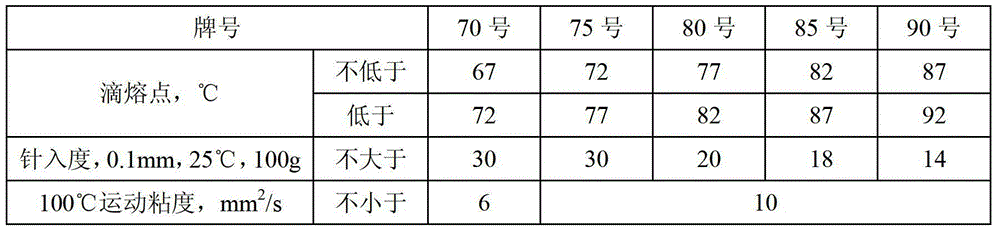
Figure 1 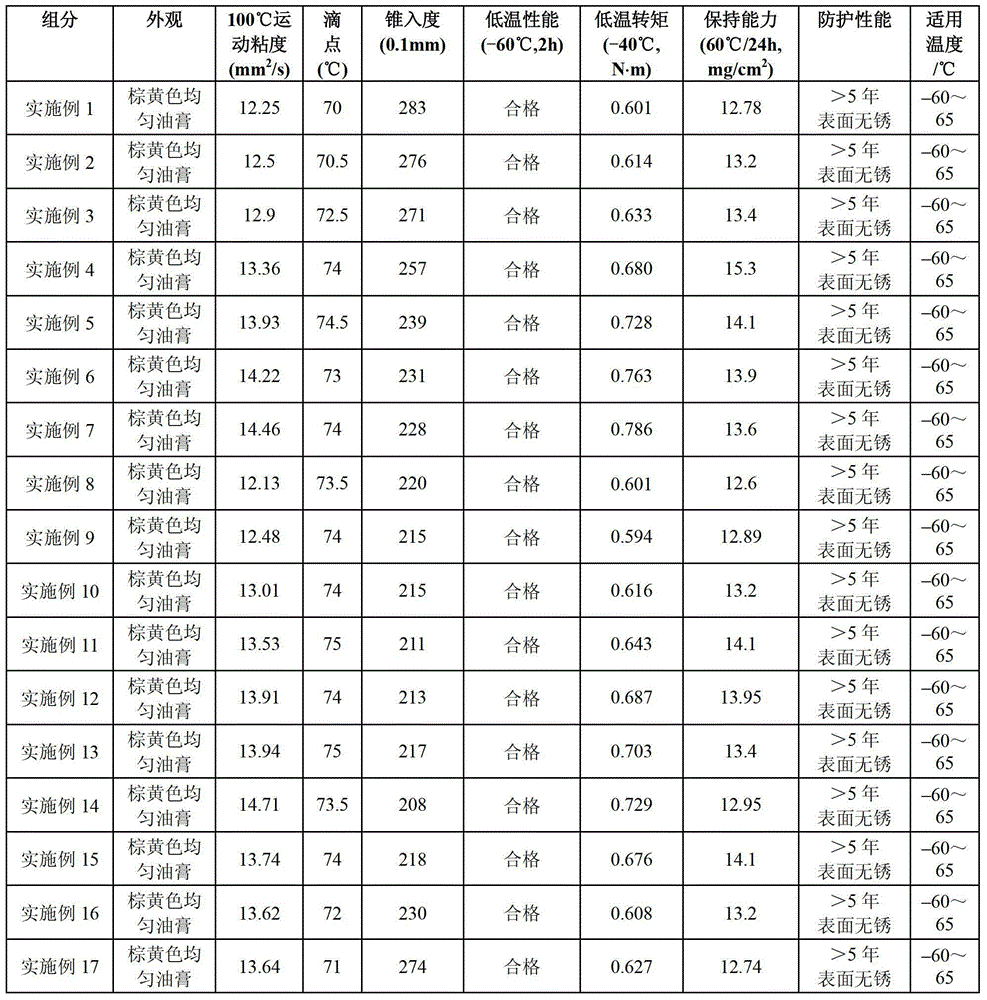
Figure 2 
Figure 3
Abstract
Description
technical field
[0001] The invention relates to a petrochemical product, in particular to an antirust and lubricating dual-purpose grease composition and a preparation method thereof. Background technique
[0002] The existing anti-rust grease varieties mainly include industrial Vaseline, steel wire rope grease, petroleum grease type anti-rust grease, dual-purpose anti-rust grease, special protective grease, etc. There are certain defects in the existing anti-rust grease: First, the general performance of this anti-rust grease is poor, and its operating temperature is -30°C. my country's cold and severe cold regions are vast, accounting for 16% of the country's land area. The lowest temperature in winter in some areas can reach -50°C, and the temperature in southern summer can even exceed 40°C. When the existing lubricating grease is used for metal surface protection, it is prone to cracks at low temperatures and may be lost at high temperatures. It cannot be used in the nort...
Examples
Embodiment 1
[0041] Add 0.2 g of 2,6-di-tert-butyl-p-cresol and 0.5 g of dibutyl phthalate into the kettle, heat to 60°C and stir at a constant temperature until they are completely dissolved to obtain a mixture A; α olefin synthetic oil (kinematic viscosity 8.39mm at 100°C 2 / s) 64.5g, stirred at 60°C for 20mim to obtain mixture B; then added low molecular weight polyisobutylene (100°C kinematic viscosity 630mm 2 / s) 5g and microcrystalline wax (dropping point 74°C, 100°C kinematic viscosity 17.65mm 2 / s) 30g into the mixture B in the reaction kettle, heated to 90°C, gradually stirred to raise the temperature to 120°C, then stirred at constant temperature for 30min, stirred evenly, and the finished product was obtained from the kettle.
Embodiment 2
[0043] Add 0.3 g of 2,6-di-tert-butyl-p-cresol and 0.7 g of dibutyl phthalate into the kettle, heat to 70°C and stir at a constant temperature until they are completely dissolved to obtain a mixture A; α olefin synthetic oil (kinematic viscosity 8.39mm at 100°C 2 / s) 62.3g, stirred at 70°C for 15mim to obtain mixture B; then added low molecular weight polyisobutylene (100°C kinematic viscosity 630mm 2 / s) 5g and microcrystalline wax (dropping point 74°C, 100°C kinematic viscosity 17.65mm 2 / s) 32g into the mixture B in the reaction kettle, heated to 90°C, gradually stirred to raise the temperature to 120°C, then stirred at constant temperature for 30min, stirred evenly, and the finished product was obtained from the kettle.
Embodiment 3
[0045] Add 0.5 g of 2,6-di-tert-butyl-p-cresol and 1.0 g of dibutyl phthalate into the kettle, heat to 70°C and stir at a constant temperature until they are completely dissolved to obtain a mixture A; α olefin synthetic oil (kinematic viscosity 8.39mm at 100°C 2 / s) 59g, stirred at 70°C for 15mim to obtain mixture B; then added low molecular weight polyisobutylene (100°C kinematic viscosity 630mm 2 / s) 5g and microcrystalline wax (dropping point 74°C, 100°C kinematic viscosity 17.65mm 2 / s) 35g into the mixture B in the reaction kettle, heated to 90°C, gradually stirred and heated to 125°C, stirred at a constant temperature for 20min, stirred evenly, and the finished product was obtained from the kettle.