
A kind of preparation method of 3-cyano-pyridine n-oxide
A technology of cyanopyridine and oxide, which is applied in the field of preparation of 3-cyano-pyridine N-oxide, can solve the problems of being unsuitable for industrialization and expensive catalyst, and achieves low price, improved purity and yield, and improved The effect of synthesis yield
Patent Information
- Authority / Receiving Office
- CN · China
- Current Assignee / Owner
- Publication Date
- 2016-05-04
Smart Images
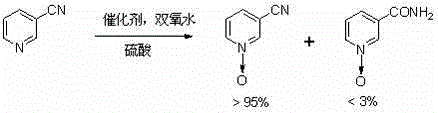
Figure 1 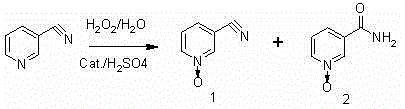
Figure 2
Abstract
Description
technical field
[0001] The invention belongs to the field of pharmacy and relates to a preparation method of 3-cyano-pyridine N-oxide. Background technique
[0002] 2-Chloronicotinic acid is an important pesticide and pharmaceutical intermediate intermediate with broad application prospects. It can be used to synthesize herbicides nicosulfuron, diflufenamide, etc. It is also used for the synthesis of anti-AIDS drug nevirapine and antidepressant drug Niflumic acid, an important raw material of non-steroidal anti-inflammatory analgesics niflumic acid, niflumic acid and niflumic acid.
[0003] Using 3-cyanopyridine as raw material to synthesize 2-chloronicotinic acid through N-oxidation, chlorination and hydrolysis is currently the most important industrialization route of 2-chloronicotinic acid. However, when 3-cyanopyridine is used as raw material for oxidation, in addition to 3-cyanopyridine-N-oxide (1), it is also easy to generate nicotinamide-N-oxide (2). Both can be use...
Examples
Embodiment 1
[0014] 100 mL of water, 7.5 g of concentrated sulfuric acid, 5 g of silicomolybdic acid and 700 g of 3-cyanopyridine were put into the reaction kettle in turn. Heating, slowly raising the temperature to 75-85°C and keeping it, and evenly adding 750mL of 30% hydrogen peroxide dropwise within 10 hours, after dropping, keep warm for 8 hours. Then cool down to below 15°C, centrifuge, and dry to obtain 768 grams of 3-cyanopyridine-N-oxide, with a yield of 95.1%, a purity of 96.3% (HPLC area normalization method), and a melting point of 169-171°C. The value is 172°C (Russian Journal of General Chemistry, 1993, 63, 1605; the same applies to the following examples).
Embodiment 2
[0016] 200 mL of water, 15 g of concentrated sulfuric acid, 10 g of phosphomolybdic acid and 1400 g of 3-cyanopyridine were put into the reaction kettle in turn. Heat, slowly raise the temperature to 86-94°C and keep it, and evenly add 1550mL of 30% hydrogen peroxide dropwise within 8 hours, and keep warm for 6 hours after the drop is completed. Then lower the temperature to below 15°C, centrifuge, and dry to obtain 1550 g of 3-cyanopyridine nitrogen oxide, with a yield of 96.1%, a purity of 95.3% (HPLC area normalization method), and a melting point of 168-171°C.
Embodiment 3
[0018] Put 100mL of water, 7.5g of concentrated sulfuric acid, 6.0g of phosphotungstic acid and 700g of 3-cyanopyridine into the reaction kettle in turn. Heat, slowly raise the temperature to 90-95°C, add 750mL of 30% hydrogen peroxide dropwise evenly within 10 hours, and keep warm for 8 hours after dropping. Then lower the temperature to below 15°C, centrifuge, and dry to obtain 765 g of 3-cyanopyridine-N-oxide, with a yield of 94.7%, a purity of 96.8% (HPLC area normalization method), and a melting point of 168-172°C.