
Dust removal process of coal gas and process gas
A process gas and coal-to-gas technology, which is applied in gasification process, gas dust removal, and combustible gas production, etc., can solve the problems of poor separation effect of small particle size particles, easy dust accumulation in pre-variable tower, high investment cost, etc., and achieves Enhance the mixing contact effect, enhance the adsorption effect, and improve the effect of economic benefits
Patent Information
- Authority / Receiving Office
- CN · China
- Patent Type
- Applications(China)
- Current Assignee / Owner
- Publication Date
- 2017-05-17
Smart Images
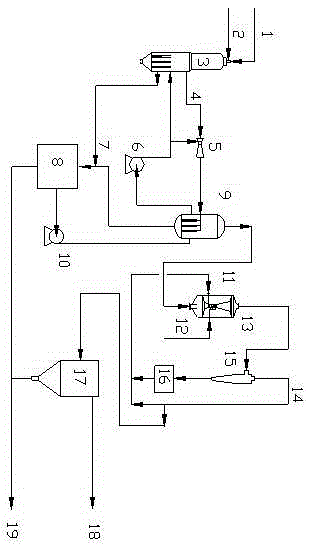
Figure 1 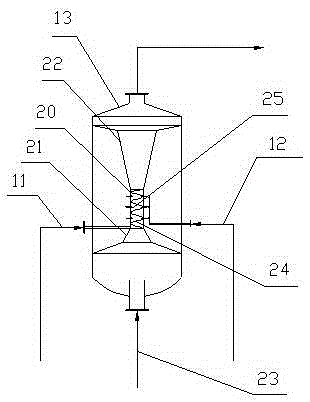
Figure 2
Abstract
Description
technical field
[0001] The invention relates to a gas dust removal process, which is especially suitable for the purification and dust removal of process gas in the coal gas industry. Background technique
[0002] In the coal gasification industry, the gasification process of coal water slurry is divided into two types: one is the gasification process of direct chilling method, and the other is the gasification process of total heat recovery type. Among these two processes, the former is widely used because of its simple process and easy control. Process gas dedusting after coal gasification is an important process of the gasification process, which directly affects the stable and continuous operation of subsequent devices.
[0003] The gasification process of the existing direct chilling method is as follows: the process gas produced by the combustion reaction in the gasifier first enters the Venturi scrubber, fully contacts and mixes with the washing water from the atomiz...
Examples
Embodiment 1
[0028] The process gas generated after the combustion reaction flows out of the gasifier 3 after being washed by the bottom water layer. The dust content of crude process gas 4 is 200g / m 3 , first enters the first-stage Venturi scrubber 5, fully contacts and mixes with the atomized washing water flowing out of the atomizing nozzle in the scrubber, and then flows into the water separation tank 9, after the washing effect of the water layer at the bottom of the tank, the condensed water-containing dust particles are washed by a large amount Removal, the dust content of the process gas 23 after the water separation tank is reduced to 2g / m 3. Then it is sent to the secondary Venturi dust collector 13, and the remaining small particle dust in the gas is first wetted by the atomized spray water 12, and collides with the sprayed adsorbent 11 for adsorption. The gas enters the cyclone separator 15 together with the adsorbent particles. After cyclone separation, the adsorbent partic...
Embodiment 2
[0035] The process gas generated after the combustion reaction flows out of the gasifier 3 after being washed by the bottom water layer. The dust content of crude process gas 4 is 300g / m 3 , first enters the first-stage Venturi scrubber 5, fully contacts and mixes with the atomized washing water flowing out of the atomizing nozzle in the scrubber, and then flows into the water separation tank 9, after the washing effect of the water layer at the bottom of the tank, the condensed water-containing dust particles are washed by a large amount Removal, the dust content of the process gas 23 after the water separation tank is reduced to 4g / m 3 . Then it is sent to the secondary Venturi dust collector 13, and the remaining small particle dust in the gas is first wetted by the atomized spray water 12, and collides with the sprayed adsorbent 11 for adsorption. The gas enters the cyclone separator 15 together with the adsorbent particles. After cyclone separation, the adsorbent parti...
Embodiment 3
[0042] The process gas generated after the combustion reaction flows out of the gasifier 3 after being washed by the bottom water layer. The dust content of crude process gas 4 is 300g / m 3 , first enters the first-stage Venturi scrubber 5, fully contacts and mixes with the atomized washing water flowing out of the atomizing nozzle in the scrubber, and then flows into the water separation tank 9, after the washing effect of the water layer at the bottom of the tank, the condensed water-containing dust particles are washed by a large amount Removal, the dust content of the process gas 23 after the water separation tank is reduced to 4g / m 3 . Then it is sent to the secondary Venturi dust collector 13, and the remaining small particle dust in the gas is first wetted by the atomized spray water 12, and collides with the sprayed adsorbent 11 for adsorption. The gas enters the cyclone separator 15 together with the adsorbent particles. After cyclone separation, the adsorbent parti...