
Printing and dyeing wastewater purifying flocculating agent, and printing and dyeing wastewater purifying application thereof
A printing and dyeing wastewater and flocculant technology, applied in the direction of flocculation/sedimentation water/sewage treatment, water/sewage treatment, chemical instruments and methods, etc., can solve problems such as difficulty in meeting industrial scale application, high manufacturing cost, and slow sedimentation rate , to achieve the effect of strong physical adsorption, low price, and accelerated coagulation
Patent Information
- Authority / Receiving Office
- CN · China
- Patent Type
- Applications(China)
- Current Assignee / Owner
- Publication Date
- 2017-09-15
- Estimated Expiration
- Not applicable · inactive patent
Smart Images
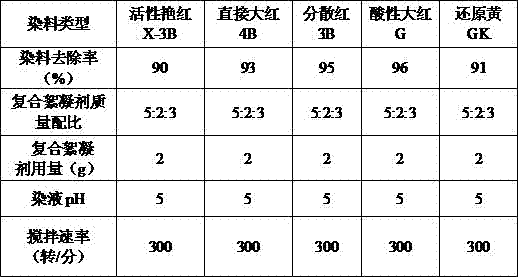
Figure 1 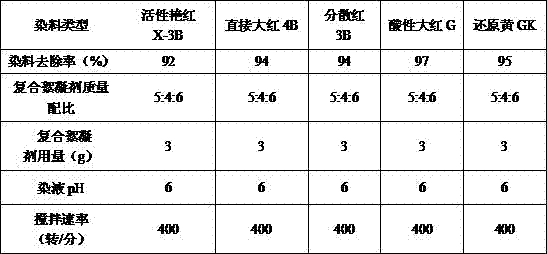
Figure 2 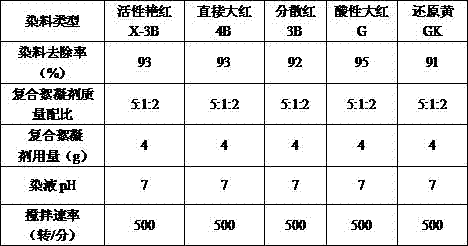
Figure 3
Abstract
Description
technical field
[0001] The invention relates to a purification treatment agent for printing and dyeing wastewater, in particular to a composite flocculation treatment agent for printing and dyeing wastewater. Background technique
[0002] With the development and expansion of the textile industry, the annual discharge of textile printing and dyeing wastewater is as high as several billion tons. The printing and dyeing wastewater has the characteristics of high chroma, complex organic components and low degree of microbial degradation, which brings many difficulties to water purification treatment. . Among them, flocculation is a relatively common method for the decolorization and purification of printing and dyeing wastewater, but the existing flocculation methods are not ideal in terms of purification rate, especially purification efficiency, and have always been a difficult problem in the purification and discharge of printing and dyeing wastewater. Urgent research is need...
Examples
Embodiment 1
[0012] The mixed components of the printing and dyeing wastewater purification flocculant include N-carboxyethyl chitosan, cationic starch and bentonite, wherein,
[0013] Bentonite is preferably purified bentonite. The purification method is as follows: add sodium-based bentonite to water with 20 times the quality of bentonite and stir for 1 hour to form a bentonite suspension. After standing for stratification, remove the supernatant, and the remaining Obtained by drying, grinding, and 200-mesh screening;
[0014] N-carboxyethyl chitosan can be prepared by using the existing N-carboxyethyl chitosan preparation method, and this application has cited a preparation method for N-carboxyethyl chitosan, but this patent application involves N-carboxyethyl chitosan is not limited to this preparation method: Dissolve chitosan in an acrylic acid solution with a mass concentration of 1.5%, prepare a chitosan solution with a concentration of 10%, stir and heat up to 55°C and keep it for...
Embodiment 2
[0019] Mixing component is identical with embodiment 1
[0020] Mix the above-mentioned treated bentonite, N-carboxyethyl chitosan and cationic starch according to the mass ratio of 5:4:6, take 3g and add it to the concentration of 50 mg / L, the volume is 1L of each listed in the table below. For various types of dye wastewater, adjust the pH of the wastewater to 6 with hydrochloric acid, stir for 30 minutes, and then settle for no less than 6 minutes. Take the supernatant to measure the liquid absorbance of the supernatant, and calculate its removal of various types of dyes The results are shown in Table 2:
[0021]
Embodiment 3
[0023] Mixing component is identical with embodiment 1
[0024] The bentonite, N-carboxyethyl chitosan and cationic starch after the above treatment were mixed according to the mass ratio of 5:1:2, and 4 g was added to the following table with a concentration of 50 mg / L and a volume of 1 L. In various types of dye wastewater, adjust the pH of the wastewater to 7 with hydrochloric acid, stir for 30 minutes, and then settle for no less than 6 minutes. Take the supernatant to measure the liquid absorbance of the supernatant, and calculate its specificity for various types of dyes. Removal rate, its result is shown in Table 3:
[0025]