
A method for producing leucine dehydrogenase by fermentation of Bacillus subtilis
A technology of leucine dehydrogenase, Bacillus subtilis, applied in the field of enzyme engineering
Patent Information
- Authority / Receiving Office
- CN · China
- Patent Type
- Patents(China)
- Current Assignee / Owner
- Publication Date
- 2020-07-07
Smart Images
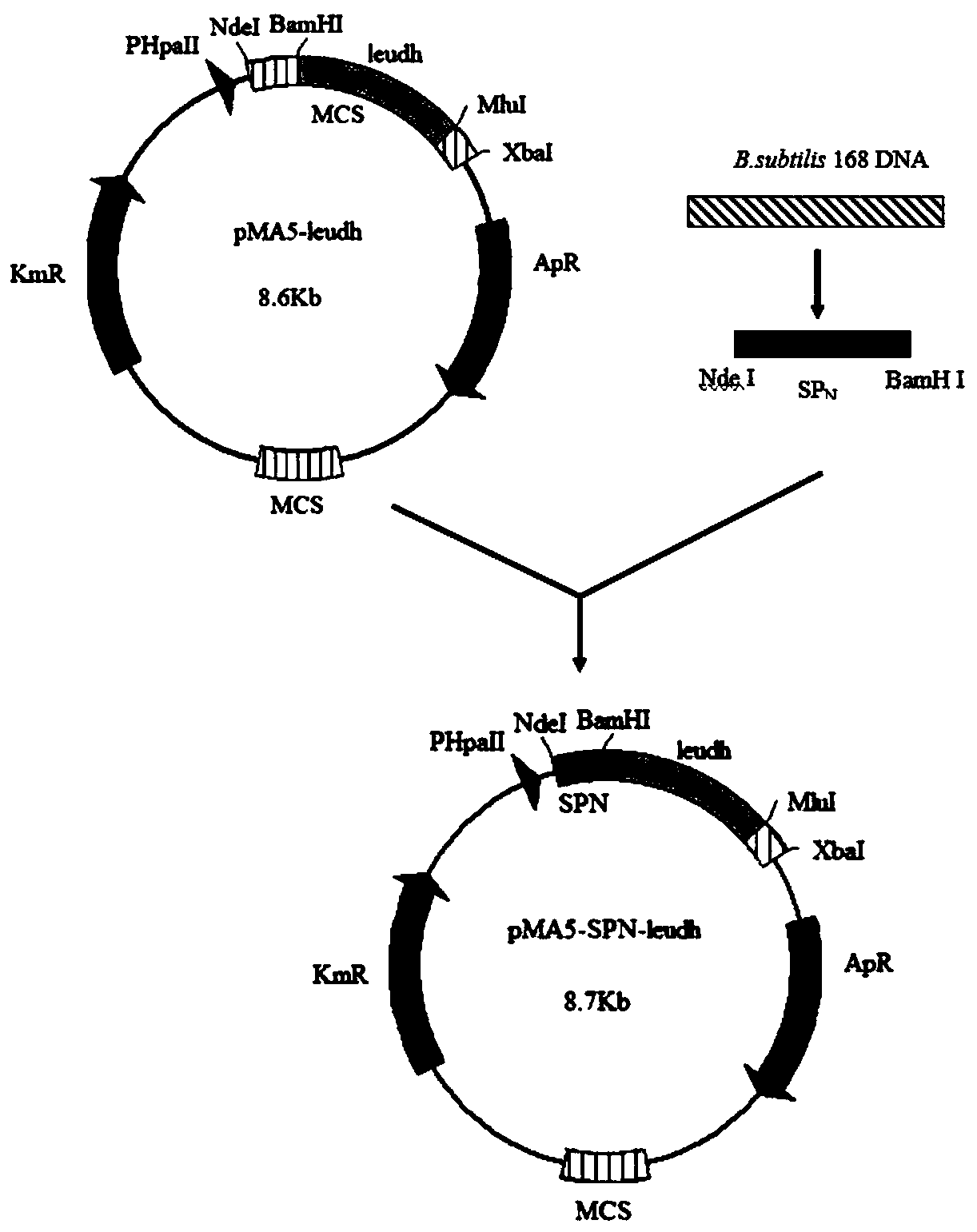
Figure 1 
Figure 2 
Figure 3
Abstract
Description
technical field
[0001] The invention relates to a method for producing leucine dehydrogenase by Bacillus subtilis fermentation, belonging to the field of enzyme engineering. Background technique
[0002] Leucine Dehydrogenase (Leucine Dehydrogenase; EC 1.4.1.9; LeuDH) belongs to the oxidoreductase class, and NAD + As a coenzyme, it can reversibly catalyze L-leucine and some branched-chain amino acids to produce corresponding ketoacids and their analogs, and can also catalyze the reduction of α-ketoacids into chiral amino acids. Currently, leucine dehydrogenases are found in many kinds of bacteria. The most studied leucine dehydrogenases are mainly derived from Bacillus, and most of them are homologous multimers of 6-8 subunits.
[0003] Leucine dehydrogenase is widely used in medicine and other industries, and can be used for biocatalysis of chiral amino acids as pharmaceutical intermediates; in clinical biochemical diagnosis, it can be coupled with urease to determine the ...
Examples
Embodiment 1
[0037] Example 1: Construction and expression of recombinant plasmid containing recombinant leucine dehydrogenase gene
[0038] Using leudh synthesized from the whole gene as a template, primers F1 / R1 (6×His introduced at the C-terminus) were used for PCR, and restriction site BamH I / Mlu I was introduced. The PCR product and plasmid pMA5 were double-enzymatically digested, and the fragments recovered from the gel were ligated overnight with T4 DNA ligase to obtain the recombinant plasmid pMA5-leudh.
Embodiment 2
[0039] Example 2: Secretion expression plasmid pMA5-SP fused with different signal peptides N - build of leudh
[0040] Extract the genomic DNA of B. subtilis 168, use the genomic DNA as a template, carry out PCR reaction through primers LipA-F / LipA-R, amplify to obtain the signal peptide LipB with sequence such as SEQ ID NO.4, and at the N-terminal of the signal peptide Nde I / BamH I sites were introduced into the C-terminus and the C-terminus, and then the signal peptide fragment and the plasmid pMA5-leudh were double-digested at the same time. After purification, the digested fragments were ligated by T4 DNA ligase and transformed into E.coli JM109. Recombinant bacteria were picked for cultivation, and plasmids were extracted for double-enzyme digestion verification. Since the signal peptide fragments are relatively short and generally about 100 bp in size, the extracted plasmids were subjected to double-enzyme digestion verification with Nde I and Mlu I. Digest for intact ...
Embodiment 3
[0041] Embodiment 3: preparation and transformation of Bacillus subtilis competent
[0042] SPI-A: 0.2g (NH 4 ) 2 SO 4 , 1.4g K 2 HPO 4 .3H 2 O, 0.6g KH 2 PO 4 , 0.1g Trisodium Citrate Dihydrate, add water to 50ml, sterilize at 121°C for 20min.
[0043] SPI-B: 0.02g MgSO 4 .7H 2 O, add water to make up to 50ml, and sterilize at 121°C for 20min.
[0044] 100×CAYE: 2g Casamino acid, 10g Yeast Extract, sterilized at 121°C for 20min.
[0045] 100×EGTA: 10mmol / l EGTA solution (add NaOH to adjust the pH to 8.0), sterilize at 121°C for 20min.
[0046] 50mM CaCl 2 : Weigh 0.5549g CaCl 2 Add water to dissolve to a volume of 100ml, and sterilize at 121°C for 20min.
[0047] 250mM MgCl 2 ·6H 2 O: weigh 2.38g MgCl 2 ·6H 2 O was dissolved in water to make up to 100ml, and sterilized at 121°C for 20min.
[0048] SPI Medium (20ml): 9.8ml SPI-A, 9.8ml SPI-B, 200ul (1% V) Glucose, 200ul (1% V) 100×CAYE
[0049] SPII Medium (6ml): 5.88ml SPI Medium, 60ul (1% V) 50mM CaCl 2 , ...