
A gene recombinant Candida utilis capable of degrading and utilizing hemicellulose and its application
A technology for producing Candida utilis and hemicellulose, which is applied in the fields of genetic engineering and fermentation engineering, can solve the problems of low output and low economic value of xylose, and achieves simplified operation steps, high added value of products, and avoidance of chemical environment. The effect of pollution
Patent Information
- Authority / Receiving Office
- CN · China
- Patent Type
- Patents(China)
- Current Assignee / Owner
- Publication Date
- 2019-10-11
Smart Images
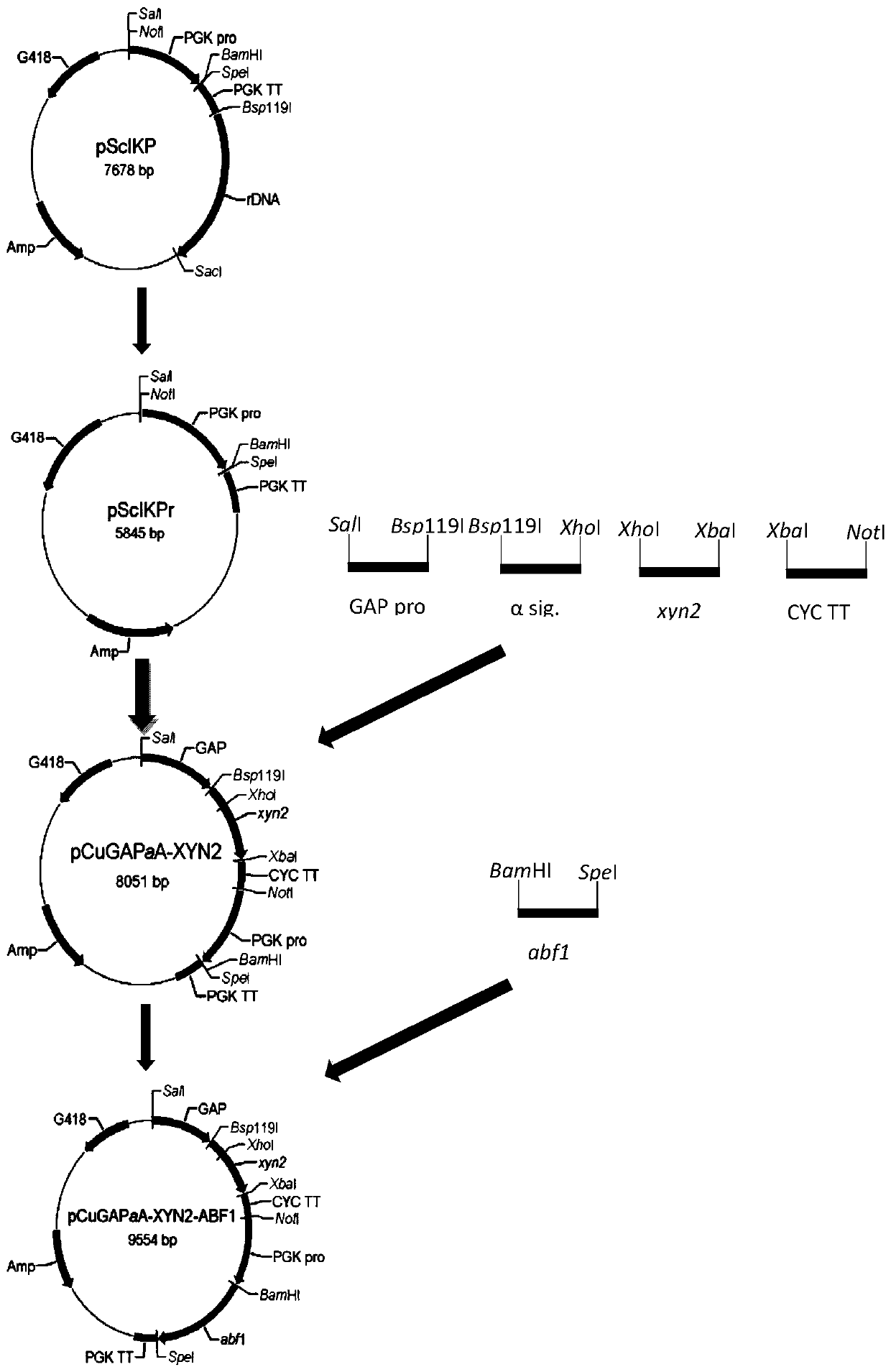
Figure 1 
Figure 2 
Figure 3
Abstract
Description
technical field
[0001] The present invention relates to the field of genetic engineering and fermentation engineering, in particular to a genetically recombinant Candida utilis capable of degrading and utilizing hemicellulose and its application. Integrated biotechnology of xylooligosaccharides, arabinose, and xylitol. Background technique
[0002] Xylooligosaccharides, xylitol and arabinose are all prebiotics and have important physiological functions. Existing studies have shown that xylooligosaccharides, xylitol and arabinose have important physiological functions, mainly including: (1) As prebiotics, they cannot be digested and absorbed in the human body, and can effectively promote the production of probiotics such as bifidobacteria. Proliferation, thereby inhibiting the growth of harmful bacteria, thereby improving the intestinal environment; (2) improving and inhibiting diarrhea and relieving constipation; (3) inhibiting the absorption of sucrose, so as to inhibit th...
Examples
Embodiment 1p
[0036] The construction of embodiment 1 pScIKPr carrier
[0037] S1. Double digest pScIKP with Bsp119I and SacI, the digestion conditions are as follows:
[0038]
[0039] After the above-mentioned components were mixed, the enzyme digestion reaction was carried out at 37° C. for 2 hours, and a fragment of about 5.8 kb was recovered by agarose gel electrophoresis.
[0040] S2. The above-mentioned 5.8kb fragment is subjected to end-smoothing treatment with S1 nuclease, and the conditions are as follows:
[0041]
[0042] After mixing the above-mentioned reaction components, react at 23°C for 10 minutes, then add 10mM EDTA to terminate the reaction; then use the PCR product purification kit (Tiangen Biochemical Technology Co., Ltd.) to purify and set aside;
[0043] S3. Self-circularize the fragment obtained in the above step S2 with T4 DNA ligase to obtain the transformed vector pScIKPr.
Embodiment 2
[0044] Construction of embodiment 2 xylanase gene (xyn2) expression cassette
[0045] S1. Design of target gene primers:
[0046] S11. Primers for the mature peptide coding region of xylanase: According to the sequence of the xylanase gene xyn2 of Trichoderma reesei provided by NCBI, use oligo6 biological software to design primers for specific amplification of xyn2 and mutated enzyme digestion The primers for the site, and the sequence of the corresponding enzyme cutting site are as follows:
[0047] Primers for xyn2 and primers for mutant XhoI and SacI sites:
[0048] Mxyn2-F:
[0049]
[0050] Mxyn2-R: 5'- TCTAGA TTAGTTGCTGACACTCTGTGAGGCAG-3'
[0051] The above are the amplification primers of xyn2, and the 5' ends of the two primers are respectively the restriction sites of XhoI and XbaI; the upstream primer simultaneously mutates the restriction site of XhoI in the coding region of xyn2 (dot added below).
[0052] Mxyn2-SacImut-F:
[0053]
[0054] Mxyn2-SacI...
Embodiment 3
[0086] Embodiment 3 Construction of arabinofuranosidase gene (abf1) expression vector
[0087] S1. Design and amplification of target gene primers: According to the sequence of arabinofuranosidase gene abf1 of Trichoderma reesei provided by NCBI, use oligo6 biological software to design primers and mutated restriction sites for specific amplification of abf1 The primers, and the sequence of the corresponding restriction site is as follows:
[0088] abf1 primers and abf1 mutant SacI site primers:
[0089] TrABF1-F: 5'- GGATCC TGCTCTCCAACGCTCGTATC-3';
[0090] TrABF1-R: 5'- ACTAGT TTAAGCAAAACCGCCACTAACCAC-3';
[0091]The above are the amplification primers of abf1, and the 5' ends of the two primers are the restriction sites of BamHI and SpeI respectively.
[0092]
[0093] Above are the primers for the SacI site in the mutated xyn2 coding region (the dots below).
[0094] S2. PCR amplification of the abf1 coding region fragment: a two-step PCR method was used to ampl...