
Bionic fishtail oar
A technology of fish tail scull and tail blade, which is applied in the direction of propulsion components, ship construction, ships, etc., can solve the problem of low efficiency and achieve the effect of convenient operation and high speed
Patent Information
- Authority / Receiving Office
- CN · China
- Patent Type
- Applications(China)
- Current Assignee / Owner
- Publication Date
- 2020-04-17
- Estimated Expiration
- Not applicable · inactive patent
Smart Images
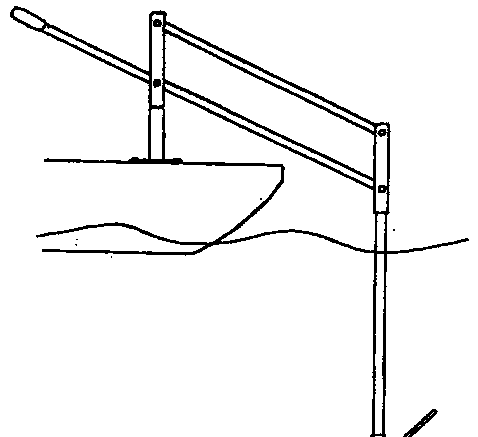
Figure 1 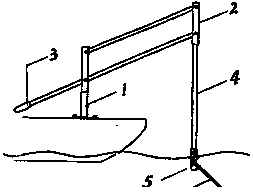
Figure 2 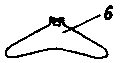
Figure 3
Abstract
Description
technical field
[0001] The invention relates to a propeller for a human-powered ship, in particular to a bionic fishtail oar which can effectively propel a small boat forward by using up and down shaking.
[0002] technical background
[0003] Background technology: the traditional scull is a scull that people (by pushing and pulling) shake to both sides. It is only suitable for use on slightly larger ships. Nowadays, slightly larger ships basically adopt the mode of propulsion by motorized propellers, while small boats It is not suitable to use sculls, because the way of propulsion by sculls will make the boat run to both sides, and the way of rowing with oars is actually not very efficient, because the way of rowing is intermittent, not continuous. Contents of the invention
[0004] Summary of the invention: The object of the present invention is to imitate the swimming method of whales and dolphins with the tail swinging up and down, and provide a bionic fishtail oar whi...
Examples
Embodiment 1
[0010] Embodiment 1 refers to 1, 2, and 3 bionic fishtail sculls, including a fixed frame 1, a crowbar frame 2, a handle 3, a lifting rod 4, a tail blade connector 5, and a fishtail blade 6. The fixed frame 1 is fixed at the stern, and the pry bar The rod frame 2 is connected to the fixed frame 1 through a shaft and a bearing, the handle 3 is connected to the crowbar frame 2, the top of the lifting rod 4 is connected to one end of the crowing rod frame 2, and the tail leaf connecting piece 5 with the up and down backing is fixed on the bottom of the lifting rod 4. At the top, the fishtail blade 6 is connected to the tail blade connector 5 through a copper ring and a shaft. When the handle 3 is moved upwards, one end of the crowbar frame 2 will move down with the lifting rod 4. At this time, due to the resistance of the water and the blocking of the upper backing, the fishtail leaf 6 forms an upward angle with the horizontal direction, and makes the fishtail The downward thrust...