
A kind of pharmaceutical composition comprising sunitinib and its preparation and application
A technology of sunitinib and its composition, which is applied in the field of tumor treatment, can solve the problems of reducing sunitinib drug resistance, severe drug resistance, and reducing the therapeutic effect, so as to improve drug safety, significantly kill efficiency, The effect of broad market prospects
Patent Information
- Authority / Receiving Office
- CN · China
- Patent Type
- Patents(China)
- Current Assignee / Owner
- Publication Date
- 2022-02-11
Smart Images
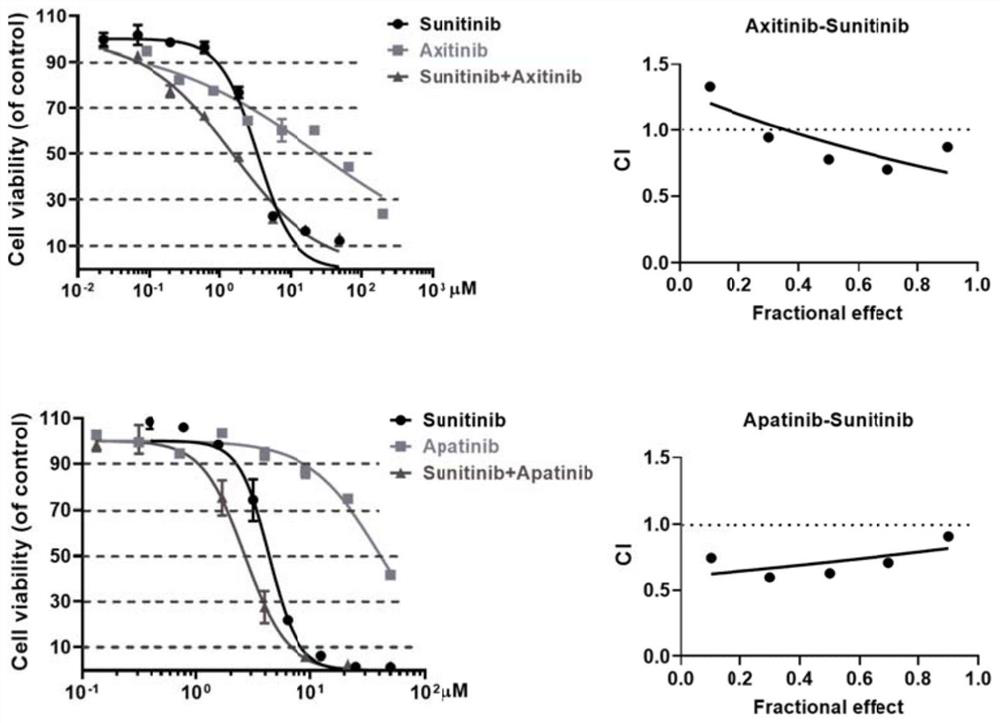
Figure 1 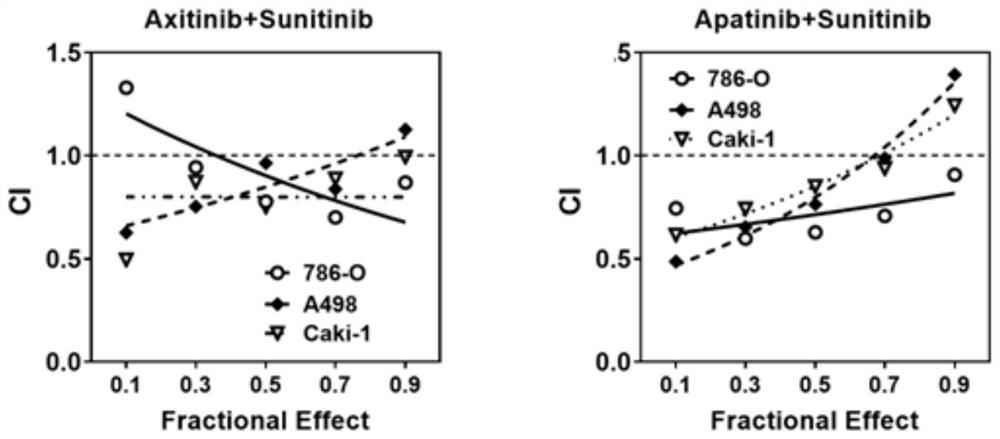
Figure 2 
Figure 3
Abstract
Description
technical field
[0001] The invention belongs to the technical field of tumor treatment, and in particular relates to a pharmaceutical composition containing sunitinib and its preparation and application. Background technique
[0002] Sunitinib is a highly effective, multi-target tyrosine kinase receptor inhibitor, its targets include vascular endothelial cell growth factor receptor 1, 2, 3 (VEGF Receptor, VEGFR-1, 2,3), platelet growth factor receptor α, β (PDGF Receptor, PDGFR-α, β), c-KIT and so on. According to the existing research results, sunitinib mainly exerts anti-tumor effects through three ways: inhibiting tumor angiogenesis, destroying tumor blood vessels and directly killing tumor cells. Currently, sunitinib is approved for the treatment of advanced metastatic renal cell carcinoma and imatinib-resistant gastrointestinal stromal tumor (Gastrointestinal Stromal Tumor, GIST). Corresponding research and clinical trials are also underway in other cancers such as no...
Examples
Embodiment 1
[0040] Example 1 Cell Proliferation Inhibition Experiment in Vitro
[0041] (1) Take 786-O cells in the logarithmic growth phase and plant them in a 96-well plate at a certain density (1500-2000 / well);
[0042] (2) Discard the old medium after 24 hours, divide the cells into 5 groups of 1-5 for use, add medium containing different drug concentrations, set 3 duplicate wells for each group, and add sunitinib alone to group 1 Sunitinib and 10 μM apatinib were added to group 2, sunitinib and 10 μM apatinib were added to group 3, DMSO was added to group 4, and group 5 was used as a blank group;
[0043] (3) After culturing for 48 hours, discard the drug solution, add medium containing 5% CCK-8, incubate at 37°C for 3 hours, and then use a microplate reader to detect the OD value at 450nm.
[0044] Based on the DMSO group, the cell survival rate = (OD value of the drug-dosed group - OD value of the blank group) / (OD value of the DMSO group - OD value of the blank group) × 100%, co...
Embodiment 2
[0048] Example 2 In vitro anti-tumor synergy experiment
[0049] In this experiment, on the basis of the in vitro cell proliferation inhibition experiment stated in Example 1, by measuring the 786-O cells at 10%, 30%, 50%, 70% and 90% inhibition rate, single drug (Apa Apatinib, Axitinib, or Sunitinib) and the drug concentration required for combination therapy (Apatinib + Sunitinib or Axitinib + Sunitinib), so as to calculate the combination index using the formula (Combination Index, CI), make a Fa-CI curve: where the CI calculation formula is as follows:
[0050] CI = D 1x / D 1 + D 2x / D 2 +( D 1x · D 2x ) / ( D 1 · D 2 ).
[0051] D 1x : The concentration of the first drug when the combination group reaches a certain cell inhibition rate; D 2x : The concentration of the second drug when the combination group reaches a certain cell inhibition rate; D 1 : The concentration of the first drug when the single-drug group reaches a certain cell inhibition ...
Embodiment 3
[0056] Example 3 In vitro anti-tumor synergistic compatibility experiment
[0057] (1) The 786-O, A498 and Caki-1 cells in the logarithmic growth phase were planted in a 96-well plate at a certain density (1500-2000 / well);
[0058] (2) Discard the old medium after 24 hours, add drugs containing different compatible forms to continue the culture, and set 3 duplicate wells for each group;
[0059] (3) After culturing for 48 hours, discard the cell culture medium, add a medium containing 5% CCK-8, incubate at 37°C for 3 hours, and then use a microplate reader to detect the OD value at 450nm.
[0060] Based on the DMSO group, the corresponding synergistic effect evaluation was carried out on the inhibition rate, and the combined drug effect was analyzed by King's formula (Q value):
[0061] Q=E (A+B) / (E A +E B -E A ×E B ), that is, E (A+B) : Inhibition rate of combination drug, E A : Inhibition rate of drug A alone, E B : Inhibition rate of drug B alone. When Q>1.15, it...