
Equivalent modeling method for photovoltaic cell
A photovoltaic cell and equivalent modeling technology, applied in the field of effective modeling, can solve problems such as complex calculations and low model accuracy, and achieve the effects of avoiding iterative calculations, easy calculations, and avoiding complex
Patent Information
- Authority / Receiving Office
- CN · China
- Patent Type
- Applications(China)
- Current Assignee / Owner
- Publication Date
- 2020-09-01
- Estimated Expiration
- Not applicable · inactive patent
Smart Images
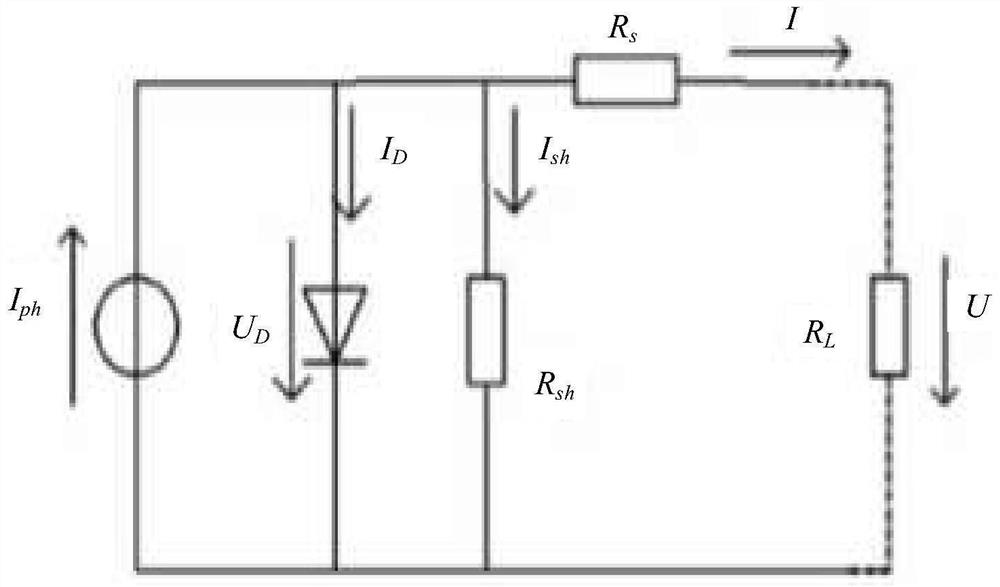
Figure 1 
Figure 2 
Figure 3
Abstract
Description
technical field
[0001] The invention relates to the field of photovoltaics, in particular to a photovoltaic cell equivalent modeling method. Background technique
[0002] With the increasing awareness of environmental protection, photovoltaic power generation systems have been more and more widely used. Photovoltaic power generation systems are usually small in scale and are used in changing installation environments and application scenarios. Photovoltaic systems usually require flexible design, and it is difficult to adopt a general modular design.
[0003] In designing a photovoltaic system, an important step is to obtain an accurate mathematical model of the photovoltaic power generation unit. However, in different regions, the temperature and light intensity are different, and the models provided by manufacturers are usually difficult to cover all working conditions. For this, parametric models need to be used in the simulation design process.
[0004] In the prior a...
Examples
Embodiment Construction
[0032] Below, according to the accompanying drawings, preferred embodiments of the present invention are given and described in detail, so that the functions and features of the present invention can be better understood.
[0033] Embodiments of the present invention include a photovoltaic cell equivalent modeling method, the model used in the method is as figure 1 shown. In this model, I sh Is the photogenerated current, and its value is proportional to the area of the photovoltaic cell and the intensity of the incident light; I D is the current flowing through the equivalent diode; I is the load current output by the photovoltaic cell; U D Is the terminal voltage of the equivalent diode. Under the condition of no light, the basic behavior of the photovoltaic cell is similar to that of an ordinary diode; U is the voltage at both ends of the load; R L is the load resistance of the battery; R S is the equivalent series resistance; R sh is the equivalent parallel resistan...