
Rotatable LED lamp holder
A technology of LED lamp holders and LED lamp beads, which is applied in the direction of lighting devices, light sources, components of lighting devices, etc., can solve the problems that the LED lamp cannot be rotated, the projection angle of the LED lamp cannot be changed, etc., and achieves the effect of easy disassembly and assembly
Patent Information
- Authority / Receiving Office
- CN · China
- Patent Type
- Applications(China)
- Current Assignee / Owner
- Publication Date
- 2020-09-11
- Estimated Expiration
- Not applicable · inactive patent
Smart Images
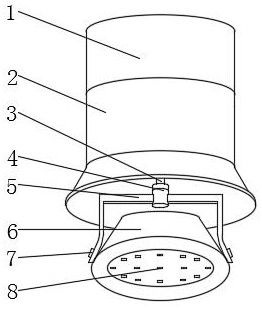
Figure 1 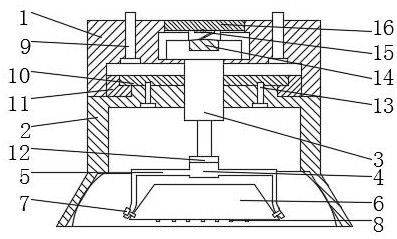
Figure 2 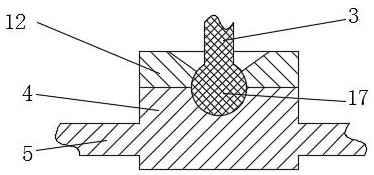
Figure 3
Abstract
Description
technical field
[0001] The invention relates to the field of LED lamp holders, in particular to a rotatable LED lamp holder. Background technique
[0002] LED is a light-emitting diode, which is a new technology developed in the middle of the 20th century. It relies on silver glue or white glue in the semiconductor heterojunction to cure it on the bracket, and then welds it with silver wires, and then seals it with epoxy resin around it. To protect the internal core wire, so the LED has good anti-seismic performance, and the lamps and lanterns made of LED do not generate heat during the lighting process, the energy conversion efficiency is close to 100%, and the service life is super long, which is the development direction of lighting technology. The preferred lamp for decoration, the LED lamp is fixed through the LED lamp holder, which makes the LED lamp easy to disassemble. However, the existing LED lamp holders are all fixed, and the LED lamp cannot be rotated, and the ...
Examples
Embodiment Construction
[0020] In order to make the technical means, creative features, goals and effects achieved by the present invention easy to understand, the present invention will be further described below in conjunction with specific embodiments.
[0021] In the description of the present invention, it should be noted that the terms "upper", "lower", "inner", "outer", "front end", "rear end", "both ends", "one end", "another end" The orientation or positional relationship indicated by etc. is based on the orientation or positional relationship shown in the drawings, and is only for the convenience of describing the present invention and simplifying the description, rather than indicating or implying that the referred device or element must have a specific orientation, use a specific Azimuth configuration and operation, therefore, should not be construed as limiting the invention. In addition, the terms "first" and "second" are used for descriptive purposes only, and should not be understood ...