
An assembly and adjustment method of an off-axis parabolic mirror group
A technology of off-axis parabolic mirror and its assembly and adjustment method, which is applied in the field of assembly and adjustment of off-axis parabolic mirror group, which can solve the problems of difficult to achieve high-precision standard installation and adjustment, cannot eliminate system errors, etc., and achieve the effect of improving the accuracy of assembly and adjustment
Patent Information
- Authority / Receiving Office
- CN · China
- Patent Type
- Patents(China)
- Current Assignee / Owner
- Publication Date
- 2022-03-08
Smart Images
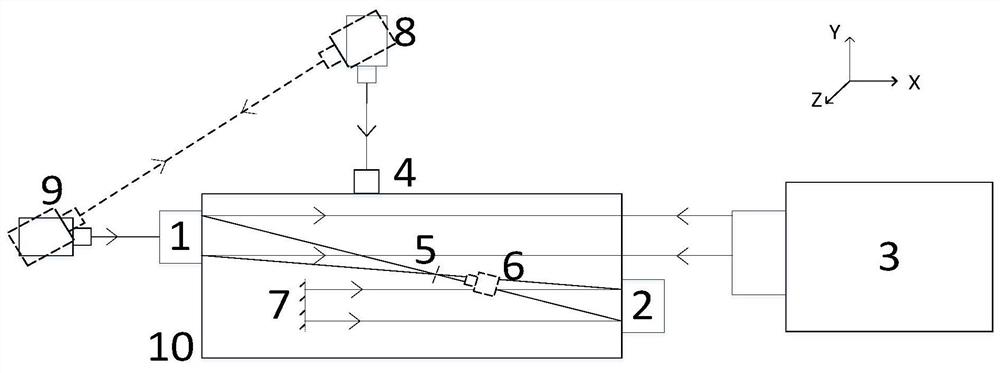
Figure 1 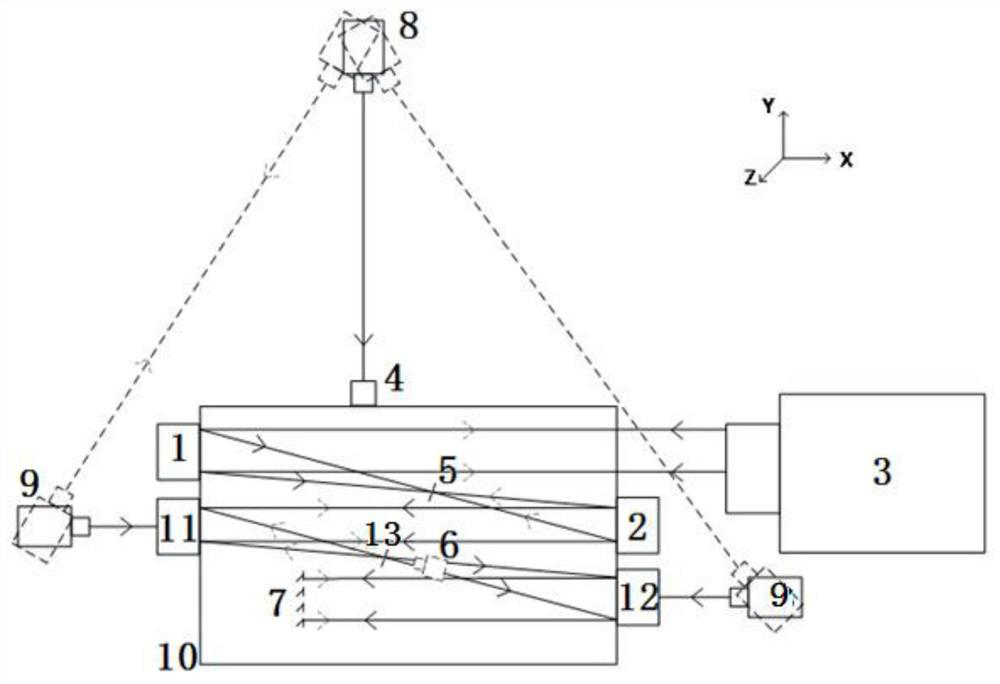
Figure 2
Abstract
Description
technical field
[0001] The invention belongs to the technical field of assembly and adjustment methods, and in particular relates to an assembly and adjustment method of an off-axis parabolic mirror group. Background technique
[0002] Off-axis parabolic mirrors can generate high-quality parallel beams without central occlusion with a simple surface shape, which can effectively improve the imaging quality of the optical system and simplify the optical system. Using multiple off-axis parabolic mirrors to form an off-axis parabolic mirror group can achieve high system efficiency. The demand for precision miniaturization. Since the off-axis parabolic mirror is not a rotationally symmetrical surface, compared with the ordinary spherical mirror, the off-axis parabolic mirror also needs to consider its own rotation vector. For the assembly and adjustment of multi-off-axis parabolic mirror groups, there are extremely high requirements for the construction of the overall optical sy...
Examples
Embodiment Construction
[0037] In order to further understand the present invention, the preferred embodiments of the present invention will be described below in conjunction with specific embodiments, but it should be understood that these descriptions are only for further illustrating the features and advantages of the present invention rather than limiting the patent requirements of the present invention.
[0038]The method for assembling and adjusting the off-axis parabolic mirror group of the present invention, the off-axis parabolic mirror group is composed of N groups of off-axis parabolic mirror groups, and each group of off-axis parabolic mirror groups is composed of two off-axis parabolic mirror groups;
[0039] Such as figure 1 As shown, when N=1, the adjustment method includes the following steps:
[0040] Step 1, setting a back mirror on the back of each off-axis parabolic mirror, the back mirror is a plane reflector;
[0041] Step 2. Calculate the theoretical position of the off-axis p...