
Fluorescence ternary correlation spectrum system for analysis of binding interaction among three molecules
A related spectrum and binding technology, applied in fluorescence/phosphorescence, analytical materials, material excitation analysis, etc., can solve problems such as the inability to achieve joint binding, and achieve the effect of increasing the number of species and increasing the amplitude
Patent Information
- Authority / Receiving Office
- CN · China
- Patent Type
- Applications(China)
- Current Assignee / Owner
- Publication Date
- 2021-08-24
Smart Images
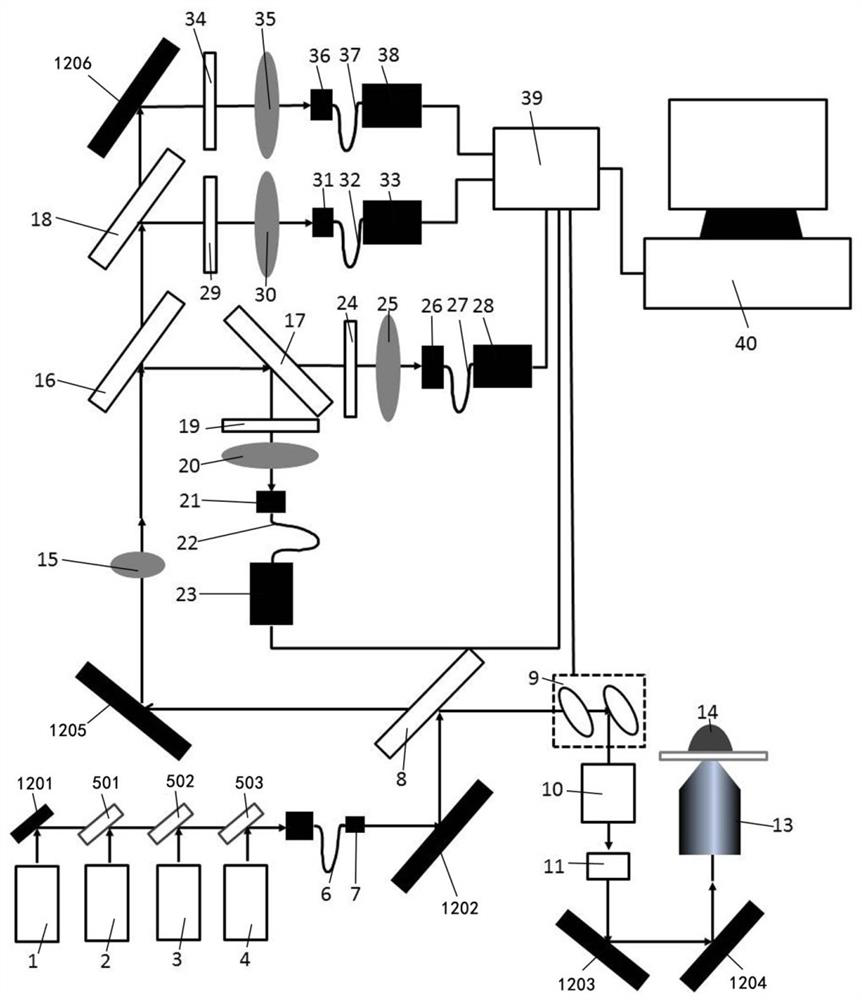
Figure 1 
Figure 2 
Figure 3
Abstract
Description
technical field
[0001] The invention relates to a fluorescence ternary correlation spectrum system used for analyzing the combination of three molecules, belonging to the field of spectrum analysis. Background technique
[0002] Microscopic imaging and spectral analysis technologies have become important research tools in current life science research due to their advantages of non-invasiveness and high detection sensitivity, such as photoactivated localization microscopy and stochastic optical reconstruction microscopy. Through continuous pairwise and ternary interactions between different biomolecules in cells, electron transfer, signal transduction, function regulation, etc. are carried out to realize the physiological functions of cells. The occurrence of abnormal intermolecular interactions in cells, such as the aggregation of polyproteins, is the basis of many diseases, such as Creutzfeldt-Jakob and Alzheimer's disease, and may lead to cancer. Many technologies curren...
Examples
Embodiment 1
[0036] In the fluorescence ternary correlation spectroscopy system provided by the present invention, the laser wavelengths output by the first solid-state laser 1, the second solid-state laser 2, the third solid-state laser 3, and the fourth solid-state laser 4 (Sapphire series or OBIS series from Coherent, Germany) Respectively 640nm, 561nm, 488nm and 405nm, respectively through the first reflection mirror 1201, the first dichroic mirror 501, the second dichroic mirror 502, the third dichroic mirror 503 (respectively from DMLP567, DMLP490 and DMLP425 from Thorlab Company ) is delivered to the collimating coupler (PAF2A-A10A from Thorlab Company) and enters the output of single-mode fiber 6 (P3-405B from Thorlab Company) after being coupled, and the output laser beam passes through the collimating beam expander 7 (from Thorlab Company’s P3-405B) F810APC-543), reflected by the second reflector 1202 and the fourth dichroic mirror 8 (ZT405 / 488 / 561 / 640rpcv2 from Chroma Company), a...