
Underwater carrier initial alignment method based on DVL assistance and vector truncation K matrix
A technology of initial alignment and matrix, applied in measurement devices, instruments, etc., to avoid traditional traps, improve initial alignment accuracy, and speed up convergence
Patent Information
- Authority / Receiving Office
- CN · China
- Patent Type
- Applications(China)
- Current Assignee / Owner
- Publication Date
- 2021-11-19
Smart Images
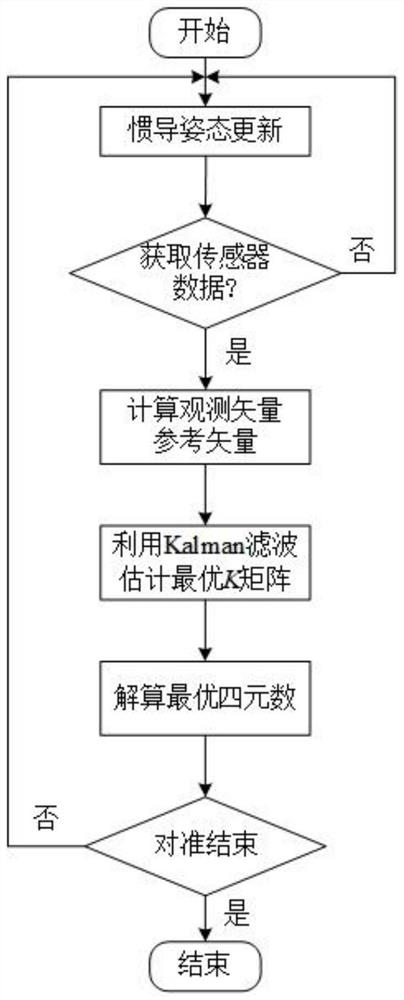
Figure 1 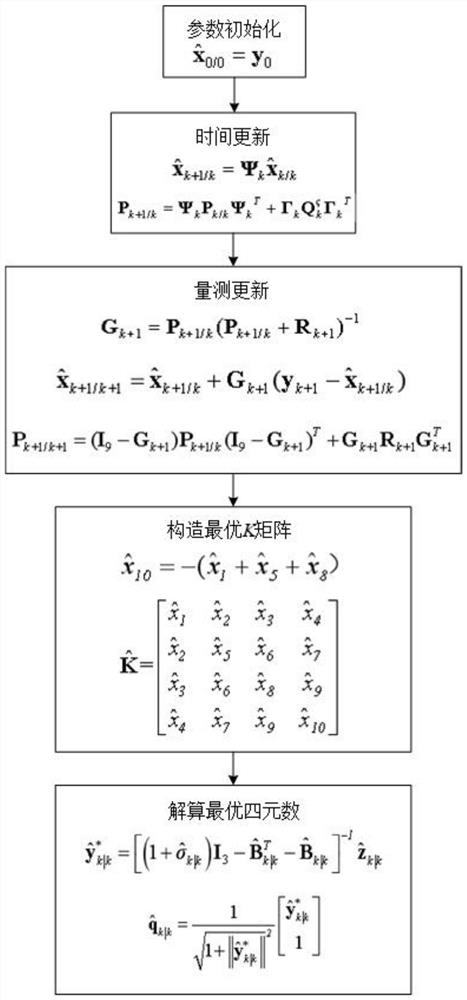
Figure 2 
Figure 3
Abstract
Description
technical field
[0001] The invention relates to an optimal K-matrix attitude estimation method based on a Wahba problem in the technical field of initial alignment of a navigation system, in particular to an initial alignment method for an underwater vehicle based on DVL assistance and vector truncated K-matrix. Background technique
[0002] Ocean observation is the basic means of understanding the ocean and the basis for marine economic development, environmental protection and rights protection. Implementing the "transparent ocean" strategy, strengthening the development of ocean observation technology and equipment, and accelerating the construction of ocean observation systems are an important direction for ocean science and technology innovation at present. As an important equipment of ocean observation technology, autonomous underwater vehicle (AUV) has attracted extensive attention of researchers due to its good concealment and the ability to replace humans to perform...
Examples
Embodiment
[0107] The present invention takes AUV as an example, adopts the underwater vehicle initial alignment method based on DVL assistance and vector truncated K matrix to implement the specific process, first defines the reference standard coordinate system required for the solution, and obtains inertial sensor data and DVL real-time data , and preprocess the data to calculate the observation vector ξ and the reference vector r; establish the matrix state equation and measurement equation of the system; use the zero trace and symmetry of the K matrix to vectorize the matrix state equation and measurement equation Truncation; then use Kalman filter to filter to obtain the optimal estimated K matrix; finally extract the optimal quaternion from the optimal estimated K matrix, use the attitude matrix chain rule to obtain the current attitude matrix, and then calculate the loss alignment angle to complete the initial alignment process.
[0108] Such as figure 1 As shown, the present in...