
Rubber composition for tires and pneumatic tire
a technology of rubber composition and pneumatic tire, which is applied in the direction of special tyres, rolling resistance optimization, transportation and packaging, etc., can solve the problems of low affinity of silicone, insufficient effect of enhancing these functions, and insufficient wet performance, etc., to achieve excellent wear resistance and low rolling resistance
Patent Information
- Authority / Receiving Office
- US · United States
- Patent Type
- Patents(United States)
- Current Assignee / Owner
- Publication Date
- 2018-08-07
Smart Images
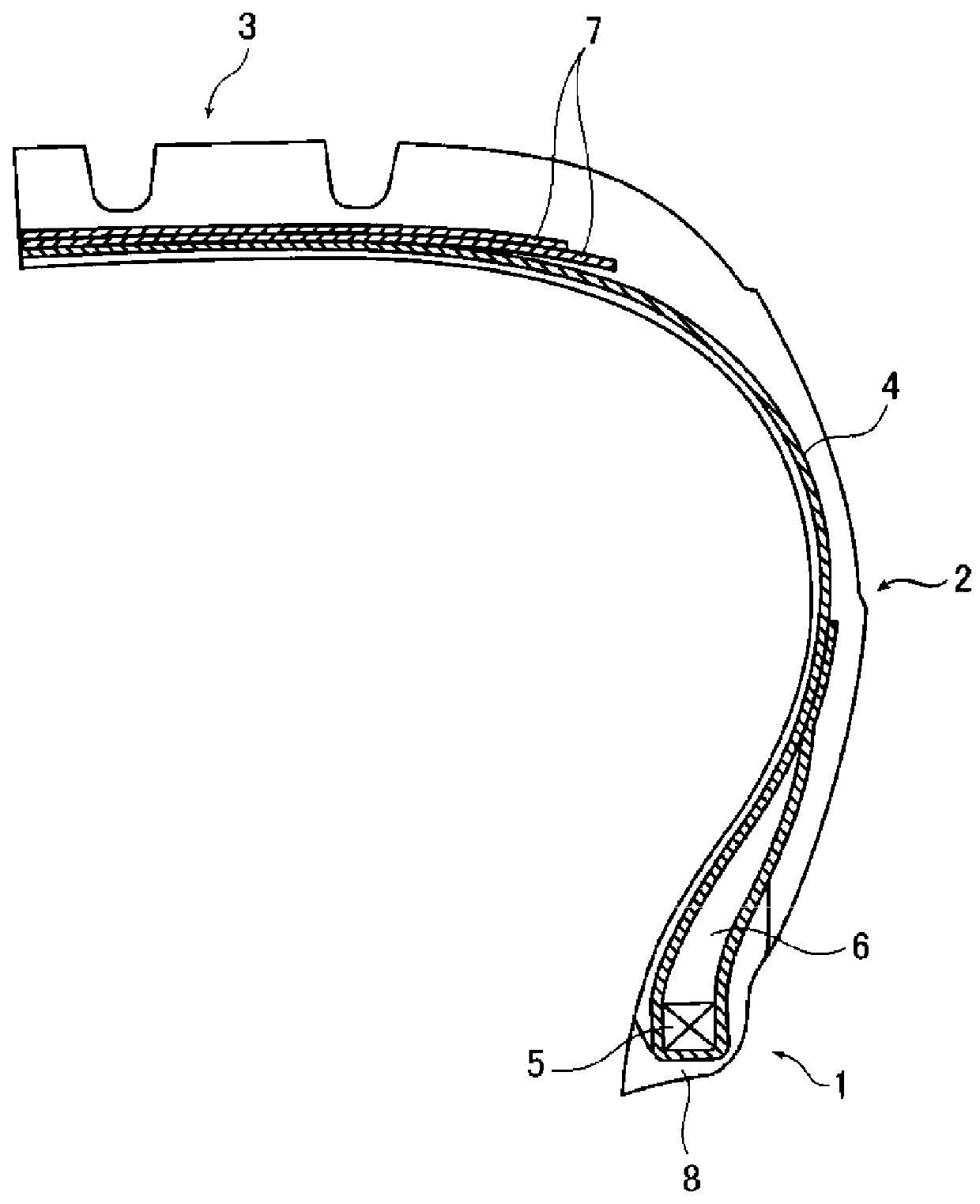
Figure 1
Abstract
Description
TECHNICAL FIELD
[0001] The present technology relates to a rubber composition for tires and a pneumatic tire.BACKGROUND ART
[0002] In recent years, enhancement in wear resistance, wet performance, and dry performance have been demanded from the perspective of safety. The reduction in tire rolling resistance has also been demanded from the perspective of fuel efficiency when a vehicle is traveling. For these, methods of enhancing these functions by blending silica in a rubber component constituting a tread portion of a tire have been known.
[0003] However, silica has low affinity with rubber components, and the cohesiveness between silicas is high, so if silica is simply blended to the rubber component, the silica is not dispersed, which leads to the problem that the effect of enhancing these functions cannot be achieved sufficiently.
[0004] In this connection, International Patent Publication No. WO / 2011 / 105362 discloses a rubber composition containing a conjugated diene rubber containing a...
Examples
examples
[0157]Hereinafter, the present technology will be further described in detail with reference to examples; however, the present technology is not limited thereto.
Production of Solution-Polymerized SBR
[0158]In a nitrogen-purged 100 mL ampoule bottle, 28 g of cyclohexane and 8.6 mmol of tetramethylethylenediamine were added, and then 6.1 mmol of n-butyllithium was further added. Then, 8.0 g of isoprene was slowly added, and the mixture was reacted for 120 minutes in the 60° C. ampoule bottle to yield isoprene block (used as initiator 1). The weight average molecular weight, molecular weight distribution, and isoprene unit-derived vinyl bond content of this initiator 1 were measured. The measurement results are shown in Table 1.
[0159]Then, in a nitrogen atmosphere in an autoclave equipped with a stirrer, 4000 g of cyclohexane, 357.7 g of 1,3-butadiene, and 132.3 g of styrene were loaded, and then the total amount of initiator 1 was added, and polymerization of the mixture was initiated ...