
Substrate processing apparatus
a processing apparatus and substrate technology, applied in semiconductor/solid-state device testing/measurement, instruments, material analysis, etc., can solve the problems of measurement errors, concentration measurement cannot be carried out in real time, etc., and achieve the effect of reducing the amount of etching of silicon nitride film, good precision and high precision
Patent Information
- Authority / Receiving Office
- US · United States
- Patent Type
- Patents(United States)
- Current Assignee / Owner
- Publication Date
- 2018-12-11
Smart Images
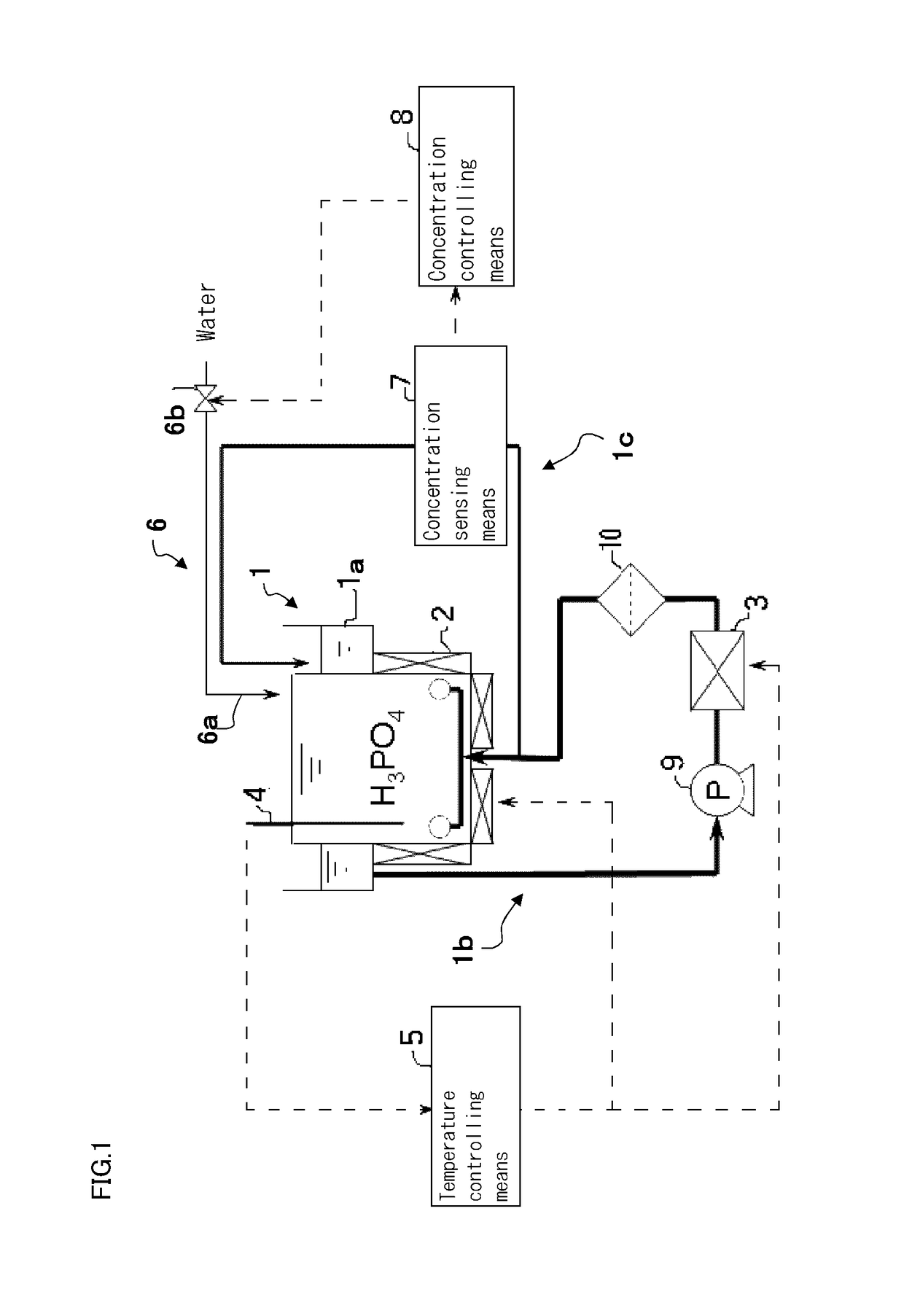
Figure 1 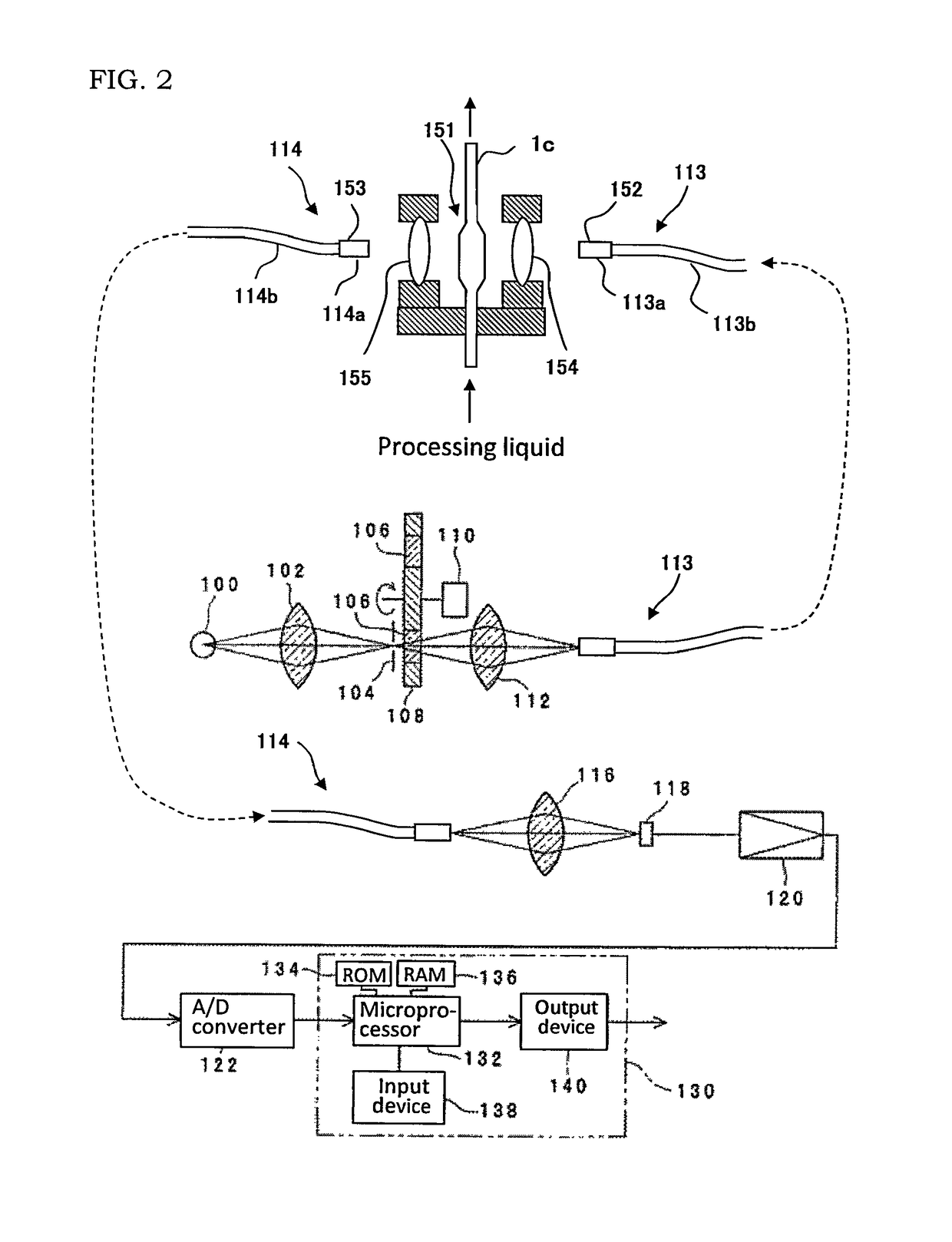
Figure 2 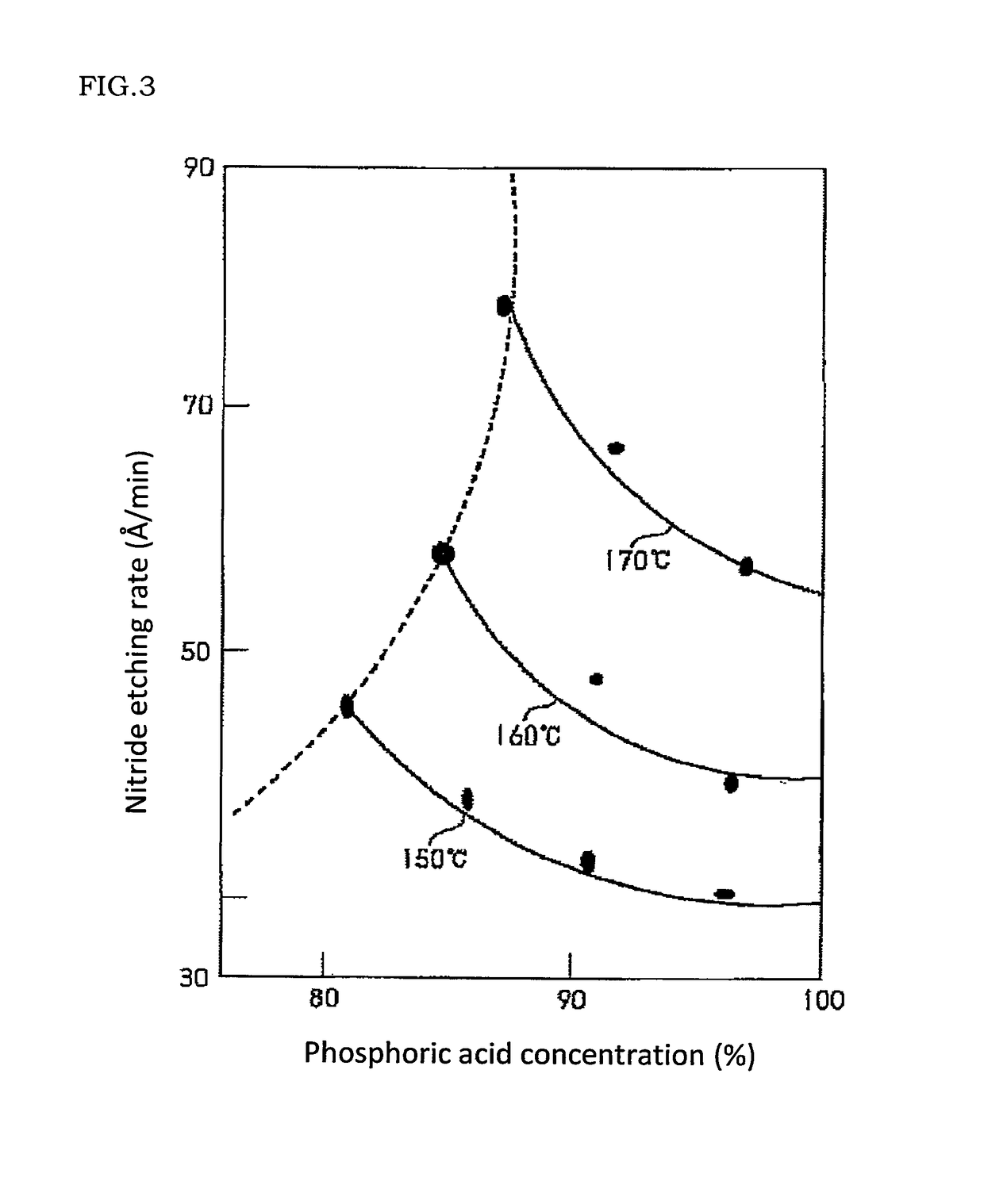
Figure 3
Abstract
Description
CROSS-REFERENCE TO RELATED APPLICATIONS
[0001] This application claims priority to Japanese Patent Application No. 2011-189159 filed on Aug. 31, 2011, the disclosure of which, including the specification, the drawings, and the claims, is hereby incorporated by reference in its entirety.BACKGROUND OF THE INVENTION
[0002] Field of the Invention
[0003] The present invention relates to a substrate processing apparatus that performs processing of a substrate such as a semiconductor wafer, a glass substrate for a liquid crystal display device, or a glass substrate for a photomask (hereafter simply referred to as “substrate”) with a processing liquid and, in particular, is useful as a technique of performing concentration control while sensing the concentration of the processing liquid at a high precision when immersing and processing the substrate in the processing liquid that has been heated to a high temperature.
[0004] Description of the Related Art
[0005] Conventionally, as a substrate processi...
Examples
experiment example 1 (
Influence of Optical Characteristics Change by Temperature Rise of the Lens)
[0111]With use of an experiment apparatus having an optical system shown in FIG. 6, how the measurement value of zero % concentration changes in accordance with the change in the lens temperature from 25° C. in a thermostatic chamber set at 25° C. was examined without using a cell for measurement. Adjustment of the optical axis of the optical system was made using a laser so that the axial shift would be 1 mm or less at a point distant by 2 m. At the time of measurement, by changing the temperature of warm water supplied (flow rate of 1.9 L / minute) to the flow path each by 5° C. from 30° C. to 50° C., the temperature of the lens at that time was measured, and also the change in the concentration (%) corresponding to each temperature was measured using an apparatus shown in FIG. 2. The result thereof is shown in FIG. 7.
[0112]As will be clear from this result, it has been confirmed that, when the lens temperat...
experiment example 2 (
Influence of Optical Axis Change by Temperature Rise of the Lens Holding Section)
[0113]By using an experiment apparatus being capable of constructing an optical system shown in FIG. 6 and further having a fixed position adjustment section (XYZ stage) relative to one of the lens holding sections, how the measurement value of zero % concentration changes in accordance with the change in temperature from 25° C. in a thermostatic chamber set at 25° C. was examined without using a cell for measurement. Adjustment of the optical axis of the optical system was made using a laser so that the axial shift at the basis position would be 1 mm or less at a point distant by 2 m. At the time of measurement, the fixed position was adjusted each in the horizontal direction X (−0.2 mm to 0.2 mm) perpendicular to the optical axis, in the height direction Y (−0.2 mm to 0.2 mm), and in the horizontal direction Z (−1.0 mm to 12.5 mm parallel to the optical axis from the standard position (position at whi...
experiment example 3 (
Influence of Cooling by Cooling Water)
[0116]By using an experiment apparatus having an optical system shown in FIG. 6 and using a quartz cell for measurement, how the measurement value of concentration changes by presence or absence of cooling water was examined while allowing an aqueous solution of phosphoric acid having a temperature of 120° C. and a concentration of 67.80 wt % to flow (flow rate of 1.5 L / minute). Adjustment of the optical axis of the optical system was made using a laser so that the axial shift would be 1 mm or less at a point distant by 2 m. At the time of measurement, the temperature of each section was continuously measured, and also the change in the concentration (%) at each time was measured using an apparatus shown in FIG. 2. The result thereof is shown in FIG. 9. Here, the dots in the Figure show measurement values of concentration. As the temperature of each section, the measurement values in the inside (cell side) and on the outside (optical fiber side)...