
Methods of manufacturing glucose measuring assemblies with hydrogels
a technology of glucose measuring and hydrogels, which is applied in the direction of instruments, material electrochemical variables, and treatment, etc., can solve the problems of unrelated signal generation, fouling of the sensing surface, and reducing the selectivity of the biosensor, so as to reduce the presence of compounds, increase the percentage of signals, and reduce the level of interfering species
Patent Information
- Authority / Receiving Office
- US · United States
- Patent Type
- Applications(United States)
- Current Assignee / Owner
- Publication Date
- 2005-08-04
- Estimated Expiration
- Not applicable · inactive patent
Smart Images
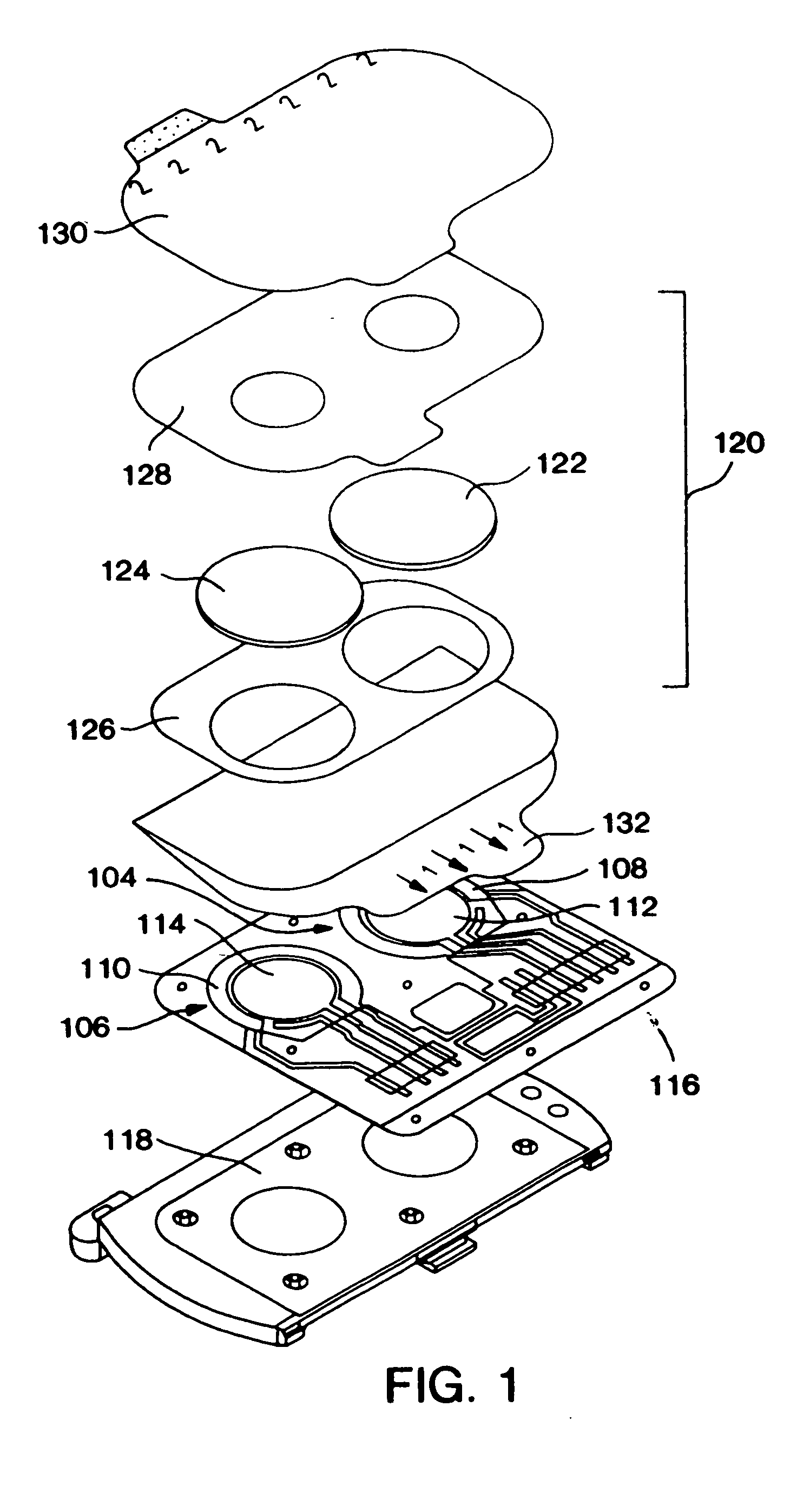
Figure 1 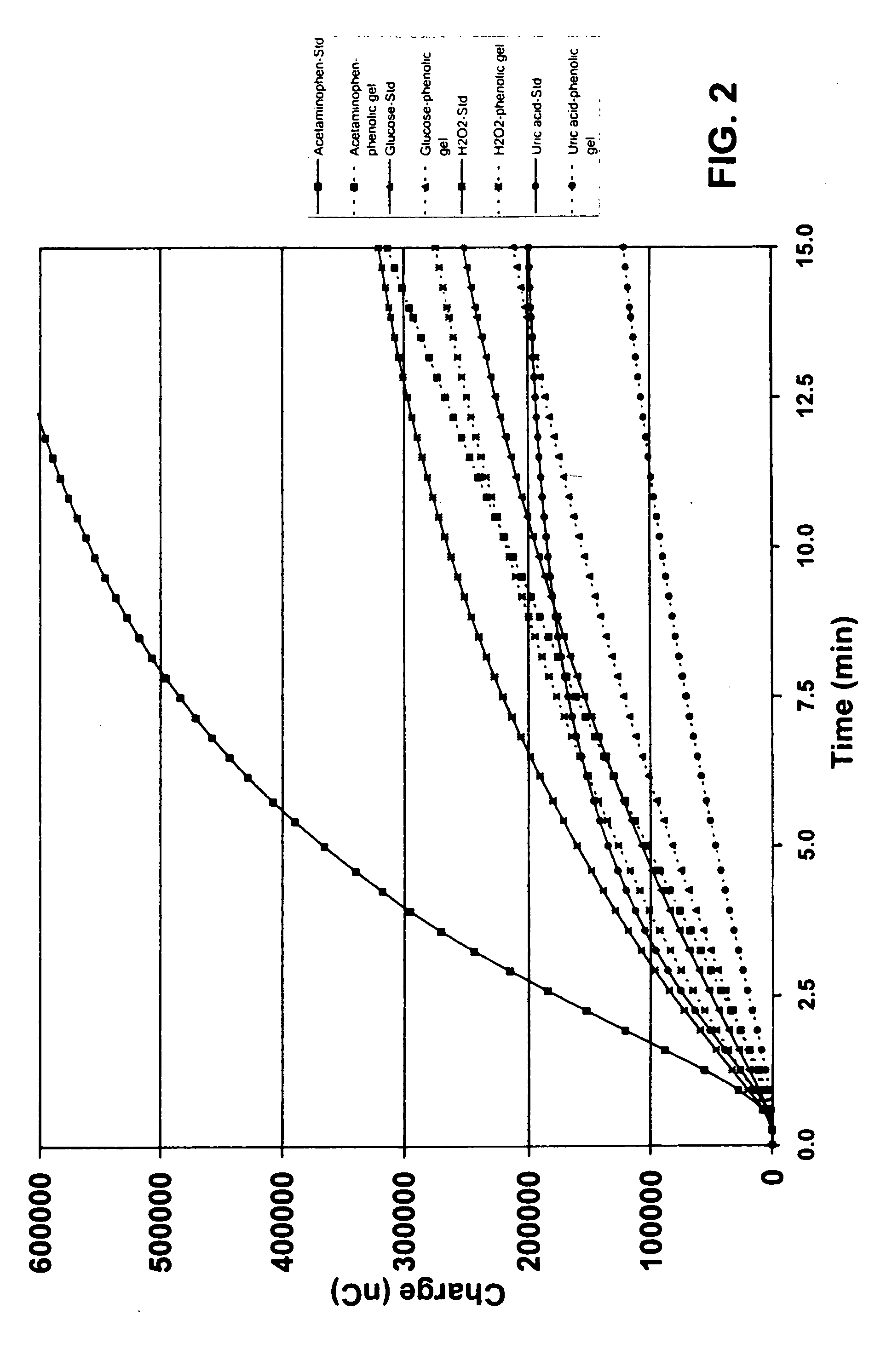
Figure 2 
Figure 3
Abstract
Description
CROSS-REFERENCE TO RELATED APPLICATION
[0001] This application is related to provisional patent application Ser. No. 60 / 130,729, filed Apr. 22, 1999 and to provisional application Ser. No. 60 / 149,513, filed Aug. 17, 1999, from which priority is claimed under 35 USC §119(e)(1) and which applications are incorporated herein by reference in their entireties.TECHNICAL FIELD
[0002] This invention relates generally to methods and devices for reducing the presence of a biocide in an ionically conductive material, e.g., for use in iontophoretic devices, either during or after the manufacture of the ionically conductive material or an assembly comprising this material. In addition, this invention relates to hydrogels comprising one or more biocides. BACKGROUND
[0003] A number of diagnostic tests are routinely performed on humans to evaluate the amount or existence of analytes present in blood or other body fluids. These diagnostic tests typically rely on physiological fluid samples removed f...
Examples
example 1
Stability of the Nipastat® Biocide in the Hydrogel
[0129] Nipastat®-containing hydrogels were formulated with the appropriate buffer salts under standard conditions, from which samples were taken for analysis. After exposure to controlled environmental conditions (temperature and humidity) for differing periods of time, the sample hydrogels were extracted in acetonitrile (ACN) / water and assayed for the presence of methyl, ethyl, propyl and butyl esters of p-hydroxybenzoic acid using a reverse phase octadecylsilane (ODS) HPLC column as follows. The hydrogels were cut using a 3 / 4 inch punch to generate the sample disks to assay. Each disk was added to 5 mL of acetonitrile / water (30% ACN, v / v) and the Nipastat® biocide was extracted for 1 hour while shaking on an orbital shaker at 100 rpm. The extract was then filtered through a 0.2 μm membrane prior to HPLC separation and UV detection at 254 nm.
[0130] Reverse phase HPLC chromatography was performed using a Waters 3.9 mm×15 cm Nova-Pa...
example 2
Migration of the Nipastat® Biocide into Components of the Biosensor Collection Assembly
[0138] Collection assemblies incorporating Nipastat® biocide-comprising hydrogels were assayed for retention of the biocide within the hydrogel. Samples of the hydrogel prior to and after incorporation into the collection assembly, as well as the components of the collection assembly in contact with the hydrogel, were prepared as described in Example 1. The decreasing quantities of parabens extracted from the hydrogel indicate that, over time, the Nipastat® biocide migrates out of the hydrogel and into the adjacent collection assembly components. When the components of the collection assembly in contact with the hydrogel (liners, gel retaining layer, and mask) were assayed, it was determined that the Nipastat® biocide was migrating preferentially into the gel retaining layer (comprising a polyester derivative) and the mask layer (comprising a polyurethane derivative). These results are presented ...
example 3
Migration of the Biocide Sodium Undecylenate into Components of the Biosensor Collection Assembly
[0140] Collection assemblies incorporating sodium undecylenate-comprising hydrogels were assayed for retention of the biocide within the hydrogel. The presence of undecylenic acid in the hydrogel and assembly components was determined by gas chromatography (GC) using a Hewlett Packard (Avondale, Pa.) 5890 gas chromatogram equipped with an HP 3396A integrator. The hydrogels and collection assembly components were cut using a ¾ inch punch to generate the samples to assay. Each sample “disk” was added to 4 mL of 1M HCl, and the undecylenic acid was extracted for 2 hours while shaking on an orbital shaker at 150 rpm, followed by 10 minutes at 100 rpm. The sample disks were then extracted twice with 4 mL of ethyl acetate. Samples 1 μL in volume were injected into the GC and the results compared to that generated for a standard solution of undecylenic acid. The undecylenic acid was also shown...