
Packet Forwarding
a packet forwarding and packet technology, applied in the field of packet forwarding, can solve the problems of not being able to adapt the rate at all, not being able to achieve ecn, and placing constraints, and achieve the effect of simple and efficien
Patent Information
- Authority / Receiving Office
- US · United States
- Patent Type
- Applications(United States)
- Current Assignee / Owner
- Publication Date
- 2008-07-03
Smart Images
Figure 1 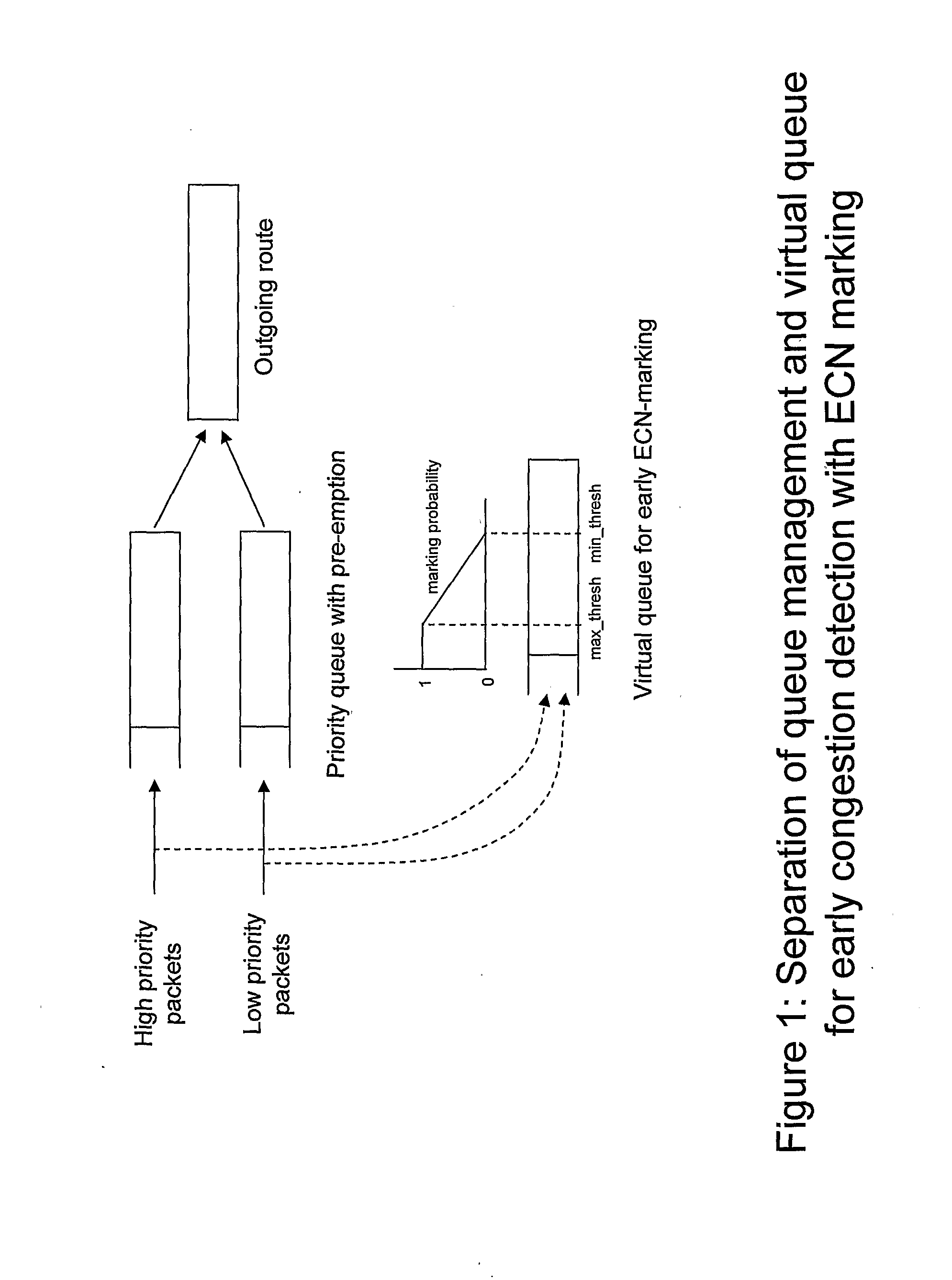
Figure 2 
Figure 3
Abstract
Description
TECHNICAL FIELD
[0001] The present invention relates to apparatus for forwarding packets in a data network, and to associated methods of forwarding packets, and to related manners and apparatus for performing such methods.BACKGROUND TO THE INVENTION AND PRIOR ART
[0002] Many different quality-of-service (QoS) mechanisms have been proposed for packet-switched communications networks such as the Internet. The use of Resource Reservation Protocol (RSVP) with IntServ enables explicit reservation of capacity for traffic that requires guaranteed bandwidth with low packet drop probability. By contrast, Differentiated Services (DiffServ) enables relative prioritisation of different ‘best-effort’ traffic classes, which do not require explicit bandwidth or packet drop guarantees. More recently the development of traffic-engineered multi-protocol label switching (MPLS-TE) has enabled efficient bandwidth management.
[0003] Another control mechanism that is relevant to the invention is the use of toke...
Examples
Embodiment Construction
[0043]The embodiment of the invention that we describe here is an extension of the virtual queue congestion detection mechanism, and is designed to enable distinct minimum bandwidth guarantees to be provided for each of two or more traffic classes. According to the embodiment, each traffic class has associated with it a corresponding counter which filters packets of that class into what can be thought of as a virtual queue. The counter acts as a form of continuous rate token bucket. If the traffic class has low priority (or equal priority to other classes) then the counter filters out packets of that class up to rate M(B), which is the rate by which the counter is incremented (the token rate).
[0044]Specifically, the counter is decremented by the size of each new packet provided that the counter would not then become negative. The packet which thereby receives a token is not then offered to the virtual queue and receives no congestion indication. If the counter would become negative ...