
Highly electron conductive polymer and electrochemical energy storage device with high capacity and high power using the same
a high-capacity, high-power technology, applied in the direction of non-metal conductors, cell components, conductors, etc., can solve the problem that the use of such polymer binders and conductive agents cannot contribute to the capacity of energy storage devices, and achieve the effects of reducing electric resistance, high output, and improving electron conductivity
Patent Information
- Authority / Receiving Office
- US · United States
- Patent Type
- Applications(United States)
- Current Assignee / Owner
- Publication Date
- 2010-06-17
- Estimated Expiration
- Not applicable · inactive patent
Smart Images
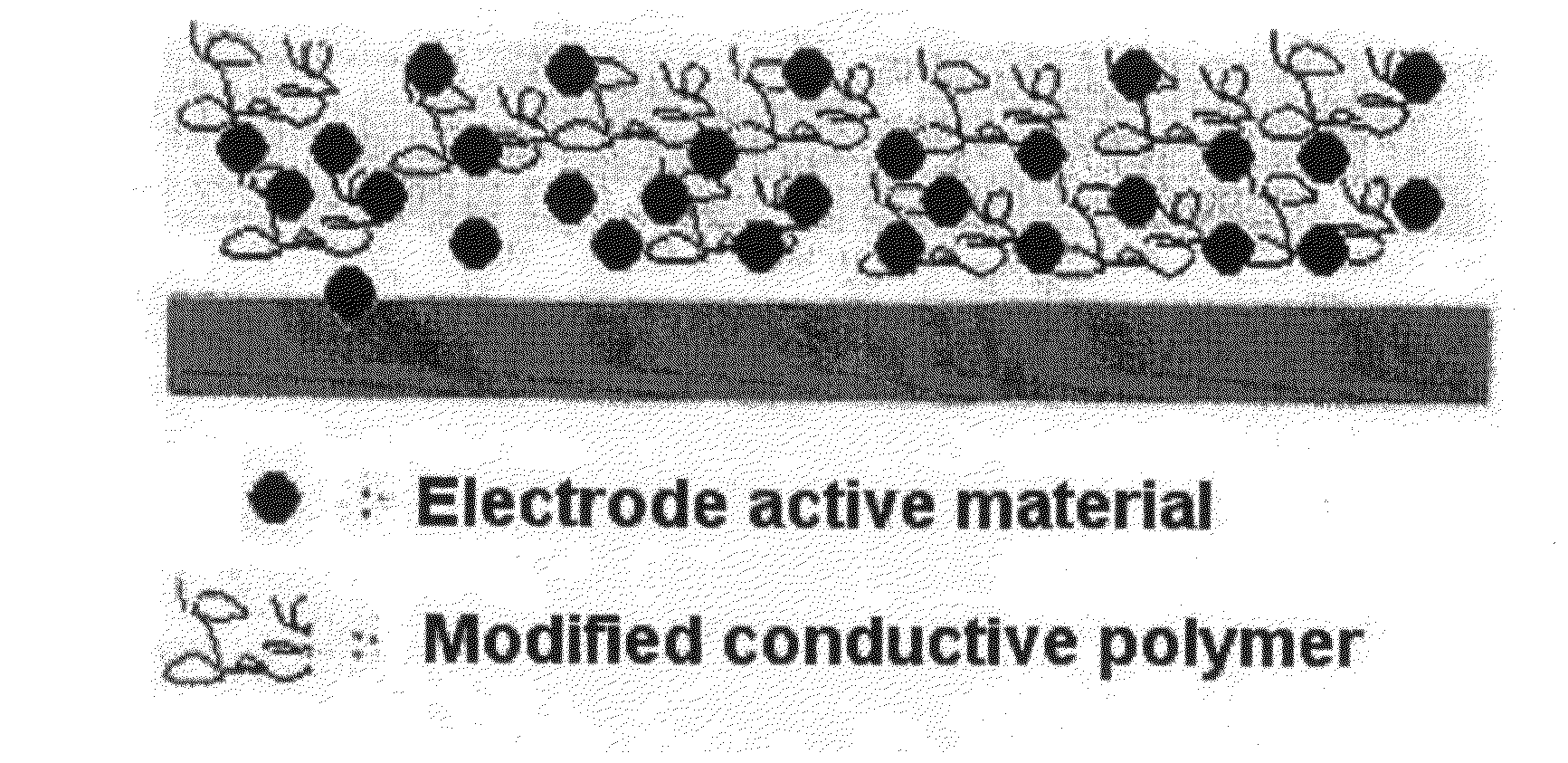
Figure 1 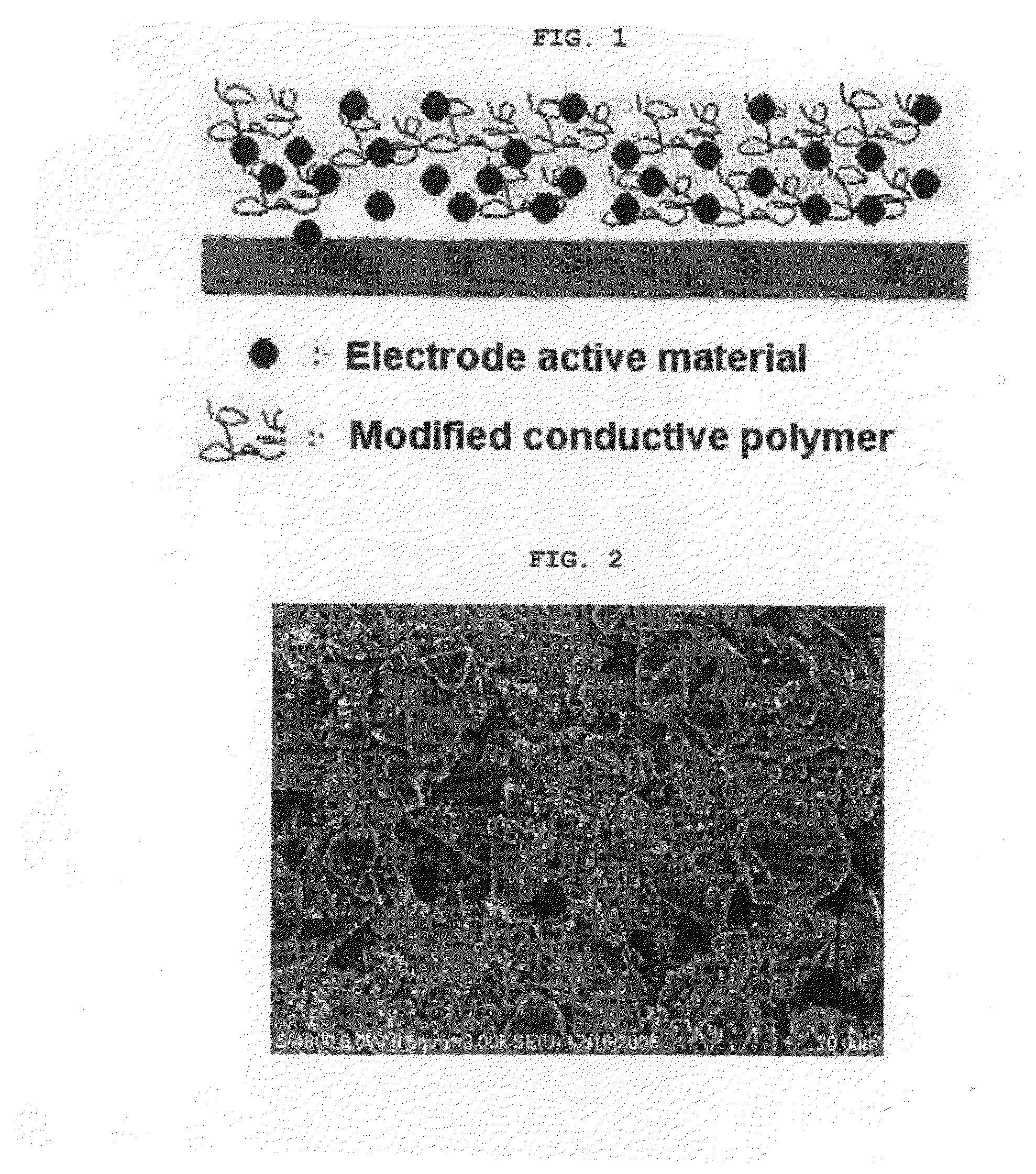
Figure 2 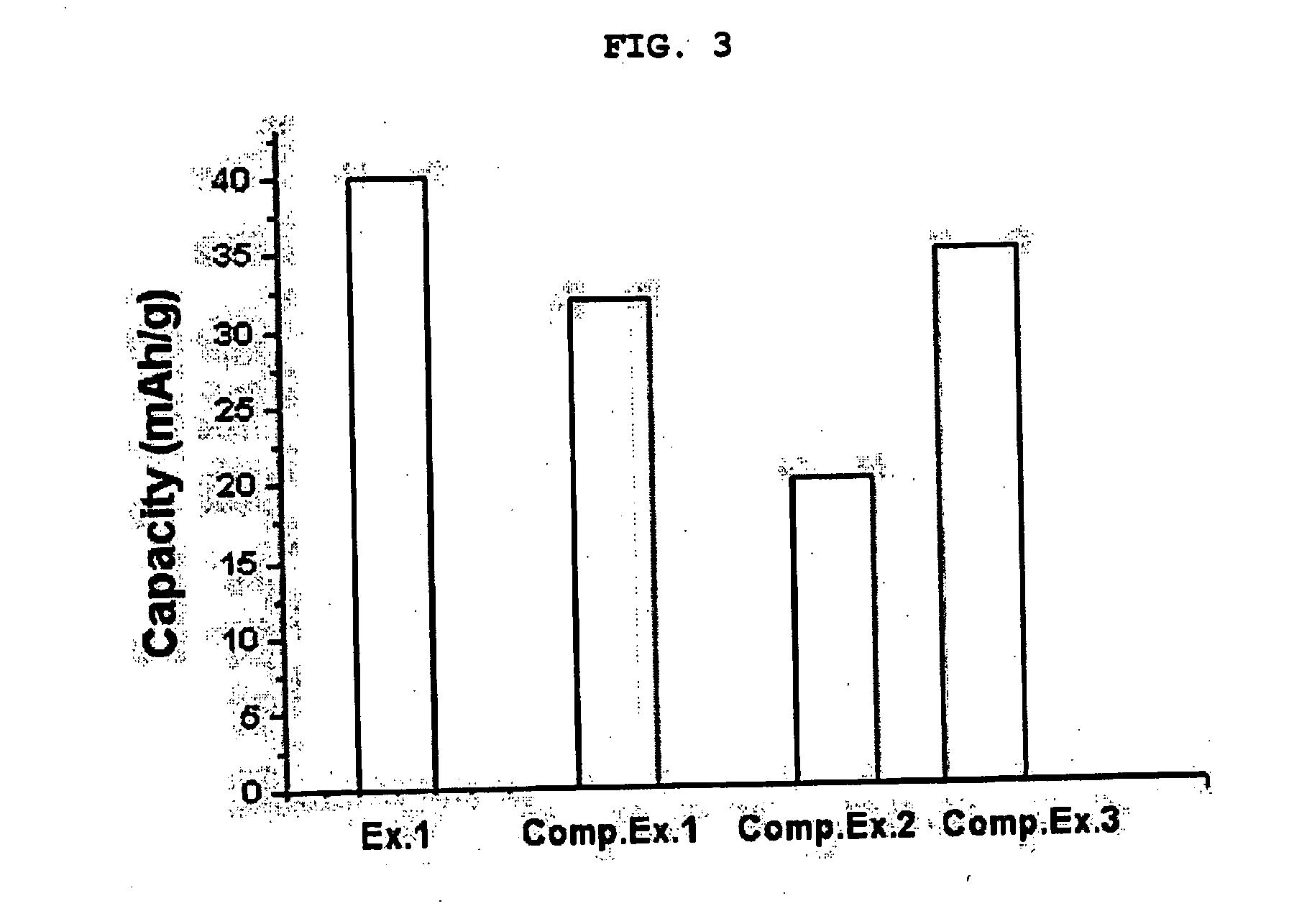
Figure 3
Abstract
Description
TECHNICAL FIELD
[0001] The present invention relates to a method for modifying a conductive polymer to impart a high electron conductivity comparable to that of a conventional conductive agent. Also, the present invention relates to a conductive polymer having an electron conductivity improved by the method, and an electrochemical energy storage device using the conductive polymer binder.BACKGROUND ART
[0002] In general, a secondary electric energy storage device is a system for storing and accumulating electric power so as to transfer it to an external electric circuit. Particular examples of such electric energy storage devices include general batteries, capacitors, electrochemical capacitors (super capacitors, ultra capacitors and electric dual layer capacitors), or the like. A lithium secondary battery, a typical example of such batteries, accomplishes charge / discharge via the lithium ion intercalaction / deintercalation mechanism, while an electrochemical capacitor accomplishes charg...
Examples
example 1
1-1. Preparation of Conductive Polymer Having Improved Conductivity Via Salt Introduction / Voltage Application
[0059]A conductive polymer film formed of PEDOT (poly(ethylenedioxy)thiophene)(Mw: 30,000; adhesion: 10 g / cm or higher, conductivity: ˜1×10⁻⁵ S / cm) was coated onto a platinum plate, and a voltage of 1V vs. Ag / AgCl was applied thereto for 1 hour while the conductive polymer film was dipped into 2 wt % HCl solution to provide a doped polymer, PEDOT. As a counter electrode, platinum was used.
1-2. Manufacture of Electrode
[0060]To distill water as a solvent, 90 wt % of activated carbon (MSP20, Kansai Coke and Chemicals Co., Ltd.) as an electrode active material, and 10 wt % of the modified conductive polymer PEDOT prepared from Example 1-1 were added to provide a binary mixture as electrode slurry. The electrode slurry was applied onto aluminum (Al) foil as a cathode collector having a thickness of about 20 μm, followed by drying, to provide a cathode. As an anode, the same electr...
experimental example 1
Comparison and Evaluation of Electron Conductivity
[0066]The modified highly electron conductive polymer (PEDOT) according to Example 1 was used as a sample, while Super-P currently used as a conductive agent for a lithium secondary battery and an electric dual layer capacitor and carbon nanotubes (CNT) regarded generally as a highly electron conductive material were used as controls. The above materials were individually pelletized and the electron conductivity of each material was measured by using the four-probe method.
[0067]After the test, it could be seen that the highly electron conductive polymer (PEDOT) according to the present invention had excellent conductivity as compared to the conventional conductive agent, Super-P, and showed an electron conductivity comparable to the conductivity of carbon nanotubes (see the following Table 1). This demonstrates that the conductive polymer can sufficiently function as a conductive agent in a cell.
TABLE 1Modified conductiveCarbonpolyme...
experimental example 2
Adhesion Test
[0068]The following test was performed to evaluate the adhesion of the electrodes according to Example 1 and Comparative Examples 1˜3.
[0069]The adhesion test was performed by attaching a tape onto the surface of the electrode active material layer of each electrode and removing the tape therefrom. The amount of each electrode active material layer remaining on the tape after removing the tape was shown in the following Table 2.
[0070]After the test, it could be seen that the electrode according to Comparative Example 1 using a binder (PTFE), was slightly stained with the electrode active material. On the contrary, each of the electrodes using conductive polymers according to Example 1 and Comparative examples 2 and 3 was not stained with the electrode active material (see the following Table 2). This demonstrates that the conductive polymer can serve as a high-quality binder.
TABLE 2Comp.Comp.ConditionEx. 1Ex. 1Ex. 2 & 3StainingnoneSlight stainingNone